Author: Amanda Moore
-
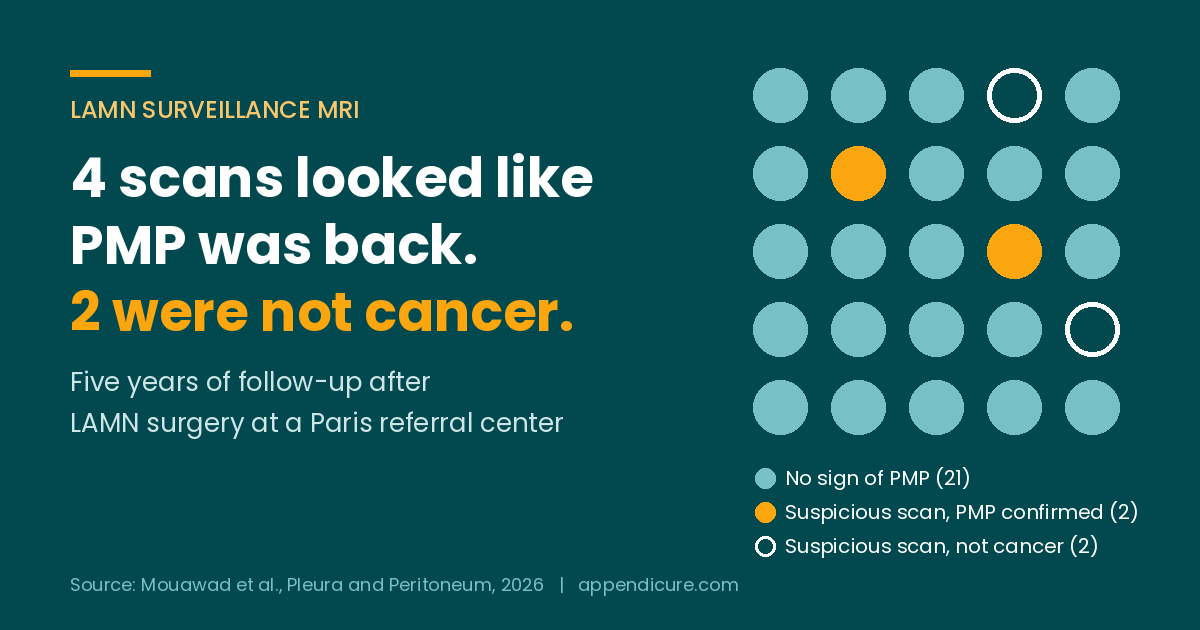
Short answer: LAMN surveillance MRI flagged both cases of pseudomyxoma peritonei (PMP) that developed during follow-up in a new five-year study from a Paris referral center. It also raised two false alarms. Of the four patients whose scans looked suspicious for PMP, two actually had it and two did not, and all four went back…
-

The metformin PMP trial at the University of California, Irvine is testing whether people with pseudomyxoma peritonei can take 850 mg of metformin a day for up to 18 months. It is a small, single-site study, and the main question right now is tolerability, not whether tumors shrink. Members started asking about this trial within…
-

BromAc appendix cancer treatment works best in one specific situation: an isolated large mucinous tumor, generally at least 5 cm across, that a radiologist can reach with a drain, in a person who is otherwise holding up reasonably well. When the disease is spread across the whole abdomen, the drug thins out through the cavity…
-

Short answer: A new MD Anderson study found no evidence that appendix cancer chemotherapy after surgery lowered the chance of relapse in people with localized appendiceal adenocarcinoma. Fewer than 1 in 10 of those patients relapsed at all, and tumor subtype and specific genetic changes were associated with relapse while several standard colorectal cancer risk…
-

An intestinal transplant for PMP is an option for a small number of carefully selected people whose pseudomyxoma peritonei can no longer be removed with conventional surgery and whose disease has caused severe intestinal or nutritional failure. A 2025 conference report from the Oxford Transplant Centre found that most people referred for it arrive too…
-
Appendix cancer biomarker testing usually means several separate tests, and they do not always agree with each other. A case report posted in August 2026 describes a young woman whose MMR protein test and MSI test gave opposite answers, and what her doctors did once they stopped treating one of those results as the whole…