

A new MD Anderson study answers real appendix cancer fertility questions for young women. It found the disease had already reached the ovaries in most patients who needed major surgery, that preoperative CT scans often failed to detect it, and that fertility discussions should happen before cytoreductive surgery whenever possible.
A woman in the community asked me a simple question last week. She has appendix cancer, she is young, and she wants to know if she can still have children. I went looking for answers and found almost nothing written for patients. So when this study came out, I read all of it. What follows is what it actually says.
What the appendix cancer fertility study looked at
Doctors at MD Anderson reviewed the records of 100 women between the ages of 18 and 45 who were treated for appendix cancer between 2020 and 2025. Their focus was the 47 women who went on to have cytoreductive surgery, the long operation that removes cancer from the belly. Most of these women had advanced disease. The question was how often the cancer had already spread to the ovaries, and what that means for women who still hope to have children.
How often appendix cancer spread to the ovaries
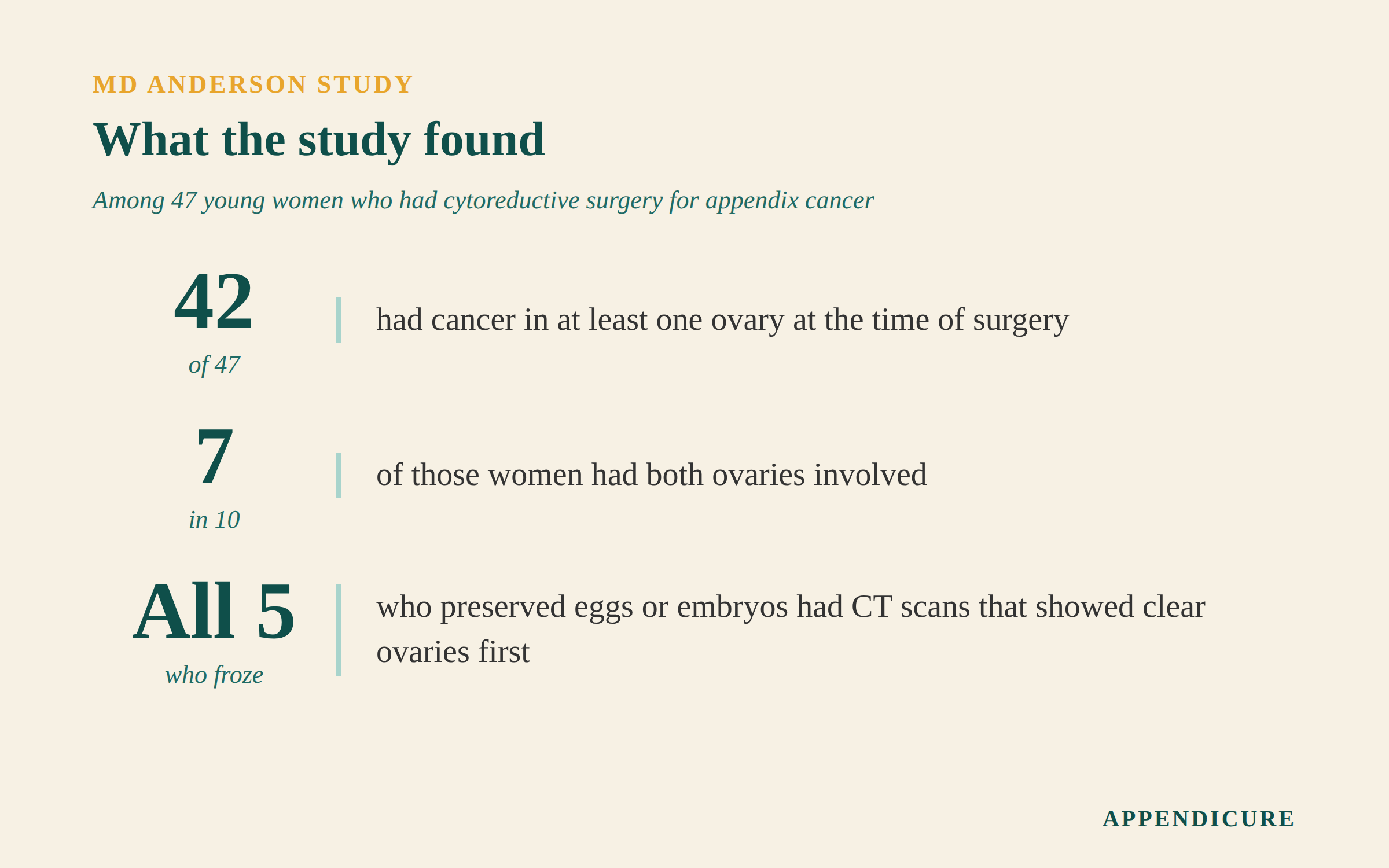
Out of the 47 women who had this surgery, 42 had cancer in at least one ovary. That is close to 9 in 10. This does not mean that 89% of all women with appendix cancer have ovarian spread. These were women selected for cytoreductive surgery because they already had advanced disease throughout the abdominal cavity. Most of these metastases involved both ovaries rather than just one, which is part of what makes fertility preservation so complex in this group.
In almost every case, the disease was visible on the ovary during surgery. Nearly all of these women had Stage 4 disease.
Ovarian involvement was not limited to one subtype. It turned up in low-grade mucinous tumors, in goblet cell and signet ring cancers, and in mucinous adenocarcinoma. Some of these groups were very small, so the exact percentages deserve caution. The overall pattern was consistent.
Why a normal CT scan can miss ovarian spread
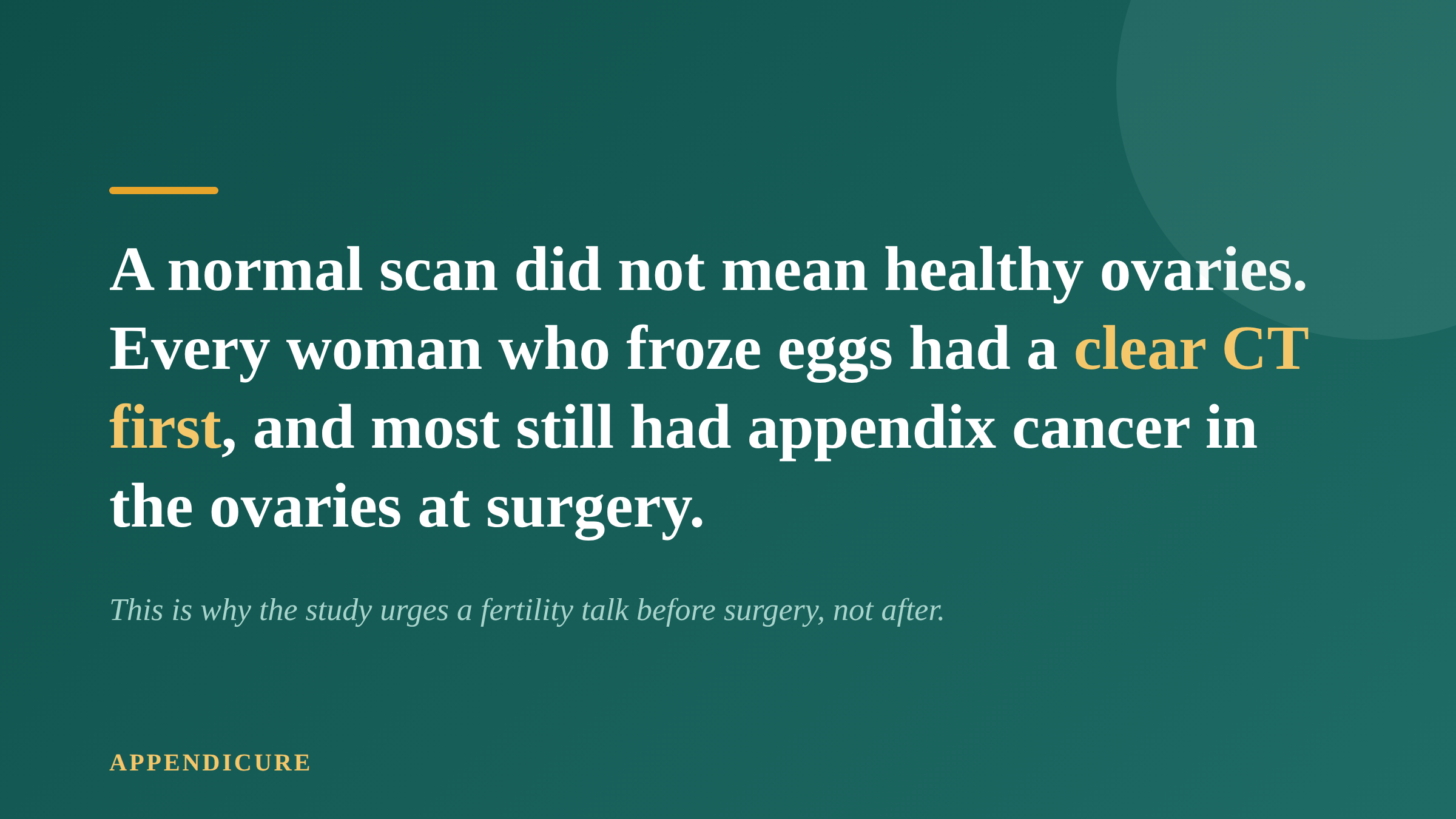
Five women in the study froze their eggs or embryos before surgery. Every one of them had a CT scan first that showed normal ovaries. In surgery, most were found to have appendix cancer involving the ovaries after all, and three of the five had it confirmed under the microscope.
The findings suggest ovarian disease may be present even when it sits below what a CT scan can detect. A normal CT scan cannot completely rule out ovarian involvement.
What this number does not mean
It is worth saying again. The near 9-in-10 rate describes women who were sick enough to need cytoreductive surgery, and almost all of them had advanced disease. If you have a low-grade tumor that does not need that operation, these numbers do not describe you. The study also left out the carcinoid and neuroendocrine tumors that usually do not need this surgery. Your situation is your own, and your care team knows its details.
There is good news in the study too. One woman who froze her eggs later got pregnant on her own and delivered a healthy, full-term baby. None of the women who had their eggs retrieved had complications from the procedure. Freezing eggs is not a promise of a baby, but it can keep a door open, and for the right person that door is worth keeping open.
What I would tell a young woman who was just diagnosed
If you want children someday, ask for a fertility referral before your surgery is scheduled. Ask for an oncofertility specialist, and ask early, because freezing eggs or embryos typically takes about 10 to 14 days. Bring your partner or a support person to that talk, because it is a lot to absorb alone. Go in knowing the hard part of this study too. If the cancer has already reached your ovaries, some fertility options may carry added risk, so this is a decision to make with your doctors, with honest numbers in front of you.
I am not a doctor. I am a caregiver and an advocate, and I started Appendicure because research like this almost never reaches the people it is about. If this raises questions, bring the paper to your next appointment. Fertility deserves to be part of the conversation before surgery, not an afterthought.
Common questions
Does appendix cancer spread to the ovaries?
It can. In this 2026 MD Anderson study of young women who needed cytoreductive surgery, 42 of 47 had cancer in at least one ovary. Most had advanced disease, so this rate does not apply to every appendix cancer patient.
Can I still freeze my eggs if I have appendix cancer?
Often yes, and no complications were reported in the study’s egg retrievals. If the cancer has reached the ovaries, some fertility options carry added risk. Talk to an oncofertility specialist before surgery.
Will a CT scan show if the cancer is in my ovaries?
Not always. In the study, all five women who froze eggs had normal CT scans, yet most were later found to have appendix cancer involving the ovaries during surgery.
When should I ask about fertility preservation?
Before your cytoreductive surgery, and as early as you can. Freezing eggs or embryos usually takes about 10 to 14 days.
Help build the answers
Studies like this are small because appendix cancer data is scattered. The Patient-Led Global Appendix Cancer Registry changes that. It is open to patients everywhere, and every entry helps researchers ask better questions.
Join the Registry: United States Join the Registry: InternationalSource: Bou Zerdan M, Hmaidan S, Ciomperlik H, et al. Incidence of Ovarian Metastases in Reproductive-Aged Women with Appendiceal Cancer: Implications for Fertility Preservation. Annals of Surgical Oncology. Published online July 30, 2026. doi:10.1245/s10434-026-20315-x. This article is for education and is not medical advice. Talk with your own care team about your situation.
Leave a Reply