

Amy Moeller was diagnosed with appendix cancer at 38 and lived well for eleven years before an appendix cancer recurrence showed up on a routine colonoscopy. She is now on a CDK4/6 inhibitor called Ibrance, and she is doing well again.
About a year ago, I typed appendix cancer into the LinkedIn search bar, and Amy popped up. I could not tell you exactly what made me message a stranger that day. But when someone has even heard of this cancer, I want to know them. Amy wrote back, and that was that.
We are the same age. Our careers have run through the same industry. By the end of the first conversation I felt like I had known her for years. She is easy to like, and she is easy to trust, which counts for a lot when the subject is the hardest thing that ever happened to you.
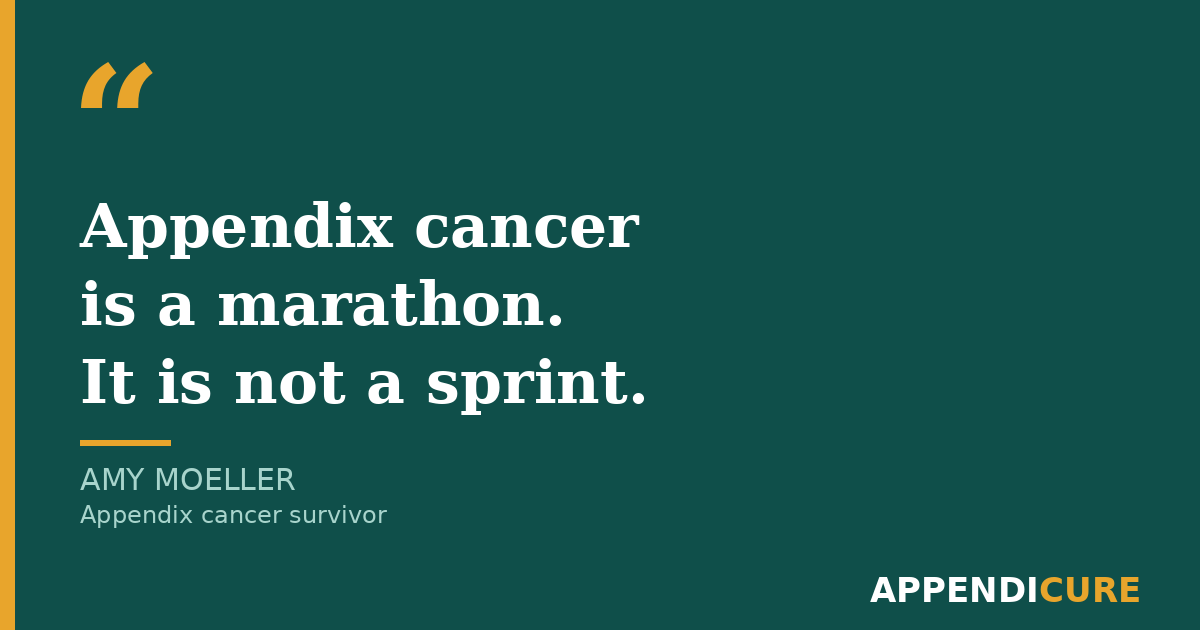
Amy lives all the way across the country from me, out in Orange County, California, and I wish she lived closer. When she sat down to tell me her story, one line stayed with me. She said appendix cancer is a marathon, not a sprint. After you hear what she has been through, you will understand exactly what she means.
Amy is the third appendix cancer patient I have interviewed who is doing better on a CDK4/6 inhibitor. Jeremy has been on Ibrance for almost ten years. Connie shared her story too. Their diagnoses are not identical, but the same kind of targeted drug has helped all three.
Amy talks about her cancer in three acts, including an appendix cancer recurrence eleven years after she was first diagnosed. You can watch our full conversation below, and here is her story in her words as much as I can keep it.
Act one: a tumor the size of a volleyball
In 2012, Amy was 38 and living in San Francisco. Her life was full. She had a good career, she traveled, and she had been an athlete her whole life, including Division I college volleyball. She had no real symptoms. One morning she woke up and her stomach looked bloated, before any coffee or water. Something told her to call a doctor.
She thought she had celiac disease, since she was living in the Italian part of the city and eating a lot of pasta. The doctor felt her abdomen, and within minutes he sent her to the emergency room. She drove herself. They admitted her, and the next day, surrounded by doctors, she was asked if she wanted the good news or the bad news first. The good news was that whatever was growing inside her was slow growing. The bad news was a tumor in her abdomen the size of a volleyball. For a college volleyball player, that detail is hard to forget.
Her parents flew up, and the family moved her care to Southern California. The first surgery, in June 2012, was exploratory. Surgeons removed the tumor and performed a full hysterectomy, and the pathology finally had an answer. It was coming from her appendix. It was pseudomyxoma peritonei, a rare mucinous cancer that starts in the appendix and spreads through the abdomen. At that point Amy and her family knew nothing about HIPEC or cytoreductive surgery. Nobody in that room had heard of any of it.
Three months later, a scan showed they had not gotten it all. The family had already done their homework. They looked at UCI, UC San Diego, and MD Anderson. Stanford and UCSF did not treat it at the time. Every road led to Dr. Andrew Lowy at UC San Diego. In November 2012, Amy had cytoreductive surgery with HIPEC, the heated chemotherapy delivered right to the abdomen. Surgeons also removed her gallbladder and spleen and repaired her small bowel. She was walking the day after surgery, because Dr. Lowy told her the best thing she could do was move. She took that to heart, and she still lives by it.
The gap that let an appendix cancer recurrence hide
After the second surgery, Amy was monitored for about five years. Then her doctors cleared her and put her on what they called an as-symptom basis. No routine scans. Just watch for symptoms. She felt great, and she trusted the people who had trained for years to take care of her. That is what most of us do.
Looking back, both of us know that plan was wrong. This is a cancer that can grow slowly and quietly for years with no symptoms at all. Amy had none. Today, many appendix cancer specialists recommend long-term, and often lifelong, surveillance because recurrence can happen many years after treatment. She is honest that the center monitoring her did not treat this cancer and was not prepared for it. That gap is exactly why asking questions and staying under a specialist matters so much. Amy’s experience shows how recurrent appendix cancer can stay silent for years before a routine test finds it.
Act two: it came back
Eleven years after her first diagnosis, in 2023, Amy went in for a routine colonoscopy around her fiftieth birthday. She had no symptoms. The doctors could not pass the scope through her sigmoid colon because of a severe narrowing caused by pressure from outside the colon. They sent her for a CT scan a couple of days later. The scan showed the same disease from 2012. This was her appendix cancer recurrence, and it arrived with no symptoms at all.
She called Dr. Lowy’s office that same day. He was about to leave for a conference in Europe, and he told her she had called at the right time, because he could get her in quickly. She had surgery on Halloween of 2023. It was another cytoreductive surgery. The team had HIPEC ready, but once they were inside, the tumors were in a location, low in the pelvis, where the heated chemo would not have been effective, so she did not qualify for it that time. She recovered quickly, faster than she expected, partly because she knew the drill by then.
About six months later she started FOLFOX chemotherapy and completed twelve rounds. That is more than a lot of people can tolerate. On the final round she had a reaction, coughing and struggling to breathe, and the team treated it quickly. She did her chemo at a USC cancer center five minutes from her home, overlooking the ocean. Her advice from that stretch is simple and practical. Do your chemo as close to home as you can, because the last thing you want after an infusion is a long drive and traffic.
Act three: why she is on a CDK4/6 inhibitor now
After chemo, three of her doctors came together on a plan: Dr. Lowy at UC San Diego, Dr. Gregory Botta at UC San Diego, and Dr. Louis Vandermolen at USC. There was still mucinous disease low in her pelvis that surgery could not safely remove. Taking it all would likely have cost her more of her colon and possibly a colostomy, a trade that would have changed her daily life. So the goal shifted. Keep the remaining disease from growing.
The drug they chose was Ibrance, also called palbociclib. It belongs to a class of targeted drugs called CDK4/6 inhibitors. Some appendix cancer specialists prescribe CDK4/6 inhibitors off-label for carefully selected patients whose tumor biology suggests they may benefit. Off-label means the choice comes from a patient’s own testing and disease, not from an approval written specifically for appendix cancer. Amy takes it as a pill, 21 days on and 7 days off. She gets bloodwork every month and sees her San Diego oncologist every three months over Zoom, so she does not have to drive down each time.
Her tumor marker, called CEA, had been sitting around 11 or 12 after chemotherapy and on Ibrance. At a recent appointment it had come down to 8.4. Amy is careful and honest about what that means. She does not claim to know exactly what is driving it. It could be the surgery, the drug, or the other things she is doing for her health. What she knows is that she has not missed a day of Ibrance, her numbers are moving in the right direction, and she feels good.
One honest note. Amy’s cancer is pseudomyxoma peritonei, a mucinous appendiceal cancer, and her plan was built around her disease and her tumor testing. A CDK4/6 inhibitor is not right for every appendix cancer or every subtype, whether that is goblet cell, signet ring, or a high-grade adenocarcinoma. What worked for Amy is Amy’s plan. If you are facing this, ask your own specialist about molecular testing and whether a targeted drug fits you.
How Amy takes care of Amy
The medical plan is only part of how Amy stays well. After so many surgeries, losing her gallbladder, spleen, and uterus, she was living with real stomach and digestive problems. She started seeing an integrative practitioner who ran a full blood panel and looked at things her cancer team does not focus on, like inflammation and hormones. She got her vitamins and minerals sorted out, added a gallbladder supplement that helps her digest fatty foods, and started progesterone, which her gynecologist had not given her. Since then she sleeps eight hours a night, uninterrupted, instead of waking at three in the morning.
She is clear that this is not a knock on her cancer doctors. Vitamins and hormones are simply out of their scope. Their job is her cancer. Getting the rest of her body in balance was her job, with the right help, and it changed how she feels every day. She calls it a holistic approach, and she says the physical part feeds the mental part. When her gut feels better, her mind feels better.
The other piece is quieter. When the recurrence hit in 2023, a colleague mentioned meditation almost in passing. Breathing exercises while fighting cancer sounded almost insulting to Amy at first. She tried it anyway. Five minutes, sometimes ten, often from her bed wrapped in blankets with tears sliding down her cheeks. It did not fix anything, but for a few moments it softened everything. Over time it became her anchor during treatment and her refuge on sleepless nights. In her own words, a thought is not a prophecy, and fear is not fate. Meditation did not cure her cancer, but it healed parts of her that medicine alone could not.
What Amy wants you to know
People ask Amy all the time if she is in remission. Her honest answer is that she is not sure anyone with this cancer is ever fully in remission. She thought she was once, and she was not. She has come to treat it as something she will watch for the rest of her life. That is the marathon she means. It is not a race you finish. It is a pace you keep.
Her biggest message is to be your own advocate. Ask the hard questions. Use tools like AI to help you write down good questions before an appointment, then bring them to your doctor. You do not know what you do not know, and neither did she at 38. The more you engage, the more you get. As she puts it, we are the client in that room, and we have every right to ask.
There is one more reason I wanted Amy’s story out in the world, along with Jeremy’s and Connie’s. All three have been on a CDK4/6 inhibitor called Ibrance to help keep their disease under control. Yet today, many appendix cancer patients who may be candidates for these same drugs are still denied coverage because the drugs are used off-label. Those denials continue even though specialists at several major appendix cancer centers prescribe them for carefully selected patients. Stories like Amy’s matter because they show what access can mean for a real patient.
Amy, thank you. For your honesty, for your grace, and for showing what it looks like to keep going.
Amanda
How you can help
Amy’s story is one reason the registry matters. One center by itself cannot prove which treatments are working. Many centers together can. The Appendicure Patient-Led Data Registry is built to gather that proof, both to advance research and to help get drugs like the one keeping Amy well covered and approved. If you are a patient or caregiver, adding your voice is the most useful thing you can do.
Add your voice to the registry
If you are a patient or caregiver, please add your voice. The registry is IRB-approved with exempt status. Choose the link for where you live.
Join the Registry: United States Join the Registry: InternationalAnd if you are able to help keep this work going, please consider a donation.
Questions people ask
Can appendix cancer come back years later?
Yes. Amy had an appendix cancer recurrence eleven years after her first diagnosis, found on a routine colonoscopy with no symptoms. That is why ongoing surveillance with a specialist matters, even after you are cleared.
What is Ibrance and how does Amy take it?
Ibrance (palbociclib) is a targeted drug called a CDK4/6 inhibitor. Amy takes it as a pill, 21 days on and 7 days off, to keep her remaining disease from growing.
Does a CDK4/6 inhibitor work for every appendix cancer?
No. It fit Amy’s disease and tumor testing. It is not right for every subtype. The only way to know is testing of your own tumor, so ask your specialist.
More CDK4/6 patient stories
Amy is not the only one. Read Jeremy’s story: 10 years on Ibrance.
Watch another patient tell her story: Connie’s CDK4/6 video interview.
Learn how these drugs work: CDK4/6 inhibitors for appendiceal cancer.
On a CDK4/6 inhibitor yourself? Your story could help change the guidelines.
Leave a Reply