The metformin PMP trial at the University of California, Irvine is testing whether people with pseudomyxoma peritonei can take 850 mg of metformin a day for up to 18 months. It is a small, single-site study, and the main question right now is tolerability, not whether tumors shrink.
Members started asking about this trial within days of it showing up on ClinicalTrials.gov, and the question was almost always the same one. Why a diabetes pill.
It’s a fair thing to ask. Metformin has been in use since the 1950s, it costs almost nothing, and it has been pointed at a long list of cancers over the years without much coming of it. What makes this trial different is the research that came first.
What the metformin PMP trial actually is
The study is registered as NCT07693452. It opened in June 2026 at the Chao Family Comprehensive Cancer Center at UC Irvine. The principal investigator is Dr. Oliver S. Eng, a surgical oncologist who came to UCI from the University of Chicago, where he helped run one of the country’s leading peritoneal surface malignancy programs. The trial grew out of research from Dr. Eng and his colleagues at UCI.
Everyone who enrolls gets the drug. There is no placebo group. The dose is 850 mg by mouth once a day, which is lower than doses used to treat type 2 diabetes. Dr. Eng has described it as closer to what he called a prophylactic dose, chosen deliberately so side effects stay mild. Treatment runs up to 18 months, with scans at baseline and then every six months.
The trial is open to people with PMP from an appendiceal mucinous neoplasm who have recurrent or refractory disease after cytoreductive surgery and HIPEC, or unresectable disease, or who are not scheduled for surgery. Dr. Eng has confirmed that both low-grade and high-grade appendiceal mucinous neoplasms count. You are not eligible if your disease is resectable and surgery is already booked, if you are already taking metformin for something else, or if you have had a bad reaction to it before.
The research that pointed them here
Cells make energy in more than one way. Plenty of cancers are known for burning sugar fast and inefficiently, which is the version most of us have heard about. There’s another route, run inside the mitochondria, that’s slower and gets far more out of the same fuel. Different tumors lean on these routes in different proportions.
Dr. Eng’s group has spent roughly four years on how PMP tumors survive in the abdomen, where the blood supply is patchy and nutrients aren’t evenly available. Part of that has involved taking tumors removed during surgery and growing them in the lab. In 2023 the group published an analysis in Annals of Surgical Oncology comparing peritoneal tumors from low-grade appendiceal mucinous neoplasms against peritoneal tumors from adenocarcinoma. Using metabolomics and RNA sequencing, they found the two had distinctly different metabolic profiles, with differences in how they handle lipids, glutathione, and that mitochondrial energy route.
Metformin is known to interfere with that same mitochondrial process. If PMP turns out to be particularly reliant on it, then blocking it could slow these tumors down in a way it wouldn’t slow down a different cancer. That is a hypothesis, not a finding. The 2023 paper identifies metabolic differences and says plainly that more research is needed. It does not show that PMP depends on this pathway, and it does not test metformin.
On a recent webinar hosted by ACPMP, Dr. Eng said his lab has since seen what he called a significant response in tumor samples they grew. That is laboratory evidence, not evidence that metformin helps patients, and those results have not been published, so nobody outside his group can evaluate them yet. What they do explain is why his team moved from the lab into a clinical trial as quickly as they did.
What this study can and cannot prove
The primary endpoint of the metformin PMP trial is feasibility. Specifically, whether participants take at least 80 percent of their scheduled doses over the first six months. Patients track it in a pill diary and the drug is dispensed by the UCI pharmacy. That is the study’s primary measure.
A feasibility endpoint isn’t a disappointment. It’s how a first study is supposed to work, and it’s the step that earns funding for a larger one. It does mean this trial is not designed to tell anyone whether metformin shrinks mucin. There’s a secondary endpoint tracking progression-free survival with scans at 6, 12, and 18 months, so they will be watching. But fifteen people in a single-arm study with no comparison group can’t separate a drug effect from the natural pace of a disease that’s often slow to begin with. If someone’s scans hold steady for 18 months, we won’t know what to credit.
Some other limits. The published paper rests on eight tumor samples, which is small even by rare cancer standards. The laboratory data showing an actual metformin effect hasn’t been published. And metformin has been tested in other cancers, including ovarian and pancreatic, with mixed results. Dr. Eng said as much himself.
Then there’s geography. The metformin PMP trial has one site, in Orange, California, in the U.S. You have to be there in person to enroll, then again at 30 days, then every six months after that. Metabolic bloodwork is checked at baseline and at one month. Roughly a third of our community lives outside the United States, and I don’t yet have a straight answer on whether international patients can take part, or whether scans can be done closer to home. Those are two of the questions I’m putting to Dr. Eng directly.
Who this covers, and who it leaves out
The protocol is written around pseudomyxoma peritonei arising from appendiceal mucinous neoplasms. Goblet cell adenocarcinoma, signet ring cell disease, appendiceal neuroendocrine tumors, and non-mucinous appendiceal adenocarcinoma all sit outside what this particular study covers. So does PMP from a non-appendiceal origin.
If that’s you, I’ve asked Dr. Eng what he’d say to those patients and what his lab is working on next. He has described the metformin work as the tip of the iceberg and said his team has found other pathways in PMP that nobody has described before. I intend to get more out of him on that.
Common questions about the metformin PMP trial
Can I just ask my doctor to prescribe metformin instead of joining a trial?
Please don’t do that on the strength of this article. Nobody knows yet whether metformin helps PMP. Taking it outside a study means you carry the risk without adding to the answer. Talk to your oncologist.
Is 850 mg a high dose?
No. It’s lower than doses used to treat type 2 diabetes. Dr. Eng has said the lower dose was picked deliberately, since gastrointestinal side effects such as diarrhea and nausea are common with metformin and tend to be worse at higher doses.
Can I stay on my other treatment?
Potentially. Dr. Eng said the trial doesn’t automatically exclude patients who are on another treatment, including systemic chemotherapy, as long as there’s no problematic interaction. The UCI team reviews each patient’s medications during screening.
Is 15 patients a hard cap?
No. Dr. Eng said fifteen is the minimum recruiting target and that the trial is allocated for more than that.
How do I ask about joining?
The study team at UC Irvine can be reached at ucstudy@uci.edu or 877-827-8839. They can do a phone or video consultation first. You can also find this trial and everything else currently open for appendix cancer and PMP on the Appendicure trial finder.
Dr. Eng is joining me live on Monday, September 22 for a session built around the questions his earlier talks didn’t get to. What participation really costs, whether imaging can be done at home, whether patients outside the U.S. can take part, how metformin sits with a gut that’s been through cytoreduction, and what’s coming behind this trial. It’s free, it’s for patients and caregivers, and about half of it is live Q&A. Register here.
Why questions like this are so hard to answer
On that ACPMP webinar, Dr. Eng was asked whether his group had studied PMP patients who were already taking metformin for diabetes. They haven’t. He also explained why looking backward at this is difficult, because PMP can develop slowly over many years and it’s rarely clear when it started relative to when someone began a medication. That’s exactly the kind of question patient-level registry data may eventually help researchers investigate. The Appendicure Patient-Led Global Appendix Cancer Registry collects molecular, genomics, and pathology data from appendiceal cancer patients worldwide. It was reviewed by Advarra and received an exempt determination in June 2026 under 45 CFR 46.104(d)(2), under protocol APPEND-REG-001.
Sources: ClinicalTrials.gov record NCT07693452, last updated July 2026. Hanse E, Wang T, Tifrea D, Senthil M, Kim A, Kong M, Eng OS, “A Novel Assessment of Metabolic Pathways in Peritoneal Metastases from Low-Grade Appendiceal Mucinous Neoplasms,” Annals of Surgical Oncology, August 2023. Dr. Eng’s remarks are from the ACPMP educational webinar on this trial.
BromAc appendix cancer treatment works best in one specific situation: an isolated large mucinous tumor, generally at least 5 cm across, that a radiologist can reach with a drain, in a person who is otherwise holding up reasonably well. When the disease is spread across the whole abdomen, the drug thins out through the cavity instead of concentrating on any one deposit, and it generally does not work. That is why most people who ask about BromAc are told no.
Why the answer is usually no
Members ask me about BromAc all the time. Many of them asked their own doctors first and got a no with no reason attached. Dr. Michael Wach at Moffitt Cancer Center gave me the reason.
BromAc is not a wash. Nobody pours it into the abdomen and lets it slosh around. A radiologist places a small tube directly into the tumor using imaging for guidance. The drug sits inside that tumor for about a day. Then the dissolved mucus gets drained back out through the same tube, and the cycle repeats. Each tumor can get up to six doses over a two week treatment period. The whole thing depends on getting a high concentration of drug into a specific target and keeping it there.
“BromAc appears to work best when there is a relatively large, unifocal collection of mucinous tumor that can be directly treated and contained in one location. With more diffuse peritoneal disease involving multiple quadrants, the drug tends to diffuse throughout the peritoneal cavity rather than achieving a sufficiently concentrated exposure to the individual tumor deposits, and generally doesn’t work.”
Michael M. Wach, MD, Moffitt Cancer Center
When disease sits in several quadrants at once, there is no single target to fill. The drug spreads out and never reaches a strong enough concentration against any one deposit.
One thing worth knowing, because it comes up. If someone has two or three separate collections and all of them meet the size criteria, more than one catheter can be placed. The vast majority of cases are a single tumor, but a few targets is not automatically a no.
What makes a tumor a good BromAc appendix cancer target
Between the published Pittsburgh program and what Dr. Wach told me, a tumor is a good target when all of these are true:
It is in one spot, or a small number of spots, rather than spread across multiple quadrants
It is generally at least 5 cm across
A radiologist can reach it with a drain, guided by CT or ultrasound
It is not sitting right up against a major blood vessel
There is no fistula between the tumor and the bowel, and no active infection inside it
It is the tumor actually causing your symptoms
There is a second half to this, and it is about you rather than the tumor. You need to be in reasonable shape going in. Good functional status, meaning you can do most of your daily activities and you are not confined to a bed. Kidneys working. Not dependent on TPN.
About that 5 cm
BromAc is new enough that there are no firm guidelines yet. Fewer than 100 patients have been treated with it anywhere in the world. That is why you will see different numbers in different places. The registered Phase 2 protocol written by the drug’s manufacturer allows tumors down to 3 cm, because a trial is designed to cast a wide net and learn.
Dr. Wach uses 5 cm at Moffitt, and he was clear with me that it is not a hard cutoff. It is the threshold where he believes the benefit clearly outweighs the risk. He also told me that if someone had a 4 cm tumor clearly causing symptoms and a radiologist could reach it, he would treat it. Tumors much smaller than that usually are not causing symptoms in the first place, so there is nothing to palliate.
Does grade matter
Somewhat. Low-grade tumors tend to have softer mucus, so BromAc dissolves it more effectively and more of it comes out. Higher-grade tumors can carry more cancer cells and harder, more dehydrated mucus, which is harder to remove. It is not a strict criterion, and Dr. Wach treats grade 2 tumors.
Why the criteria matter
The Pittsburgh team did some of the first BromAc treatments in the United States, and they published what they learned.
In that program, seven of the ten patients were not able to complete the planned six treatments per tumor. Most side effects were mild to moderate rather than anything dramatic, and in two cases treatment stopped because the mucus was not dissolving well enough to be worth continuing. Some patients did end up in the hospital during therapy.
Four patients were hospitalized at some point. Across the whole group there were six mild adverse events, twenty moderate ones, and six serious ones. The list includes abdominal pain that needed medication, dehydration that needed IV fluids, infections inside the tumor that needed antibiotics, anemia that needed a transfusion, one acute kidney injury, one case of severe constipation, and one fistula that formed between a tumor and the bowel.
The two patients who did worst were the two who started in the weakest condition. Both died within 40 days of beginning treatment, from disease progression, clinical deterioration, or both. The investigators concluded that this was not from direct drug toxicity, but from using the drug in patients it may not have been right for.
That is why the criteria exist. A no is not a brush-off, and it is not a doctor being unwilling to try. It is the selection process doing exactly what it is meant to do.
What it looks like when it works
Ed Meyers is 82, a Vietnam veteran from Florida. He had already been treated for chronic lymphocytic leukemia years earlier. Then during hernia surgery, doctors found mucinous material in his abdomen, and further testing showed pseudomyxoma peritonei from appendix cancer. Between his age and his medical history, he had no standard treatment options left.
He had one large mucinous tumor pressing on his stomach. It had been there more than two years, causing chronic pain and killing his appetite. Dr. Wach treated it with BromAc over two weeks, on an outpatient basis. They removed a liter and a half of liquefied mucus. Imaging afterward showed the tumor had shrunk by 32 percent.
Ed told Moffitt that his appetite came back for the first time in a long while, and that he no longer feels the same pressure in his abdomen.
His tumor is close to a textbook target. One tumor. Large. Reachable with a drain. And directly responsible for the symptom that was wrecking his quality of life. Shrinking it by a third did not cure anything, and nobody claimed it would. It gave his stomach room to expand so he could eat again.
The second patient treated at Moffitt had a single large tumor in the pelvis that extended into his glute. His main symptom was pain every time he sat down. That may not sound serious until you think about never being able to sit comfortably, or sleep on that side. Treatment finished recently and the tumor is noticeably smaller. A third patient is scheduled.
Both cases fit the same pattern. One dominant tumor, reachable, causing a specific problem that treatment could target.
Can it be done more than once
Repeat treatment of the same tumor has been done in Australia by Professor David Morris. As far as Dr. Wach knows, nobody in the United States has had a tumor treated twice yet. He told me he would consider it at Moffitt for a patient who met the criteria.
Why you cannot find a BromAc trial to join
This one confused me for a while, so I expect it confuses other people too.
There is a registered Phase 2 BromAc trial, NCT03976973, run by the Australian company that makes the drug. Its status on ClinicalTrials.gov is listed as unknown. The record was last verified in February 2022 and last updated in March 2022, and the last status it ever reported was not yet recruiting. It is not an open enrollment path in the United States. Do not build a plan around it.
What Moffitt is doing is compassionate use under a single patient IND. For each individual person, Dr. Wach submits paperwork to the FDA and gets clearance before treating them. There is no enrollment list and no randomization. It happens one patient at a time, and it takes a physician willing to do the regulatory work for you specifically.
Work is ongoing to bring the Phase 2 trial to the United States, and the investigators are hopeful it launches before long. For now it remains single patient IND. If that changes, I will update this post.
What it costs, and the part nobody warns you about
The drug itself is free. Bromelain is being donated by MucPharm and ThermaSolutions while it is under investigation. The CT scans, the lab work, and the radiology procedure to place the drain have been covered by insurance for every patient treated at Moffitt so far.
The part that varies is the treatment chair time. Each session takes four to six hours of nursing, IV access, and monitoring. Moffitt currently covers that through philanthropic support, and that may not always be the case. It also varies from one institution to another, so ask your center directly rather than assuming.
The real cost for most people is not the treatment. It is getting there and staying there. Treatment runs two weeks straight, and you need to be in the Tampa area, or wherever your treating center is, for all of it. That means travel, two weeks of lodging, and two weeks away from work and family. Roughly a third of Appendicure members live outside the United States, and for many of them that is the thing that decides whether any of this is possible.
Work out the travel and lodging before you get your hopes up, not after.
How to find out whether you might qualify
Dr. Wach is taking referrals at Moffitt within the criteria above, and he asked that people not fly to Florida only to be told no.
Send it to me first. I will look at whether you fit the criteria, and if you might, I will pass you to Dr. Wach’s team with your imaging. He is screening cases himself right now. That way you are not spending money on a trip that was never going to work, and he is not spending time on cases that were never going to fit.
Here is what to gather before you contact anyone:
Your actual CT images, not just the radiology report
Your pathology report
A plain description of where you are medically right now: your other health problems, whether you are on TPN, and whether you are up and moving around or mostly in bed
One thing rules people out immediately. If you have a fistula, meaning an abnormal connection between the tumor and your bowel or another organ, BromAc will make it worse. That is an automatic no, and it is not a judgment call.
Where you can get it
Dr. Haroon Choudry and the team at UPMC in Pittsburgh were among the first in the United States to treat patients with BromAc, and they remain the most experienced. The published results this whole post is built on came out of their program, and they are still treating. Dr. Wach trained there and told me he is proud to have been part of that team.
Moffitt Cancer Center in Tampa is the newest program and the first in Florida. Dr. Zachary Brown at NYU has also started treating patients. Dr. Ed Levine at Wake Forest treated patients previously, though Dr. Wach is not sure whether that program is still active.
For members outside the United States, Professor David Morris at St George Hospital and UNSW Sydney leads the group that developed BromAc and ran the first human trials. Dr. Wach describes them as the most experienced team in the world with this drug.
What this does not cover
This post is specifically about mucinous appendiceal tumors and pseudomyxoma peritonei. Goblet cell adenocarcinoma and appendiceal neuroendocrine tumors are different diseases and are not what BromAc is being used to treat. High-grade mucinous disease, including disease with signet ring cells in it, needs to be looked at individually rather than sorted by a rule.
And if your disease can still be removed with surgery, cytoreductive surgery with heated chemotherapy where appropriate remains the standard first treatment under the 2025 Godfrey consensus guidelines. BromAc is being used mainly for people whose disease is considered unresectable, or who are not good candidates for another major operation. It is not meant to replace surgery that could still help you.
Add your data to the registry
The Patient-Led Global Appendix Cancer Registry collects the pathology and molecular detail that answers questions like who a mucus therapy actually helps. The IRB protocol is approved through Advarra and the study is exempt. Every record makes the next answer possible.
Most likely because your disease is spread across multiple areas of your abdomen rather than concentrated in one large tumor. BromAc is delivered directly into a tumor through a drain. When disease is diffuse, the drug disperses through the abdominal cavity instead of staying concentrated on any one deposit, and it generally does not work.
How big does the tumor need to be for BromAc appendix cancer treatment?
Generally at least 5 cm across, though that is a threshold rather than a hard rule. It also has to be reachable by a drain placed with imaging guidance, away from major blood vessels, with no fistula to the bowel and no active infection inside it.
Is BromAc a clinical trial I can join?
Not in the United States. There is a registered Phase 2 trial, NCT03976973, but its status is listed as unknown and the record has not been updated since March 2022. In the US, BromAc is given as compassionate use under a single patient IND, which means a doctor files paperwork with the FDA for you specifically. Work is underway to bring the Phase 2 trial to the US.
Does BromAc cure appendix cancer?
No. It dissolves the mucus so it can be drained, which reduces bulk and can relieve symptoms like pain, pressure, and loss of appetite. It is not a cancer-killing drug on its own.
Where can I get BromAc in the United States?
UPMC in Pittsburgh, Moffitt Cancer Center in Tampa, and NYU are treating patients within specific criteria. The procedure has been performed roughly 20 times in the United States and fewer than 100 times worldwide.
How long does treatment take?
Two weeks, and you need to be near your treating center for all of it. Each tumor can receive up to six doses across that period. It is done on an outpatient basis, but each session takes four to six hours.
Can I take bromelain and NAC supplements instead?
No, and the reason is worth understanding. A bromelain pill has to be absorbed by your gut, pass into your bloodstream, get filtered by your liver, circulate through your body, and then somehow get into the tumor. These tumors are already hard for drugs to penetrate, because the mucus itself is a barrier. Essentially none of the bromelain you swallow reaches the tumor. As Dr. Wach put it to me, you would get the same effect from eating extra pineapple.
Appendicure runs on community support. If this helped you, you can donate here to keep the research and education going.
Sources
Altpeter S, Wach MM, Giran E, Derby J, Beasley S, Pingpank JF, Ongchin M, Choudry HA. Intra-Tumoral Mucolytic Therapy for Unresectable Pseudomyxoma Peritonei: Results of a Single-Center Expanded Access Program. Annals of Surgical Oncology. 2026. doi:10.1245/s10434-025-18966-3
ClinicalTrials.gov. NCT03976973, BromAc for Recurrent Peritoneal Mucinous Tumour or Pseudomyxoma Peritonei. Status unknown, last verified February 2022, last updated March 15, 2022.
Correspondence and document review with Michael M. Wach, MD, Department of Gastrointestinal Oncology, Moffitt Cancer Center, September 2026. Reviewed and approved by Dr. Wach before publication.
Standard of care reference: 2025 Godfrey / PSM Consortium consensus guidelines.
Short answer: A new MD Anderson study found no evidence that appendix cancer chemotherapy after surgery lowered the chance of relapse in people with localized appendiceal adenocarcinoma. Fewer than 1 in 10 of those patients relapsed at all, and tumor subtype and specific genetic changes were associated with relapse while several standard colorectal cancer risk factors were not.
My husband David had a right hemicolectomy for stage 3B goblet cell adenocarcinoma of the appendix and never had chemotherapy. That was Dr. JP Shen’s recommendation. At the time it felt like the loneliest decision in the world, because almost everyone we met with a colon cancer diagnosis at the same stage was being handed a chemo schedule. On September 9, 2026, Dr. Shen and his team published a study that gives real data for decisions like the one we faced.
The paper ran in JAMA Surgery and it is the largest look yet at localized appendiceal adenocarcinoma. I want to walk through what it actually says, what it does not say, and who it does not apply to.
One disclosure up front. Dr. JP Shen serves on Appendicure’s medical advisory board and on our board of directors, and he is a named investigator on our registry protocol. He had no role in this post. The study was funded by the Cancer Prevention and Research Institute of Texas, the Appendix Cancer Pseudomyxoma Peritonei Research Foundation, and Conquer Cancer, the ASCO Foundation.
What the study found about appendix cancer chemotherapy
The researchers went back through the records of 439 people treated at MD Anderson for stage I, II or III appendiceal adenocarcinoma between January 2000 and February 2024. The median age at diagnosis was 56.5 years, and it was an even split between men and women.
Of those 439, there were 202 who had their surgery at MD Anderson, so those are the ones the team could follow closely enough to count relapses. Nineteen of them, or 9.4 percent, had the cancer come back. The median follow-up was 62.6 months, or just over five years.
Then they compared the people who received chemotherapy after surgery with the people who did not. After accounting for the differences between those two groups, chemotherapy was not associated with a lower chance of relapse or with longer survival. The paper states that finding most directly for stage II disease, and the researchers checked it against a separate group of 128 stage II patients treated at Memorial Sloan Kettering, which supported the stage II result.
That wording matters. This was a retrospective study, meaning the researchers looked backward through charts rather than assigning people to chemotherapy or no chemotherapy ahead of time. What they found is an absence of evidence that chemotherapy helped. That is not the same thing as proof that it does nothing.
Dr. Shen put the larger point plainly in the MD Anderson release: “For too long, the outdated notion that appendix cancer behaves similarly to colon cancer has driven treatment decisions for our patients.”
The colon cancer warning signs mostly did not apply
If you have ever had a pathology report explained to you, you have probably heard about poor differentiation, perforation, lymphovascular invasion and perineural invasion. Those are the features oncologists watch in colorectal cancer, and finding one on your report is usually treated as bad news.
In this study, none of those four was significantly associated with the cancer coming back.
What was associated with relapse: lymph node involvement, more locally advanced tumors classified as T4, and histology. Recurrence was 6 percent in stage II and 19.5 percent in stage III, more than three times as high in the stage III group. Goblet cell tumors had the lowest relapse rate of any subtype. Mucinous and enteric type tumors came back more often.
So the risk factors that get borrowed from colon cancer and applied to appendix cancer mostly did not hold up here, while subtype did.
What the study found about TP53 and GNAS
The team looked at tumor sequencing alongside the pathology, and two specific mutations lined up with relapse.
In goblet cell adenocarcinoma, a TP53 mutation was associated with a higher chance of the cancer coming back. In tumors that were not goblet cell, a GNAS mutation was associated with higher relapse risk.
Both associations were large, and both came from small numbers of patients. The range of uncertainty around them is wide, wide enough that the true effect could be much smaller than the headline number suggests. These are associations worth studying further, not settled tests you can act on today.
Sacha El Khoury, the study’s first author, said it this way: “Appendiceal cancers are not all the same. When we consider tumor histology together with its molecular features, we can better identify which patients are truly at a higher risk of recurrence.”
Our community spans every appendiceal subtype, and a lot of the questions I get come from people this paper says nothing about.
Everyone in this study had localized disease, meaning stage I, II or III. If you have stage IV disease or pseudomyxoma peritonei, this study was not about you. Neither were appendiceal neuroendocrine tumors, sometimes called carcinoid. Neither were LAMN or HAMN without invasive cancer.
There are limits on the study itself too. The people who got chemotherapy got it because their doctors chose it, and those doctors may have been picking the patients they were most worried about. The primary group came from a single hospital, though the Memorial Sloan Kettering check helps for stage II. The authors say the findings need confirmation elsewhere, and I agree with them.
What I would do with this if it were my family
I would not change a single thing about my treatment because of a blog post, including this one. What I would do is bring the paper to my next appointment.
Three questions are worth asking. What subtype is my tumor, in the exact words on the pathology report. Has my tumor been sequenced, and what did it show for TP53 and GNAS. If chemotherapy after surgery has been recommended to me, what is the specific reason in my case, given this data.
If your oncologist recommends chemotherapy after reading this study, that is not them ignoring the evidence. One retrospective study does not overturn a treatment plan built around your particular tumor. It gives you a much better conversation to have. The appendix cancer chemotherapy decision is one of the few in this disease where you usually have time to think, so use it.
Appendiceal cancers are also not colorectal cancer, and the standard of care reference for this disease is the Godfrey and PSM Consortium 2025 consensus guidelines rather than colorectal protocols.
Why our registry cares about this
Sequencing data is exactly what the Appendicure Patient-Led Global Appendix Cancer Registry collects. Mutations, pathology, subtype, treatment, outcome. A study like this one is only possible because a large cancer center happened to have that information sitting in its own records for 24 years.
Most people with this disease are never treated at a large cancer center, so their data never lands anywhere a researcher can use it. The registry exists to change that. If TP53 in goblet cell tumors and GNAS in non-goblet tumors really are associated with relapse risk, a global dataset that includes patients from community hospitals in 52 countries could help answer that question, not just the records of the people who made it to Houston.
Common questions about appendix cancer chemotherapy after surgery
Does chemotherapy after surgery lower the risk of relapse in localized appendiceal adenocarcinoma?
This study did not find evidence that it did. Patients who received chemotherapy after surgery relapsed at about the same rate as those who did not. The study was retrospective, not a randomized trial, so it shows a lack of demonstrated benefit rather than proof of no benefit.
How often does localized appendiceal adenocarcinoma come back after surgery?
In this study, 19 of 202 patients, or 9.4 percent, had a recurrence over a median follow-up of 62.6 months. It was 6 percent for stage II and 19.5 percent for stage III.
Which patients had the highest risk of recurrence?
Patients with lymph node involvement, T4 tumors, and mucinous or enteric type histology. A TP53 mutation in goblet cell tumors and a GNAS mutation in tumors that were not goblet cell were also associated with relapse. Goblet cell tumors had the lowest relapse rate overall.
Do the usual colon cancer risk factors apply to appendiceal adenocarcinoma?
In this study, mostly no. Poor differentiation, perforation, lymphovascular invasion and perineural invasion are established risk factors in colorectal cancer, and none of them was significantly associated with relapse here.
Does this study apply to pseudomyxoma peritonei or stage IV appendix cancer?
No. Everyone in the study had localized stage I to III disease. Pseudomyxoma peritonei, stage IV disease, appendiceal neuroendocrine tumors, and LAMN or HAMN without invasive cancer were not part of this analysis.
Should I stop chemotherapy because of this study?
No. Take the paper to your oncologist and ask what it means for your specific tumor. A treatment decision belongs to you and your care team, not to a single retrospective study.
Source
El Khoury S, Fanaeian MM, Yousef M, et al. Risk of Relapse and Efficacy of Adjuvant Chemotherapy in Localized Appendiceal Adenocarcinoma. JAMA Surgery. Published September 9, 2026. doi:10.1001/jamasurg.2026.4000
The Appendicure Patient-Led Global Appendix Cancer Registry collects pathology, mutation, treatment and outcome data from people with every appendiceal subtype, anywhere in the world. It is reviewed by an independent IRB. Enrollment is region specific, so please use the correct link.
An intestinal transplant for PMP is an option for a small number of carefully selected people whose pseudomyxoma peritonei can no longer be removed with conventional surgery and whose disease has caused severe intestinal or nutritional failure. A 2025 conference report from the Oxford Transplant Centre found that most people referred for it arrive too late to be listed.
I went through a two page conference abstract from the Oxford Transplant Centre and the Peritoneal Malignancy Institute in Basingstoke. It covers a treatment that almost never comes up in appendix cancer conversations, and it says something uncomfortable about timing. An intestinal transplant for PMP may offer another treatment option for a few people who have run out of conventional surgical options. Most of the people who got sent to Oxford were sent too late for it to be possible.
What an intestinal transplant for PMP actually is
Pseudomyxoma peritonei fills the abdomen with mucin. For many people with resectable PMP, cytoreductive surgery, often with HIPEC, is the standard surgical approach, sometimes more than once. But in some people the disease coats the small bowel so completely that a surgeon cannot leave behind enough working intestine. The bowel obstructs. Nutrition fails. Some people develop fistulas through the abdominal wall.
For a very small number of carefully selected patients who have no conventional surgical option left, intestinal or multivisceral transplantation may offer another approach. Surgeons remove the affected abdominal organs and replace them with a donated small bowel, or with a modified multivisceral graft that includes more than the intestine. In the Oxford series, seven of fifteen people also received a full thickness abdominal wall transplant, because the tumor had destroyed the wall itself.
This operation exists at a handful of centers in the world.
Ten years of referrals, and what happened to them
The Oxford team looked at every PMP patient referred to them between January 2015 and December 2024. Forty nine assessments were done.
Seventeen people, or 35 percent, went on to a transplant. Eleven people, about 22 percent, were listed but never transplanted. Most of those either deteriorated while waiting or ended up having debulking surgery instead. The remaining twenty one people, 43 percent of everyone assessed, were never listed at all. They were not suitable.
So more than four out of ten people who made it as far as a transplant assessment had already passed the point where the operation was possible.
BMI did not separate the groups. Muscle measurements did.
This is the part I think matters most for people reading this at home.
The Oxford team measured body composition on CT scans taken before transplant. They calculated skeletal muscle area at the L3 vertebra and adjusted it for height to get a skeletal muscle index. They also recorded BMI, grip strength, and mid arm muscle circumference.
BMI was nearly the same in every single group. The people who were transplanted and did well had a mean BMI of 22.2. The people who were never listed had a mean BMI of 21.4. Those two numbers both sit in the middle of the normal range. If you were looking only at BMI, you would not be able to tell those two groups apart.
The skeletal muscle numbers were spread much further apart. The group that was transplanted and did well averaged 35.09. The group that was never listed averaged 26.69. Grip strength followed a similar pattern. The never listed group sat between the third and tenth centile, which is very low. The abstract reports these as descriptive comparisons across four small groups, so they show a pattern rather than a validated way to predict who will do well.
The reason BMI struggles here is straightforward. Tumor and mucin have weight. A body full of mucinous disease can put a perfectly ordinary number on the scale while the muscle underneath is disappearing. The authors said it plainly: BMI cannot be relied upon in this population.
If your team is telling you your weight is fine, that is not the same as telling you your nutrition is fine. A CT scan you have already had may be used to measure skeletal muscle, and grip strength can provide another quick measure of physical reserve. Neither one settles the question on its own, but both give information the scale does not.
The criteria that decide who is still eligible
A phase 2 study registered in the United States lists who this operation is meant for, and those criteria show how narrow the window is.
Disease has to be unresectable. The study defines that as at least one of the following: the surgeon cannot preserve at least one and a half to two meters of small bowel, the pancreatic surface is extensively infiltrated, the mesentery is retracted, the whole stomach would have to come out, a ureter is obstructed, liver disease cannot be cleared with enough liver left over, or recurrent disease cannot be resected again.
Then there are the criteria about the person rather than the tumor. Age eighteen to seventy five. ECOG performance status of zero or one, which means you are still up and about most of the day. No extra abdominal spread except in the lungs. No other curative option available.
That performance status requirement is why early referral matters. By the time someone is spending most of the day in bed, they no longer qualify, even though that is exactly when the disease feels most urgent. The Oxford authors made the same point. Earlier referral gives time for nutritional prehabilitation and for an honest conversation about a high risk operation, and it means the assessment happens while the answer can still be yes.
Where this is done, and what is registered in the United States
The Oxford program published its full results in Annals of Surgery in 2023. Fifteen patients were transplanted between 2013 and 2022. Eight had an isolated small bowel transplant and seven had a modified multivisceral transplant. The paper is free to read on PubMed Central, and the authors report that most patients had a significant improvement in quality of life afterward.
For people in the United States, there is now a registered study. TRANSCAPE, NCT06084780, is a phase 2 prospective case series at the Cleveland Clinic Digestive Disease and Surgery Institute, run through Case Comprehensive Cancer Center, with Dr. Masato Fujiki listed as the site contact. It plans to enroll twenty people. The registry entry states the goal as assessing the efficacy and safety of intestinal or multivisceral transplantation in people with PMP not amenable to other curative intent treatments, and describes the study as an effort to corroborate the Oxford results in an American cohort. As of the current ClinicalTrials.gov record the status is not yet recruiting, so this is something to ask about and track rather than something you can enroll in today.
Both low grade and high grade mucinous carcinoma peritonei are eligible in that study, with or without signet ring cells, and previous CRS with HIPEC does not disqualify you.
What this does not cover
The Oxford referral review was reported as a conference abstract in Intestinal Failure in 2025 rather than as a full research paper. The numbers in it come from forty nine people at one center, and the transplanted group is seventeen people. That is a small series, and the four groups being compared are smaller still.
The work covers pseudomyxoma peritonei and mucinous carcinoma peritonei. It does not cover goblet cell adenocarcinoma, non mucinous appendiceal adenocarcinoma, or appendiceal neuroendocrine tumors. Do not carry these findings over to those subtypes.
An intestinal transplant for PMP carries serious risks, and the published Oxford paper says so. Two of the fifteen transplanted patients died within ninety days from complications related to the surgery. Disease was found again in 91 percent of the patients followed for more than six months. The goal of the operation is to extend survival and improve quality of life when conventional surgical options have been exhausted. It is not considered a cure, and nobody involved describes it as one.
Frequently asked questions
What is an intestinal transplant for PMP?
It is an operation in which surgeons remove the abdominal organs affected by pseudomyxoma peritonei and replace the small bowel with a donated one, sometimes along with other organs and part of the abdominal wall. It is considered for a small number of carefully selected people when the disease can no longer be removed by conventional cytoreductive surgery and there is severe intestinal or nutritional failure.
Who qualifies for an intestinal transplant for PMP?
Broadly, adults aged eighteen to seventy five with unresectable PMP, no curative alternative, no spread outside the abdomen apart from the lungs, and a performance status where they are still up and about most of the day. The exact criteria vary by center.
Is this available in the United States?
A phase 2 study called TRANSCAPE, NCT06084780, is registered at Cleveland Clinic through Case Comprehensive Cancer Center. As of the current ClinicalTrials.gov record it is listed as not yet recruiting. The established program with published medium term results is at the Oxford Transplant Centre in the United Kingdom.
My BMI is normal. Does that mean my nutrition is fine?
Not necessarily. In the Oxford referral group, BMI was almost identical whether someone was transplanted successfully or turned down entirely. Mucinous disease adds weight, which can hide muscle loss. Skeletal muscle measured on a CT scan and a grip strength test can provide additional information about muscle and nutritional status.
Is an intestinal transplant a cure for PMP?
No. In the published Oxford series, disease was detected again in 91 percent of patients followed longer than six months. It is offered to extend survival and improve quality of life when conventional surgical options are gone.
The Patient-Led Global Appendix Cancer Registry collects pathology, mutation, treatment and outcome data from people with every appendiceal cancer subtype, including PMP. It is IRB approved through Advarra and it is enrolling now. The links are region specific, so please use the one that matches where you live.
Already enrolled and need to add a new report or fix an earlier answer? Update your record here.
Sources. Yates C, Woodhouse E, Camp F, Corbey K, Vokes L, Mohamed F, Dayal S, Moran B, Udupa V, Reddy S, Allan P, FitzPatrick M, Cecil T, Ambrose T, Canovai E. Intestinal Transplantation for End-Stage Pseudomyxoma Peritonei (PMP): The challenge of Early Referral in Optimising Outcomes. Intestinal Failure 2025;6:100151. doi.org/10.1016/j.intf.2025.100151. Reddy S, Punjala SR, Allan P, et al. First Report With Medium-term Follow-up of Intestinal Transplantation for Advanced and Recurrent Nonresectable Pseudomyxoma Peritonei. Annals of Surgery 2023;277(5):835-840. Free full text on PubMed Central. TRANSCAPE, NCT06084780, ClinicalTrials.gov.
Appendicure is a 501(c)(3) nonprofit, EIN 41-5040966. If this was useful, you can support the work here.
Appendix cancer biomarker testing usually means several separate tests, and they do not always agree with each other. A case report posted in August 2026 describes a young woman whose MMR protein test and MSI test gave opposite answers, and what her doctors did once they stopped treating one of those results as the whole picture.
A 25-year-old woman in Japan went to a clinic with a swollen abdomen. She had been having abdominal pain for months. Scans showed masses on both ovaries, nodules scattered across her peritoneum, and a large amount of fluid. She was referred to gynecology with suspected ovarian cancer.
A colonoscopy and a set of stains on her biopsy pointed somewhere else. The tumor had started in her appendix. It was signet ring cell adenocarcinoma, and it had spread to both ovaries and to her cervix.
What appendix cancer biomarker testing actually measures
Appendix cancer biomarker testing is not one test. Three separate ones show up in this story, and each asks a different question about the tumor.
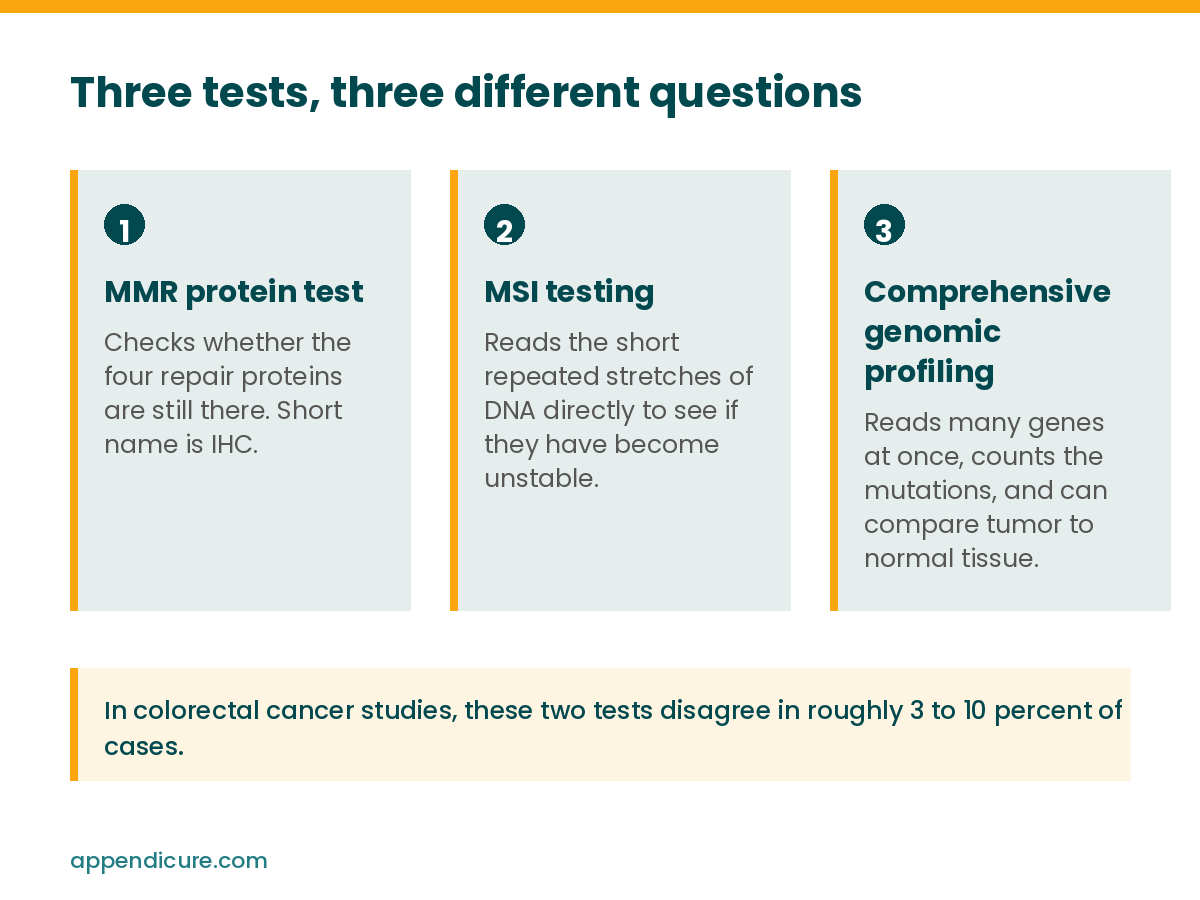
The MMR protein test checks whether four specific repair proteins are still present in the tumor tissue. Pathologists call it immunohistochemistry, or IHC. When one or more of those proteins is missing, the report says mismatch repair deficient, usually written dMMR.
MSI testing skips the proteins and reads the DNA. It looks at short repeated stretches called microsatellites to see whether they have become unstable. A stable result is written MSS. An unstable one is MSI-high.
Comprehensive genomic profiling, or CGP, reads many genes at once. It can report MSI status, count how many mutations the tumor is carrying, which is called tumor mutational burden or TMB, and check individual genes like RAS, BRAF, and HER2. When it is run on tumor tissue and normal tissue side by side, the comparison can also flag a change that looks inherited rather than something the tumor developed on its own. That is a flag rather than a final answer, and confirming it usually means a separate germline test through a genetics service.
What happened in this case
Her MMR protein test showed loss of MLH1 and PMS2. MSH2 and MSH6 were still there. On that result by itself, her tumor was mismatch repair deficient, which pointed her team toward immunotherapy.
Then the MSI test came back microsatellite stable. The genomic profiling agreed and put her tumor mutational burden at 3.7 mutations per megabase, which is low. Both of those results point away from immunotherapy.
Her team followed the MMR result and started nivolumab plus ipilimumab. After three cycles her scans showed the cancer had grown, and her fluid had built up enough to need draining again.
They switched to mFOLFOX6 chemotherapy. After two cycles the fluid still had not come down.
At that point they went back to the full genomic profile and read it as a whole. Her tumor was RAS and BRAF V600E wild type, HER2 negative, and carried none of the major changes known to block anti-EGFR drugs. Her team added panitumumab, an anti-EGFR antibody, to the mFOLFOX6. Her fluid nearly disappeared, her abdominal nodules shrank, and the response was scored as a partial response. By the time the authors wrote the case up, she had received ten more cycles and was still under control.
Why two tests of the same system can disagree
Published colorectal cancer studies put the disagreement rate between MMR protein testing and molecular MSI testing at roughly 3 to 10 percent. Comparable figures for appendiceal cancer specifically have not been established.
Confirmation testing catches some of it. In the CheckMate 8HW colorectal cancer trial, 303 patients entered the first-line comparison based on MSI-high or dMMR testing done at their own hospital. Central testing confirmed that status in 255 of them. The trial does not break down why the rest were not confirmed, so those are not all wrong local results, but the gap is a reason to take a second look when a result does not fit the rest of the picture.
Several things can cause it. Not enough tumor in the sample. Handling problems before the test is run. Real differences between tumor cells in one part of the tissue and another. Differences in how sensitive each assay is.
In her case the authors ruled some of those out. She had not had chemotherapy before either test. The protein loss was even across the tissue rather than patchy. The genomic profiling found no mutation in MLH1 itself. They offer methylation of the MLH1 promoter as one possible explanation, though they did not test for it. They raise a simpler possibility too, which is that losing the protein did not damage the repair system enough to produce a hypermutated tumor.
That first explanation has a wrinkle worth naming. An MD Anderson study of 108 appendiceal carcinomas concluded that MLH1 promoter methylation does not appear to be a mechanism for microsatellite instability in the appendix, unlike in the right colon where it is the usual cause. The hypothesis these authors offer is reasonable for her tumor, but it runs against what the larger appendiceal series found.
The inherited finding nobody was looking for
Her genomic profiling was run on tumor and normal tissue together. That paired setup found a TP53 mutation, p.R248Q, sitting in her normal tissue at a variant allele frequency of 46.8 percent, which means she was born with it. ClinVar classifies it as pathogenic. It confirmed Li-Fraumeni syndrome, an inherited condition that raises the risk of several cancers.
Both of her parents were tested for the same variant and neither one carried it, so it appears to have arisen new in her. No family history would have flagged it. Nothing about how she presented would have prompted the test on its own. It surfaced from a panel that was run to help pick a chemotherapy.
I wrote the plainer version of what inherited testing adds, and why it reaches your relatives, in appendix cancer genetic testing.
What this case does not show
This is one patient. The authors say so plainly and list four limits of their own.
She received panitumumab on top of mFOLFOX6, so there is no way to separate what the panitumumab did from what the chemotherapy did.
Anti-EGFR evidence in appendiceal cancer is thin. The idea of ruling out resistance mutations before choosing an anti-EGFR drug was developed in metastatic colorectal cancer, not in this disease.
The reason her two tests disagreed was never established.
And this is signet ring cell appendiceal adenocarcinoma, a subtype that makes up roughly 4 to 5 percent of primary appendiceal carcinomas. Nothing in this case covers LAMN, HAMN, goblet cell adenocarcinoma, mucinous adenocarcinoma, appendiceal neuroendocrine tumors, or pseudomyxoma peritonei.
One more thing about the source. This is a preprint posted on Research Square on August 28, 2026, and it is marked under review. It has not been through peer review. I am writing about it because the testing question sitting underneath it is one I see members hit right now, not because a single case changes anyone’s treatment.
What to ask your care team about appendix cancer biomarker testing
Has my tumor had MMR protein testing, MSI testing, and tumor mutational burden measured, or only some of those? If all of them were done, did the results agree with each other? Has comprehensive genomic profiling been run, and was it run on tumor tissue alone or on tumor and normal tissue together?
That last question decides whether an inherited finding can be spotted at all. A tumor-only panel cannot tell you what you were born with.
Questions people ask
Can a tumor be mismatch repair deficient and microsatellite stable at the same time?
Yes. Published colorectal cancer studies put the disagreement between MMR protein testing and MSI testing at roughly 3 to 10 percent. The two tests measure different things, so one can come back abnormal while the other comes back normal. Equivalent figures for appendiceal cancer have not been established.
Does a dMMR result always mean immunotherapy will work?
No. In this case report the tumor was dMMR on protein testing but microsatellite stable with a low tumor mutational burden, and nivolumab plus ipilimumab did not control it. Treatment decisions belong to you and your oncologist, and one case does not set a rule.
What is the difference between genetic testing and genomic profiling?
Genomic profiling reads the tumor. Genetic testing, also called germline testing, reads what you were born with. Some paired tumor and normal panels can flag both at once, which is how the Li-Fraumeni syndrome in this case surfaced. An inherited finding that turns up on a tumor panel still usually needs to be confirmed and handled through a genetics service.
Does appendix cancer biomarker testing require a new biopsy?
Often not. These tests usually run on tumor tissue that has already been removed and stored. Ask your team whether your existing tissue can be used.
Nobody knows how often appendix cancer biomarker testing comes back with results that disagree. Appendiceal-specific data on that question is very limited. The Patient-Led Global Appendix Cancer Registry gathers mutation, biomarker, and pathology data from patients directly. It takes about ten minutes. The enrollment links are region-specific, so please use the one that matches where you live.
Already enrolled and need to add a new report or fix an earlier entry? Use the registry update form. Appendicure runs on donations, and if you want to help fund this work you can give here.
Sources
Ando T, Tajiri Y, Noda Y, et al. Comprehensive genomic profiling-guided treatment selection in appendiceal adenocarcinoma with discordant mismatch repair findings: a case report and literature review. Research Square preprint, posted August 28, 2026. Not peer reviewed. https://doi.org/10.21203/rs.3.rs-10434247/v1
Evrard C, Tachon G, Randrian V, Karayan-Tapon L, Tougeron D. Microsatellite instability: diagnosis, heterogeneity, discordance, and clinical impact in colorectal cancer. Cancers. 2019;11:1567. https://doi.org/10.3390/cancers11101567
Andre T, Elez E, Van Cutsem E, et al. Nivolumab plus ipilimumab in microsatellite-instability-high metastatic colorectal cancer. New England Journal of Medicine. 2024;391(21):2014-2026. https://doi.org/10.1056/NEJMoa2402141
Taggart MW, Galbincea J, Mansfield PF, et al. High-level microsatellite instability in appendiceal carcinomas. American Journal of Surgical Pathology. 2013;37(8):1192-1200. https://doi.org/10.1097/PAS.0b013e318282649b
McCusker ME, Cote TR, Clegg LX, Sobin LH. Primary malignant neoplasms of the appendix: a population-based study from the Surveillance, Epidemiology and End Results program, 1973 to 1998. Cancer. 2002;94:3307-3312. https://doi.org/10.1002/cncr.10589
This post is patient education from Appendicure and is not medical advice. Testing and treatment decisions should be made with your own care team.
Renee Hill is an appendix cancer survivor who was diagnosed at 31 with stage 4B mucinous adenocarcinoma of the appendix with signet ring cells. Her cancer returned in her liver in 2020, and she has had no evidence of disease in the six years since that surgery.
Renee is flying to Italy this afternoon. Ten days with her brother and his kids on the coast, and she is working part of the trip, which she does not seem to mind doing from there. She was 31 when a surgeon looking for ovarian cancer found something else.
She is on the Appendicure board of directors. She is also a Senior Manager of Research Administration at the Versiti Blood Research Institute, which means she reads data for a living.
Watch my full conversation with Renee
An appendix cancer survivor who almost explained her symptoms away
It was the summer of 2016. Renee was training for what would have been her twenty fifth half marathon. She was working with a personal trainer. She was kayaking. She was, by any measure she had, in excellent shape.
She also could not drink a beer without feeling like she had eaten a full meal. She sat at a beer garden with friends and made a joke about it. Something must be wrong with me, she said, I can’t drink beer. It turned out to be every carbonated drink, and then food too. Small amounts filled her up completely.
And she had a belly that would not go away no matter how many miles she ran. Nobody knew what it was until they opened her up. It was full of mucin.
Every single one of those things had an easy explanation, and she used all of them. She told herself it was her menstrual cycle. She told herself she was bloated because she had just run twelve miles in eighty degrees and eighty five percent humidity. She looked for a pattern and could not find one.
“It was easy to talk away the symptoms. I wasn’t feeling good because of X, Y, or Z. But when none of it changed.”
Renee didn’t actually decide to go to the doctor. She already had her annual exam on the calendar. What she did do was add her questions to the check in form, in the box that asks what you want to discuss. She wrote it down instead of letting it go.
Her primary care doctor first suggested probiotics. Then she did the pelvic exam, felt that something was off, and ordered an ultrasound. From that appointment to the operating room was two weeks.
The surgery she went in for, and the one she woke up from
The ultrasound showed something on her ovaries. She was sent straight to a gynecologic oncologist, who explained that ovarian cysts fall roughly into benign, malignant, and something in between. Hers looked in between. It had to come out either way.
Because she was 31, the consent form was full of conditions. If this, then that. They were trying to protect her fertility.
Once the gynecologic oncologist opened her up, she knew immediately that this was not a gynecologic cancer. She called in a second surgeon with more expertise in what she was looking at. Renee was at a high volume hospital, and the pathology came back that same day. Appendix cancer.
She was never misdiagnosed. Not once, not for a day. If you have spent any time in our community you know how rare that sentence is. So many women with appendiceal tumors are treated for ovarian cancer for months or years before anyone says the word appendix.
They removed her ovaries, her appendix, and the mucin. Then they deliberately stopped. Her surgical team already understood that she would need cytoreductive surgery with HIPEC later, and they did not want to make that operation harder.
She woke up in a hospital room she can still picture. To this day she does not remember whether it was a parent or a doctor who told her.
“One, it was kind of like, that’s a cancer, because most of us have never heard of it.”
The final pathology was stage 4B mucinous adenocarcinoma with signet ring cells. High grade. Fast growing. In her words, all the bad things. The only thing she had going for her, she says, was her age.
Chemo, hair, and the part nobody warned her about
The timing was awkward in a way that turned out to matter. Dr. Kiran Turaga had just left the Medical College of Wisconsin, and the surgeon trained in this disease who replaced him, Dr. Harveshp Mogal, did not start until September 1. Dr. Mogal now directs the HIPEC program at UW Medicine and Fred Hutchinson Cancer Center in Seattle. Renee’s line about him was simple. I love the man.
She had scheduled six weeks off work. She healed well enough to start chemotherapy at four. In between, she went to New York for a wedding and met her baby niece, who had been born a month before her diagnosis. Not meeting that baby had been one of her biggest fears. She went in an abdominal binder and got tired walking across rooms, and she went.
Then the port, then chemotherapy, and she worked through all of it. She carried her own insurance and she was her only income. She had no other option, and she says plainly that she knows how lucky she was to have a flexible employer, paid leave, and a boss who let her work from home on Fridays in 2016, when almost nobody did that.
She started on FOLFOX. It held her tumor burden steady but nothing shrank. After five rounds they added irinotecan, moving her to FOLFIRINOX, and that combination was much harder on her body.
It also took her hair, and she did not see it coming. She had been told FOLFOX probably would not, and either nobody told her the new regimen would or she was too overwhelmed to hear it.
“I found losing my hair an incredibly traumatic experience. Because for the first time I looked sick.”
She never shaved her head. She refused, and would not let anyone else do it either. She let her mother trim it once it got really thin, so it would sit better under a wig. She also learned something she had no reason to know at 31, which is that a cancer center can write you a prescription for a wig so your insurance will cover it.
She got through Thanksgiving in Seattle by giving herself white blood cell shots that had to be mailed to her, which is a lot to ask of someone who used to pass out at routine blood draws. She says now that she probably should have gone to an emergency room that week, and that she flat out refused. Her father, a retired emergency physician, was on the phone with her surgeon, and between them they set a fever number that would have ended the argument. She never went. She almost skipped everything that Thanksgiving and was there for all of it.
Twelve hours, five weeks, and forty pounds
Her cytoreductive surgery with HIPEC was January 20, 2017. It took twelve hours.
Her parents waited all day. Friends brought them coffee and sat with them, things Renee only learned about later. Her surgeon came out himself with updates instead of sending someone. Her parents still talk about it.
By then she had already lost her appendix and ovaries. In this surgery they took her spleen, her gallbladder, her omentum, part of her colon, and her uterus, completing the hysterectomy. They did something with her intestines she cannot fully recall.
“Basically, if you don’t need it, I don’t have it.”
Her surgeon made one more decision that I want people to notice. He could have gone a step further, but that step would have left her with an ileostomy and it would not have improved her score. He weighed the fact that she was an active 31 year old, and he did not do it.
The epidural never happened. She has a hard time with needles, and she passed out before they could place it. She had epidurals for her other operations, but not for the biggest one. She was still heavily medicated for pain, just without the block she was supposed to have.
They told her ten to twelve days in the hospital. She was there five weeks, with two discharges and readmissions in between. She picked up a hospital infection nobody could identify, which brought in the entire infectious disease department, and along the way they discovered she is allergic to a whole class of antibiotics. She went home on IV antibiotics. She was in bed so long that she needed trigger point injections for back pain.
She could not eat. She got full almost immediately, and a dietitian came every day. She lost somewhere in the range of forty to fifty pounds and got down to a weight her team considered dangerous. Her clothes fell off her and she cried, because none of it was healthy.
She was angry at her parents, at her doctors, at everyone. She is still annoyed about the therapist who tried to talk to her with her parents in the room, which she points out is not okay for a teenager and is definitely not okay for a thirty year old woman. She did not want to get up and walk, and she knew perfectly well that she needed to get up and walk.
“At this point, there’s so little control you have over anything.”
Eight weeks after that surgery she was back at work, doing partial days, with her parents driving her so she would not spend her energy on the commute. She spent part of those days lying on the floor under her desk, because sitting in a chair was hard and her abdomen and back were weak.
Recovery was walking up and down her own street. One block, then two, then paying for it the next day if she pushed.
“People throw around that recovery isn’t linear, but it’s so, so true. You can feel really good one day, but then if you overdo it, everything would hurt.”
About fifteen months later, a half marathon
The race she had been training for when she was diagnosed was going to be her twenty fifth. She never ran it.
On May 5, 2018, about fifteen months after the twelve hour surgery, she went back to Door County and ran the same half marathon she had run the two years before. The Medical College of Wisconsin was marking its one hundred twenty fifth anniversary, and Renee volunteered her own story for it, so a video crew came. Her medical oncologist drove up with his wife. Her surgeon could not make it and sent a video.
Door County, Wisconsin, May 5, 2018. The slowest half marathon she ever ran, and the one she finished anyway.
She started with friends and told them to go ahead. Then it got hard.
“I have to finish this. There are people here, my mom is here, my friends are here, my doctor is here.”
It was by far the hardest and slowest half marathon she ever ran. She finished it.
I told her I used to think people who ran marathons did not get cancer. Her answer was flat and immediate. Cancer does not care how old you are, how fit you are, any of it.
January 2020: a job offer and a recurrence, on the same day
Because her cancer was high grade and fast growing, her team scanned her every three months. Renee was fine with that. Surveil me, she said. Her tumor marker, CEA, tracked her disease reliably, which is not true for everyone.
Her surgeon gave her an instruction she still quotes. Go live your life and leave the worrying to me.
She said yes to almost everything after that, because a year had been taken from her. The only thing she put off was her MBA, and only for a year. She started it in 2018.
In early January 2020 she was driving home on the freeway in Milwaukee when her nurse practitioner called and asked if she could talk. She can still picture the exact spot on the road. Her CEA was elevated for the first time in three years, and there were two tiny tumors on her liver. The pathology was identical to 2016. Same cancer, unchanged.
The same day she found out, she got a job offer.
So she walked into a brand new job and, on day one, told her new boss she had cancer again and needed every other Friday off. She had already decided how the rest of it would go. No treatment before February 1, because she was switching insurance and was not paying two deductibles. Chemotherapy on Fridays, because she had class Tuesdays and Thursdays and she was in the last semester of her MBA.
“If I have to do this again, I’m taking control of it this time.”
They put her on FOLFIRI and deliberately left out the oxaliplatin so they would not add to her neuropathy. She had three rounds before the world shut down.
Because she has family in Italy, she saw COVID coming before most Americans did. When her cancer center stopped allowing anyone to come in with patients, she happened to be between treatments, so she got to have her breakdown at home. Walking into an empty cancer center was eerie. It was also quieter, and she got a private room, and she video called her brother and her niece from the chair.
That spring she bought a season pass from a local kayak company, because kayaking was outdoors and naturally distanced and it was more or less the only thing available. In her words, she got her money’s worth out of May and June.
Her blood work improved. The liver tumors did not shrink. Her surgeon brought in a liver surgeon.
Surgery was June 20, 2020. When she woke up and saw the clock, she panicked, because so little time had passed that she assumed they had not been able to do it. The opposite was true. It was easier than anyone expected. Nothing was hiding that the scans had missed. They used part of her existing scar and she was home in five or six days.
Then she felt terrible again and ended up back in the hospital with a bowel obstruction, which her team attributed to scar tissue coming loose. She has a body full of it. She has been NED since, six years now.
What ten years out actually looks like
For the first five years after that surgery, scans every six months and blood work every three, so anything off would trigger an earlier scan. Now she is scanned once a year, and her team alternates or combines CT and MRI, partly to keep her lifetime radiation exposure down. She has had so many CTs she cannot count them.
She changed primary care doctors a few years ago and found one who specializes in caring for people after cancer treatment. Her original doctor took her seriously and got the whole thing moving, and Renee credits her for that. But afterward Renee felt she did not understand what had actually happened to her body, and she went looking for someone who did. I did not know that was a thing. It is worth asking for.
She does not need an OBGYN anymore. The only long term medication she takes is estrogen, after going through surgical menopause young. There are very few foods she cannot eat, which she finds a little shocking given what is missing.
She turned 40 last year and threw a big party, because she did not think she would get there.
Skiing, hiking, kayaking. She is missing a spleen, a gallbladder, an omentum, part of a colon, and her reproductive organs. This is what ten years looks like.
“I see every birthday as just something to celebrate, because tomorrow is just not promised to any of us. I’m grateful I get to age.”
Why she reads data differently than most patients
Renee never asked her doctors for survival numbers. Her parents did, and she found that out later.
She did not want to know, and she had a second reason on top of the fear. She understands data better than most people. She knew that anything published was already years old by the time she could read it, and that there was essentially nothing published about thirty year olds with her disease.
“I’m not a statistic and this data isn’t about me.”
She has a point. The numbers matter, but they cannot tell an individual patient exactly what is going to happen to them.
Why she is still here doing this
Plenty of people finish treatment and never want to think about it again, and I think every appendix cancer survivor feels that pull at some point. Renee did it for a while. She left the Facebook groups. She stepped away because she could not carry it.
She came back, and she recently joined the Appendicure board, for two reasons.
The first is that nobody knows this disease exists. Renee put it in numbers. Colon cancer counts about 150,000 new cases a year. Appendix cancer counts 2,000 or 3,000. Renee’s point was that you cannot even compare the two, and that difference is why awareness has to keep being built by the people who lived it.
The second is what she has watched happen in ten years.
“What I’ve seen change in these 10 years is amazing. The research and the science and the care that didn’t exist 10 years ago that does today is fascinating.”
She has enrolled in every study she qualifies for. Some are appendix cancer specific and some are for young adults with cancer, because she believes people diagnosed in their thirties fall into a gap. The category is called adolescent and young adult, and as she put it, she was 31 and did not relate to a 19 year old. She did not relate to a 65 year old either.
I asked her what her forty year old self would say to her thirty year old self. She did not have a speech ready.
“You’re stronger than you think you are. You’re surrounded by a lot of really good people. And while you think cancer might be your whole life, it’s not.”
She spent much of her thirties dealing with this. She is spending her forties traveling, going to concerts, and doing what she wants to do, because she already knows what it feels like to have that taken away.
One honest note. Renee had high grade mucinous adenocarcinoma of the appendix with signet ring cells. Her course is not a map for low grade appendiceal mucinous neoplasms, goblet cell adenocarcinoma, or appendiceal neuroendocrine tumors, and it is not a prediction for anyone else with her own subtype. One person’s story does not set anyone else’s. Decisions about surgery, chemotherapy, and surveillance belong to you and your team, and the standard of care reference for appendiceal disease is the 2025 Godfrey consensus guidelines.
Questions people ask about being an appendix cancer survivor
What does NED mean?
NED stands for no evidence of disease. It means that scans, blood work, and exams do not show cancer right now. It is not the same as cured, and it is why surveillance continues.
What is mucinous adenocarcinoma of the appendix with signet ring cells?
It is a form of appendix cancer that produces mucin, a thick jelly like substance that can spread through the abdomen. Signet ring cells are a specific cell shape pathologists look for under the microscope, and their presence generally puts a tumor in the high grade category.
What does surveillance look like ten years after appendix cancer?
It varies by person and by subtype. In Renee’s case it was scans every three months at first, then every six months for five years with blood work every three months, and now one set of scans a year using CT and MRI. Her team watches her CEA tumor marker, which tracks her disease reliably. That is not true for every patient.
Can you run again after cytoreductive surgery with HIPEC?
Some people do. Renee finished a half marathon about fifteen months after a twelve hour cytoreductive surgery, and she is clear that it was the hardest and slowest race she ever ran. Renee’s team told her three to six months, and getting back to athletic activity takes longer than that. Ask your own surgical team what is realistic for you. Building strength before surgery, sometimes called prehab, can help.
Why does it matter where you are treated?
Renee’s gynecologic oncologist recognized during surgery that she was not looking at a gynecologic cancer, called in a colleague with the right expertise, and had a pathology answer the same day. Appendix cancer is frequently mistaken for ovarian cancer in women. Centers that see this disease often are more likely to identify it quickly and to plan a first operation that does not compromise a later cytoreductive surgery.
Renee joins every study she qualifies for. You can start with ours.
The Patient-Led Global Appendix Cancer Registry collects the molecular and pathology information that researchers cannot get anywhere else, because no single hospital sees enough appendix cancer patients to answer these questions alone. It is IRB approved.
Today is the last day of Appendix Cancer Awareness Month. Renee’s cancer was recognized for what it was from the beginning. Too many appendix cancer patients still don’t get that, and it is not something we should be relying on luck to get right. If you want to help change it, you can donate to fund appendix cancer research.