
For patients living with pseudomyxoma peritonei, PCI is one of the first numbers they learn. It estimates how much disease is in the abdomen, and along with the completeness of cytoreduction score, it has anchored prognostic conversations for more than two decades.
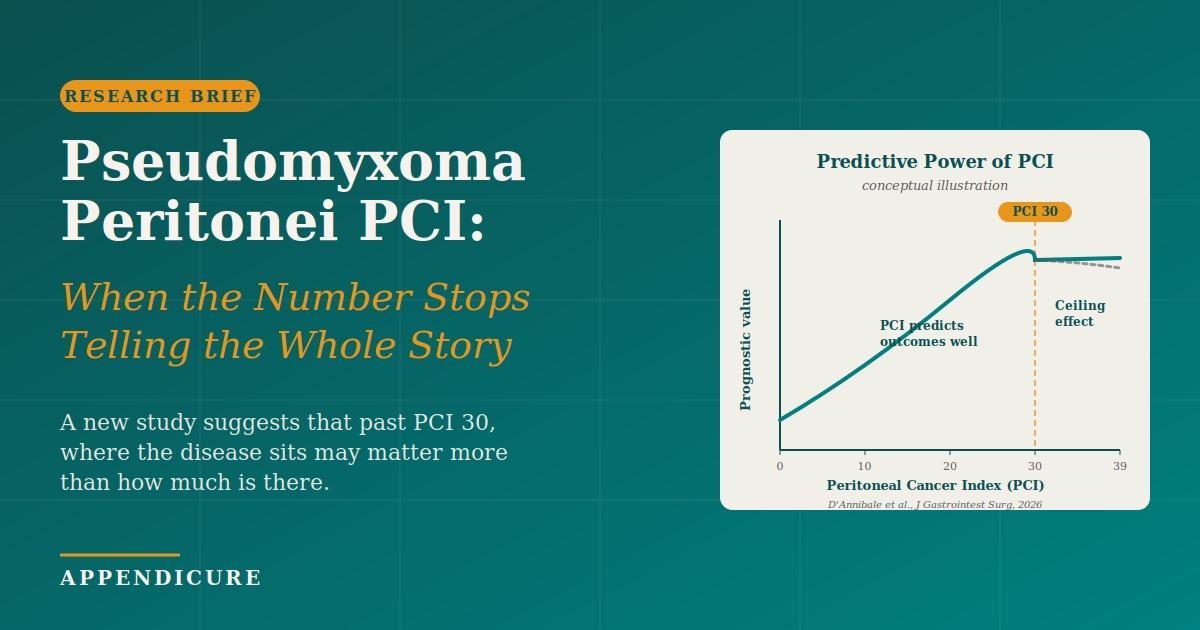
A new study from a Rome center treating LAMN-origin pseudomyxoma peritonei raises a careful question about what happens at the extremes. When PCI gets very high, somewhere above 30, the number itself begins to lose its predictive power. What appears to take its place is not how much disease is present, but where it sits.
This is one study. Seventy-three patients, single center, retrospective. The findings are directional, not practice changing. The direction is worth understanding, though, because it reflects a broader shift in how high-volume peritoneal surface centers think about extreme tumor burden.
A Quick Refresher on PCI and CC Score
The PCI scoring system, developed by Paul Sugarbaker, divides the abdomen and pelvis into 13 regions. Each region receives a score of 0 to 3 based on the size of tumor deposits found there during surgery. The maximum possible score is 39. Higher numbers mean more disease, distributed across more of the abdominal compartments.
The CC score describes what remained at the end of the operation. CC-0 means no visible disease was left behind. CC-1 means residual deposits smaller than 2.5 mm. CC-2 and CC-3 indicate larger amounts of residual disease. For LAMN-origin pseudomyxoma peritonei, the goal of cytoreductive surgery is CC-0 or CC-1, which preserves the benefit of hyperthermic intraperitoneal chemotherapy (HIPEC) delivered at the end of the case.
For decades, high PCI and incomplete cytoreduction have been the two most consistent predictors of worse outcomes after CRS/HIPEC for pseudomyxoma peritonei. Every major peritoneal surface program reports versions of the same finding.
What the Study Did
The research team at Fondazione Policlinico Universitario Agostino Gemelli IRCCS reviewed 73 consecutive patients with LAMN-origin pseudomyxoma peritonei treated with cytoreductive surgery between January 2016 and December 2023. Most received HIPEC. The cases were retrospectively analyzed for the standard prognostic variables.
The researchers then did something less common. They asked whether there was a PCI threshold above which the usual prognostic factors stopped doing their usual work. An exploratory analysis identified PCI 30 as that threshold, and the authors zoomed in on the 20 patients in the super-extended group.
In that subgroup, they looked at how the disease was distributed. They examined whether the surgery required extensive work in the supramesocolic compartment, meaning the upper abdomen above the transverse mesocolon. In practical terms, this is the part of the abdomen that includes the diaphragm, liver capsule, lesser sac, stomach, spleen, and surrounding structures. Surgery in this compartment is technically harder, takes longer, and carries higher complication risk.
Pseudomyxoma Peritonei PCI Findings at the High End
Across the full cohort of 73 patients, the standard story held. Higher PCI predicted worse overall survival. Incomplete cytoreduction predicted worse overall survival. For disease-free and progression-free survival, intraoperative complications also mattered. None of this is surprising. It is consistent with what high-volume centers have been publishing for years.
The interesting finding came from the 20 patients with PCI above 30. In that group, the relationship between PCI and survival weakened. So did the relationship between CC score and survival. The numbers that ordinarily separate better and worse outcomes lost some of their power to discriminate.
What rose to the top instead was the anatomy of the disease. Patients whose surgery required extensive supramesocolic resections had worse overall survival and shorter restricted mean survival time at 36 months. The authors describe this as a ceiling effect. Past a certain volume of disease, the number stops sorting patients into meaningful prognostic groups, and the compartment of the abdomen most affected becomes the dominant signal.
Why This Matters for Patients and Families
For patients with low to moderate PCI, this study does not change much. The traditional metrics still work, and the conversations patients have been having with their surgical teams are still grounded.
For patients with very extensive disease, the picture is more nuanced. Two patients with a PCI of 32 can have very different outlooks depending on where their disease is concentrated. Lower abdominal and pelvic involvement, even at high pseudomyxoma peritonei PCI, may be more amenable to complete cytoreduction with a lower complication burden. Extensive upper abdominal disease, particularly when it requires work around the diaphragm, liver, or spleen, is harder surgically and, according to this study, may carry a worse outlook even when complete cytoreduction is achieved.
This is worth knowing going into a pre-op consult. The question is not only what your pseudomyxoma peritonei PCI is. It is also where the disease is concentrated, what compartments the surgery will need to address, and what your surgical team’s experience is with the specific anatomical pattern you have.
PCI and CC are not being discarded. They remain the foundation of how surgical teams stage and plan these operations. At the high end, though, they are not telling you everything.
What This Study Cannot Tell Us
The findings come from a single institution with 73 patients, only 20 of whom fell into the super-extended group. That is a small sample for any threshold analysis, and the authors are appropriately careful in framing the pseudomyxoma peritonei PCI 30 cutoff as exploratory.
The study includes only LAMN-origin pseudomyxoma peritonei. It does not speak to higher-grade appendiceal cancers, goblet cell adenocarcinoma, mucinous adenocarcinoma with signet ring cell features, or other histologies in the appendiceal cancer family. The biology of those diseases is different, and the prognostic factors may behave differently as well.
The findings also have not yet been validated in larger, multi-center cohorts. Whether the supramesocolic compartment signal holds up across other high-volume programs, such as Wake Forest, Basingstoke, MD Anderson, UCSD, or Moffitt, remains to be seen.
Most importantly, this study does not change who should be offered CRS/HIPEC. It is a prognostic observation, not a surgical selection rule. Patients with high PCI continue to derive substantial benefit from cytoreductive surgery at experienced centers, and the decision about whether to proceed remains a careful one made by an experienced multidisciplinary team.
How This Fits With What Other Centers Are Doing
The idea that disease location matters as much as disease volume is not new. In advanced ovarian cancer, specific anatomical regions of peritoneal involvement have been shown to predict outcomes more reliably than total pseudomyxoma peritonei PCI in some cohorts. The conversation in peritoneal surface oncology has been moving from how much to how much and where for several years.
Another response to extreme tumor burden has been the staged or two-step approach. A French group has published on splitting the operation for very high PCI patients into two procedures separated by several months. The first operation addresses the lower abdomen and pelvis. The second, performed once the patient has recovered, addresses the upper abdomen. The goal is to reduce the burden of a single very long operation and improve both safety and completeness of cytoreduction. The Rome study does not directly address this approach, but its findings fit the same underlying logic. The upper abdomen is where the difficulty concentrates.
Questions to Bring to Your Surgical Consult
These are questions patients and caregivers can take into a pre-op appointment when pseudomyxoma peritonei PCI scores are high or when imaging suggests upper abdominal involvement.
| What is my estimated PCI based on imaging or staging laparoscopy? |
| Where is my disease concentrated? Is most of it in the lower abdomen and pelvis, or does it involve the upper abdomen? |
| If the upper abdomen is involved, what specific structures will the surgery need to address? |
| What CC score are you aiming for, and how confident are you in achieving it given my anatomy? |
| For very high pseudomyxoma peritonei PCI cases, do you consider a staged or two-step approach? |
| How does your center’s experience with super-extended disease compare to high-volume reference centers? |
Closing Thoughts on Pseudomyxoma Peritonei PCI
Pseudomyxoma peritonei PCI has served the peritoneal surface oncology community well for a long time, and it is not going away. For patients with very extensive disease, though, the number can give a false sense of certainty in either direction. A PCI of 34 in someone with disease confined to the lower abdomen is a different clinical situation than a PCI of 34 in someone with extensive upper abdominal involvement, and patients deserve to understand the difference.
This study is not saying pseudomyxoma peritonei PCI is wrong. It is saying that at the extreme end, the conversation has to get more specific. Where the disease sits, what the surgery has to address, and what the surgical team has done with similar cases before all become part of the picture. For patients walking into a consult with a high PCI on their CT report, those are the questions worth bringing into the room.
Glossary
| PCI | Peritoneal Cancer Index. A surgical scoring system that divides the abdomen into 13 regions and assigns 0 to 3 points per region based on the size of tumor deposits. Maximum score is 39. |
| CC score | Completeness of Cytoreduction. A measure of how much visible disease remained after surgery. CC-0 means no visible residual disease. |
| CRS | Cytoreductive Surgery. The surgical removal of all visible tumor from the peritoneal cavity, often combined with peritonectomy procedures and organ resections. |
| HIPEC | Hyperthermic Intraperitoneal Chemotherapy. Heated chemotherapy delivered into the abdominal cavity at the end of cytoreductive surgery to address microscopic residual disease. |
| LAMN | Low-grade Appendiceal Mucinous Neoplasm. A low-grade tumor of the appendix that can rupture and seed the peritoneal cavity, leading to pseudomyxoma peritonei. |
| PMP | Pseudomyxoma Peritonei. A clinical syndrome characterized by progressive accumulation of mucinous material throughout the peritoneal cavity, most often from a ruptured appendiceal neoplasm. |
| Supramesocolic compartment | The upper abdominal region above the transverse mesocolon, including the diaphragm, liver capsule, lesser sac, stomach, and spleen. |
| Restricted mean survival time | A statistical measure of average survival over a defined time window, often used when long-term follow-up is incomplete. |
Source
D’Annibale G, Abatini C, Lodoli C, Barberis L, Partipilo T, Catapano A, Alterio M, Calegari MA, Pacelli F, Santullo F. Prognostic Ceiling Effect of the Peritoneal Cancer Index in Super-Extended Pseudomyxoma Peritonei of Appendiceal Origin: Impact of Anatomical Disease Distribution and Surgical Complexity. Journal of Gastrointestinal Surgery. 2026. DOI: 10.1016/j.gassur.2026.102456. Available at: https://doi.org/10.1016/j.gassur.2026.102456
Continue Reading: When One Surgery Is Not Enough and What’s the Difference Between LAMN and PMP
Patient education and advocacy for appendiceal cancer.
Leave a Reply