Real voices. Real journeys.
These appendix cancer patient stories share strength, hope, and resilience in the face of a rare disease. They come from patients, caregivers, and survivors in our community, including the story that started it all.
Our Story
How appendix cancer changed our lives, and why I built APPENDICURE
June 2026

In August 2023, my husband David and I became empty nesters. Our daughter had just left for college, and we had also just sold our business. After years of raising a family and running a company, we finally had room to breathe. We bought a camper, loaded up the dogs, and spent two weeks on the road. We laughed, explored, and talked about everything we still wanted to do.
We came home to Lake Norman, North Carolina, rested and happy. David had a follow-up colonoscopy coming up. It was supposed to be routine. His first one, back in January 2023, had turned up a few benign polyps, so we expected a clean report and a three-year break before the next test.
That is not what happened.
The phone call
On January 22, 2024, David’s gastroenterologist, Dr. Trivedi, told us everything looked great. Fewer polyps this time, nothing to worry about. Two days later, the phone rang. One of the polyps, a tiny one, had come back malignant.
It was in his appendix.
Dr. Trivedi said it was a miracle he even saw it. The appendix is usually hidden during a colonoscopy. There is no screening test for appendix cancer. Most people find out by accident during another surgery, or after their appendix ruptures. By then it is almost always stage 4.
David’s cancer was high-grade, poorly differentiated Goblet Cell Adenocarcinoma. We caught it early. We got lucky, at least so far. We are about two and a half years out now.
What I learned fast
At first they made it sound like nothing. Take out the appendix, a quick outpatient snip, home that same day, cancer free. Then it became a right hemicolectomy, which is major surgery, not a small piece of anything. By then I had already started reading, and I knew this was bigger than anyone was letting on. Appendix cancer is not just “a kind of colon cancer.” It is its own disease, and very few doctors really understand it.
Within days I joined an online support group and met Deborah Shelton, the Executive Director of ACPMP. She told me what I now tell everyone: find a specialist who treats this disease regularly and has done hundreds of these cases, not one who sees it once a decade.
That advice changed everything. Deborah and a handful of total strangers helped guide us.
With Deborah’s advice in mind, I went looking for experience, not just a willing scalpel. The first surgeon we met was kind and more than capable of doing a right hemicolectomy, but in ten years he had seen exactly one goblet cell patient. I walked into that meeting already knowing it would be a no.
I somehow managed to track down Dr. Edwin Levine’s phone number at Wake Forest and sent him a text. He called me back right away. He was going through his schedule trying to get us in sometime in the next month when he realized he had a cancellation for 8am the very next morning. We took it.
He had the experience I was after. The problem was the surgery timing. He was booked until May, and he told me, “There’s no rush. That tumor has been there for ten years.” He said to go ahead and take the Aruba trip we had already planned with our daughter in April.
But David’s appendix had not ruptured yet, and I knew exactly what happens when one does. The thought of it rupturing on an island like Aruba was terrifying. How anyone thought we could fly off and enjoy that vacation is beyond me. There was no way we were going to sit on this for four months. It felt like a ticking time bomb in his body that could go off at any time.
Then I found Dr. Armando Sardi at Mercy Hospital in Baltimore, one of the most experienced appendix cancer surgeons I could find. His office got us in right away.
The surgery
We drove to Baltimore and met Dr. Sardi and his colleague Dr. Gushchin. For the first time, everything made sense. Dr. Sardi pulled up David’s scans, walked us through how goblet cell cancer spreads silently through mucin that coats the organs, and told us straight: the fact that Dr. Trivedi caught it at all probably saved David’s life.
David had a right hemicolectomy on February 14, 2024, at Mercy. The surgery went well. They removed 21 lymph nodes. One came back positive, which made it Stage 3B.
Then came the next fight: chemo.
Fifty-fifty either way
After the surgery, three different appendix cancer specialists told us the same thing: do six months of FOLFOX chemotherapy. But when we pushed, they were honest about why. It was basically fifty-fifty. The cancer had about the same odds of coming back with or without the chemo, and they treated it like colon cancer because they did not have anything better to offer. That did not sit well with us.
That is when Deborah Shelton told us about a study coming out of MD Anderson by Dr. Shen, one that had not even been published yet. So we made the trip to MD Anderson Cancer Center in Houston, one of the few places doing real research on this disease. We flew out in early March and spent several days in tests and consults.
Dr. Shen did not recommend chemotherapy, and unlike everyone else, he had the data to back it up. He walked us through his research in person, well before it was published. It was one of the largest studies ever done on early-stage appendix cancer, and it found no survival benefit from chemotherapy after surgery, even for patients flagged as high risk by colon cancer rules. For David’s subtype and stage, there was no evidence chemo would lower his risk. He was clear this was specific to David’s situation. If David had been stage 4, he would have recommended chemo first to shrink the tumor before surgery, but only three months of it, not six. I wrote more about this study and what it means for patients here.
That was data we could trust.
Dr. Shen also ordered genomic sequencing on David’s tumor. It built a personalized DNA profile, so his blood could be checked for tiny signs of recurrence long before a scan would ever pick them up.
With that research in hand, David made his call: no chemo, observation only.
Observation, not chemo
By April 2024, Dr. Shen confirmed the genomic results backed up his recommendation, and David officially moved into observation. He recovered well. Three weeks later we were back in the camper, headed for the life we loved, with a stop in Orlando to see our daughter.
Why I built APPENDICURE
After months of phone calls, research, and sleepless nights, I realized our story was not special. It was just lucky. We caught it early. We found the right people. We learned to ask for data instead of taking assumptions at face value. Most patients never get that head start, and most have no idea where to begin.
That is why I built APPENDICURE: to make the path clearer for the people who come after us.
This site is built for patients and caregivers, by someone who has lived it. It is a place to find credible information, real support, and stories of survival, without the confusion and misinformation that follow this disease around.
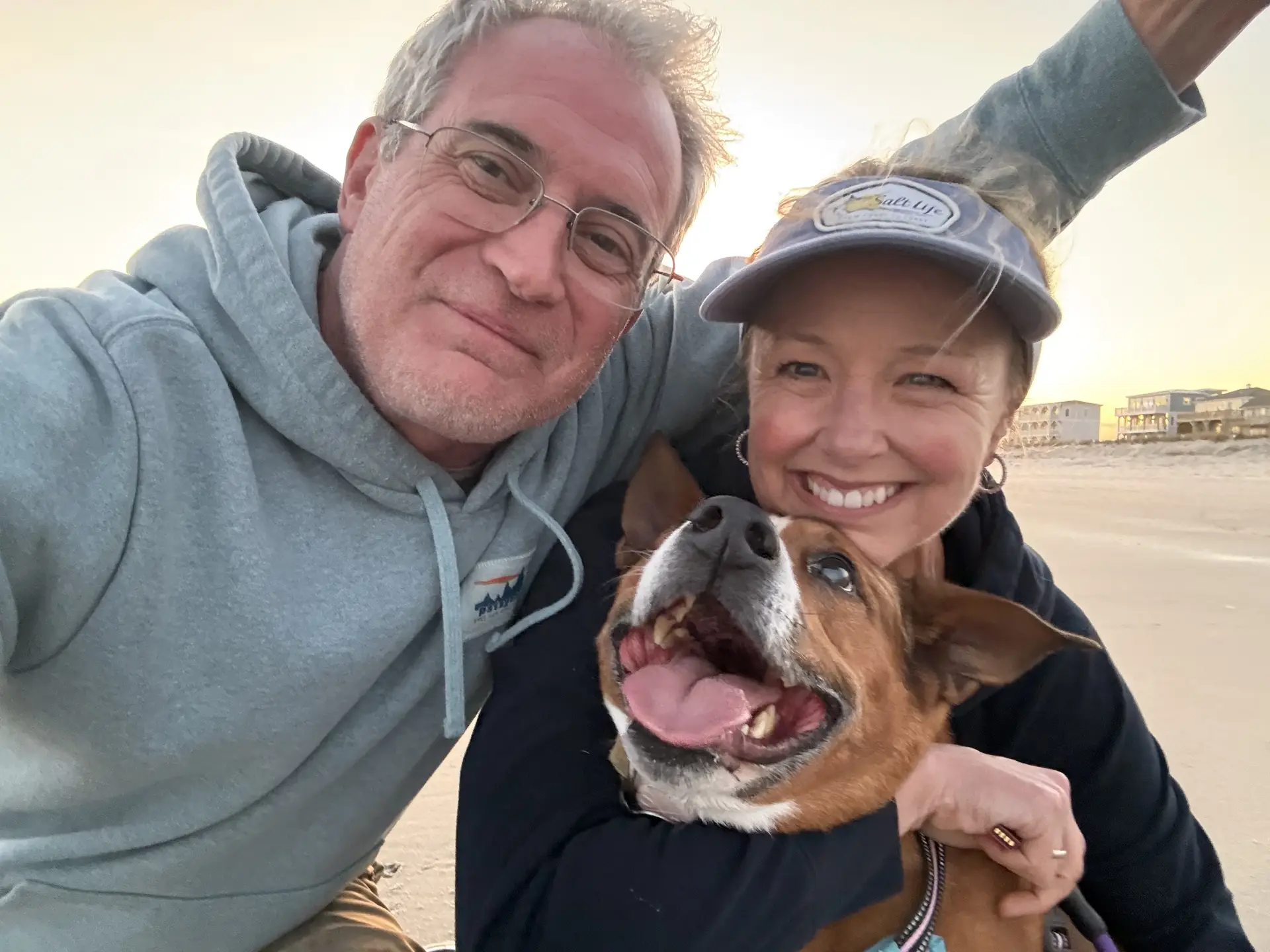
In October 2024, we sold our house and moved to Oak Island, North Carolina. Nothing puts life in perspective like a cancer diagnosis.
Now I look out at the ocean every morning and think about how close we came to missing this view, and how many people never get that miracle phone call after a routine colonoscopy. I hope APPENDICURE can be the place where patients and caregivers find answers they can actually understand.
Hear David and me tell this story in our own words.
Appendix cancer patient stories from our community
Stories that inspire, one page at a time.


Real experiences, real voices
Watch survivors share what diagnosis, treatment, and recovery actually looked like.
The PMP Project Podcasts
Conversations on cancer, fertility, and survivorship from the broader PMP community.