

Short answer: Bowel obstruction after HIPEC is a recognized complication of cytoreductive surgery and heated intraperitoneal chemotherapy. Studies have documented hospital readmissions for small bowel obstruction months and even years after surgery. What those studies may miss are the episodes patients manage entirely at home, without an emergency department visit or an admission.
This started this morning with a phone call.
A caregiver in this community called me about her husband. His ostomy bag had stopped holding. It was coming unstuck and leaking, sometimes more than once a day, and she was the one changing it every single time. It had worked well for months. Now it was failing constantly, and she had started to believe she was doing something wrong.
She was not. As she talked, something else came out. He had been through a bowel blockage not long before.
That reframed the whole problem. A blockage distends the abdomen, and a barrier shaped to a flat stomach will not seal against a swollen one. When things open back up, output often runs thin and fast for a while, and thin output undermines a seal in hours rather than days. Add a hospital stay, and skin that is already sore, and you get exactly what she was describing. There was no way to know for certain, but the most likely explanation was that the bag was not really the problem. The bag was the symptom.
She had been treating it as a supply issue for weeks. Different products, different technique, a lot of quiet self-blame. Nobody had connected it to the blockage, because nobody had asked.
After the call, I kept thinking about how ordinary that conversation was. I have had some version of it many times. A blockage here. An emergency room trip there. Someone who has had three this year and has stopped telling people about it. It rarely comes up in conversations about what life looks like after cytoreductive surgery, and yet it comes up in this community constantly.
So I went looking for what the research actually says about bowel obstruction after HIPEC.
What the research on bowel obstruction after HIPEC actually shows
Surgeons have studied this, and the numbers are worth seeing.
What studies have found
In one CRS/HIPEC cohort, the cumulative incidence of readmission for small bowel obstruction was 24% at one year, rising to 38% at two and three years.[2]
In another, covering 366 patients, 19.9% were readmitted with small bowel obstruction. Of those cases, 57.5% were attributed to adhesions and 42.5% to malignancy. The median time to obstruction was 7.7 months, with cases occurring from two weeks to just over five years after surgery.[1]
Among patients readmitted with obstruction, 28.7% required surgical intervention. Overall, 76.7% of obstructions eventually resolved, either without surgery or after surgical intervention.[1] These figures describe documented medical encounters, not necessarily every episode a patient experiences.
There is a real body of evidence here. Risk factors have been examined too. Studies have linked post-CRS/HIPEC obstruction with factors including higher PCI scores, high-grade appendiceal or colorectal tumors,[2] and the intraperitoneal chemotherapy agent used.[1]
One limit is worth naming honestly. Most of these studies combine several different peritoneal malignancies, and even when appendiceal cancers are included, the sample sizes for individual appendiceal histologies are often too small to give reliable subtype specific estimates. If you are living with goblet cell adenocarcinoma, signet ring cell, a neuroendocrine tumor or a low grade mucinous neoplasm, the published numbers may or may not describe your situation, and the research generally cannot tell you which.
What hospital records may miss
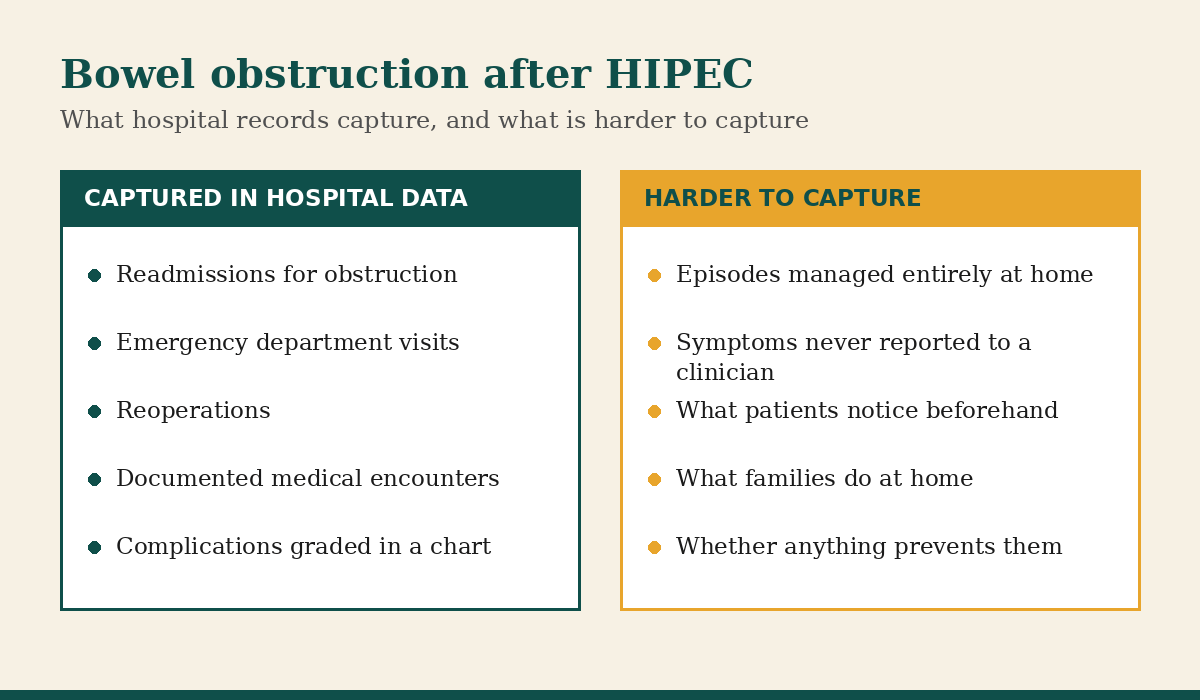
Notice what all of those numbers have in common. Every one of them counts a readmission, an emergency department visit, a reoperation, or another documented medical encounter. Some studies focus on early postoperative complications or short term readmissions, while others follow patients for several years. Even the longer term studies generally rely on hospital contact, which means episodes managed entirely at home may be missed.
Think back to the couple I described at the start. He has also recognized symptoms he believed were the beginning of a blockage and had them settle without an emergency department visit, an admission or a chart note.
That episode would not appear in a hospital readmission dataset, because he never sought medical care for it. If many patients are quietly doing the same thing, hospital based incidence estimates may not capture the full burden patients experience.
There are other gaps. Very little has been written about whether patients can feel an obstruction coming, even though many people tell me they absolutely can. There is limited published research on what families actually do at home when symptoms begin, or on whether anything reliably reduces how often these episodes happen.
The caregiver read the survey and found what I had missed
Before I put this in front of anyone, I sent it to her. Not to fill out. To tear apart.
She wrote back and told me something I had not thought to ask. On the day her husband said he thought a blockage might be starting, one of the first things he said was that his bag had been very slow that day.
I had been asking people to describe pain. Pain is hard to put into words and easy to forget afterward, and she told me that even when she asked him directly, there was not much more he could give her. Output is different. It is a number people with an ostomy already watch every single day. They know their normal. A change from it is concrete in a way that a feeling is not.
If it turns out that a slowdown in output is a common early signal, that is something that could be taught. Know your normal. Notice when it changes. That costs nothing, needs no prescription, and might be the difference between a quiet evening at home and a night in an emergency department.
She raised a second thing I had missed. As far as she knows, none of his obstructions were ever complete. Something was always still getting through. My survey had no way to record that difference, and partial versus complete is a distinction that shapes what happens next.
Three questions and one answer choice in the survey below exist because of her, and she opened her email by saying she doubted she had anything useful to offer.
The people living this know things the literature has not gotten around to asking about.
Why I am asking you to fill out a survey
I am not a doctor and I am not going to tell anyone what to take or what to do. I am also not trying to correct the surgeons. The existing surgical literature matters. What it does not necessarily capture is the burden of episodes patients never bring to a hospital.
Questions like this one can be difficult to study, because episodes managed entirely at home may never enter the medical record. But there are more than 1,500 people in the Appendicure community across 52 countries, and many of them have lived this.
The survey takes a few minutes. It asks how many blockages you have had, whether you ended up hospitalized or handled it at home, whether your output changed beforehand, whether you get any other warning, what was done in hospital if you went, and what you did at home. If you have never had a blockage, it takes less than a minute, and I still want your answer. The people this does not happen to matter just as much for understanding it.
Take the bowel blockage survey
Your answers stay confidential. Anything I share publicly has names and contact details removed. I ask for an email address only so I can thank you, follow up if something is unclear, and connect your answers to your registry record if you already have one.
What Appendicure is trying to find out
The survey is built around seven questions that the existing research cannot fully answer.
- How often do appendiceal cancer patients experience bowel obstruction after surgery?
- How many episodes are treated in a hospital, and how many are managed without hospital care?
- How often do obstructions recur?
- How long after CRS and HIPEC do they occur?
- Do patients recognize symptoms before an obstruction becomes severe?
- Does ostomy output change before an obstruction, and could that be an early signal?
- What do patients report doing when symptoms begin?
What I hope this becomes
If enough people answer, the result will be a description of how often blockages happen from where patients sit, how many are handled at home, how many recur years later, and whether there is a warning phase people can learn to recognize.
It would also mean the next caregiver who calls me about a bag that will not stay on does not spend weeks believing it is her fault.
A survey like this cannot prove that any particular approach prevents blockages, and I will not claim that it does. What it can do is describe the experience more completely than hospital records alone, which is a reasonable place to start.
Join the Appendicure Patient Registry
The registry collects pathology and molecular information from appendiceal cancer patients around the world. It is how the case gets built for better treatment and better coverage for this disease.
Join the Registry: United States Join the Registry: International
Questions people ask about bowel obstruction after HIPEC
Is bowel obstruction common after cytoreductive surgery and HIPEC?
It is a recognized complication. In one CRS/HIPEC cohort, cumulative readmission for small bowel obstruction reached 24% at one year and 38% by two years.[2] Another study of 366 patients reported 19.9% readmitted with obstruction.[1] Rates vary by population, by how long patients were followed, and by how obstruction was defined.
What causes a blockage after this surgery?
Adhesions are bands of scar-like tissue that can form after abdominal surgery and can narrow, pull or kink the bowel. They are the leading cause of small bowel obstruction after abdominal surgery generally, accounting for roughly 60% of cases.[3] In one CRS/HIPEC series of patients readmitted with obstruction, 57.5% were attributed to adhesions and 42.5% to malignancy, so both are common in this population.[1] Only your medical team can determine the cause in your case.
How long after surgery can a blockage happen?
Not only in the early recovery period. In one study of 366 patients, the median time to obstruction was 7.7 months, and cases occurred anywhere from about two weeks to just over five years after surgery.[1] In another cohort, cumulative readmission for obstruction continued to rise between one year and two years.[2] Obstruction remains a risk well beyond the immediate postoperative window.
Can patients tell when a blockage is starting?
Many patients say yes and describe a period of warning before symptoms become severe. Patient recognition of an impending obstruction is not well characterized in the published literature, which is one reason the survey asks about it directly.
When should someone seek urgent medical care for a possible bowel obstruction?
Bowel obstruction can become a medical emergency. Persistent vomiting, worsening or severe abdominal pain, increasing abdominal swelling, or an inability to pass stool or gas are reasons to seek urgent medical evaluation. If you have an ostomy and output unexpectedly stops, contact your medical team promptly or follow the emergency instructions they have given you. Do not rely on this article to decide whether it is safe to stay home.
Who can take the survey?
Anyone with an appendiceal cancer diagnosis, whether or not you have had surgery and whether or not you have ever had a blockage. You do not need to be enrolled in the registry.
Sources
[1] Mor E, et al. Natural History and Management of Small-Bowel Obstruction in Patients After Cytoreductive Surgery and Intraperitoneal Chemotherapy. Annals of Surgical Oncology. 2022;29(13):8566-8579. doi:10.1245/s10434-022-12370-x
[2] Jedrzejko N, et al. Predictors of Small Bowel Obstruction Post-Cytoreductive Surgery and Hyperthermic Intraperitoneal Chemotherapy. Journal of Gastrointestinal Surgery. 2022;26(10):2176-2183. doi:10.1007/s11605-022-05394-x
[3] ten Broek RPG, et al. Bologna guidelines for diagnosis and management of adhesive small bowel obstruction (ASBO). World Journal of Emergency Surgery. 2018;13:24.
Further background reading: Challenges following CRS and HIPEC surgery in cancer patients with peritoneal metastasis, Frontiers in Surgery, 2024, and Casado-Adam A, et al., Gastrointestinal complications in 147 consecutive patients with peritoneal surface malignancy, International Journal of Surgical Oncology, 2011.
Read more
Wild Type Appendix Cancer: What That 1 Word on Your Report Actually Means
Signet Ring Cell Appendix Cancer: Christine’s Story of Six Surgeries and Hope
10 Years Cancer-Free: A Stage IV Appendiceal Mucinous Adenocarcinoma Case Worth Knowing
This article is for information only and is not medical advice. Appendicure is a patient led nonprofit, not a medical practice. Please talk with your own care team about your symptoms and your treatment.
Leave a Reply