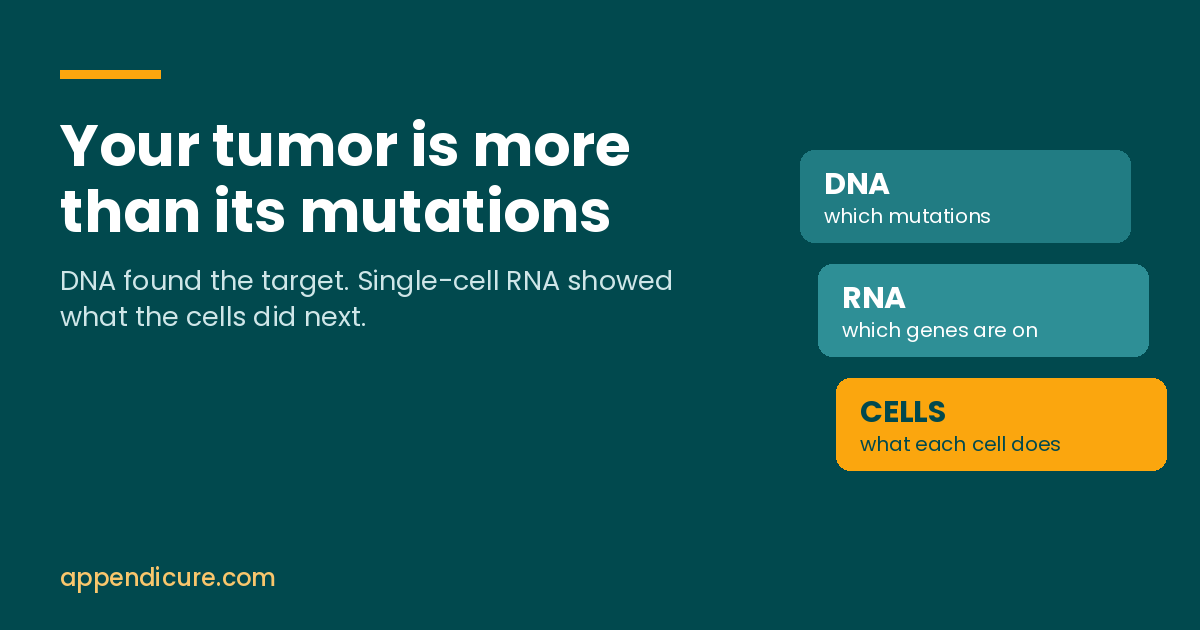

Short answer: A new MD Anderson study in appendiceal adenocarcinoma shows why looking beyond mutations matters. DNA testing found the KRAS mutation that made the tumors a target. Single-cell RNA sequencing then showed what the tumor cells and the cells around them did when KRAS was blocked, something no mutation report can tell you. If you’re an appendix cancer patient, put your appendix cancer genomic report in the registry, and if you have surgery coming up, ask about saving tissue before the operation.
For most people, an appendix cancer genomic report is the most detailed look anyone has taken at their tumor. It lists mutations like KRAS, GNAS or TP53, and sometimes it points to a drug. Often it doesn’t. I’ve come to believe that when a report comes back without an obvious target, it doesn’t necessarily mean there’s nothing to target. It may mean nobody has looked deeply enough yet.
A study from Dr. JP Shen’s group at MD Anderson, published this summer in the Journal of Hematology & Oncology, is the clearest example I’ve seen of what looking deeper means in appendix cancer itself. I wrote about its main results in July. This time I want to talk about how they got them.
DNA found the target
The researchers worked with tumors from appendiceal adenocarcinoma patients. They grew some as organoids, which are tiny three-dimensional clumps of tumor that behave more like a real cancer than cells on a flat dish. They also grew patients’ tumors in the abdomens of mice, so the cancer spread across the lining the way peritoneal disease does in people.
DNA testing is what made the study possible. One model carried KRAS G12D and another carried G12V, and that told the team which drugs to try. MRTX1133 targets only KRAS G12D. It isn’t an approved drug. RMC-6236 is daraxonrasib, which the FDA approved on August 26 as Rasonque for adults with metastatic pancreatic cancer who have had at least one prior treatment or who can’t take combination chemotherapy. Daraxonrasib targets the active form of RAS across several common RAS mutations.
Both drugs worked in the organoids at very low doses. In the mice, tumors grew more slowly, and under the microscope there were far fewer dividing cancer cells and far more dying ones. Without knowing the exact mutation, none of that would have been designed.

DNA testing found the target. Single-cell RNA showed what happened next.
Single-cell RNA showed what happened next
DNA tells you which mutations a tumor carries. RNA tells you which genes are actually switched on. Single-cell RNA sequencing does that one cell at a time, so researchers can tell cancer cells apart from the fibroblasts, immune cells and lining cells around them and see how each group responds.
The team ran single-cell sequencing on one of the mouse models, the G12D tumor, after a week of MRTX1133. Tumor cells made up about 38 percent of the cells captured from the untreated tumor and about 1.5 percent from the treated one. Tumor cells nearly disappeared from the single-cell sample.
The few that survived looked different. They had turned up a program called EMT, short for epithelial to mesenchymal transition, in which cancer cells shift toward a more flexible state. The authors think this may be one way some cells adapt to KRAS inhibition and possibly come back later. The picture isn’t simple, though. The same data suggested the drug also kept tumor cells from moving into one particular EMT-like state. Sorting out which of those matters is a question single-cell data can help answer.
The neighborhood changed just as much. Fibroblasts went from about 8 percent of the cells captured to about 42 percent, and many shifted into an inflamed state. Those are shares of the sample, not counts, so some of that shift comes from the cancer cells dropping away. The cells that line the abdomen went from about 17 percent of the sample to under 1 percent. Immune cells changed, and interferon signaling, part of the body’s alarm system, went up.
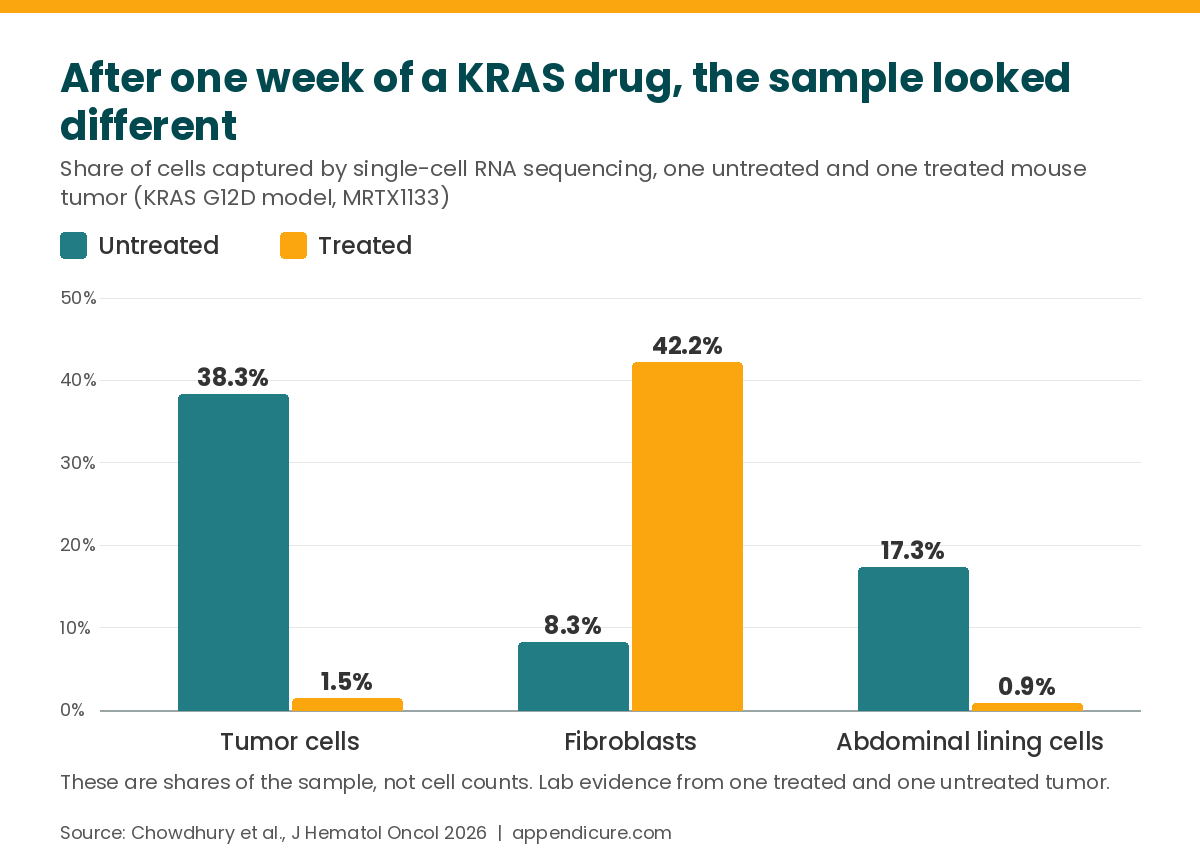
Shares of cells captured by single-cell RNA sequencing, not cell counts. One treated and one untreated tumor.
None of that is in a genomic report. The mutation was the same before and after treatment. What changed was what the cells were doing.
The authors suggest that a KRAS drug might work better combined with a drug that blocks tumor blood vessel growth and an immunotherapy drug. They did not test that combination, and nobody has shown it works in appendix cancer. This is lab evidence, and the single-cell results come from one treated tumor and one untreated tumor.
What it showed in patients so far
The same paper included 15 appendiceal adenocarcinoma patients treated with KRAS inhibitors, mostly in early clinical trials. Every patient who could be evaluated had a drop in tumor markers, and the authors reported clinical benefit on imaging, including one complete response, one partial response and 12 with stable disease. Nine of the 15 were still on treatment when the paper was written, and the median time on treatment was only 3.7 months, so it’s far too early to know how long those responses last. Fifteen patients is a signal, not a trial.
Dr. Andrew Lowy described a planned appendiceal trial of daraxonrasib at the Appendicure webinar on August 21, and he expected it to open in early 2027. That’s his estimate. As of October 4, the trial isn’t listed on ClinicalTrials.gov yet.
The same idea in PMP
Ricki Dhal, an Appendicure board member, has been asking the same question in pseudomyxoma peritonei through his company, Bina Therapeutics. KRAS and GNAS mutations are common in PMP, but knowing those mutations alone doesn’t explain why these tumors can produce enormous amounts of mucin while often growing relatively slowly. Looking cell by cell, his analysis found genes involved in polyamine metabolism rising along with the mucin-making machinery rather than with cell division. I wrote about it in May in Why PMP Behaves the Way It Does. It’s an independent analysis, not a peer-reviewed paper, and it points to a part of PMP biology that a mutation list would never show.
Where your appendix cancer genomic report comes in
This is why I’m asking patients to put their genomic testing reports into the Appendicure Patient-Led Global Appendix Cancer Registry.
I don’t only want to know whether someone’s ctDNA blood test was positive or negative. I want to know what is in these tumors: KRAS G12D or G12V, GNAS, TP53, PIK3CA, and everything else on the report. The patients whose reports show no obvious target matter just as much as the ones whose reports do. A hundred patients saying they have a KRAS mutation is useful. A hundred actual reports showing the exact KRAS variant, the other mutations beside it, the testing platform and what wasn’t found is a research dataset. With enough reports, researchers can group patients by what their tumors have in common, identify molecular groups that may be relevant to trials, and know which tumors to study more deeply.
If you haven’t had tumor tissue genomic testing, ask your oncologist about it. If you have, upload your full appendix cancer genomic report to the registry, not just the summary page. Don’t assume your report isn’t useful because it didn’t find a treatment for you. From a research standpoint, the reports with no obvious answer may be some of the most important ones the registry collects.

Your genomic report and your tissue both help research move past the mutation list.
Where your tissue comes in
The deeper work needs tissue, and the way it’s handled at surgery decides what’s possible later.
After surgery, the pathology lab puts your tumor in formalin and seals it in wax. That’s called FFPE. It’s the right choice for diagnosis, and it supports DNA testing and many other molecular tests. But you can’t go back and grow living organoids or mouse models from it, and some measurements are impossible or work much better on tissue that was never put in formalin.
Different studies need tissue handled in different ways. Some need living cells, which is what single-cell RNA sequencing and organoids usually require. Some need tissue frozen quickly. Some can use preserved tissue. A research lab I’ve been talking with, which measures polyamines, needs about 10 milligrams of frozen tissue, a piece smaller than a pea, and can’t use FFPE at all. That’s why the conversation has to happen before surgery.
I wrote a full guide in June on preserving tumor tissue before appendix cancer surgery, with the questions to ask your surgical team and a program that can collect tissue from almost any hospital in the contiguous United States. A few additions since then. Ask whether a piece of tumor can be saved fresh or frozen for research, and ask about a small piece of normal tissue too, so researchers have something to compare against. Ask whether there’s a separate research consent form, because at many hospitals there is, and it has to be signed before surgery. Your diagnosis always comes first. The pathologist takes everything needed to stage and grade your tumor before anything goes to research.
If your surgery is behind you, your FFPE blocks are still valuable. How long they’re kept depends on where you live. U.S. labs accredited by the College of American Pathologists keep them at least ten years, the U.K. guideline is 30 years, and British Columbia in Canada requires 20. Elsewhere, ask your hospital.
I’m also working on a way for patients to send their tissue to appendix cancer research directly. It isn’t open yet, and I’ll share it here when it is.
Who this research is about
Everything in the Shen study applies to KRAS-mutant appendiceal adenocarcinoma. The patient group included a range of grades, from low-grade mucinous to signet ring cell disease, but every patient had a KRAS mutation. It says nothing about KRAS wild-type tumors, goblet cell adenocarcinoma, where KRAS mutations are uncommon, or neuroendocrine tumors of the appendix. But researchers need genomic reports and properly saved tissue from those patients too. Nobody can figure out what’s different about their tumors without something to study.
Questions I’m getting
What’s the difference between DNA testing and single-cell RNA sequencing?
DNA testing reads the tumor’s mutations, such as KRAS or GNAS. Single-cell RNA sequencing reads which genes are switched on in each individual cell, so researchers can see what cancer cells and the cells around them are actually doing.
If my appendix cancer genomic report shows no drug target, is there nothing else to try?
Not necessarily. A report without an obvious target means no known match was found in the genes tested. Deeper research, including RNA studies, may find things DNA testing can’t, which is one reason the registry wants every report, not just the ones with targets.
Does daraxonrasib work for appendix cancer?
It hasn’t been proven. It’s FDA approved only for metastatic pancreatic cancer. In appendiceal adenocarcinoma, the evidence is lab models plus a 15-patient series treated with several different KRAS drugs.
Add your genomic report to the registry
The Appendicure Patient-Led Global Appendix Cancer Registry collects molecular, genomic and pathology data from appendiceal cancer patients worldwide. It’s IRB-reviewed. Upload your full reports, including the ones that found no drug target.
Join the Registry: United States Join the Registry: International
Already enrolled? Add a new report or update your record here.
Appendicure runs on donations, and the registry is a big part of where they go. You can support the work here.
Read more
KRAS Inhibition in Appendiceal Cancer: What the New Study Shows
Preserving Tumor Tissue Before Appendix Cancer Surgery
Why PMP Behaves the Way It Does: A New Look at the Biology of the Disease
Wild Type Appendix Cancer: What That 1 Word on Your Report Actually Means
A RAS Drug Just Got Approved. Appendix Cancer Was Not on the Label
Sources. Chowdhury S, Ito I, Pattalachinti VK, et al. KRAS inhibition is an effective therapy for appendiceal adenocarcinoma. J Hematol Oncol. 2026. doi:10.1186/s13045-026-01817-3
U.S. Food and Drug Administration. FDA approves daraxonrasib for metastatic pancreatic adenocarcinoma. August 26, 2026.
Dhal R, Svetlov A. Single-cell analysis of pseudomyxoma peritonei. Bina Therapeutics, April 15, 2026. Not peer-reviewed.
Royal College of Pathologists. The retention and storage of pathological records and specimens.
Provincial Laboratory Medicine Services, British Columbia. Block and Slide Retention Guidelines. 2024.
This post is patient education, not medical advice. Treatment decisions belong to you and your oncology team.
Leave a Reply