

Appendix cancer mutation testing done on your tumor tissue is still worth doing, even when a blood ctDNA test comes back negative. The blood test and the tissue test answer different questions, so a negative blood result does not mean genomic testing has nothing to offer you.
I keep hearing the same thing from people living with LAMN, the low-grade appendiceal mucinous neoplasm. They get a blood ctDNA test, it comes back negative or “not informative,” and someone tells them genomic testing does not work for their kind of tumor. So they stop. They skip the tissue testing too. I understand why. It sounds like the same thing. It is not, and I think stopping there is a mistake.
Appendix cancer mutation testing is not the same as a blood test
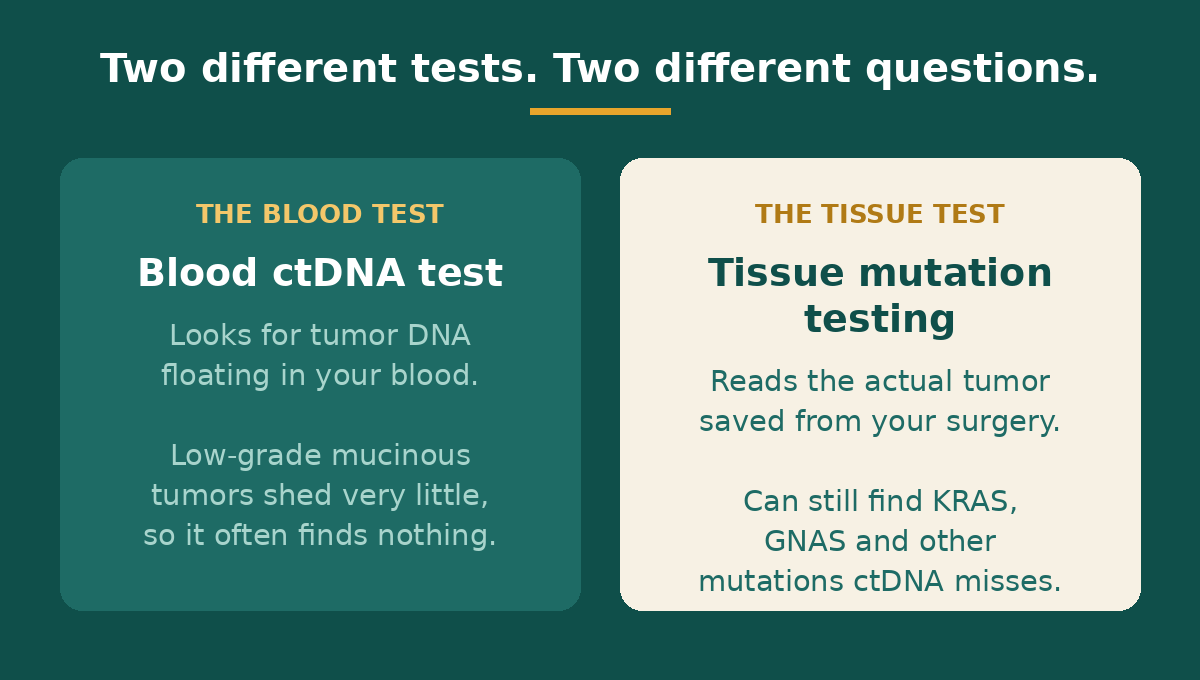
A blood ctDNA test looks for tiny pieces of tumor DNA floating in your bloodstream. Tests like Signatera and Guardant Reveal use it to watch for cancer that is active or coming back. The catch is that low-grade mucinous tumors shed very little DNA into the blood. There is a lot of mucin and not much cell turnover, so there is often nothing for the test to catch. A negative result in that setting does not prove you are clear, and it does not say anything about the mutations inside your tumor.
Tissue mutation testing is a separate test. It is run on the actual tumor tissue that was removed and saved during your surgery. A lab reads the tumor’s DNA directly and reports the mutations it finds. In appendiceal mucinous tumors that often includes changes in genes like KRAS and GNAS. Those are the kinds of findings a blood test in a low-grade tumor tends to miss.
Why the mutations inside your tumor matter
Cancer treatment keeps moving toward drugs that are matched to a specific target in the tumor. Appendix cancer mutation testing is how that target gets found, and it reads the tumor tissue, not a blood draw. You cannot match what you have never measured.
There is now appendiceal evidence pointing the same way. A Memorial Sloan Kettering team looked back at more than 1,500 appendiceal adenocarcinoma patients and studied the ones whose tumors were treated with drugs aimed at MAPK pathway mutations, the EGFR, BRAF, and KRAS targets. The results were mixed, and worth being honest about. The EGFR drugs borrowed from colon cancer mostly did not help. A couple of patients whose tumors carried a BRAF mutation responded, though only for a short time. One patient on a KRAS drug held steady for more than a year. The study’s own conclusion is the part that matters here. It points to the value of genomic profiling and the need for trials built around these mutations. No one becomes the patient who benefits from a KRAS or BRAF drug if their tumor was never tested for those mutations. I wrote about that study in more detail in this post on appendix cancer targeted therapy.
The same pattern is showing up across gastrointestinal cancers. A review published in the British Journal of Cancer on July 23, 2026, walks through a wave of newer drugs called antibody-drug conjugates that go after targets such as HER2, Claudin 18.2, CEACAM5, and MET. These treatments only help if the team knows what target is on the tumor, and again that comes from testing tissue.
I want to be straight about the limits, because false hope helps no one. The Memorial Sloan Kettering patients had metastatic appendiceal adenocarcinoma, not LAMN, and most of those targeted drugs helped only a small number of them. The British Journal of Cancer review is about adenocarcinomas of the stomach, esophagus, colon, and pancreas, and the drugs it covers have not been proven in low-grade appendiceal mucinous tumors. For LAMN and pseudomyxoma peritonei, surgery is still the main treatment, and most mutations found today are not matched to an approved drug for this disease. I am not telling you that testing your tissue will hand you a targeted drug. I am telling you it gives you and your team real information you do not have now, and the appendix cancer field itself is now saying that information has value.
The fastest way to find out if your tumor tissue still exists
Here is the part people do not realize. You cannot run tissue mutation testing without the tissue. When you had surgery, the pathology lab saved your tumor in a small wax block, along with slides. That block is what a lab needs to read your mutations. The problem is that hospitals do not keep those blocks forever. Retention time varies by hospital and by state, and some are discarded sooner than families expect. If your surgery was years ago, the clock may be running.
The fastest way to find out whether your tumor tissue is still available is to pick up the phone. Call the hospital where you had your surgery and ask for the pathology department. Not medical records. Pathology is the department that physically holds the tissue.
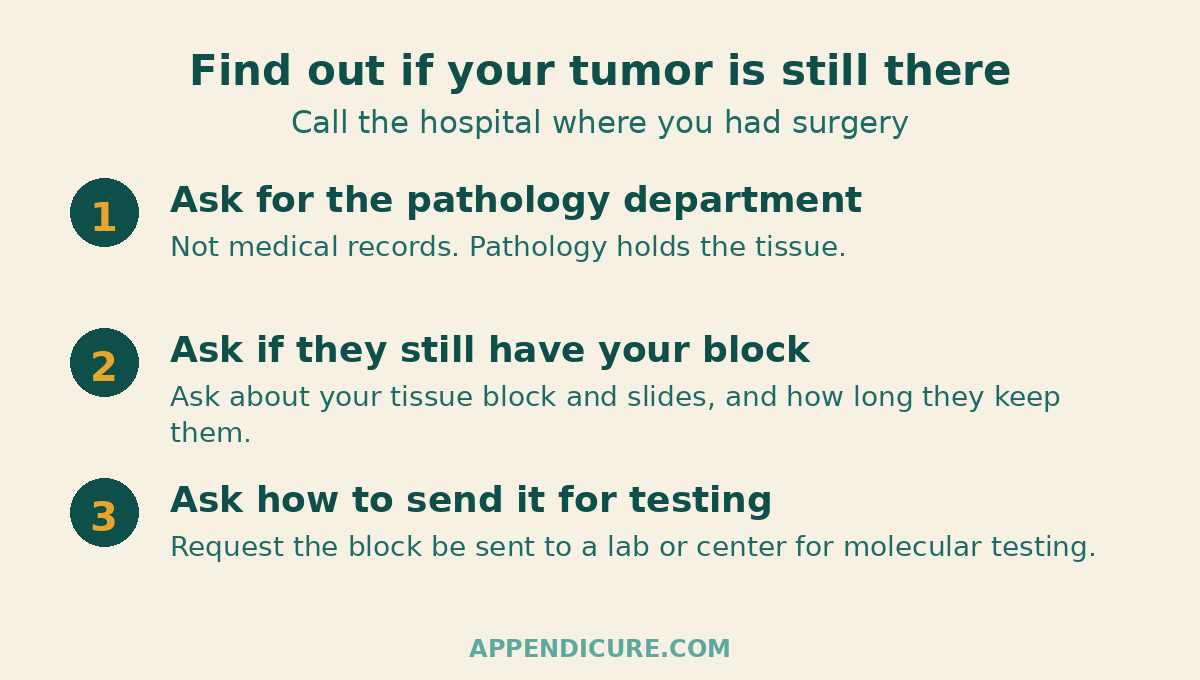
When you reach pathology, ask three things. First, do they still have your tissue block and slides from your surgery date. Second, how long do they keep them. Third, what is the process to have the block sent to a lab or to another cancer center for molecular testing. You may need to sign a release, and your oncologist can order the testing and tell the lab which panel to run. If the block is running up against the hospital’s retention window, ask whether you can have it released to you or transferred so it is preserved.
Add your tumor to the research record
The Patient-Led Global Appendix Cancer Registry is focused on the molecular, genomics, and pathology side of this disease. If you have testing done, or you are working to locate your tissue, joining the registry helps build the data that this rare cancer has never had. Pick the form for your location.
Join the Registry: United States Join the Registry: International
What appendix cancer mutation testing can and cannot tell you
Testing your tissue can confirm your diagnosis and grade, give you a baseline in your own records, show whether you carry mutations like KRAS or GNAS, and open the door to trials that match patients by tumor biology instead of by label alone. What it cannot do is promise a treatment. It also does not replace the care plan you already have. Goblet cell adenocarcinoma, signet ring cell, and neuroendocrine tumors of the appendix behave differently from LAMN, so what testing means for you depends on your exact subtype and your own team’s read. This is information to bring to your oncologist, not a decision to make alone.
Put your tissue to work
There is one more thing you can do once you locate your tissue. Pattern.org, a program of the nonprofit Rare Cancer Research Foundation, helps rare cancer patients donate tumor tissue, stored or fresh, to research. It is free, and it does not affect your treatment. For a cancer this understudied, tissue sitting in a research lab is how the science moves. If you want your tumor to count for more than your own file, it is worth registering at pattern.org and asking what is open for appendiceal cancer.
Common questions
Is appendix cancer mutation testing worth it if my ctDNA was negative?
Yes, because they are different tests. A negative blood ctDNA result in a low-grade mucinous tumor usually means there was not enough tumor DNA in the blood to detect, not that your tumor has no mutations. Tissue testing reads the tumor directly.
What is the difference between ctDNA and tissue testing?
A ctDNA test looks for tumor DNA in a blood sample and is mainly used to monitor for active or returning disease. Tissue testing reads the DNA of the tumor saved from your surgery and reports the specific mutations it finds.
How do I find my tumor tissue after surgery?
Call the hospital where you had surgery and ask for the pathology department. Ask if they still have your tissue block and slides, how long they keep them, and how to send the block out for molecular testing.
Do hospitals keep tumor tissue forever?
No. Retention time varies by hospital and by state, and blocks can be discarded after a set number of years. That is why it is worth calling now to confirm yours is still there.
Will testing my tissue get me a targeted drug?
Not necessarily. For LAMN and pseudomyxoma peritonei, surgery is still the main treatment and most mutations are not yet matched to an approved drug. Testing gives you and your team information, a baseline, and possible trial eligibility.
Read more
Appendix Cancer Targeted Therapy: What 1 New Study of the Drugs Found
10 Appendix Cancer Treatment Mistakes, and How to Avoid Them
Appendix Cancer Clinical Trials: A Real Access Gap, and 1 Hopeful New Tool
Pattern.org (Rare Cancer Research Foundation): donate your tumor tissue to research
Sources: Abdelfattah S, Vemula N, Gowda T, et al. Clinical benefit of MAPK inhibition in appendiceal adenocarcinoma [abstract A045]. AACR Special Conference: Breaking Barriers in the Fight against Rare Cancers, 2026. doi:10.1158/1538-7445.RARECA26-A045. Cassier PA, Izarn F, Dumontet C, Coutzac C. Advancing antibody drug conjugates in gastrointestinal cancers. British Journal of Cancer. 2026. doi:10.1038/s41416-026-03510-1
Appendicure is a patient-led nonprofit. If this helped, you can support the work here: give to Appendicure.
Leave a Reply