


Appendix cancer clinical trials are hard to get into, and a new review shows why. Researchers looked at hundreds of studies and found only a small handful were built for this disease.
Two studies caught my eye this month at the ESMO Gastrointestinal Cancers Congress 2026. Both came from research teams in Sydney, Australia. One looked at how often appendix cancer patients get into clinical trials. The other built new lab tools to test drugs for the disease. Together they tell a story I hear from our community all the time. The science is moving, but access is still the problem.
What the review of appendix cancer clinical trials found
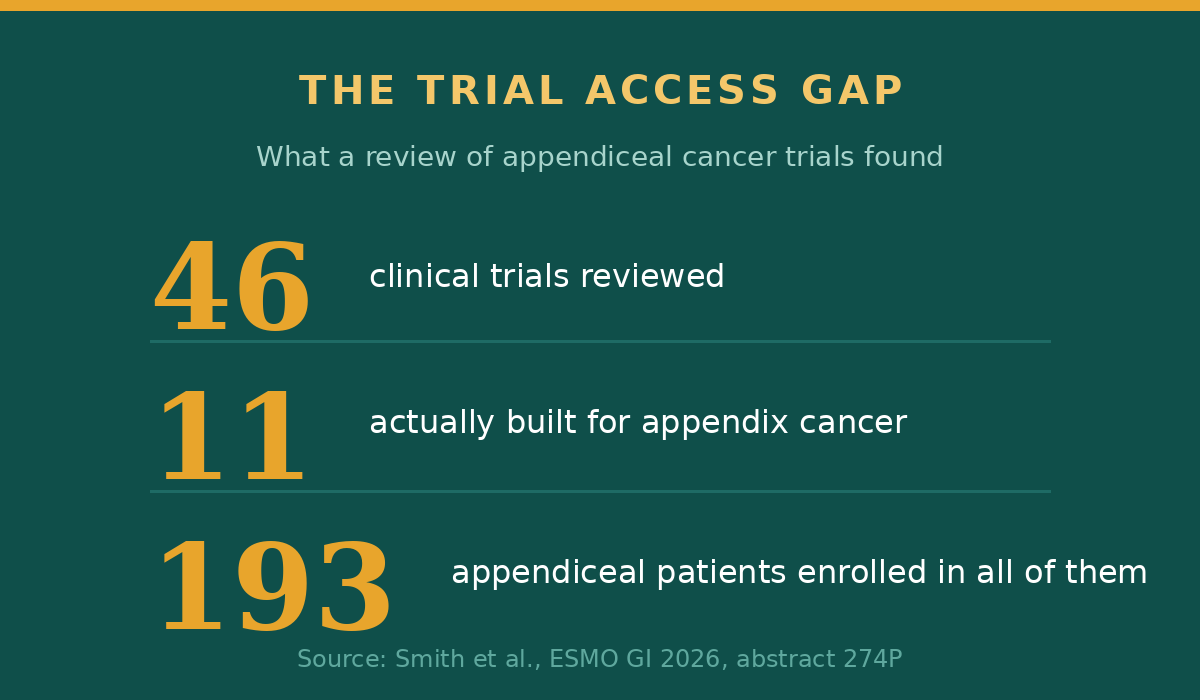
The first team reviewed appendix cancer clinical trials run or published between 2015 and 2026. They searched five trial registries around the world, plus the main cancer research journals. They started with 828 studies. After filtering, 46 trials were left. Of those, only 11 were built for appendix cancer. The other 35 were broad trials open to many cancer types. Almost all were early-phase studies, and most were run by drug companies.
In total, 193 appendix cancer patients made it into these trials. That is a small number for a disease that reaches people in dozens of countries. The trials tested a mix of approaches. Most aimed at targeted therapy, often at a cell signal pathway called MAPK. Others tested immunotherapy or chemotherapy.
There was a hopeful signal too. Among the appendix cancer patients who did get in, about 1 in 4 saw their tumors shrink, and about half had their disease held steady for a time. The authors were careful with these numbers. Appendix cancer is hard to measure on scans, and the results are pooled from very different patients. Even so, it suggests these patients can benefit when they get the chance.
Why the access gap matters
The access gap is the real headline. Appendix cancer often carries mutations that drugs can target, like KRAS. That should open doors to trials. So far it has not. Many basket trials, the kind that test one drug across many cancer types, do not report their few appendix cancer patients at all. So a person with appendix cancer can take part in a study and still be invisible in the results. The authors called for trial designs that include rare cancers on purpose, not by accident.
We built a tool for exactly this
The access gap is why I built the Appendicure Trial Finder. Most trial tools match you on your cancer’s name. This one matches on your cancer’s biology, your histology, grade, stage, and mutations like KRAS. It reads open trials from ClinicalTrials.gov and explains in plain words why each one might fit. You can print or email the results and talk them over with your own oncologist. It does not give medical advice. It gives you a place to start.
The second study: new lab tools for appendiceal cancer
The second team, based at the Garvan Institute of Medical Research, worked on a different problem. There are almost no lab models of appendix cancer. That makes it very hard to test new drugs before trying them in people. This team took fresh tumor tissue from patients during surgery. They grew it two ways. One was in mice, as what scientists call a patient-derived xenograft. The other was as tiny 3D clusters of cells called spheroids.
Both versions held onto the features of the original tumor. The team also found something useful. Appendix cancer tumors are built from two main cell types, the cancer cells and a second type called mesothelial cells. Knowing that gives researchers clearer targets. These new models give scientists a way to screen many drugs quickly and find the ones worth moving into trials.
What I take from both
Surgery is still the main treatment that works for appendiceal cancer. The current standard of care reference is the 2025 Godfrey consensus, not colon cancer rules. Drugs are a harder question, and that is exactly where trials and lab models come in. One study shows the door to trials is barely open. The other builds a better way to find drugs worth testing. This is the disparity our community lives with, and it is why we build our own tools. Our registry puts our molecular and pathology details in one place, so researchers have the data to make the case for us. Our Appendicure Trial Finder helps you find the trials open to you right now, matched on your cancer’s biology, not just its name.
Both studies looked at appendix cancer as a broad group. They did not break the results out by subtype. So they do not tell us how goblet cell, signet ring, low-grade mucinous, or neuroendocrine tumors each respond. Read them as a picture of the whole field, not a guide for any one person. Talk with your own care team about what fits your case.
Our patient-led registry collects the molecular and pathology details that studies like these depend on. If you have appendix cancer, adding your information helps build the picture researchers need.
Common questions
Are there appendix cancer clinical trials?
Yes, but few are built only for appendix cancer. A 2026 review found 46 relevant trials and just 11 designed for this disease. Most others are broad trials open to many cancer types. You can search open trials matched to your case with the Appendicure Trial Finder.
Why are appendix cancer patients often left out of trials?
Appendix cancer is rare, so most trials are not designed for it. Many broad trials do not even report their few appendix cancer patients, which hides the results.
What are patient-derived models?
They are lab versions of a patient’s tumor, grown in mice or as small 3D cell clusters. Scientists use them to test drugs before trying them in people.
What is the standard treatment for appendix cancer?
For many patients it is cytoreductive surgery, sometimes with heated chemotherapy in the abdomen. The 2025 Godfrey consensus is the current reference for care. Your own team can tell you what fits your case.
Appendicure runs on support from people who care about this disease. If you want to help fund advocacy and research like this, you can donate here.
Read more
The Largest Goblet Cell Adenocarcinoma Study Yet: What It Means for Patients
Sources: Smith S, Strach MC, Sutherland S, Mahon KL. Clinical trials in appendiceal tumours: actionable mutations with inequitable access. Ann Oncol. 2026;37(S1), abstract 274P. doi.org/10.1016/j.annonc.2026.05.313. Leong KH, Strach MC, Alfred S, et al. Establishment of patient-derived models and a drug screening platform for the treatment of metastatic appendiceal cancer. Ann Oncol. 2026;37(S1), abstract 275P. doi.org/10.1016/j.annonc.2026.05.314.
Leave a Reply