

Goblet cell adenocarcinoma of the appendix is rare, and the evidence guiding its treatment has been thin. A new study from The Christie in Manchester is the largest look yet, following 210 patients for almost three decades. It gives doctors a much clearer picture of which patients are most likely to benefit from surgery, who benefits from chemotherapy, and how the tumor should be graded.
FROM OUR COMMUNITY. Many people in the Appendicure community carry a goblet cell adenocarcinoma diagnosis and struggle to find research that speaks to it directly. This study is one of the few built on a large group of GCA patients. If you have faced this diagnosis, your experience belongs in the registry.
Goblet cell adenocarcinoma, often shortened to GCA, makes up roughly 15 to 20 percent of appendix tumors. It tends to spread to the lining of the abdomen, called the peritoneum. Because it is uncommon, treatment has often been borrowed from colon cancer rather than built on evidence specific to the appendix. A study published in ESMO Open in 2026 by Strach and colleagues helps fill that gap.
What the study did
The team reviewed 210 patients treated for appendiceal GCA between 1993 and 2021. Expert pathologists re-examined the tissue and re-graded every case using current standards. At diagnosis, 60 percent of patients had disease that was still localized, and 40 percent already had spread to the peritoneum.
Most patients had surgery. Cytoreductive surgery, paired with heated chemotherapy washed through the abdomen, known as CRS and HIPEC, was done in 135 patients, about 64 percent of the group. Systemic chemotherapy, the kind given through the bloodstream, was given to 85 patients, about 40 percent.
What it found on survival
Across the whole group, median overall survival was 80 months, and 56 percent of patients were alive at five years. Median follow-up was 75 months, so these numbers rest on long observation rather than a short snapshot.
Stage made a big difference in how patients did. Patients whose disease was still localized at diagnosis had a median survival of 193 months. Patients who already had peritoneal spread had a median survival of 25 months. Positive lymph nodes also pointed to worse outcomes.
Surgery was also linked to longer survival. Patients who had CRS and HIPEC had a median survival of 126 months, with 69 percent alive at five years. Patients who did not have that surgery had a median survival of 29 months, with 35 percent alive at five years. Healthier patients with less disease were more likely to be offered surgery, so this is an association, not proof that surgery alone produced the gap. Even so, the pattern matches what specialist centers have reported.
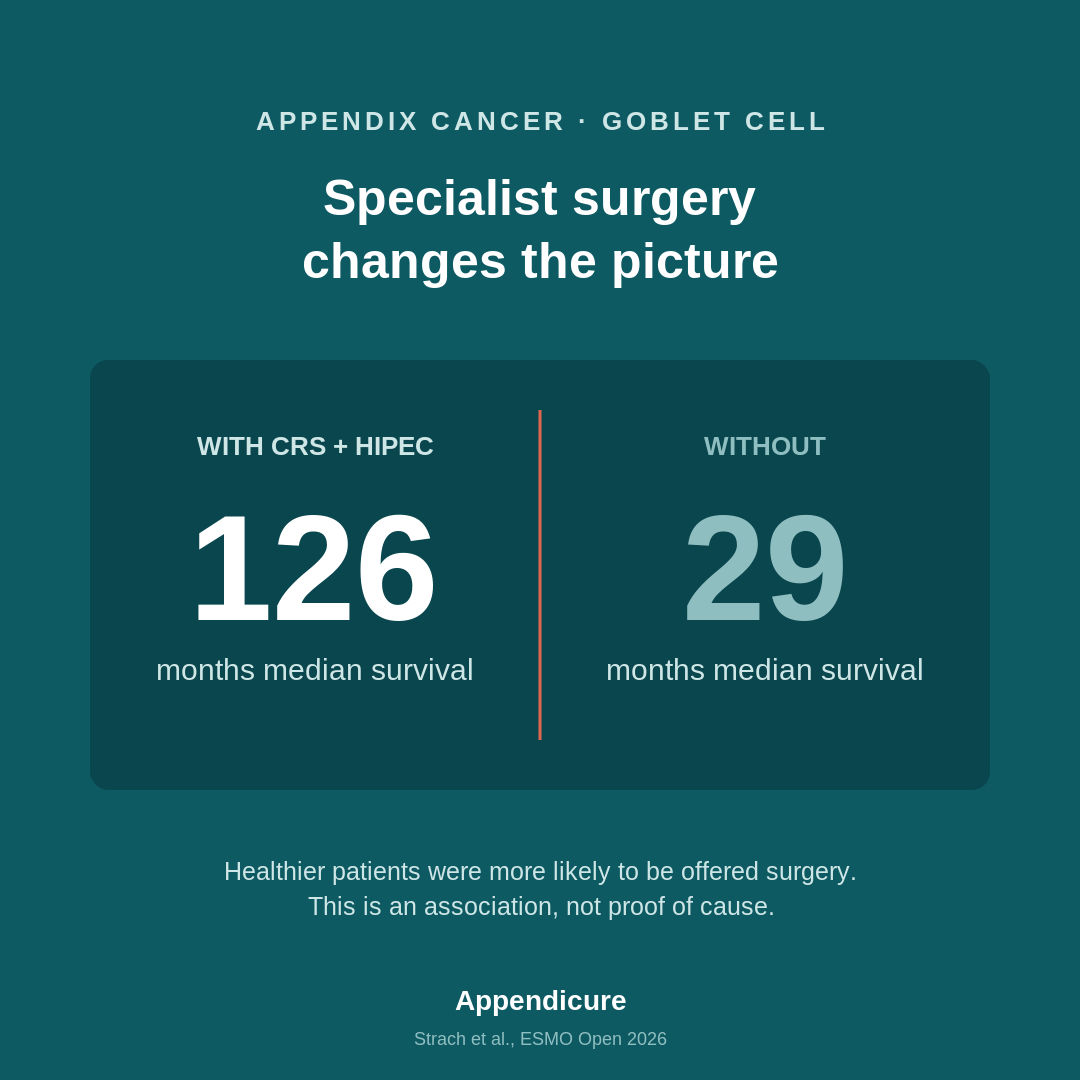
KEY TAKEAWAY. In the largest GCA cohort to date, patients treated with cytoreductive surgery and HIPEC had a median survival of 126 months, compared with 29 months for those who did not. Patient selection shaped who received surgery, so read the gap as a strong signal, not final proof.
The chemotherapy finding needs context
On paper, patients who received systemic chemotherapy had shorter survival. That is easy to misread. Chemotherapy was mostly given to patients with the highest-risk disease, including those with spread that could not be fully removed. The treatment was not causing the worse outcome. The worse outcome was the reason the treatment was given. Researchers call this selection bias, and the authors flag it directly.
A closer look showed where chemotherapy did help. Patients with high-grade tumors, patients with positive lymph nodes, and patients left with residual disease after surgery derived benefit. The authors also point to a separate registry study, not part of this Manchester cohort, that found node-positive patients who received chemotherapy after surgery had a five-year survival of 77 percent, compared with 43 percent for those who did not. Taken together, these findings suggest chemotherapy is most useful for selected higher-risk patients rather than everyone with GCA.
The study also looked at how well chemotherapy worked. Only about 5 percent of tumors actually shrank with first-line chemotherapy, although another group achieved stable disease for an overall disease control rate of 24 percent. That underlines why careful patient selection matters more than treating everyone the same way.
This does not mean chemotherapy does not work for GCA. It means the patients receiving chemotherapy were often the sickest patients to begin with, which makes simple comparisons misleading.
Another important finding involved tumor grading
Grading describes how aggressive a tumor looks under the microscope. For GCA, the current World Health Organization 2019 system sorts tumors into three grades. This study found that system did a poor job of separating patients by outcome in several groups.
The researchers compared several different grading systems before concluding that a simpler two-tiered approach may work better and should now be tested by other centers. They split tumors into two groups based on whether more than half of the tissue showed a high-grade pattern. This two-tiered method separated patients by outcome better in this study. The authors recommend testing it in other centers before it could replace the current system.
For patients, the takeaway is smaller but real. Grading is hard, even for expert pathologists, and the labels are still being refined. If a diagnosis is unclear, or a treatment decision hinges on grade, a second pathology review at a specialist center is reasonable to request.
What this study cannot tell us
This is the largest non-registry cohort of appendiceal GCA reported to date, and its long follow-up gives it weight. It is also retrospective and drawn from a single specialist center. Some records had missing details, and a few subgroups were small. It cannot prove cause and effect the way a randomized trial can. It adds important evidence in a disease where high-quality studies are still uncommon, and it points to questions worth testing next.
Questions to bring to your team
These questions fit this study’s findings. Some may already be part of your conversations. Take what is useful.
- What is my tumor grade, and is my disease considered low grade or high grade?
- What is my lymph node status, and does it change whether chemotherapy is likely to help me?
- Am I a candidate for cytoreductive surgery with HIPEC, and is it available at a specialist center near me?
- If I have surgery, what is the goal for removing all visible disease?
- Would a second pathology review at a specialist center help confirm my grade?
Why your data matters
A study like this is possible because one specialist center tracked 210 patients over decades. Most appendix cancer patients are scattered across health systems that never compare notes. That is the exact gap the Patient-Led Global Appendix Cancer Registry is built to close. When patients pool their diagnosis, grade, treatment, and outcomes, researchers can ask better questions about rare subtypes like GCA across many centers instead of just one. The registry now has IRB approval and an exempt determination, and your information is handled with care.
Add your data to the registry
Joining takes a few minutes and it is open worldwide. There are two ways to join, one for participants in the United States and one for everyone else.
You can also support this work at the Appendicure donation page: givebutter.com/support-appendicure-5j7b3s
Glossary
Goblet cell adenocarcinoma (GCA). A rare appendix cancer that tends to spread to the lining of the abdomen.
CRS and HIPEC. Cytoreductive surgery to remove visible tumor, followed by heated chemotherapy washed through the abdomen to target cells left behind.
Peritoneum. The lining of the abdominal cavity. Spread to the peritoneum is called peritoneal metastasis.
Overall survival. The length of time patients live after diagnosis or treatment, often reported as a median or a five-year percentage.
Grade. A measure of how abnormal tumor cells look and how aggressively the disease tends to behave.
Source
Strach MC, Aziz O, Nonaka D, et al. Long-term outcomes, pathological classification and prognostic factors in localised and advanced appendiceal goblet cell adenocarcinoma following cytoreductive surgery, intraperitoneal and systemic chemotherapy. ESMO Open. 2026;11(7):108245. Open access. https://doi.org/10.1016/j.esmoop.2026.108245
Read more
Experts Didn’t Agree on Goblet Cell Adenocarcinoma Grade in 16 of 20 Cases
Appendix Cancer Expert Centers and the Case for Sharing Every Story
Medical disclaimer. This post is for educational purposes only and is not medical advice. Research on appendix cancer evolves quickly. Treatment decisions should always be made with a qualified medical team familiar with your case. Appendicure is a 501(c)(3) nonprofit dedicated to appendiceal cancer patient education and advocacy and is not a medical provider.

Leave a Reply