
A new study looked at appendix cancer targeted therapy, the drugs that block growth signals inside the tumor. In appendiceal adenocarcinoma, one whole class of these drugs did not help, while two others helped only a small number of patients.
Many appendix tumors carry a mutation in a chain of growth signals called the MAPK pathway. Common names on that chain are EGFR, BRAF, and KRAS. When a tumor has one of these mutations, it is natural to hope that a drug built to block that signal will work. Researchers at Memorial Sloan Kettering set out to test whether that hope holds up.
They reviewed 1,505 people treated for appendiceal adenocarcinoma at their center over about thirty years. From that large group, 47 had received a targeted drug after the cancer had spread. Most got these drugs later on, after other treatments had stopped working. Forty-two received an EGFR inhibitor, three received a BRAF inhibitor, and two received a KRAS inhibitor.
What appendix cancer targeted therapy did in this study

The EGFR inhibitors were the biggest letdown. About two out of every three patients saw the cancer keep growing on the drug. Only a couple saw the tumor shrink at all. It did not matter which line of treatment it was, what chemo it was paired with, or whether the tumor also carried a KRAS mutation. The result was the same.
The BRAF inhibitors looked different. Two of the three patients responded. The catch was that the responses did not last. The cancer found a way around the drug within a few months.
The KRAS inhibitors are the most interesting part, even though only two patients received them. One patient had a striking result, with the cancer held in check for more than a year and counting. The other patient’s cancer grew back within two months. Two patients is far too few to draw any firm conclusion. Even so, that one lasting response is the kind of signal that pushes researchers to run a real trial.
How the targeted drugs compared to chemo
The team did not stop at describing the targeted drugs. They matched patients on the targeted drugs to similar patients who got standard chemo, so the comparison was fair. In the second line of treatment, patients on an EGFR or BRAF drug did worse than the matched patients on standard chemo, either FOLFIRI or FOLFOX. Later on, in patients whose cancer had already stopped responding to chemo, the targeted drugs were no better than one older option, and a chemo pill called TAS-102, sold as Lonsurf, did the best of the group.
What this means for patients
The lesson here is not that appendix cancer targeted therapy is useless. The lesson is more specific. On this evidence, EGFR inhibitors are not the answer for appendiceal adenocarcinoma, even when the biology seems to point that way. BRAF and KRAS drugs are worth watching, and worth asking about, but they are early signals in a handful of patients, not a proven treatment.
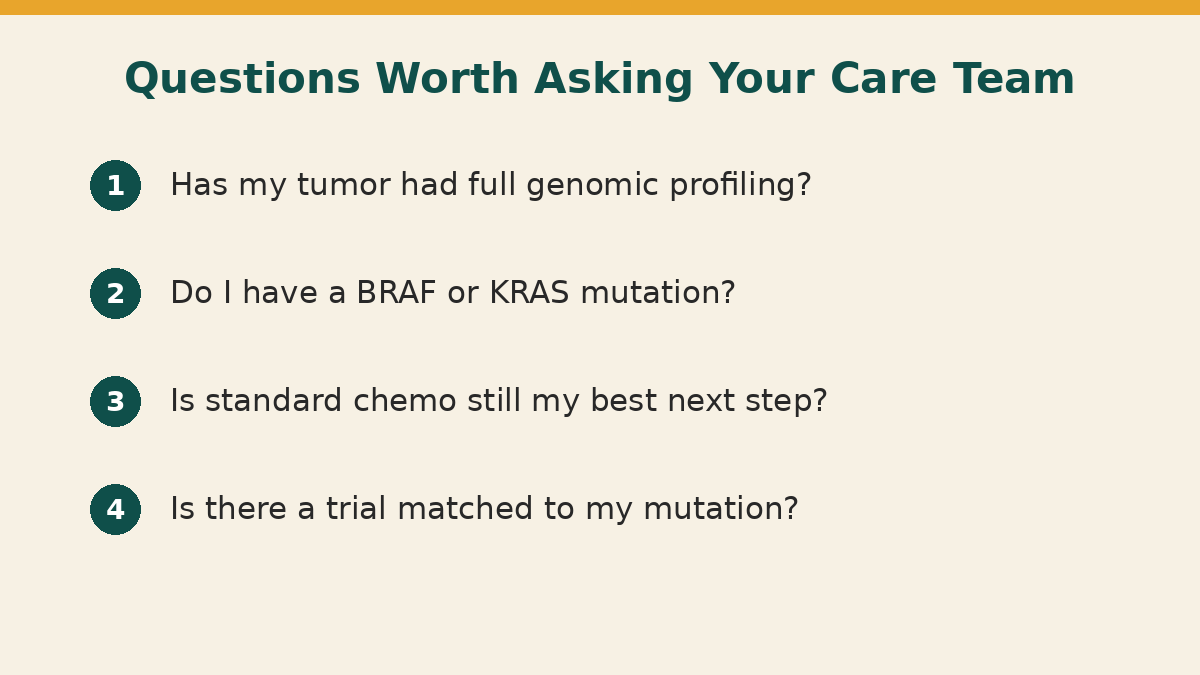
The bigger takeaway is that knowing your tumor’s mutations still matters. Genomic profiling is what tells your care team whether a BRAF drug, a KRAS drug, or a matched clinical trial is even on the table. Without that testing, none of these options can be considered.
A few honest limits belong with this. The study looked back at old records rather than testing the drugs in a planned trial, so it cannot prove cause and effect. The BRAF and KRAS groups were tiny. It was presented as a conference abstract, which is an early form of research, not a full peer-reviewed paper. And it covered appendiceal adenocarcinoma only. Goblet cell adenocarcinoma, signet ring cell tumors, neuroendocrine tumors, and low-grade mucinous neoplasms were not the focus, and each of those behaves differently. The study also did not address GNAS, another mutation that is common in appendix tumors and that these particular drugs do not target.
One of the study’s senior authors is Dr. Mike Foote of Memorial Sloan Kettering, who serves on the Appendicure board. Work like this is exactly why full genomic testing is worth pushing for, even when the honest answer today is that most of these drugs are not ready yet.
Add your data to the registry
The Patient-Led Global Appendix Cancer Registry collects molecular, genomic, and pathology data. That is the exact information that shows which mutations appendix tumors carry, and which patients a future BRAF or KRAS trial could reach. The IRB protocol is approved and exempt. Every record helps.
Join the Registry: United States Join the Registry: InternationalIf your tumor’s mutations are known, you can act on them now. The Appendicure Trial Finder matches on your cancer’s biology, not just its name, and returns open trials you can print or email to your oncologist.
Frequently asked questions
Does targeted therapy work for appendix cancer?
In this study of appendiceal adenocarcinoma, EGFR inhibitors did not help. BRAF and KRAS inhibitors helped a small number of patients, but they are early signals, not proven treatments. Standard chemo still did better in a fair comparison.
Should I get my tumor’s genes tested?
Genomic profiling is what tells your care team whether a BRAF drug, a KRAS drug, or a matched trial is an option. It is worth asking whether your tumor has had full testing.
What is the MAPK pathway?
It is a chain of growth signals inside the cell. EGFR, BRAF, and KRAS are steps on that chain. Many appendix tumors carry a mutation somewhere along it.
Is this a cure?
No. This was an early look back at 47 patients. It points toward which drugs are worth studying next, and it shows why knowing your mutations matters.
Read more
Appendix Cancer Clinical Trials: A Real Access Gap, and 1 Hopeful New Tool
Appendix Cancer Imaging: Two Advances Worth Watching
Appendicure runs on community support. If this was useful, you can help keep it going at the Appendicure donation page.
Leave a Reply