
If one hospital says your tumor cannot be removed, an appendix cancer second opinion at a specialized high-volume center is worth getting. A new study found that most patients turned away elsewhere still went on to have a complete surgery at a program that treats these cancers all the time.
I hear one sentence over and over. They told me it could not be removed. Sometimes it comes from a person whose surgery was called off before it started. Sometimes it comes from someone whose operation was stopped partway through. It lands like a closed door. A study published in July 2026 looked at exactly these patients, and it is worth reading before anyone accepts that a door is closed for good.
The study came out of Allegheny Health Network in Pittsburgh, a large program that handles cancers spread across the surface of the belly. The authors were Edward Joseph, Muhammad Khan, Catherine Lewis, David Bartlett, Patrick Wagner, and Casey Allen, and it ran in the journal Annals of Surgical Oncology. They looked back at 171 people who had cytoreductive surgery, often with heated chemotherapy, between 2022 and 2024. Appendix tumors were the single largest group in the study. Appendiceal adenocarcinoma and the mucinous appendix neoplasms known as LAMN and HAMN together made up more than half of the patients, so this is close to home for anyone facing appendiceal disease.
What the study looked at
The team split the patients into two groups. One group was referred from inside the hospital’s own network. The other group, called out-of-system, was referred in from outside. Most patients, about six in ten, came from outside.
The outside group arrived with harder disease. They had more tumor spread through the belly, needed longer operations, lost more blood during surgery, and stayed in the hospital longer. Their care cost more too. None of that is surprising. People travel to a specialized center when their case is complicated. What matters is what happened once they got there.
Why an appendix cancer second opinion can change the answer
Here is the part that stopped me. Of the outside-referred patients, 71 percent had already run into a wall somewhere else. That is 72 people. More than half of them had never even been offered this surgery. Others had an operation that was stopped partway or that left disease behind. In other words, the system had already told them, in one form or another, that surgery was not going to work.
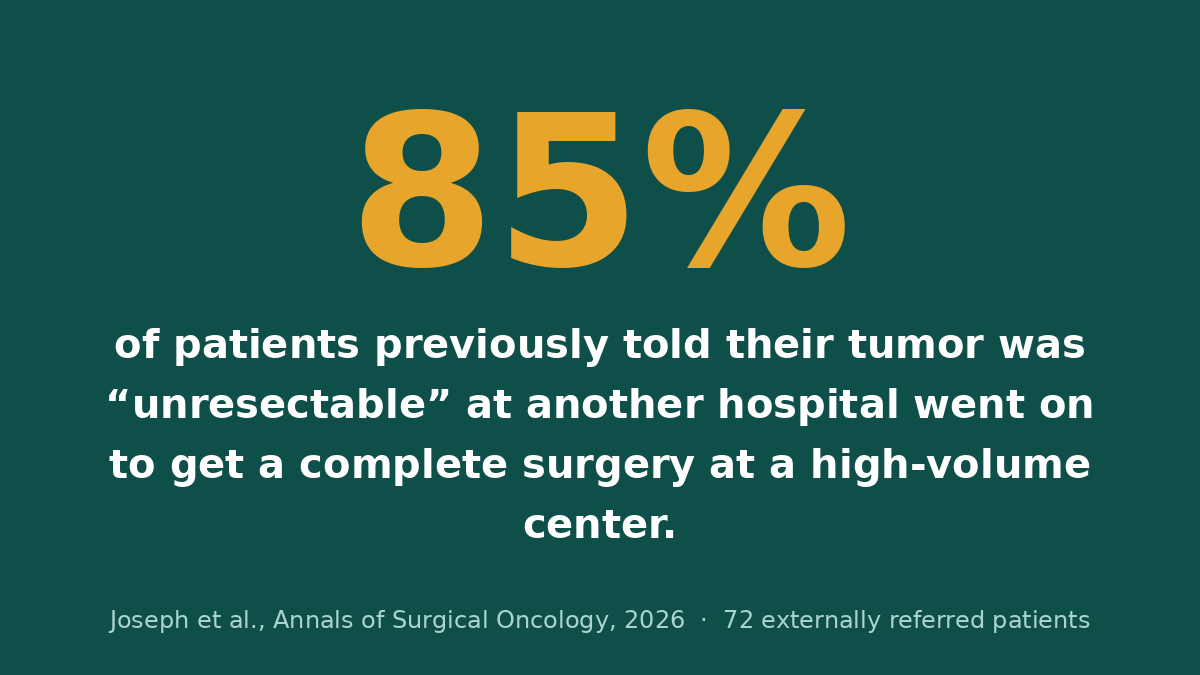
Of those 72 patients, 85 percent went on to have a complete surgery at the specialized center. That means the surgeon removed all or nearly all of the visible tumor. Another 10 percent had surgery to ease their symptoms. And even though the outside group arrived sicker, their rate of complete surgery was about the same as the patients who came from inside the network, roughly 85 percent against 88 percent. The higher disease burden did not lower the odds of a full operation once these patients reached an experienced team.
That is the case for an appendix cancer second opinion in one paragraph. A hospital that rarely does this operation may look at a complicated belly and see a tumor it cannot safely remove. A center that does these surgeries week in and week out may look at the same scan and see a plan.
Where this study stops short
I want to be straight about the limits, because the honest version is more useful than the hopeful one. This study pooled several belly-surface cancers together. Appendix tumors were the biggest group, but the resectability and cost numbers were not broken out for appendix cancer by itself, and they were not broken out by subtype. Goblet cell, signet ring cell, neuroendocrine tumors, and low-grade mucinous neoplasms each behave differently, and this study did not analyze them one by one.
It was also a single hospital looking back at its own records. A quaternary program like this sees a selected group of complex cases, so the exact numbers may not repeat at an average hospital. The study did not prove that every tumor can be removed. Some of these patients still could not have a complete surgery. This was a high-volume specialized center, not a promise that lives in every zip code. And the cost figures came from one hospital’s books. They did not count what families actually pay in travel, lodging, and lost work to get to a place like this.
What the study does show, clearly, is that being told no at one hospital is not the same as being out of options. For cancers spread across the belly, the current standard of care is set by the 2025 PSM Consortium consensus, and the centers that follow it are built to handle exactly the cases that get turned away elsewhere.
What I would ask before accepting inoperable
If you or someone you love has been told surgery is not possible, the next call matters. Going to a center that rarely treats these cancers is one of the most common and most fixable mistakes in this disease. Asking for a second opinion is not being difficult. It is what the experts recommend.
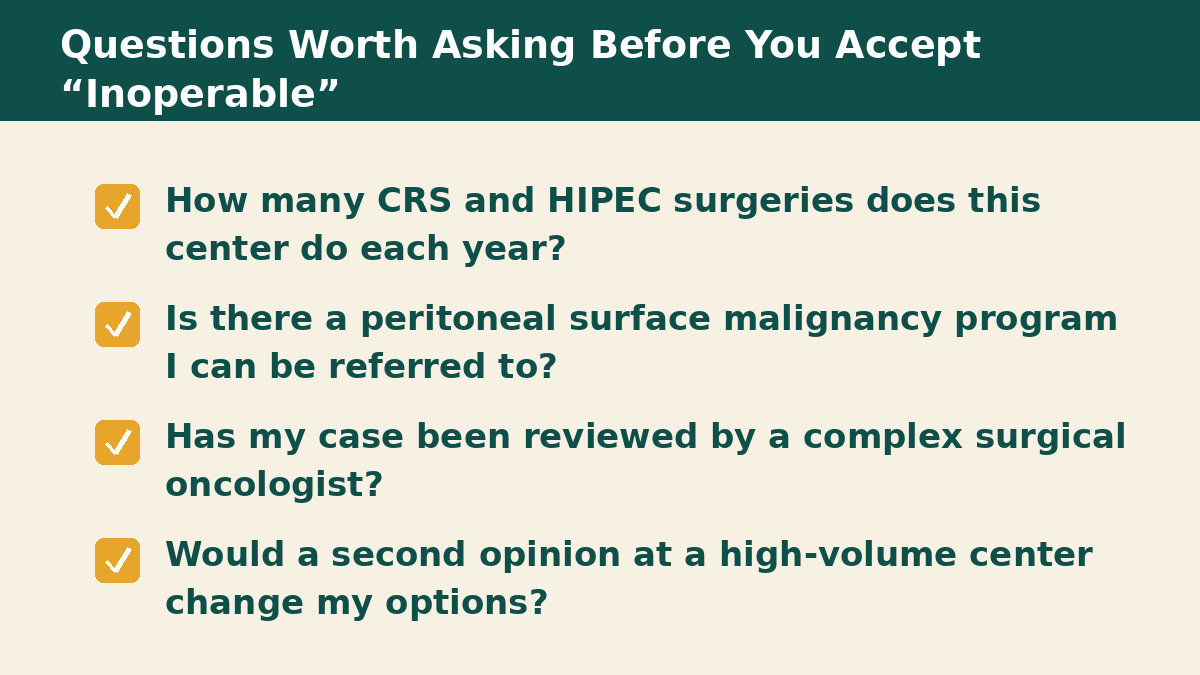
An appendix cancer second opinion is not about doubting your doctor. It is about getting your case in front of a team that does this surgery all the time, so the answer you get is the most informed one available.
Add your data to the Patient-Led Global Appendix Cancer Registry
The more patients who share their pathology, genetics, and treatment history, the faster researchers can answer the questions that matter to patients. The registry is IRB-approved and takes about fifteen minutes.
Join the Registry: United States Join the Registry: International
Common questions
If one hospital says my appendix cancer is inoperable, is it?
Not always. In this study, most patients told their tumor could not be removed at one hospital still had a complete surgery at a specialized high-volume center. An appendix cancer second opinion at a peritoneal surface malignancy program is worth getting before you accept that surgery is off the table.
What is cytoreductive surgery with HIPEC?
Cytoreductive surgery, or CRS, is an operation to remove all visible tumor from the belly. HIPEC is heated chemotherapy washed through the belly during the same surgery. Centers that specialize in belly-surface cancers do these procedures often.
Does this study apply to every type of appendix cancer?
No. Appendix tumors were the largest group, but the study pooled several belly-surface cancers and did not break the results out by subtype. Goblet cell, signet ring cell, neuroendocrine, and low-grade mucinous tumors each behave differently and need their own plan.
Why does center experience matter so much?
Centers that do many of these surgeries are more likely to remove all visible disease and manage complications well. In this study, outside-referred patients arrived with more advanced disease but still reached a complete surgery at about the same rate as local patients.
Read more
10 Appendix Cancer Treatment Mistakes, and How to Avoid Them
Gallbladder Removal During CRS/HIPEC: What a New Study Means for Appendix Cancer Patients
Appendicure is a patient-led nonprofit. If this helped you, you can support the work at the Appendicure donation page.
Source: Joseph EA, Khan MMM, Lewis C, Bartlett DL, Wagner PL, Allen CJ. Characteristics and Outcomes of External Referral Patients Undergoing Cytoreductive Surgery at an International Peritoneal Surface Malignancy Program. Annals of Surgical Oncology, 2026. doi:10.1245/s10434-026-20115-3. Open access.

Leave a Reply