
For two years I have been telling people that the only way appendix cancer gets onto the roadmap at AI drug discovery companies is if we show up early, with data, and make ourselves impossible to ignore. This week, the strategy started to pay off.
I reached out to the CEO of one of the leading AI biology companies in the world. I will not name him or the company in this post, because the message he sent me back was a direct, private response to a cold message and I want to respect that. What I can tell you is this. I told him about Appendicure. I told him my husband was diagnosed with appendix cancer in 2024. I told him we have around 1,300 members in our community and have started a patient registry, and that we are in the process of becoming IRB certified. I asked if we could talk.
He responded the next minute. His message:
![LinkedIn exchange: Amanda Moore's message describing Appendicure, the patient registry, and IRB certification, followed by a reply one minute later reading 'Hey Amanda. We are working on appendix cancer right now so super interested. My email [blurred]'. The CEO's name, photo, and email are blurred.](https://i0.wp.com/appendicure.com/wp-content/uploads/2026/05/appendicure-blog-ai-drug-discovery-appendix-cancer-message.png?ssl=1)
My message and his reply, sent one minute later. His name, photo, and email are blurred.
No one has told me that before.
This is the part where I have to be careful with myself. I lean optimistic on these stories. As Rick Page wrote in Hope Is Not a Strategy, a book I read years ago when I was building my company, hope is not a strategy. Our community deserves the real picture, not the rosy one.
So before I tell you what I think this means, let me tell you what I do not know.
What kind of company this is
This is an AI biology company built around one of the largest multimodal oncology datasets in the world. Their platform pulls spatial multiomics data from a network of leading research centers. They have an oncology and immunology pipeline. They have an exclusive licensing deal with a Swiss pharmaceutical partner on a clinical-stage compound that is already moving toward Phase 1 trials. They have a multi-year decision-making partnership with one of the largest pharmaceutical companies in the world. They recently announced an integration with Anthropic, which means their pathology AI is now accessible through the same protocol that powers Claude.
This is not a small startup. This is a company that is already in the clinic with cancer drugs, working with one of the largest pharmaceutical companies in the world, and operating at the scale where appendix cancer needs to be visible.
What “working on appendix cancer” can mean
At an AI drug discovery company in 2026, working on a disease can mean several different things. It can mean running their models on appendix cancer cases to find molecular targets. It can mean including appendix samples in their pathology analysis. It can mean a small internal team exploring whether there are druggable patterns specific to our disease. It can mean a target has been nominated and early lead optimization is underway.
I do not know which of those it is. The CEO did not specify, and I would not have gotten a more specific answer if I had asked. What I know is that a major AI drug discovery company has confirmed they are working on our disease. That is not the same as a drug in development or a clinical trial coming next year.
Why this happened now
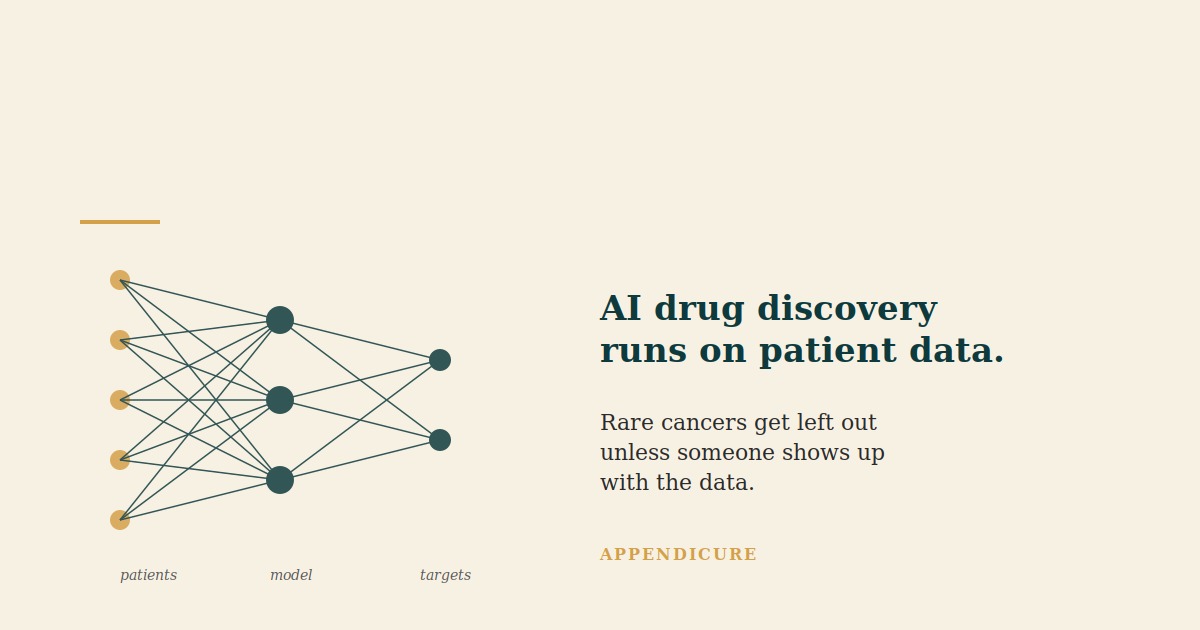
A piece in the Journal of Medical Internet Research published this week walked through how AI is changing preclinical drug discovery. The takeaway in that article that matters more for us than anything else is this. Every one of these AI systems runs on patient data. The models are only as good as the cohorts they learn from.
Appendix cancer has historically been a rounding error in those cohorts. Our cases are scattered, often miscoded as colorectal cancer, and almost never linked to outcomes at the scale these models require. We have been missing not because we are unimportant but because we are not assembled.
The registry we maintain is one of the assets that changes that equation. So is the patient survey work we do. So is the community itself, which is now approaching thirteen hundred members. And Appendicure is in the process of becoming IRB certified, which gives our data the credibility framework these companies need. Together, these turn appendix cancer into a cohort an AI drug discovery company can actually use, instead of a footnote in a colon cancer dataset.
When I reached out, that is what I brought to the table. The registry, the community, the data we collect, the survey work, the IRB framework we are building, the relationships we have with the leading clinicians in the field, the willingness of our members to share their pathology reports and treatment histories. I cannot tell you whether any of that influenced the company’s existing work on appendix cancer. What I can tell you is that the patient infrastructure exists on our side to make appendix cancer a real research target instead of a rounding error, and the CEO now knows it.
The other conversation
This company is not the only AI drug discovery company we are talking to. I have also been in conversation with a Carnegie Mellon University spinout that focuses on AI-accelerated drug discovery for radiopharmaceuticals.
Radiopharmaceuticals are cancer drugs that pair a targeting molecule with a radioactive component. The targeting piece finds the cancer cell. The radioactive piece destroys it locally. Think of it as a guided missile rather than carpet bombing. The category is growing quickly, and theranostic approaches are particularly interesting for peritoneal disease, which is where most appendix cancer patients run into trouble.
This is a young company. It exists today because two graduate students built it three years ago. That is exactly the stage where adding appendix cancer to the roadmap is possible. It is much harder to do once a pipeline is set. I told the CEO what we have and what we can offer. We are early in that conversation.
What this is and what it isn’t
This is positioning. We are making sure appendix cancer is on the map at companies that will be designing cancer drugs for the next twenty years. And in the case of the company that responded this week, a CEO has told me directly that one of those companies is already working on it.
This is not a drug. This is not a clinical trial you can enroll in. There is no timeline I can give you. Preclinical work at an AI drug discovery company can run for years before anything reaches the clinic, and most preclinical programs in cancer do not produce a drug at all. About ninety percent of cancer drug candidates fail in clinical trials. AI does not change the underlying biology of how cancer drugs succeed or fail in human bodies. It changes which candidates get pursued and how quickly. The attrition rate is still the attrition rate.
The worst thing I could do right now is let my own optimism turn this into something it is not. A CEO saying yes is not a drug. But it is more than I had a week ago. It tells me the strategy of showing up early with data and a community is working.
What you can do
If you have not added your record to the registry yet, this is the kind of thing it goes toward. Every record we add makes appendix cancer more visible to the AI systems that will be designing cancer drugs for the rest of our lifetimes.
Patient Registry: Click here to add your record
Amanda
More from Appendicure
Appendix Cancer and Surgical Decisions: How AI May Help Guide the Hardest Choice
Part one of the series A Clearer Path: AI in Appendix Cancer. Where AI is already changing how surgeons make the hardest calls in our disease.
Appendix Cancer Finally Gets Its Own Spotlight
The first time appendix cancer received its own dedicated NCCN guidelines, and what the update means for patients and caregivers.
Early Access to Investigational Treatments
A country-by-country guide to expanded access programs for patients who cannot wait for a trial.
Background reading: Cuffari B. From Virtual Molecules to Clinical Trials: How AI Is Reshaping Preclinical Drug Discovery. J Med Internet Res 2026;28:e101366. doi: 10.2196/101366
Leave a Reply