

Short answer: On August 26, 2026, the FDA approved Rasonque (daraxonrasib), the first RAS drug approved for pancreatic cancer and the first that blocks multiple mutant forms of RAS at once. The approval covers metastatic pancreatic adenocarcinoma only. There is no approved RAS inhibitor appendix cancer patients can get today.
The FDA just approved the kind of RAS inhibitor appendix cancer patients have been tracking for years. The label says pancreatic cancer. It does not say appendix.
People are going to see the headlines today, call their oncologist, and find out this drug is not approved for them. I want to be clear about that upfront. So I want to lay out the approval itself, what it actually changes for appendiceal disease, and what still has to happen.
What the FDA approved today
Rasonque is the brand name. Daraxonrasib is the generic name, and if you have followed this drug in research papers you know it as RMC-6236. It is a tablet taken once a day, made by Revolution Medicines. The approval is for adults with metastatic pancreatic adenocarcinoma who have received at least one prior systemic therapy, or who are not candidates for multiagent systemic therapy.
What makes it different from the KRAS drugs that came before it is the range. Sotorasib and adagrasib target only the G12C version of KRAS. Daraxonrasib is built to block several mutant forms of RAS at once, in the active state. That is the reason it has been the most watched drug in this whole space.

The FDA granted the approval to Revolution Medicines on August 26, 2026.
The most common side effects reported are rash, diarrhea, mouth sores, nausea, fatigue, vomiting, abdominal pain, swelling, loss of appetite, and bleeding. This is not a gentle drug. It is a daily pill, which is a real quality-of-life difference from infusion chemotherapy, but it comes with its own load.
Why appendix cancer patients care about a pancreatic drug
Because many appendiceal adenocarcinomas, especially mucinous tumors, are driven by KRAS. In mucinous appendiceal adenocarcinoma, KRAS mutations show up in roughly three out of four tumors. In low-grade mucinous neoplasms and pseudomyxoma peritonei, when the sample is handled well, almost every tumor carries KRAS, GNAS, or both. Across appendiceal cancers as a whole the rate is lower, closer to half, because the subtypes differ so much from each other.
There is also early clinical signal in appendiceal disease specifically. Dr. JP Shen and colleagues at MD Anderson published a series of 15 appendiceal adenocarcinoma patients treated with KRAS inhibitors. Among evaluable patients, one had a complete response, one had a partial response, and 12 had stable disease. All evaluable patients showed a biochemical response by serum tumor markers. The cohort included eight patients treated with G12D-directed agents, five with G12C agents, and two with pan-KRAS agents. Fifteen patients is not a trial. It is a signal, and it is the strongest appendiceal-specific signal this drug class has produced. I wrote about that study in July.
Today’s approval matters for appendix cancer for a reason that has nothing to do with the label. Until this morning, daraxonrasib existed only inside clinical trials and an expanded access protocol. Now there is an FDA-approved drug that can enter commercial use rather than existing only as an investigational therapy. That matters. Approval makes off-label access and appendiceal-specific research more realistic, even though neither is guaranteed.
What this RAS inhibitor appendix cancer news does not mean
It does not mean you can get this drug for appendiceal cancer tomorrow. The approved indication is pancreatic adenocarcinoma. Off-label prescribing is legal, but insurers deny it routinely when there is no guideline support and no cohort data, and this drug will not be cheap. The Appendicure community already knows this fight from CDK4/6 inhibitors, where palbociclib has activity in GNAS mutated disease and coverage denials are still constant.
It does not mean the drug is proven in appendiceal disease. I could not find a registered daraxonrasib trial currently enrolling appendiceal cancer patients as of August 26, 2026. The registered studies I found are pancreatic. The appendiceal evidence is laboratory work plus that 15-patient series.
It also does not mean RAS is the whole story in this disease. GNAS is mutated alongside KRAS in a large share of mucinous appendiceal tumors, and a RAS inhibitor does not directly target GNAS. Whether a concurrent GNAS mutation changes response to RAS inhibition is an important unanswered question. Nobody knows yet.
Which subtypes this is even about
This is where scoping matters, because appendix cancer is not one disease. RAS-directed drugs are most relevant when the tumor carries a susceptible RAS alteration.
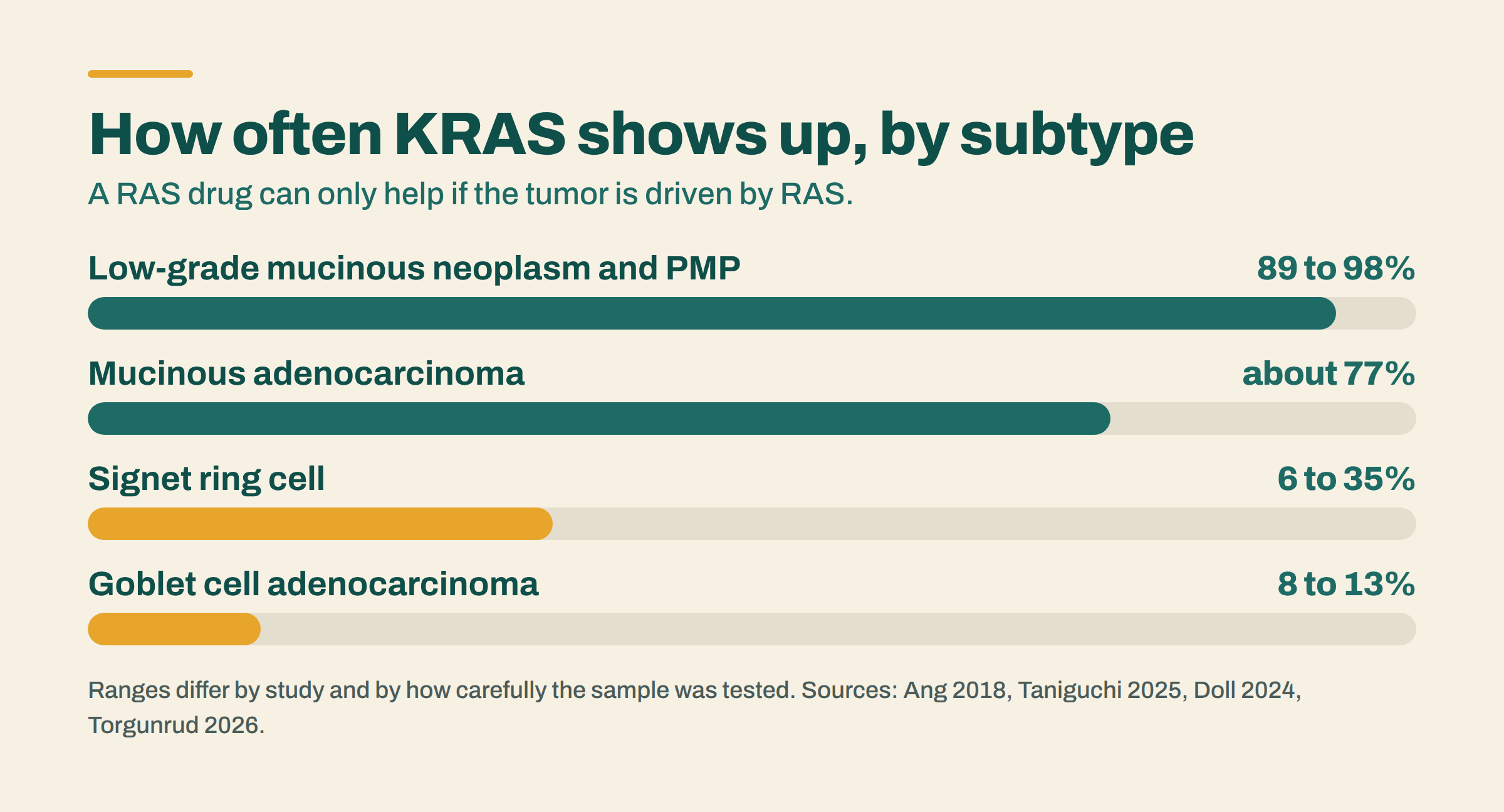
Rates differ between studies partly because of the tumor and partly because of how hard the laboratory looked.
Goblet cell adenocarcinoma sits at the far end. Across five independent cohorts, KRAS shows up in roughly 8 to 13 percent of goblet cell tumors. That is biology, not a lab failure. Goblet cell tumors carry other alterations instead. Signet ring cell disease points the same direction on much shakier numbers. Three studies report KRAS in 5.9 percent of 17 cases, 15 percent of 27 cases, and 35 percent of 37 cases, which is a sixfold spread on very small cohorts. If you or your person has goblet cell or signet ring disease, a RAS-directed drug is far less likely to be the answer, and you deserve to hear that plainly rather than find out after a denied appeal.
Neuroendocrine tumors and carcinoids of the appendix are a separate disease entirely and are not part of this conversation at all.
What has to happen next
The most direct route is a trial, and one is already written. At the Appendicure webinar on August 21, Dr. Andrew Lowy of UC San Diego described a cooperative trial with MD Anderson for patients with mucinous appendix cancer, using daraxonrasib. The protocol is under review at Revolution Medicines, and the company has agreed to support it. It could not open until the drug was approved. That happened this morning. Dr. Lowy expects the trial to open in early 2027. That timing is his estimate, not a scheduled date. It would be the first RAS inhibitor appendix cancer trial anywhere.
There is a specific safety reason the study has to be appendiceal rather than a line added to a pancreatic trial. Mucinous tumors sit up against the small intestine. Killing them quickly could in theory cause a perforation. Nobody knows whether that actually happens in people, and finding out is part of what the trial is for.
Trials get built on data, and appendix cancer keeps losing there. Insurers and guideline panels move on cohorts, not anecdotes, and the appendiceal patients who have already been treated with RAS-directed drugs are scattered across dozens of institutions with nobody counting them. The Appendicure Patient-Led Global Appendix Cancer Registry collects molecular, genomic, and pathology data from appendiceal patients worldwide. The IRB protocol has been approved as exempt.
Guidelines are the slowest piece and the one that decides coverage. There are now appendix-specific consensus guidelines from Godfrey and the PSM Consortium, rather than relying solely on colorectal cancer protocols, and they fit this disease far better than what insurers usually reach for. Getting appendiceal-appropriate recommendations into the documents that drive coverage decisions is the difference between a drug existing and a patient getting it.
What you can do this week
Find out whether your tumor has a KRAS mutation, and which one. Ask your oncologist for tumor tissue genomic testing if it has not been done. A blood-based test can find KRAS, but appendiceal tumors can shed very little DNA into the bloodstream, so a negative blood result does not rule out a mutation. When adequate tumor tissue is available, tissue-based genomic testing is particularly important in this disease.
If you already have your report, look for the exact variant. G12D is the most common by a wide margin in mucinous appendiceal disease, followed by G12V. G12C, the one with already-approved targeted drugs in other cancers, is rare here, on the order of one to two percent. Knowing your variant is what makes you findable when a trial opens.
One nuance worth knowing before you panic about a wild type result. Daraxonrasib blocks normal RAS as well as mutant RAS, so a RAS test may not end up being required to enroll. That is Dr. Lowy’s read, not a protocol rule. Get tested anyway. Your variant still decides which other trials and drugs are open to you.
Ask your team to keep an eye on daraxonrasib studies on ClinicalTrials.gov, and tell them you want to know about appendiceal-inclusive studies, not just pancreatic ones.
Questions I am already getting
Is there a RAS inhibitor appendix cancer patients can take today?
Not with an FDA-approved appendiceal indication. Daraxonrasib is approved for previously treated metastatic pancreatic adenocarcinoma only. Any use in appendiceal cancer would be off-label or through a clinical trial.
Is an appendix cancer trial of this drug coming?
A cooperative trial between UC San Diego and MD Anderson for patients with mucinous appendix cancer has been written and is under review at Revolution Medicines. It could not open until daraxonrasib was approved. Dr. Andrew Lowy of UC San Diego expects it to open in early 2027. That is his estimate, not a registered start date.
What is daraxonrasib?
Daraxonrasib, sold as Rasonque and known in research as RMC-6236, is a once-daily tablet that blocks several mutant forms of the RAS protein in its active state, rather than a single mutation such as G12C.
How common is KRAS in appendix cancer?
It depends on the subtype. Roughly 77 percent of mucinous appendiceal adenocarcinomas carry a KRAS mutation, and 89 to 98 percent of well-sampled low-grade mucinous neoplasms and pseudomyxoma peritonei do. Goblet cell adenocarcinoma is much lower, around 8 to 13 percent.
Does this approval change insurance coverage for appendiceal patients?
Not directly. Coverage follows the approved indication and the guidelines. Changing that requires appendiceal-specific data and guideline recommendations.
Should I ask about a KRAS G12C drug instead?
Only if your tumor is G12C, which is a minority of appendiceal cases. Bring your genomic report to the conversation.
Add your record to the registry
The Patient-Led Global Appendix Cancer Registry collects molecular, genomic, and pathology data from appendiceal cancer patients worldwide. Your record helps build the evidence needed to change guidelines and improve access to treatment. The IRB protocol is approved as exempt, and it takes about fifteen minutes.
Join the Registry: United States Join the Registry: International
Appendicure runs on donations, and the registry is the reason. If today’s news made you want to do something, you can support the work here.
Read more
Appendix Cancer Treatment Update: GNAS, KRAS, and CDK4/6 Inhibitors with Dr. Andrew Lowy
KRAS Inhibition in Appendiceal Cancer: What the New Study Shows
1 Promising RAS Cancer Study and Why Appendix Cancer Research Still Needs More Data
Appendix Cancer Mutation Testing: Know What Your Tumor Is Made Of
Sources. U.S. Food and Drug Administration. FDA Approves First in Class Targeted Therapy for Metastatic Pancreatic Cancer. Press release, August 26, 2026.
Chowdhury S, Ito I, Shen JP, et al. KRAS inhibition is an effective therapy for appendiceal adenocarcinoma. J Hematol Oncol 2026. doi:10.1186/s13045-026-01817-3.
Lowy A. Appendicure community webinar, August 21, 2026. Recording: https://youtu.be/nXHCz6YeD1c
Ang CS-P, et al. Genomic Landscape of Appendiceal Neoplasms. JCO Precis Oncol 2018;2:PO.17.00302.
Taniguchi SH, et al. Impact of genetic mutations on prognosis and chemotherapy efficacy in advanced appendiceal carcinoma. Int J Clin Oncol 2025;30:914-925.
Doll J, et al. Molecular Profiling of Low-Grade Appendiceal Mucinous Neoplasms. Genes Chromosomes Cancer 2024;63(10):e23270.
Torgunrud A, et al. High prevalence of KRAS and GNAS mutations in pseudomyxoma peritonei. Pleura Peritoneum 2026;11(1):11-18.
White MG, et al. The Landscape of ctDNA in Appendiceal Adenocarcinoma. Clin Cancer Res 2025;31:551-560.
Godfrey H, et al. Consensus Guideline for the Management of Patients with Appendiceal Tumors, Part 2: Appendiceal Tumors with Peritoneal Involvement. Ann Surg Oncol 2025.
This post is patient education, not medical advice. Treatment decisions belong to you and your oncology team.
Leave a Reply