
The retracted fenbendazole study that keeps circulating was pulled by its journal on January 21, 2026. It described three patients. None of them had appendix cancer.
Someone sends me a fenbendazole link almost every week. It’s a dog dewormer. The claim is that it cures cancer, and the claim almost always arrives with a paper attached, because a paper makes a thing feel settled.
So I went and read the paper. Then I read what happened to it.
What the retracted fenbendazole study actually said
The paper was titled “Fenbendazole as an Anticancer Agent? A Case Series of Self-Administration in Three Patients.” The authors were William Makis, Ilyes Baghli and Pierrick Martinez. It was published online in Case Reports in Oncology on May 26, 2025.
It described three people who took fenbendazole on their own. An 83-year-old woman with breast cancer. A 75-year-old man with prostate cancer. A 63-year-old man with melanoma. The paper reported that two reached complete remission and one came close.
Three people. No comparison group. Nobody was assigned to take the drug and nobody was assigned to skip it. That design is called a case series. It can show that something happened in a few patients, but it cannot establish that fenbendazole caused it. Everybody in it was also receiving other treatment, and there’s no way to pull those threads apart afterward.
The journal took it back
On January 21, 2026, Case Reports in Oncology published a retraction of that paper. The journal’s own page now carries the words “Retracted Paper” in front of the title. The retraction is indexed on PubMed and carries its own permanent record.
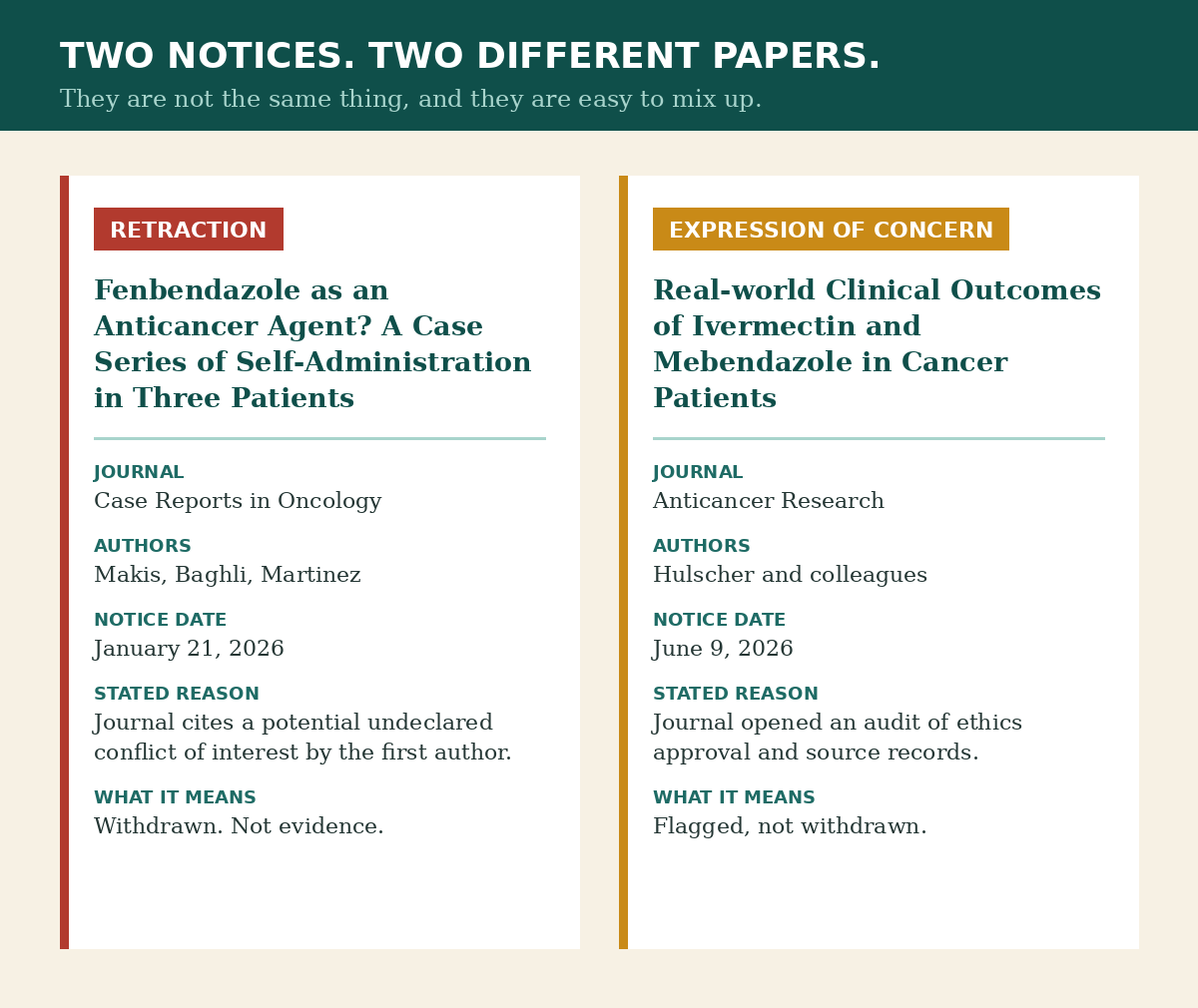
The journal gave a reason, and it’s worth reading closely. According to the retraction notice, concerns were brought to the journal about a potential undeclared conflict of interest by the first author, William Makis. The notice says he was offering services related to the topic of the study at the time the manuscript was submitted, and that this was not disclosed in the paper’s conflict of interest statement. The journal says his response was found unsatisfactory, and that the concerns could affect how the work and its recommendations were interpreted.
Compare that to what the paper itself said when it was published. Under the disclosure heading it read: “Authors state no conflict of interest.”
That is the journal’s account, not mine. I’m quoting the notice because it’s a published document anyone can read, and because it lands on the exact thing most people never check.
The retracted fenbendazole study is still sitting online, and copies of the PDF are still being passed around. That’s normal. Retraction doesn’t delete anything. It marks the paper as withdrawn and tells the rest of medicine to stop building on it.
A retraction is not a correction
There are three things a journal can do to a paper after publishing it, and they don’t mean the same thing.
A correction fixes an error. A number was wrong, a name was misspelled, a figure was mislabeled. The paper stands.
An expression of concern is a warning flag. The editors have a problem they haven’t finished investigating. The paper still stands, but readers are being told to be careful with it.
A retraction is the strongest step. The journal is withdrawing the work. It shouldn’t be cited as evidence anymore. That’s what happened here.
Two notices, two different papers
This part gets mixed up constantly, so I want to separate it cleanly.
There’s a second paper going around about antiparasitic drugs and cancer. It’s called “Real-world Clinical Outcomes of Ivermectin and Mebendazole in Cancer Patients,” it followed 197 patients, and it ran in Anticancer Research. On June 9, 2026, that journal published an expression of concern about it and opened a formal audit. The journal said it is checking the study’s ethics board approval or exemption paperwork, source records confirming the cancer diagnoses of the 197 participants, and the medical documentation behind the tumor regressions the paper reported.
That paper has not been retracted. It’s a different paper, in a different journal, by a different group of authors. William Makis is not one of them. If you see someone online saying “they retracted the ivermectin study,” that isn’t accurate, and if you see someone saying “the fenbendazole paper only got a warning,” that isn’t accurate either.
Nobody in the retracted fenbendazole study had appendix cancer
Breast. Prostate. Melanoma. That’s the whole list.
There was no appendiceal adenocarcinoma in it. No goblet cell adenocarcinoma. No signet ring cell. No neuroendocrine or carcinoid tumor of the appendix. No low-grade appendiceal mucinous neoplasm and no pseudomyxoma peritonei.
This matters even apart from the retraction. Appendiceal cancers behave differently from breast and prostate cancer. They spread differently and they’re treated differently. A result in one disease doesn’t carry over to another one just because both are called cancer. Even if this paper had held up perfectly, it would not have provided clinical evidence that fenbendazole works in appendix cancer.
How to check a paper yourself
You don’t need a science degree for this, and you shouldn’t have to take my word for it either. Here’s exactly what I did, and it took about five minutes.

Find the real paper. Copy the exact title into the search box at pubmed.ncbi.nlm.nih.gov. A screenshot or a video isn’t a paper. If nobody can give you a title, a journal name and a date, there may be nothing underneath the claim at all.
Look for a notice on the record. PubMed and the journal both put retractions, corrections and expressions of concern right on the article page, usually in a colored bar near the top. A retracted paper often says so in the title itself. This is the step almost nobody takes, and it’s the one that answers the question.
Read who was actually in it. How many people. Which cancers. Was there a comparison group. Did anyone in the study have your disease. Three patients can raise a question. They can’t prove a treatment works, and results in one type of cancer don’t automatically apply to another.
Read the disclosure section. Most medical journals put conflict of interest and funding statements at the end. Scroll down and look for them. They can tell you whether the authors reported financial relationships or funding that matter when you weigh the study. This is the step that ended the fenbendazole paper, so it’s worth the thirty seconds.
What I’m not saying
I’m not telling you what to put in your body. That decision belongs to you and your oncology team, and I’m not a doctor.
I’m also not saying the idea of repurposing old drugs for cancer is silly. It isn’t. Real researchers work on it, and some repurposed drugs have earned their place. What I’m saying is that this particular paper was withdrawn by the journal that published it, that it never included a single appendix cancer patient, and that both of those things were knowable in five minutes.
Fenbendazole is a veterinary dewormer. It isn’t approved to treat cancer in people anywhere in the world. If you’re taking it, or thinking about it, tell your oncologist. Not so they’ll bless it. So they know, because drug interactions are real and your team can’t protect you from something they don’t know you’re taking. In my experience most oncologists would far rather hear it than find out later.
The retracted fenbendazole study is one paper. The habit of checking is what I actually want you to keep.
Questions I get about this
Was the fenbendazole cancer paper really retracted?
Yes. Case Reports in Oncology retracted “Fenbendazole as an Anticancer Agent? A Case Series of Self-Administration in Three Patients” on January 21, 2026. The retraction notice is indexed on PubMed and the journal’s own article page now reads “Retracted Paper.”
Why was the fenbendazole paper retracted?
The journal said concerns were raised about a potential undeclared conflict of interest by the first author, William Makis. According to the retraction notice he was offering services related to the topic of the study when the manuscript was submitted, and that was not disclosed in the paper’s conflict of interest statement. The journal said his response was unsatisfactory and that the concerns could affect how the work was interpreted.
Is the retracted fenbendazole study still evidence for appendix cancer?
No. It was withdrawn by its journal, and it contained no appendix cancer patients to begin with. Its three cases were breast cancer, prostate cancer and melanoma.
Was the ivermectin and mebendazole study retracted too?
No. That is a separate paper in a separate journal by a separate group of authors. Anticancer Research published an expression of concern about it on June 9, 2026 and opened an audit. An expression of concern is a warning, not a withdrawal.
How do I check a study myself?
Search the exact title on PubMed, look for a retraction or correction notice on the article page, read how many patients were included and which cancers they had, and read the conflict of interest and funding lines at the end.
Read more
A RAS Drug Just Got Approved. Appendix Cancer Was Not on the Label
What it looks like when a real drug clears real trials, and why the label still matters.
Appendix Cancer Treatment Update: GNAS, KRAS, and CDK4/6 Inhibitors with Dr. Andrew Lowy
Where the actual evidence for appendiceal cancer treatment stands right now.
Appendix Cancer Awareness Month States: 14 Down, 36 to Go
The advocacy work behind getting this disease recognized.
Help build the evidence that doesn’t exist yet
The reason a withdrawn three-patient paper can travel this far is that there’s so little real data on appendiceal cancer. The Patient-Led Global Appendix Cancer Registry is how I’m trying to fix that. It’s molecular, genomics and pathology focused, the IRB protocol is approved as exempt, and it takes most people about twenty minutes. Every subtype is welcome.
Join the Registry: United States Join the Registry: International
Sources you can open yourself
Retraction notice, Case Reports in Oncology, January 21, 2026: PubMed record
The retracted paper, publisher page: Karger
Expression of concern, Anticancer Research, June 9, 2026: PubMed record and journal notice
The paper that notice concerns: Anticancer Research
This post is education, not medical advice. Talk to your oncology team before starting or stopping anything.
Leave a Reply