

The number of states recognizing Appendix Cancer Awareness Month went from one in 2025 to fourteen in 2026, largely because patients, caregivers, and family members decided to ask their governors.
How many states recognize Appendix Cancer Awareness Month?
As of August 23, 2026, fourteen states have granted August state-level recognition: Delaware, Hawaii, Idaho, Illinois, Kentucky, Louisiana, Maryland, Michigan, New Jersey, Pennsylvania, South Dakota, Virginia, West Virginia, and Wisconsin. Thirteen are governors’ proclamations. Pennsylvania’s is a statement of recognition. No national government anywhere has been confirmed to recognize the month.
Add your state or country to the map
This guide has step-by-step instructions and language you can copy for your governor, health minister, member of parliament, mayor, or local council. Jump to how to get your state on the map, or to how to do it outside the United States.
I went looking for how official August really is, and what I found changed how I think about advocacy for a rare disease.
August is official, but nobody in Washington made it official
In 2021, the ACPMP Research Foundation designated August as Appendix Cancer Awareness Month and established amber as the awareness color. Cancer.net, the patient education site of the American Society of Clinical Oncology, lists it on its awareness calendar. So do a number of other health publishers.
What I could not find was a presidential proclamation or an act of Congress creating it. Colorectal cancer got its month by presidential proclamation in 2000. Childhood cancer has had a Senate resolution nearly every year since 2019. Appendix cancer has neither. It exists because a nonprofit founded in 2008 by families who refused to let this disease stay invisible decided there should be one.
Wisconsin went first, in 2025
In 2025, Governor Tony Evers signed a proclamation recognizing the month in Wisconsin. It was ACPMP’s first statewide proclamation for this disease. It happened because a Wisconsin patient and volunteer named Deborah Stalsberg asked for it.
One person. One request. First state.
A year later the count is fourteen, and it grew during August itself. On August 1, 2026, ACPMP’s press release named eight states. By August 19, its confirmed list had grown to thirteen. Virginia makes fourteen.
The fourteen states, and what each one actually issued
ACPMP lists thirteen states with confirmed recognition. Virginia’s governor has also issued an official proclamation, which brings the number I can independently verify to fourteen. Thirteen of those are governors’ proclamations. Pennsylvania is a statement of recognition, a distinction ACPMP itself draws. The Village of Schaumburg, Illinois issued a municipal proclamation on top of the state one.
The part of the list worth reading closely is the names beside it.

Carol Clancy in Delaware. Katelen Fortunati in Idaho. Whittney Allen in Kentucky. Scott Durkin in Maryland. David Zyble in Michigan. Lindsay Frankenfeld in South Dakota. Ashby Kave in West Virginia. Deanna Flanick and Yesenia Madas in New Jersey. Dandylyon Darr in Hawaii. Ellen Zolper in Illinois, who also got her village to do it. One person in Louisiana who asked to stay anonymous.
These are not professional advocates. They are people who live with this disease or love someone who does, and who spent an afternoon on a state government website.
What one of these actually looked like
Kentucky is the one I can trace end to end, because a local paper covered it. Earlier this year, Vivian Morgan had imaging for an unrelated problem and the scan turned up something on her appendix. Further evaluation led to a diagnosis of low-grade appendiceal mucinous neoplasm. Whittney Allen, who is named on ACPMP’s list as Kentucky’s advocate, asked the governor’s office to recognize the month. Governor Andy Beshear signed the proclamation on July 14, 2026. Both women are nurses, and Allen told the paper that recognition matters precisely because rare cancers do not carry the visibility of common ones.
Four months from a diagnosis nobody saw coming to a signed statewide proclamation. That is the whole process, and there is nothing exotic about any step of it.
Pennsylvania took a different route, and shows a third
Pennsylvania is the exception on the list. Governor Josh Shapiro issued a statement of recognition rather than a proclamation, a distinction ACPMP draws itself. The statement describes appendix cancer as rare and under-researched, curable when caught early and dangerous when it goes unnoticed.
A statement of recognition is a different document from a proclamation, and it still puts the disease on the governor’s record. If your governor’s office pushes back on a full proclamation, this is a reasonable thing to accept in year one and build on in year two.
There is also a legislative path. On August 19, 2026, Pennsylvania State Senator John Kane circulated a co-sponsorship memo asking colleagues to join a resolution recognizing August 2026 in the Commonwealth. His memo describes the disease as genetically distinct from colorectal cancer and notes that incidence has been rising among people under 50. The legislature’s own page states the document has not been submitted for introduction yet, so there is no adopted Pennsylvania resolution. It is still worth knowing that a state senator will carry this if a constituent asks. Kane is a stage three cancer survivor himself.
The rest of the world is further behind than it looks
Awareness itself is genuinely international. ACPMP’s Light Up Amber campaign lists landmarks in the United States, Canada, Australia, and Ireland. Appendix Cancer Canada runs its own awareness month campaign. Hospitals and patient groups in other countries mark August too.
Government recognition is a different story. I could not verify national government recognition in Canada, Australia, Ireland, the United Kingdom, or New Zealand, or an official designation by the European Union or the World Health Organization. Roughly a third of the Appendicure community lives outside the United States, spread across 44 countries, and almost none of those countries have put anything official on paper.
If you are reading this from outside the US, there is a full section below with the letter to send and who to send it to.
How to get your state on the map
This is the whole reason I wrote this post. Requesting a proclamation costs nothing, requires no medical knowledge, and patients and families have already shown that it works. Most of it you can finish in the next twenty minutes.
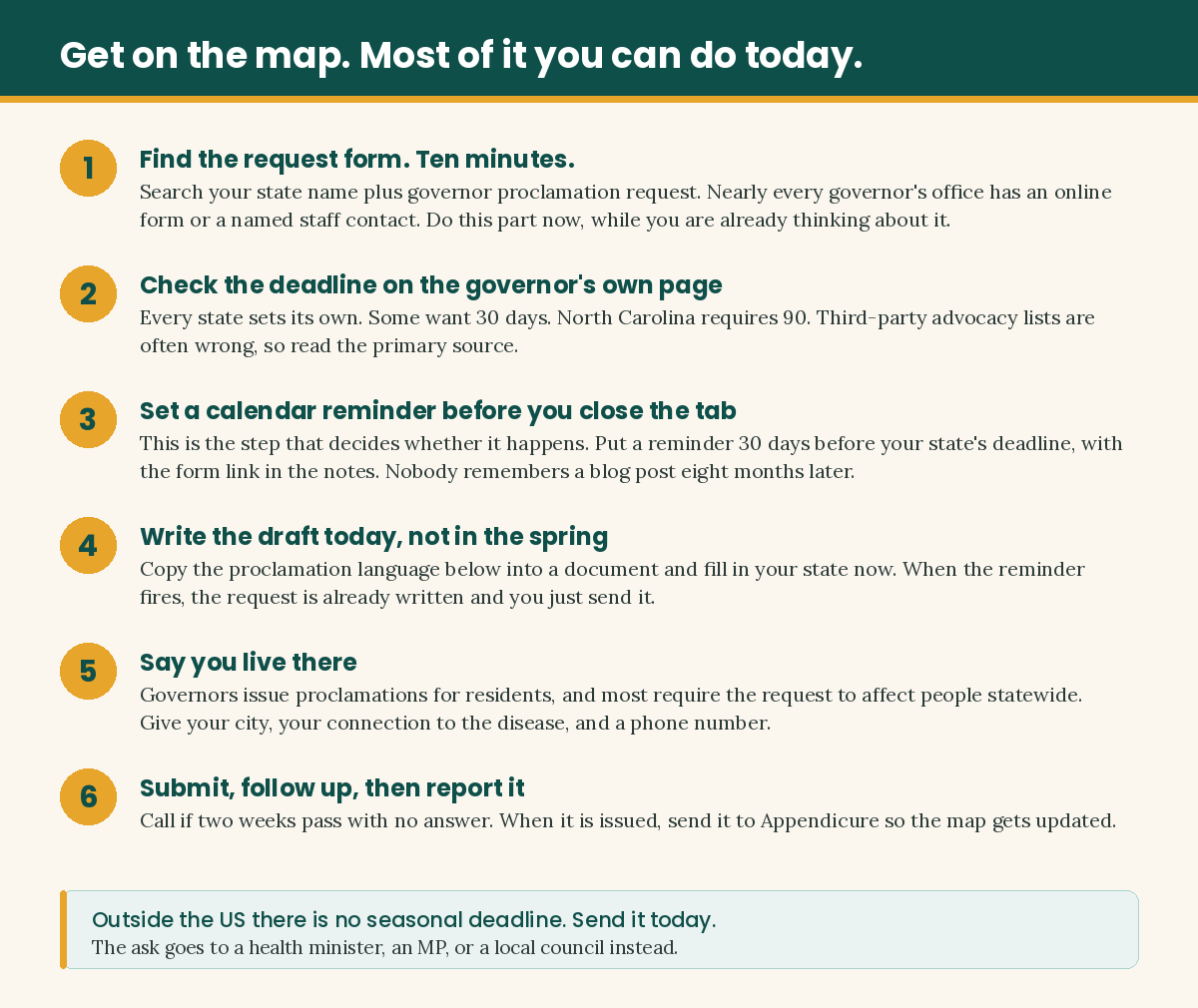
Find the request form. Ten minutes. Search your state name plus the words governor proclamation request. Nearly every governor’s office has an online form, and the ones that do not will list a staff contact for ceremonial requests. Do this part now, while you are already thinking about it.
Check the deadline on the governor’s own page. Every state sets its own. Some want thirty days. North Carolina requires ninety. Do not trust the proclamation deadline lists published by advocacy organizations. Three of them currently list North Carolina as six weeks, six to eight weeks, and one hundred twenty days. The state says ninety. Read the primary source.
Set a calendar reminder before you close the tab. This is the step that decides whether any of this happens. Put a reminder thirty days ahead of your state’s deadline, with the form link in the notes. Nobody remembers a blog post eight months later, and proclamations are almost never renewed automatically. This is a fresh request every single year.
Write the draft today, not in the spring. Copy the proclamation language below into a document and fill in your state now. When the reminder fires, the request is already written and you just send it. Expect edits. North Carolina states outright that submitted language may be rewritten at the office’s discretion, and that draft language must be factually accurate and current.
Say you live there. Governors issue proclamations for residents, and most require the request to affect a broad group of people statewide or at least regionally. Include your city, one or two sentences about your connection to appendix cancer, and a phone number.
Submit, follow up, then report it. Call if two weeks go by with no response. When it is issued, send it to me so the map gets updated and other people in your state can see it was done.
Ask for a proclamation, and know what you are being offered instead
Governors issue more than one kind of document, and the words are not interchangeable. A proclamation is the formal ceremonial document, signed and sealed, that declares the month. A statement or letter of recognition is a shorter acknowledgment on official letterhead. Pennsylvania’s 2026 recognition is the second kind. North Carolina’s governor runs two entirely separate request forms for the two, both with the same ninety day deadline, so asking for the wrong one costs you a year.
Ask for a proclamation by name. If the office offers a letter of recognition instead, take it. It is a real result, it gets your state on the board, and it gives you something concrete to point at when you ask for the full proclamation the following year. Worth knowing either way: proclamations are honorary and carry no legal force. Nobody is obligated to do anything because of one.
Proclamation language you can copy
The template below is adapted from Virginia’s 2026 proclamation. The five clauses are Virginia’s own wording. Replace the state, governor, and year, and check your governor’s requirements before submitting it. This is stronger than anything drafted from scratch, because a governor’s office has already approved this exact language.
WHEREAS, appendix cancer, also known as appendiceal cancer, is a rare but serious disease that is biologically distinct from colorectal cancer; and
WHEREAS, the incidence of appendix cancer has been increasing, particularly among individuals under the age of 50, while the disease remains difficult to diagnose because its symptoms are often vague or absent in the early stages; and
WHEREAS, delayed diagnosis can make treatment more complex, underscoring the importance of increased awareness, early recognition, and continued research; and
WHEREAS, the Appendix Cancer PMP Research Foundation, founded in 2008, supports research and education to improve the diagnosis and treatment of appendix cancer and pseudomyxoma peritonei (PMP); and
WHEREAS, patients, survivors, caregivers, healthcare professionals, researchers, and advocates are working together to raise awareness, advance research, and improve outcomes for all those affected by appendix cancer;
NOW, THEREFORE, I, ______, Governor of ______, do hereby recognize August 2027 as APPENDIX CANCER AWARENESS MONTH in ______, and I call this observance to the attention of all our citizens.
If the governor’s office declines or does not respond, go local. Mayors, city councils, and county commissions issue proclamations with far less lead time and far less process. Schaumburg, Illinois proved that this year. A city proclamation in hand also makes the state request easier the following year.
North Carolina is not on the list, and neither are thirty-five other states. I have already done the local version of this here. In 2024 I volunteered for ACPMP’s Light Up Amber campaign and got three North Carolina venues to light amber for Appendix Cancer Awareness Month. That was a first for this state. Lighting a building is not the same as a governor’s signature, and it has not gone unnoticed by me that North Carolina still has no official recognition. I am going to fix that. If you are a North Carolinian reading this, reach out to me and we will go after it together. If you live anywhere else, I am glad to look over your draft before you send it.
How to get recognition in your country
There is no single international process, and the American proclamation format does not travel well. Depending on where you live, the request goes to a national health ministry or health minister, a member of parliament, a provincial or territorial government, a mayor or local council, or a national cancer agency.
Do not feel you have to start nationally. A province, territory, city, or council recognizing August is a real result and is usually far easier to get than a national designation. Wisconsin started with one state and the United States now has fourteen. The same thing can happen anywhere. There is also no seasonal deadline outside the US, so this letter can go out today.
Adapt this and send it. Keep it short. Officials respond better to one clear ask than to a long history of the disease.
Subject: Request to recognize August as Appendix Cancer Awareness Month
Dear [Minister, Member, or Official],
I am writing to ask [government or body] to formally recognize August as Appendix Cancer Awareness Month.
Appendix cancer is a rare cancer that includes several different tumour types and is often diagnosed unexpectedly, or after the disease has already spread. Because it is rare, many patients and families have never heard of it before diagnosis, and it is biologically distinct from colorectal cancer.
August is recognized as the awareness month for this disease by appendix cancer organizations and patient communities internationally, and amber is the awareness colour. In the United States, fourteen states received state-level recognition of the month in 2026. Government recognition here would help raise awareness among patients, families, healthcare professionals, and the public.
I am [a patient, caregiver, family member, or advocate] living in [location], and this matters to me because [one or two personal sentences].
I respectfully ask [government or body] to recognize August 2027 as Appendix Cancer Awareness Month in [country, province, state, or city]. I would be glad to provide suggested wording, supporting information, or examples of recognitions already issued elsewhere.
Thank you for considering this request.
[Name]
[City, Country]
[Contact information]
If you get one, send it to me. Nobody is keeping an international list right now, and I would like to start one.
Why a piece of paper matters
A signed piece of paper does not fund a trial or shorten anyone’s time to diagnosis. What it does is put the name of this disease into a state’s official record, give local press a reason to cover it, and give a newly diagnosed person proof that they are not the only one this ever happened to. Kentucky is the example. One family’s diagnosis became a governor’s signature, and then a newspaper article that explained appendix cancer to a readership that had probably never heard of it.
A federal resolution is the longer play. State recognition creates a record of support that eventually makes the case for congressional recognition harder to wave off. Recognition and research move together. Visibility is what attracts funding, and funding is what produces the studies this community has been waiting on. Proclamations make the disease visible. Data makes it fundable.
Join the Patient-Led Global Appendix Cancer Registry
The registry collects tumor mutation, genomic, biomarker, and pathology information from appendix cancer patients worldwide. It has its own ethics board approval, which came back exempt. Every record adds to what researchers can learn about this disease and helps make future studies possible.
Join the Registry: United States Join the Registry: International
Questions about Appendix Cancer Awareness Month
Is August Appendix Cancer Awareness Month?
Yes. The month has been designated by the Appendix Cancer PMP Research Foundation since 2021. State governments have increasingly recognized the observance, although there is currently no presidential proclamation or congressional designation establishing it.
What color represents appendix cancer?
Amber. ACPMP established amber as the official ribbon color for appendix cancer in 2021, at the same time it designated the awareness month.
What is the difference between a proclamation and a statement of recognition?
A proclamation is the formal signed and sealed document declaring the month. A statement or letter of recognition is a shorter acknowledgment on official letterhead. Both are honorary and neither is legally binding. Some governors’ offices, including North Carolina’s, take requests for the two on separate forms.
Do I need to be a patient to request a proclamation?
No. Caregivers, family members, friends, and bereaved families all request proclamations successfully. You need to be a resident of the state, not a patient.
Does it cost anything?
No. Governors’ proclamation offices do not charge for ceremonial recognitions, and there is no filing fee anywhere I looked.
I live outside the United States. Can I still help?
Yes. The request goes to a health ministry, a member of parliament, a provincial or territorial government, or a local council rather than a governor. Use the letter template above, and start local rather than national if that is easier where you live.
What if someone in my state already asked?
Recognitions expire. Most cover a single year, which means all fourteen states on the 2026 list need someone to ask again for 2027. Repeat requests are usually easier, because the office already has the file.
How long does the whole thing take?
Filling out the request takes under an hour if you use the language above. Waiting for the answer takes anywhere from thirty to ninety days depending on the state.
Read more
Why Appendix Cancer Awareness Month Matters to Me
Fourteen states now recognize Appendix Cancer Awareness Month because a small number of people decided to ask. If your state or country is not on the list, you can be the person who changes that.
If you would rather support the work directly, you can do that here.
Sources: ACPMP Research Foundation proclamation list, About Us timeline, and Light Up Amber pages; Office of the Governor of Virginia proclamation, August 2026; ACPMP press release on Pennsylvania recognition, August 2026; Salyersville Independent reporting on the Kentucky proclamation; Pennsylvania Senate co-sponsorship memo 49117; Office of the Governor of North Carolina proclamation request guidelines. All verified August 23, 2026. Appendicure is not affiliated with ACPMP.
Leave a Reply