

August is Appendix Cancer Awareness Month, and the ribbon is amber. This is why the month matters to me, and five simple ways you can help.
I did not go looking for this cause. It found my family. In 2024, my husband David was diagnosed with appendix cancer. He is the reason Appendicure exists.
David has goblet cell adenocarcinoma of the appendix. He had surgery, a right hemicolectomy, and on his oncologist’s advice he did not need chemotherapy. Today he is under active surveillance with no evidence of disease. His path was not the usual one. Most of the survivors on the Appendicure board went through chemotherapy, and many had major surgery called CRS with HIPEC. Appendix cancer is not one disease, and no two people walk the same road.
When David was diagnosed, I did what most people do. I searched for answers. What I found was written for scientists, not for patients. The studies sat behind journal paywalls and jargon. The good information was scattered. Families were left to piece it together during the scariest weeks of their lives. I built Appendicure to close that gap.
Appendicure is now a community with members in 52 countries, and it grows every day. Patients, caregivers, survivors, and the doctors who treat this disease. Appendix cancer is rare, so no single hospital sees many cases. Put together, the community is not small.
Appendix cancer needs its own month because it is easy to miss. There is no screening test for it. It is often found by accident during surgery for something else, or mistaken for ovarian cancer or appendicitis. Awareness is not a slogan for a disease like this. It is the difference between a tumor caught early and one found late.
Five ways to help this Appendix Cancer Awareness Month
None of these take much. Every one of them helps someone you may never meet.
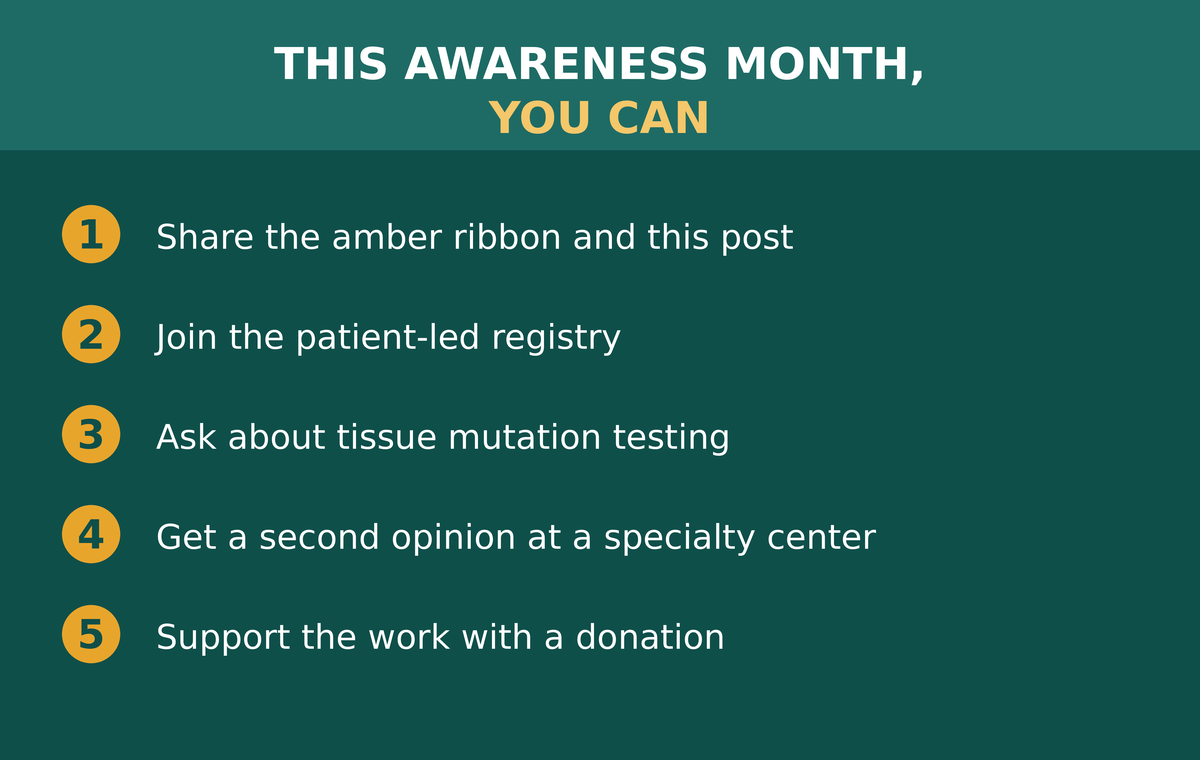
1. Share. The amber ribbon is the symbol of appendix cancer. Post it this month. Share this note. Tell one person that appendix cancer exists, and that it does not show up on a routine colonoscopy. Rare cancers stay invisible until enough people say the name out loud.
2. Join the registry. The Appendicure Patient-Led Global Appendix Cancer Registry collects the molecular, genomic, and pathology details of real cases, the exact information researchers need and rarely have in one place for a disease this rare. It is now approved by an ethics board and classified as exempt, which means your privacy is protected and taking part is simple. Every record makes the next study possible, and you can join from anywhere in the world. The links are below.
3. Ask about tissue mutation testing. If you or someone you love has appendix cancer, ask the care team whether the tumor tissue has been tested for mutations like KRAS and GNAS. A blood test that comes back negative does not mean tissue testing is pointless. The two tests look for different things. Testing does not guarantee a targeted treatment today, but it can open doors, especially to clinical trials. If you want to look for a trial, the Appendicure Trial Finder matches patients to studies based on the biology of the cancer, not just its name.
4. Get a second opinion at a specialty center. Appendix cancer is rare enough that most hospitals rarely treat it. A word like unresectable at a general hospital can change at a high-volume center that sees this disease often. Asking for a second opinion is not being difficult. For a rare cancer, it is one of the most important things you can do.
5. Support the work. Appendicure runs on a simple belief. Patients deserve answers in language they can understand. Donations keep the registry, the research reviews, and the patient education free and open to everyone, in every country. If you are able to give, it goes straight into the mission. You can donate here.
Join the Patient-Led Global Appendix Cancer Registry
Ethics-board approved and exempt. Open to patients and caregivers worldwide. Pick the form for your location.
Join the Registry: United States
Join the Registry: International
David is doing well. Not every story ends that way, and I carry the ones that do not. What I can do is make sure the next family that hears the words appendix cancer does not start where I did, alone with a search bar at two in the morning. That is what Appendix Cancer Awareness Month is for.
Read more
When “Unresectable” Isn’t the Final Word in Appendix Cancer
Appendix Cancer Mutation Testing: Know What Your Tumor Is Made Of
Appendix Cancer Clinical Trials: The Access Gap and How to Close It
Common questions
When is Appendix Cancer Awareness Month?
August. The awareness ribbon is amber.
How can I help during Appendix Cancer Awareness Month?
Five simple things. Share the amber ribbon, join the patient registry, ask about tissue mutation testing, get a second opinion at a specialty center, and donate if you can.
What is the Appendicure patient registry?
A patient-led registry that collects the molecular, genomic, and pathology details of appendix cancer cases. It is ethics-board approved and exempt, and open to patients and caregivers anywhere in the world.
Why does appendix cancer need an awareness month?
It is rare and easily missed. There is no screening test, it is often found by accident or mistaken for other conditions, and its subtypes, from low-grade mucinous to goblet cell, signet ring, and neuroendocrine, each behave differently. Awareness gets people to the right care sooner.
Leave a Reply