

A 2025 study of the appendix cancer tumor microenvironment found that when these tumors spread into the belly, the cancer cells stay much like the original tumor, but the tissue around them changes. The biggest change is in collagen, the structural material that surrounds a tumor. That could help explain why drugs have a hard time reaching these tumors after the disease spreads, though the study did not test that directly.
For a long time, appendix cancer research focused almost entirely on the cancer cells. Which mutations they carry. How fast they grow. What drugs might hit them. A study out of Moffitt Cancer Center in Tampa looked at something different. It looked at the neighborhood the cancer lives in.
The appendix cancer tumor microenvironment is the tissue that surrounds the cancer. It is not the tumor cells themselves. It is the connective tissue, the immune cells, the blood vessels, and the mesh of proteins that hold everything together. Researchers are learning that this surrounding tissue often plays a major role in how a cancer grows, spreads, and responds to treatment. This study is one of the clearer looks at that tissue in appendix cancer.
What the researchers did
They studied tissue from 14 patients. Each patient had three matched samples available, which is rare and valuable: normal appendix tissue, the original appendix tumor, and a matching peritoneal metastasis, meaning tumor that had spread inside the abdomen.
They used a technology called digital spatial profiling, run on the NanoString GeoMx platform. It lets researchers measure which genes are switched on while keeping the tissue map intact, so they know exactly where each signal is coming from. They also used a marker to separate two parts of every sample. One part was the cancer cells. The other part was the surrounding tissue, the stroma. Then they measured gene activity in each part on its own. That separation is the point of the study. Most older work blended the two together.
What they found
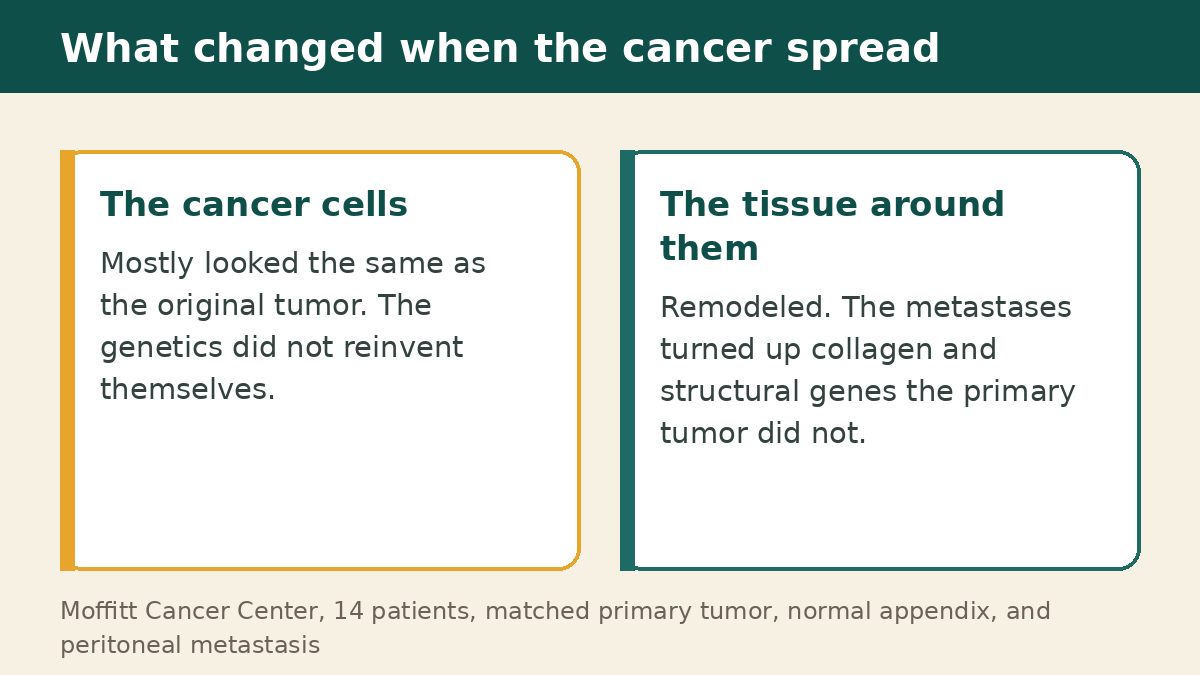
The first finding was reassuring. The metastatic tumors still looked a lot like the original appendix tumor at the gene level. The metastatic cancer kept much of the same gene-expression program as the primary tumor. So the original tumor still reflects much of the biology seen later in the disease.
The tumors were not identical, though. Inside the cancer cells, the metastases turned up the activity of genes tied to collagen and to the internal scaffolding of cells. Once the tumor cells reached the abdomen, they started adapting to their new home.
The surrounding tissue changed too. In both the primary tumor and the metastasis, the stroma showed increased activity in genes involved in making proteins. That is not the behavior of passive scar tissue. It looks more like tissue that is actively helping the tumor along.
The clearest takeaway is not that the cancer cells changed a lot. They did not. The standout difference was a shift toward collagen and the matrix biology around the tumor once the disease reached the peritoneum.
Why the collagen finding matters
Collagen is one of the main structural proteins around a tumor. A dense, collagen-rich environment can make trouble in several ways. It can act as a physical wall that keeps chemotherapy from reaching the cancer. It can make the tumor stiffer. It can help cancer cells survive and push into new tissue. And it can change how nearby immune cells behave.

This fits what surgeons already see in the operating room. Appendix cancer, especially the mucinous kind, often spreads as dense, fibrous tissue mixed with mucus throughout the abdomen. For years the mucus itself got most of the blame for blocking drugs. This study points at another player. The collagen and the surrounding tissue may be part of the problem too.
What the appendix cancer tumor microenvironment means for treatment
Systemic chemotherapy has limited effectiveness for many people with advanced appendix cancer. This study suggests part of the reason may sit outside the cancer cells. If the tissue around the tumor is helping it survive and keeping drugs out, then hitting the cancer cells alone may never be enough.
That opens a different line of thinking. Future treatments may need to target the surrounding tissue as well: the collagen, the stromal cells that build it, and the mesh of proteins around the tumor. Drug companies are already testing this idea in several cancers. Nothing here is a treatment you can ask for today. It is a direction, and a reason to keep studying the tissue and not just the cells.
How this fits with other research
This paper lines up with a study from Dr. JP Shen’s group in 2024, which showed that the lining of the abdomen actively promotes appendix tumor growth rather than just serving as a place for tumors to land. It also adds to earlier work on the mucus barrier. Put together, the picture is that the environment around an appendix tumor is not a bystander. It appears to help shape how the disease behaves.
What I keep in mind about this study
This is early science, and it has real limits. It included only 14 patients. It measured which genes were switched on, not whether those genes actually drive the cancer, so it points to suspects rather than proof. It describes differences. It does not test any treatment aimed at them. And the 14 patients likely spanned different kinds of appendix cancer, but the study did not break the results out by subtype. Low-grade appendiceal mucinous neoplasms, high-grade mucinous adenocarcinoma, goblet cell adenocarcinoma, and signet ring cell carcinoma each behave differently, and this work does not tell them apart. So I read it as a promising clue about the biology, not the final word on any one person’s tumor.
How the registry helps
Studies like this get stronger with more matched tissue and better records. The Patient-Led Global Appendix Cancer Registry collects the molecular, genomics, and pathology details from patient reports. That includes tumor subtype, grade, mutation status like KRAS and GNAS, and notes on fibrosis or dense tissue when the pathology report mentions them. It can also flag when a patient still has tumor tissue stored from surgery. That is exactly the kind of tissue that makes spatial studies like this one possible. Every record adds to what researchers can ask next.
Add your data to the registry
The registry is patient-led and IRB approved. Your pathology and molecular details help build the appendix cancer dataset researchers have never had. Pick the form for where you live.
Join the Registry: United States Join the Registry: InternationalRead more
Appendix Cancer Targeted Therapy: What a New Study of the Drugs Found
Appendix Cancer Mutation Testing: Know What Your Tumor Is Made Of
Appendicure is a patient-led nonprofit. If this work matters to you, you can support the mission here.
Frequently asked questions
What is the tumor microenvironment?
It is the tissue that surrounds a cancer rather than the cancer cells themselves. It includes connective tissue, immune cells, blood vessels, and the mesh of proteins that support the tumor. That surrounding tissue often affects how a cancer grows and how it responds to treatment.
Does this study change my treatment?
No. It is early research on 14 patients, and it does not test any treatment. Standard of care today still follows the 2025 Godfrey and PSM Consortium consensus. The study is a clue about biology, not a new therapy.
Why does collagen matter in appendix cancer?
A dense, collagen-rich environment around a tumor can block drugs from reaching it, make the tumor stiffer, and help cancer cells survive. In this study, the tumors that had spread showed more collagen-related gene activity, which may help explain why drugs can struggle to reach these tumors once the disease spreads, though the study did not test that directly.
Did the study look at different appendix cancer subtypes?
Not separately. The 14 patients likely included several subtypes, but the results were not broken out by type. Low-grade mucinous neoplasms, high-grade mucinous adenocarcinoma, goblet cell adenocarcinoma, and signet ring cell carcinoma each behave differently, and this study does not tell them apart.
Source
Park MA, Jacobson R, Genilo-Delgado M, et al. The Transcriptomic Landscapes of Appendiceal Primary and Metastatic Tumors are Distinct. Annals of Surgical Oncology. 2025;32(5). doi:10.1245/s10434-025-16939-0. PMID 39987388. Moffitt Cancer Center, Tampa, FL.

Leave a Reply