
A major new cancer study found that counting how many mutant copies of a gene a tumor carries, not just whether the gene is mutated, helps predict how a cancer behaves. This idea is called gene mutant dosage. Appendix cancer was not part of the study. Even so, the findings matter to us, because appendix cancer gene dosage points toward the kind of data the patient registry is designed to collect.
I read a lot of cancer research so our community does not have to. Most of it is written for scientists. Once in a while a paper changes the questions we should be asking, even when it never mentions our disease. A study published in Nature Genetics on July 31, 2026 is one of those. It looked at 60,000 tumors and made a simple point that stuck with me. The number of mutant copies of a cancer gene can tell you more than the plain fact that the gene is mutated.
What the study actually did
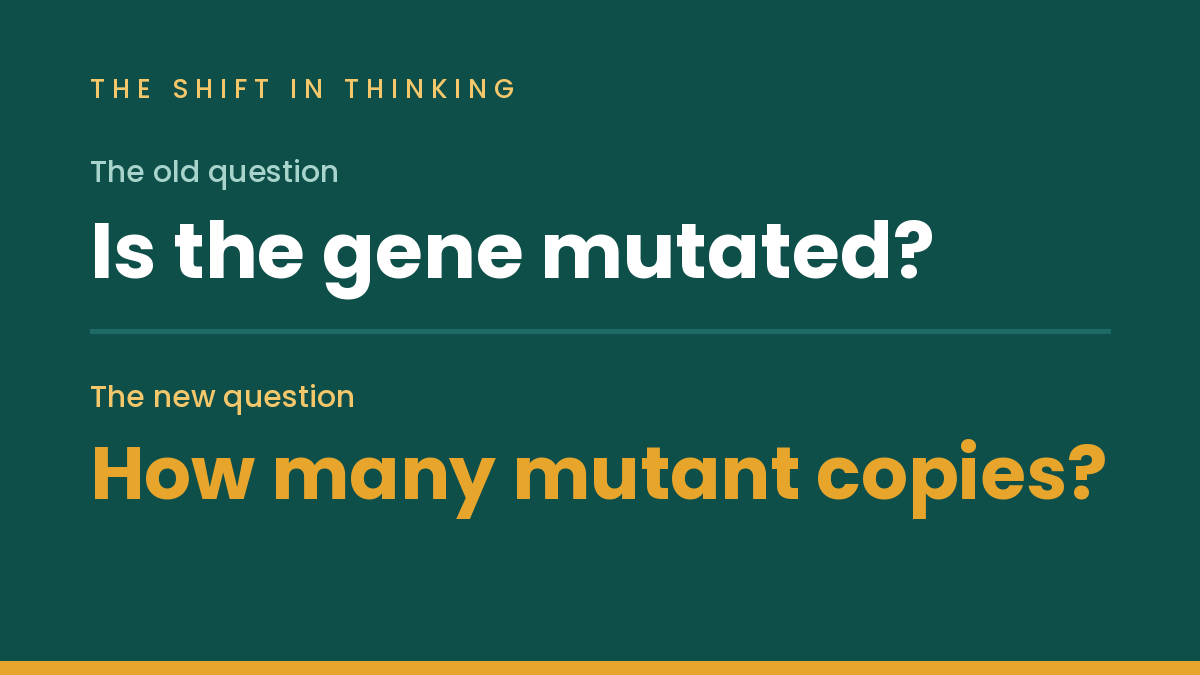
Every one of our cells normally carries two copies of most genes. When a tumor has a mutation in a gene like KRAS, the usual lab report says one of two things. The gene is mutated, or it is not. The authors of this study argue that this misses something important. A tumor with one mutant copy of KRAS is not the same as a tumor with three or four mutant copies. They call this difference gene mutant dosage, and they built a free, open tool named INCOMMON to measure it from the kind of tumor sequencing many patients already get.
They ran the tool across roughly 60,000 tumor samples and more than 500,000 mutations, covering 39 major solid cancer types. That scale makes the findings hard to ignore.
Why counting copies changes the picture
Counting copies matters because of what the extra copies do. Extra mutant copies can make a cancer-driving gene even more active, while losing the normal copy removes an important brake. Together, those changes may help explain why two tumors with the same mutation can behave very differently.
When the researchers sorted tumors by dosage instead of by simple mutation status, the patterns got sharper. Higher mutant dosage tracked with more aggressive disease across many cancer types. It also tracked with a greater tendency to spread, and even with where a cancer was likely to spread. The team flagged dozens of dosage-based markers tied to how patients did over time, to whether a cancer had spread, and to which organ it reached. Many of these signals were invisible when the same tumors were sorted the old way, as simply mutated or not.
KRAS was one of the clearest examples. In pancreatic cancer, tumors carrying more mutant KRAS behaved more aggressively than tumors with a single mutant copy. That matters to us for a reason I will get to.
What appendix cancer gene dosage could mean for us
The genes that drove the strongest dosage effects in this study overlap with the ones seen in appendiceal tumors. KRAS, GNAS, TP53, BRAF, and, less commonly, PIK3CA are among the recurrent genetic changes in appendix cancer. Today most patients are told only whether one of these genes is mutated. Appendix cancer gene dosage asks the next question. How many mutant copies are there, and has the normal copy been lost?
Two patients can have the same KRAS mutation on paper and very different journeys. Some of that gap may come down to dosage. If that turns out to be true for appendix cancer the way it appears to be true in other cancers, appendix cancer gene dosage could one day help explain why similar tumors behave so differently, and help sort out who needs closer watching. It could also shape how future drug trials read tumor genetics, so the question becomes not just whether a patient has a KRAS mutation but how much mutant KRAS is present.
An honest limit. Appendix cancer was not studied in this paper. No appendiceal cancer subtype was analyzed as a distinct group, because there were too few cases within these datasets. That includes goblet cell adenocarcinoma, signet ring cell cancer, neuroendocrine and carcinoid tumors, and low grade mucinous neoplasms. Everything above is a reasonable extension of other cancers, not a finding about ours. This is not a test you can ask for today, and it is not medical advice.
Why this points straight to the registry
The reason appendix cancer was left out is the part that stays with me. It is not that our tumors are boring. It is that no one has pulled together enough detailed genomic data on appendiceal cancers in one place. Methods like this one need copy number and allele information, not just a yes or no on each gene. That is exactly the kind of data the Patient-Led Global Appendix Cancer Registry is built to collect.
This is the direction cancer research is heading. Not just whether a gene is mutated, but how many copies it carries and what the whole tumor is doing. Appendix cancer is not in these studies yet. I believe that will change. When researchers turn this lens on our disease, the only thing that will matter is whether the data is already there to include us. I would rather have it built and waiting than start from zero when that day comes. That is why I keep pushing the registry now, before the science arrives, so we are ready with the data instead of trying to catch up later.
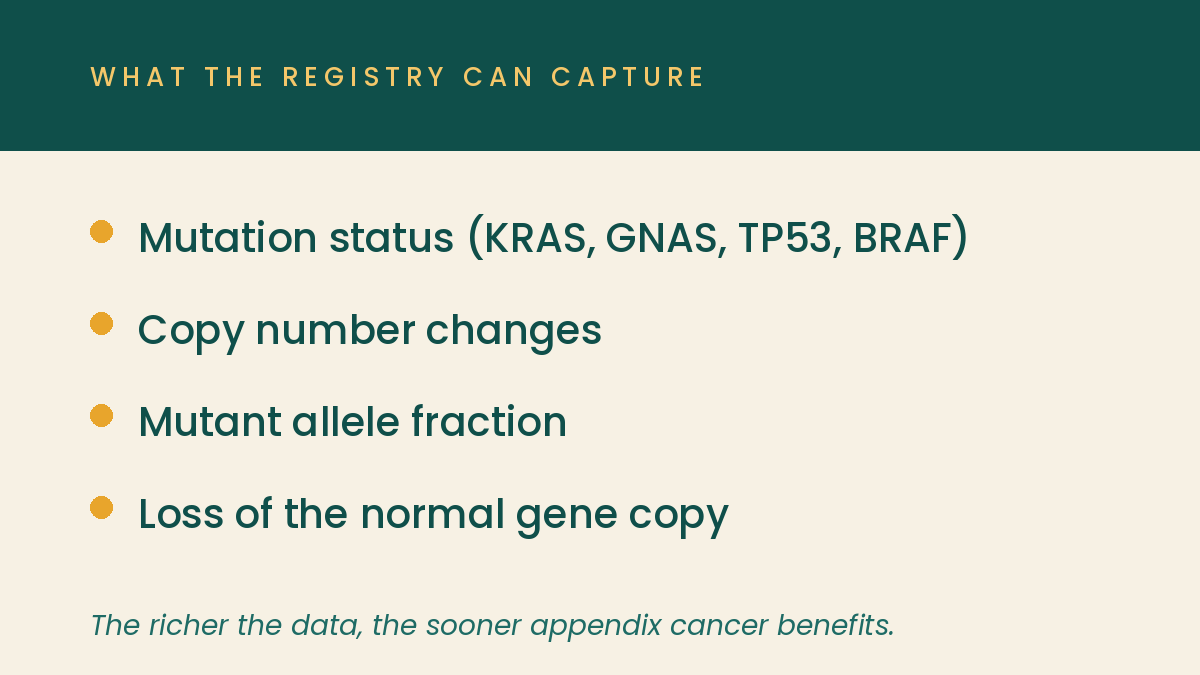
When you enroll and share your molecular pathology and genomic testing reports, you are not just adding a name to a list. You are adding the copy number and allele detail that a future study of appendix cancer gene dosage would need. The more of us who share this level of detail, the sooner appendix cancer can be studied the way these 60,000 tumors were. Our registry is molecular and genomics focused, and this is precisely why that focus was chosen. If you have had tumor testing, even a single genomic report can add information that researchers cannot get any other way.
Add your data to the registry
It takes a few minutes. Sharing your genomic and pathology reports helps build the dataset appendix cancer research has been missing. Pick the form for your location.
Common questions
What is appendix cancer gene dosage?
It is the number of mutant copies of a cancer gene in an appendiceal tumor, along with whether the normal copy has been lost. It goes a step beyond the usual report that only says whether a gene is mutated.
Did this study include appendix cancer?
No. The study covered 39 solid cancer types across 60,000 tumors, but appendiceal cancer had too few cases to analyze. The relevance to appendix cancer is an extension of the findings, not a direct result.
Can I get a gene dosage test right now?
Not as a standard clinical test. The tool used here is a research method. What you can do today is keep copies of your tumor sequencing reports and share them with the registry so this kind of analysis becomes possible for appendix cancer.
Read more
Appendix Cancer Mutation Testing: Know What Your Tumor Is Made Of
The first step. Why knowing which genes are mutated matters before you can ever ask how many copies there are.
Appendix Cancer Tumor Microenvironment: It’s Not Just the Cancer Cells
Another piece of the same puzzle. What surrounds the tumor shapes how it grows and spreads.
Source: Calonaci N, Krasniqi E, Colic D, et al. Gene mutant dosage is associated with prognosis and metastatic tropism in 60,000 clinical cancer samples. Nature Genetics, July 31, 2026. Open access.
Building this registry costs money, and the community funds it. If you want to help this work move faster, you can support Appendicure here.
Leave a Reply