

Short answer: Ibrance appendix cancer research has now run for ten years, and it shows that palbociclib has activity in mucinous appendiceal tumors with GNAS mutations and may slow their growth. It is not a cure. Dr. Andrew Lowy says the next step is pairing it with the new KRAS drugs, and a trial built only for appendix cancer patients is being written right now.
August is Appendix Cancer Awareness Month. I wanted to do something that actually mattered.
Dr. Andrew Lowy and his team at UC San Diego found that a drug already approved by the FDA for another cancer shows real activity against one of the most common mutations in appendix cancer. The drug is palbociclib, sold as Ibrance. It has been treating breast cancer for years. The mutation is GNAS.
It started with one patient who responded far better than anyone expected. His team took that back to the lab, then back to the clinic, and published the results in the Journal of Clinical Oncology. Dr. Lowy calls it a bedside to bench and back story.
For a disease this rare, that is enormous. Most of us are told there is nothing left to try. Ibrance appendix cancer treatment came out of exactly that dead end.
So this month I did not want another lecture. I invited two of Dr. Lowy’s patients to tell him, directly, what his work has meant to their lives.
That is what happened on August 21. Dr. Lowy gave fifteen minutes of slides on twenty years of Ibrance appendix cancer research, and then took questions from the community for the rest of the hour. The full recording is below.
Dr. Andrew Lowy, UC San Diego Moores Cancer Center, August 21, 2026.
Jeremy and Amy went first
Two of Dr. Lowy’s patients opened the night, and I am glad they did. Ibrance appendix cancer treatment started with one of them. The science makes more sense once you have heard from the people it was built on.

Jeremy Kitzhaber served 22 years in the Air Force.

Amy Moeller has been in treatment since 2012.
Jeremy Kitzhaber was diagnosed in early 2014. He had cytoreductive surgery with HIPEC somewhere else, the cancer came back inside a year, and that surgeon told him there was nothing left to try. Another patient pointed him toward Dr. Lowy. He sent his records, got a meeting, and said something he repeated on the call. He was not asking to be cured. He was asking for someone to help him. Dr. Lowy did a debulking surgery in 2016, ran blood work, and found a lead. Jeremy started palbociclib in September of that year and has taken it ever since. In the nearly ten years since, he watched both sons graduate high school, watched his wife and sons graduate college, and dove the Epcot aquarium with his family. He credits the drug and the surgeries for the time.
Amy Moeller was diagnosed in 2012 with pseudomyxoma peritonei that started in her appendix. She has had three cytoreductive surgeries with HIPEC and made it through eleven and a quarter rounds of FOLFOX. Molecular profiling confirmed a GNAS mutation, which is what pointed her care team toward Ibrance as maintenance therapy. She has been on it about a year. Her scans are good, her numbers are down, and she is living a normal life in Southern California with her dog and her family nearby.
Both of them donated tumor tissue during their surgeries. Dr. Lowy said plainly that none of the findings in his talk would exist without patients who agreed to that.
Why Ibrance appendix cancer research started at all
Dr. Lowy trained in surgical oncology at MD Anderson during the early years of cytoreductive surgery and heated chemotherapy. He picked this disease because almost nobody was studying it, and the reasons it was ignored are the same reasons it is hard. A mucinous tumor is mostly mucin and immune cells with only a few cancer cells scattered through it, so grinding up a sample mostly tells you about normal tissue. Mice do not have an appendix, so there is no natural animal model. The cells grow beautifully inside a person and badly in a dish.
His lab got around the first problem with laser capture, which means picking individual tumor cells off a slide one at a time before sequencing them. It takes hours to do a single tumor. What came back was striking. Almost every patient had a mutation in KRAS and a mutation in GNAS. Colon cancer looks nothing like that. RAS is mutated in roughly 40 to 50 percent of colon cancers, GNAS in 2 to 7 percent, and APC in nearly all of them. APC was essentially absent from the appendiceal tumors.
That is the whole argument in one slide. Appendix cancer has been treated with colon cancer drugs because the appendix hangs off the colon. The genetics say it is a different disease.
How Jeremy ended up on a breast cancer drug
Jeremy’s tumor could not be sequenced the usual way. There were too few cancer cells. So the lab used circulating tumor DNA, which picks up fragments the tumor sheds into the blood, and found extra copies of the cyclin D gene. Cyclin D drives cells to divide. It works by binding to enzymes called CDKs. Palbociclib blocks CDK4 and CDK6, and the FDA had just approved it in 2015 for a type of breast cancer. Pfizer agreed to supply it. Jeremy got the drug through the VA because he is a veteran. His CEA had been climbing through chemotherapy. After he started palbociclib it flattened out and mostly stayed there for years.
Then the reason fell apart. Breast cancer data came out showing that extra copies of cyclin D did not predict who responded to palbociclib. Dr. Lowy has a slide he titles “serendipity is more important than smart,” and this is where it earns its name. The drug was working. The explanation was wrong.
His lab built a model called slice culture, where a thin slice of a patient’s tumor stays alive in a dish long enough to test drugs on it. They published it in 2022 as the first human appendix cancer model that could be used to study drug response. When they treated a slice with palbociclib, the dividing cells stopped lighting up. A database from the Broad Institute then showed seven compounds that slowed the growth of GNAS mutant cells, and palbociclib was one of them. Their own patient data matched. GNAS mutant tumors grew slower, and GNAS mutant cells responded to the drug while GNAS normal cells ignored it.
What the 16-patient study showed, and what it did not
That work led to the study that produced the first published Ibrance appendix cancer data: 16 patients with GNAS mutated peritoneal mucinous carcinomatosis treated at UC San Diego between August 2016 and June 2022, 13 of them with appendix primaries. Twelve of the sixteen had already progressed on at least one line of chemotherapy before they enrolled. Thirteen of the sixteen saw their CEA fall, and six of those saw it cut by more than half. Half the group still had stable disease at twelve months. The results were published in the Journal of Clinical Oncology in 2024. The lab also compared each patient’s time to progression on palbociclib against their time to progression on whatever they took before it, which uses each person as their own control, and the ratio favored palbociclib.
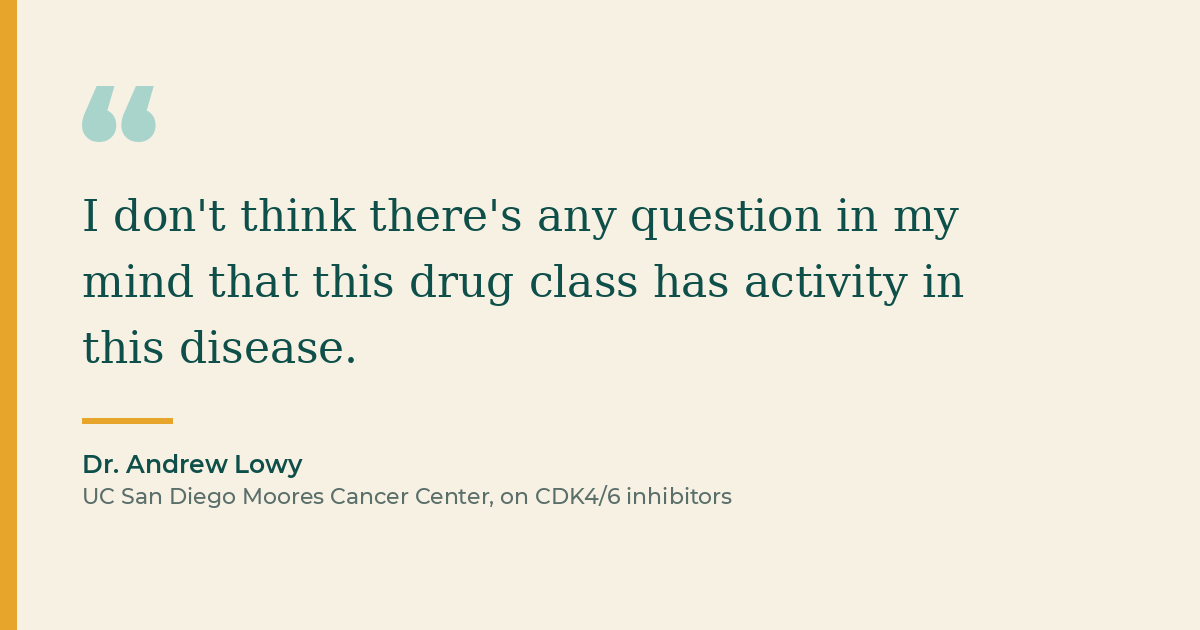
I asked him directly what that proves. He was straight about it. There is no control group, so it is not a comparative study, and this disease can sit still for a while on its own. What he leans on instead is that the trial did not stand alone. The tumor slices in the dish stopped dividing under the drug, the response tracked with GNAS status, and an independent Broad Institute dataset pointed the same way. Add the anecdotal experience of patients around the country taking it now, and he said the drug class clearly has activity. What he cannot tell you yet is how long the average person stays stable on it.
He framed the decision as a risk-benefit scale. Modest benefit for high risk is out of balance. Modest benefit at very little cost to the patient is worth delivering. Ibrance appendix cancer treatment sits in that second category, and both Jeremy and Amy said their quality of life on it has been good.
One honest limit. CDK4/6 inhibitors are cytostatic. They stop cells from dividing, they do not kill them, and any cancer on one drug long enough eventually learns to grow around it. Dr. Lowy called this a stepping stone, a beginning and not an ending.
KRAS is the next target
Mucinous appendix cancer has one of the highest G12D rates of any tumor. More than half of KRAS mutations in this disease are G12D. G12V is next. G12C, the one with drugs already approved, is only about 1 to 2 percent. For decades KRAS was considered undruggable. There are now more than 60 KRAS drugs in clinical trials.
The one closest to the finish line is daraxonrasib, a pan-RAS inhibitor that is still investigational. It hits G12D, G12V, G12R and the rest, and it also blocks normal KRAS, which is why patients without a RAS mutation appeared to benefit in the pancreatic studies. Dr. Lowy expects RAS testing will not even be required for it. He said he expects FDA approval in pancreatic cancer within the next couple of months.
In his lab, a RAS inhibitor slowed tumor growth in mice carrying human appendiceal tumors and cleared most of the dividing cells in slice culture. He was careful about this. It was not a home run and it did not eliminate the tumor. What did look like a home run was the combination. Palbociclib alone cut proliferation, the RAS inhibitor alone cut it about the same, and the two together produced true synergy on the math. Dr. J.P. Shen’s group has reported RAS inhibitor activity that matches those findings.
All of that appendiceal RAS data is preclinical. It is mice and tumor slices, not people. The trial that changes that is already being written. UC San Diego and MD Anderson are building a small study for mucinous appendix cancer patients only, the protocol is under review at Revolution Medicines, the company has agreed to support it, and it cannot open until daraxonrasib is approved. Realistically that means early 2027.
There is a reason for the caution. If a drug kills tumor sitting on the small intestine quickly, it could cause a perforation. It is theoretical. It is also exactly why you run a safety study in this disease instead of assuming pancreatic cancer results transfer.
The insurance problem is a guidelines problem
Insurers lean on NCCN guidelines to decide what they will pay for, and Ibrance appendix cancer treatment is not in them. Some patients get covered anyway, because the system is uneven. Dr. Lowy wants the guidelines changed instead, and he hopes it happens within a year. He said the treatments sitting in those guidelines now are there because they have been done for years, not because science supports them, and he would argue his palbociclib dataset has more depth than anything currently listed.
Worth knowing that there are now appendix-specific consensus guidelines from Godfrey and the PSM Consortium, rather than relying solely on colorectal cancer protocols. The gap between what specialists know and what insurers read is the whole fight.
Getting there takes numbers. UC San Diego is pulling every Ibrance appendix cancer patient they have treated, well beyond the 16 in the paper, into a real-world dataset. MD Anderson is gathering theirs. The Appendicure Patient-Led Data Registry is gathering yours, and Ibrance appendix cancer records are exactly what it needs. The registry is not a side project. It is the evidence that makes the coverage argument.
Questions from the community
If my tumor could not be sequenced, am I shut out of Ibrance?
No. Dr. Lowy said some tumors simply cannot be sequenced, and several patients on his trial were included because the tumor’s appearance and behavior made a GNAS mutation highly likely. It is harder to get the drug approved without a documented mutation, and he has done it successfully. A clean sequencing result showing no GNAS mutation is a different situation than a failed test.
What about celecoxib added to palbociclib?
Reasonable to ask, weak on evidence. Celecoxib has shown mild effects in colon cancer and can reduce mucin production in cell culture. Jeremy took it. Dr. Lowy called it relatively low risk if you are monitored, since it can cause ulcers and kidney damage, and something to raise with your own oncologist. He is looking for stronger tools.
Can I take a KRAS inhibitor and Ibrance together?
Not yet, and not on a trial. Ibrance appendix cancer patients have been on their drug for years, but only a handful of people nationally have had a RAS inhibitor at all. Single agent activity has to be understood before a combination can be tested. And when you enroll on a clinical trial, the trial drug is the only cancer therapy you take. He was blunt that this is not red tape, it is the only way anyone learns anything.
Does progression on an earlier treatment disqualify me from a trial?
No. Early phase trials are built almost entirely for patients who have progressed on prior therapy. He called it a non-issue.
What makes someone a candidate for a second or third CRS/HIPEC?
Whether the disease can actually be removed, and what happened after the last one. If it came back in six months, repeating the same operation makes little sense. If someone went a couple of years and has a limited recurrence, it may. If you cannot get all the disease out, HIPEC adds little.
Is any of this being studied in goblet cell or high-grade tumors?
Yes, and it is early. Dr. Lowy’s lab recently developed a high-grade model and those experiments are running now. Everything in his talk covers mucinous appendiceal neoplasms and pseudomyxoma peritonei. It does not cover goblet cell adenocarcinoma, signet ring cell, or neuroendocrine tumors of the appendix. He was also honest about why the rarest subtypes lag. Fewer than a thousand goblet cell cases a year is not a market, so rare diseases tag along behind pancreatic, lung and colon.

What I asked everyone to do
Three things, and I meant all of them. Donate money, because nobody else is paying for Ibrance appendix cancer research and federal funding for a disease this rare is hard to come by. Donate tissue and put your data in the registries, all of them, because every dataset that grows makes the case stronger. And keep educating the doctors who miss this cancer. General surgeons, ER physicians, GI doctors and OBGYNs are the people who see it first and often do not recognize it.
Jeremy is proof that one patient’s tumor sample can change what is possible for everyone who comes after. When he swallowed the first pill there was no Ibrance appendix cancer data at all, and nobody could tell him whether it would work. There is data now, and ten years of it.
Join the Patient-Led Data Registry
The registry collects molecular, genomic and pathology data from appendiceal cancer patients worldwide. It is IRB approved and exempt. Your record helps build the evidence needed to change guidelines and improve access to treatment.
Research costs money that does not arrive on its own. Donate to Appendicure here.
Read more
This post summarizes a live Q&A and is not medical advice. Talk to your own oncologist about anything here. Nothing in this recap covers goblet cell adenocarcinoma, signet ring cell carcinoma, or appendiceal neuroendocrine tumors.
Leave a Reply