

Appendix cancer nutrition is one of the biggest questions caregivers face, and no one hands you a manual. When Judi Moore told me her husband’s story, she kept coming back to one thing: she couldn’t find a single nutritionist who understood what George’s gut was now doing. She went back to school to become one herself.
George Moore was 45 when a routine appendectomy in 2007 turned up pseudomyxoma peritonei (PMP), a rare cancer that usually starts in the appendix. Since then, he has had two CRS/HIPEC surgeries and spent three years on IV nutrition. His wife and caregiver, Judi, is joining the Appendicure community for a live Q&A on October 22 to talk about appendix cancer nutrition and how they got through it.
I have Google alerts set for appendix cancer, and George and Judi’s names came through because they had just released a memoir, No Guts, His Glory: A One-in-a-Million Cancer and the Faith That Carried Us Through. The book tells the story from both sides, George as the patient and Judi as the caregiver. I ordered it and asked Judi for a call. We talked for more than an hour. I was late to my next meeting and would have kept going.
The Moores live outside Richmond, Virginia. They have been married more than forty years and have four grown children and nine grandchildren. Their faith runs through the whole book, and through everything Judi told me.
A routine surgery that wasn’t
In 2007, appendix cancer was sorted into far fewer groups than it is today. George’s abdomen was full of mucin, and his doctors thought it had probably been growing for five to ten years before anyone found it.
George and Judi talked to five surgeons before choosing one, including Dr. Paul Sugarbaker. They went with Dr. Perry Shen, a surgical oncologist at Atrium Health Wake Forest Baptist. He is a different Dr. Shen from Dr. JP Shen at MD Anderson, who sits on the Appendicure board. Judi told me one reason they chose him was that he never brushed off what they were trying outside the hospital. He wanted to hear about all of it.
The first surgery took 18 hours, with heated chemotherapy washed through George’s abdomen at the end. George lost five organs, including his stomach, large intestine, gallbladder, spleen and omentum.
Appendix cancer nutrition after short bowel syndrome
Losing that many organs created problems no one on the care team was fully prepared to walk them through, and it changed how George would need to eat for the rest of his life. His small intestine now does work that used to be spread across several organs. A lot of sugar passes straight through him, and he can’t handle much fat. He spent three years on TPN, which is nutrition fed straight into the bloodstream through an IV, while his body adjusted. He lived with an ostomy for the first year.
Judi went through nutritionist after nutritionist and couldn’t find one who understood severe short bowel syndrome. So she went back to school. She is now a Certified Health and Nutrition Coach (AADP) and runs a practice called Moore Healthy Living. Appendix cancer nutrition after CRS/HIPEC isn’t a topic most dietitians have ever seen in training, and that gap is what pushed her to become one.
When it was time to reverse George’s ostomy, his surgeon warned them that scar tissue was the one thing that could stop it. Judi remembers the surgery being scheduled for four hours and finishing in two. She says Dr. Shen came out and told her George’s abdomen was free of adhesions, that he only had to put everything back and close, and that he had never seen that before. Judi credits the high doses of vitamin C she gave George during that time. Nobody can prove why his abdomen stayed clear. Scar tissue is a real problem after CRS/HIPEC, though, because it can make later surgery harder or rule it out, so it’s worth asking your own surgical team about.
Three tumors that sat still for nine years
A few years after the first surgery, three small tumors showed up on George’s scans. George had no symptoms, so Dr. Shen decided to watch them instead of operating. George was scanned every six months, and for nine years the tumors didn’t grow.
In January 2019 one of the tumors ruptured and pushed out through his abdominal wall with a serious infection. He spent about two months at Wake Forest while the infection was cleared, then had his second CRS/HIPEC. This time the surgeons only had to remove the tumors, because nothing else had been invaded.
Rising numbers and what they tried
After his second CRS/HIPEC, George’s CEA tumor marker ran above the lab’s normal range. CEA is a protein in the blood that can rise when some kinds of cancer are active. It’s not a perfect test, especially in appendiceal cancer, but it’s one data point the care team watches over time.
A family member told Judi about ivermectin, the antiparasitic drug, and Judi found a published paper on it and cancer. Before she acted on it, she took the paper to Dr. Shen and asked for his approval. He agreed. Judi then brought the paper to George’s primary care doctor, who read it and prescribed George a dose based on his weight.
His CEA trend from his chart at Atrium Health Wake Forest Baptist looks like this:
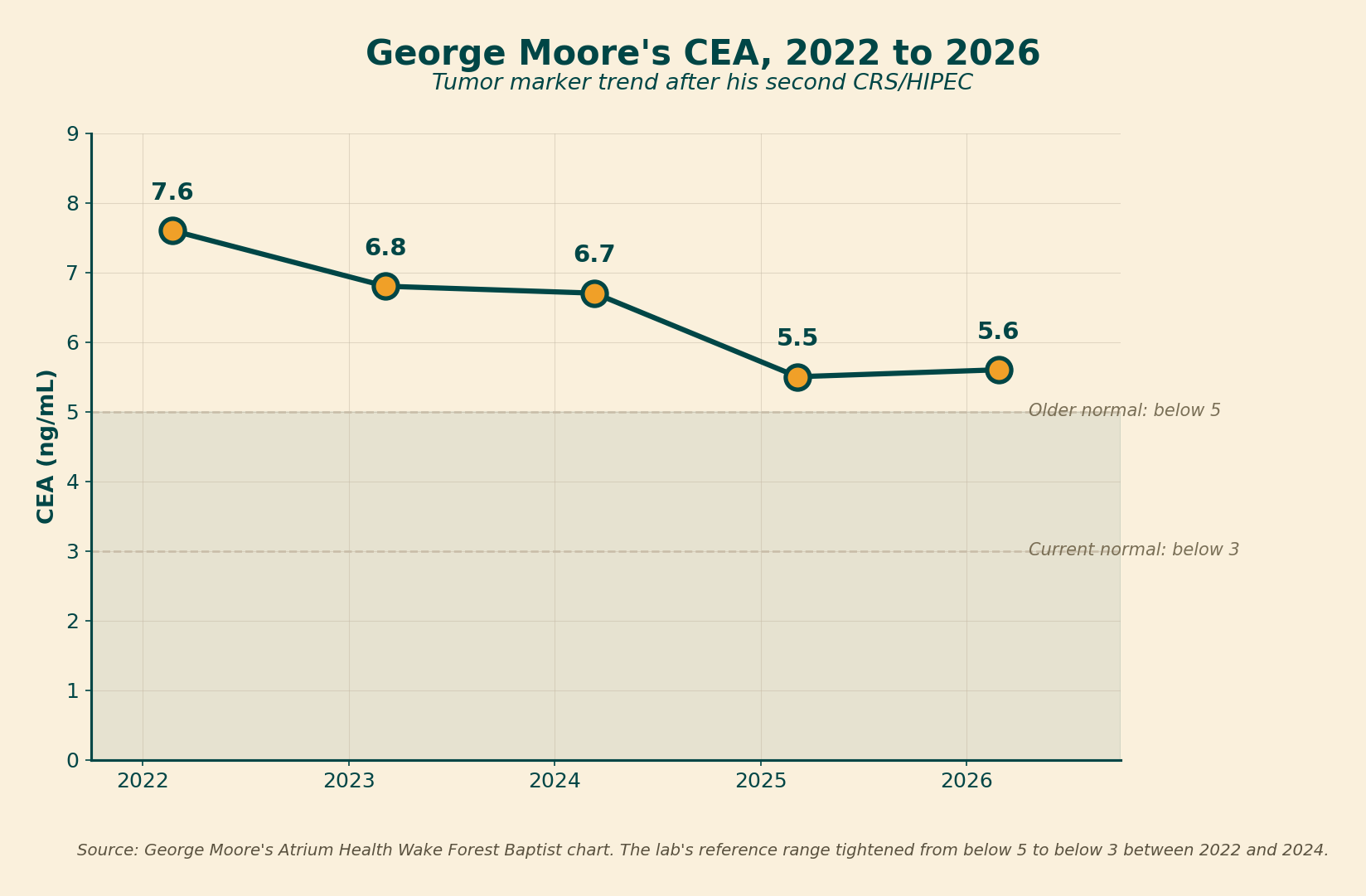
In February 2022, his CEA was 7.6, flagged High against the lab’s then-current normal of 0 to 5. By March 2023 it was 6.8, and by March 2024 it was 6.7. By then the lab had tightened its reference range to below 3, so those same values were still called High. In March 2025 his number dropped to 5.5, and in February 2026 it was 5.6. His baseline now sits in the 5 range.
This is one man’s experience, and I’m going to be careful with it. No clinical trial has tested ivermectin in appendix cancer, and the cancer research on it so far has been mostly in lab cells and animals. George’s tumors also sat still for nine years at one point with no treatment at all, which tells you his cancer grew slowly. His subtype is LAMN.
What his story does show is how Judi went about it. She asked George’s oncologist for his approval first, then brought the paper to their primary care doctor, who chose the dose, and Dr. Shen kept watching with scans the whole time. That is very different from buying a protocol online from someone selling miracle stories, which I’ve written about before. If you’re thinking about any drug or supplement, tell your oncologist first, even if you’ve already made up your mind. Some supplements interact with chemotherapy.
Why appendix cancer nutrition matters to our community

Members ask me about diet and supplements all the time, and I haven’t lived with this for nearly twenty years. Judi has. She has cooked for someone missing most of his gut, managed TPN at home, sat through two huge surgeries and watched tumors for nearly a decade. Appendix cancer nutrition is her lived expertise, not something she read in a textbook.
Judi’s coaching work includes nutritional supplements, and she is an independent brand partner with a supplement company. I’m telling you that up front so you can weigh what she says with that in mind. Appendicure doesn’t sell or endorse any supplement brand, and I personally don’t endorse ivermectin or any specific supplement protocol. I’m sharing Judi’s story because so many people in our community have asked about both, and I’d rather we have the conversation openly, with a real caregiver who’s lived it, than let patients navigate it alone.
Join the live Q&A
Nearly Twenty Years, Two CRS/HIPEC Surgeries, Still Here
Judi Moore shares her experience caring for her husband through PMP, surgery, and short bowel syndrome.
Thursday, October 22, 2026
6:00 – 7:00 PM Eastern
Bring your questions about appendix cancer nutrition, recovery after CRS/HIPEC, short bowel syndrome, home TPN, ostomies, and living with slow-growing appendix cancer.
You can find their book, No Guts, His Glory, on Amazon and learn more at nogutshisglory.com.
Frequently asked questions about appendix cancer nutrition
Can someone live nearly twenty years after a PMP diagnosis?
Many people do. George Moore was diagnosed in 2007, has had two CRS/HIPEC surgeries, and is still living with the disease nearly twenty years later. How any one person does depends on their subtype, grade and treatment, so ask your own care team what applies to you.
What is short bowel syndrome after CRS/HIPEC?
When surgery removes a large part of the intestine, the body can’t absorb enough nutrients from food. Appendix cancer nutrition becomes a daily challenge, and some patients need IV nutrition called TPN while the remaining gut adapts. For George, that took three years.
Does ivermectin treat appendix cancer?
No clinical trial has shown that ivermectin treats appendix cancer. There is no test that has measured Ivermectin alone without surgery and clinical treatments like chemo. Research so far is mostly in lab cells and animals. George’s family used it with his oncologist’s approval and a doctor’s prescription, and one person’s result when combined with surgery and chemo can’t show whether it works. That said, there are a lot of FDA approved drugs sitting on the shelf that could work, but haven’t been tested in our cancer.
Keep reading
What is pseudomyxoma peritonei (PMP)?
A plain-language explainer on George’s subtype, how it behaves, and how it’s treated.
The Retracted Fenbendazole Study, and How to Check Papers Yourself
What to look for before you trust a social-media claim about an antiparasitic drug and cancer.
Join the registry
The Appendicure Patient-Led Global Appendix Cancer Registry collects pathology reports and tumor mutation data from patients around the world so researchers can find better treatments.
US residents · International (non-US) · Update an existing record
Leave a Reply