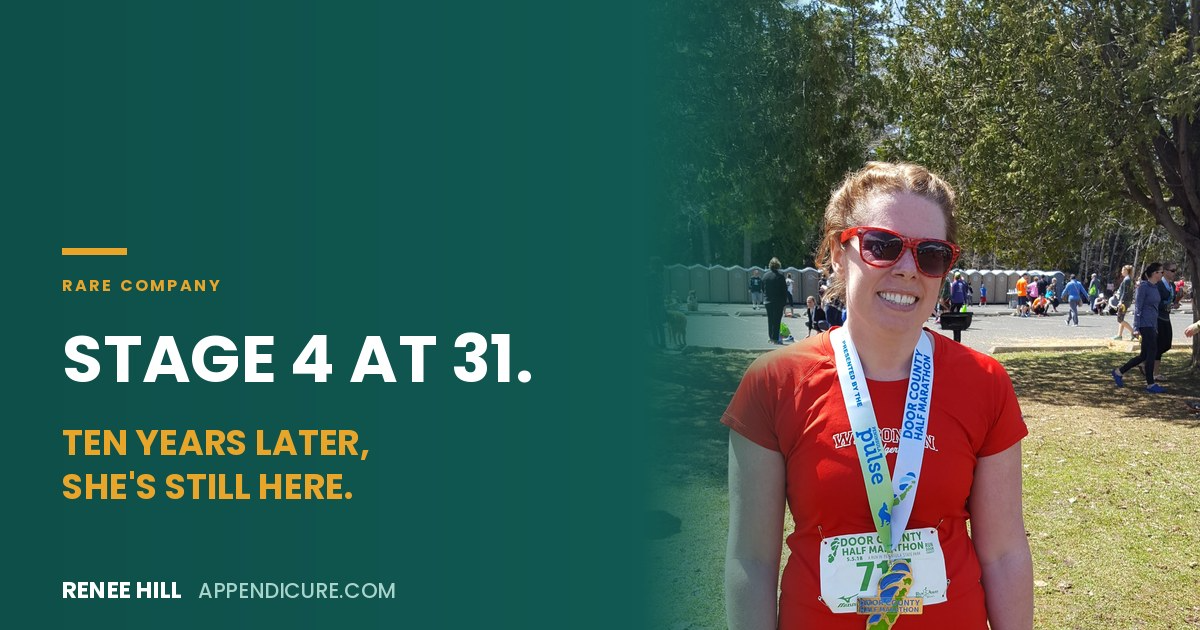

Renee Hill is an appendix cancer survivor who was diagnosed at 31 with stage 4B mucinous adenocarcinoma of the appendix with signet ring cells. Her cancer returned in her liver in 2020, and she has had no evidence of disease in the six years since that surgery.
Renee is flying to Italy this afternoon. Ten days with her brother and his kids on the coast, and she is working part of the trip, which she does not seem to mind doing from there. She was 31 when a surgeon looking for ovarian cancer found something else.
She is on the Appendicure board of directors. She is also a Senior Manager of Research Administration at the Versiti Blood Research Institute, which means she reads data for a living.
Watch my full conversation with Renee
An appendix cancer survivor who almost explained her symptoms away
It was the summer of 2016. Renee was training for what would have been her twenty fifth half marathon. She was working with a personal trainer. She was kayaking. She was, by any measure she had, in excellent shape.
She also could not drink a beer without feeling like she had eaten a full meal. She sat at a beer garden with friends and made a joke about it. Something must be wrong with me, she said, I can’t drink beer. It turned out to be every carbonated drink, and then food too. Small amounts filled her up completely.
And she had a belly that would not go away no matter how many miles she ran. Nobody knew what it was until they opened her up. It was full of mucin.
Every single one of those things had an easy explanation, and she used all of them. She told herself it was her menstrual cycle. She told herself she was bloated because she had just run twelve miles in eighty degrees and eighty five percent humidity. She looked for a pattern and could not find one.
“It was easy to talk away the symptoms. I wasn’t feeling good because of X, Y, or Z. But when none of it changed.”
Renee didn’t actually decide to go to the doctor. She already had her annual exam on the calendar. What she did do was add her questions to the check in form, in the box that asks what you want to discuss. She wrote it down instead of letting it go.
Her primary care doctor first suggested probiotics. Then she did the pelvic exam, felt that something was off, and ordered an ultrasound. From that appointment to the operating room was two weeks.
The surgery she went in for, and the one she woke up from
The ultrasound showed something on her ovaries. She was sent straight to a gynecologic oncologist, who explained that ovarian cysts fall roughly into benign, malignant, and something in between. Hers looked in between. It had to come out either way.
Because she was 31, the consent form was full of conditions. If this, then that. They were trying to protect her fertility.
Once the gynecologic oncologist opened her up, she knew immediately that this was not a gynecologic cancer. She called in a second surgeon with more expertise in what she was looking at. Renee was at a high volume hospital, and the pathology came back that same day. Appendix cancer.
She was never misdiagnosed. Not once, not for a day. If you have spent any time in our community you know how rare that sentence is. So many women with appendiceal tumors are treated for ovarian cancer for months or years before anyone says the word appendix.
They removed her ovaries, her appendix, and the mucin. Then they deliberately stopped. Her surgical team already understood that she would need cytoreductive surgery with HIPEC later, and they did not want to make that operation harder.
She woke up in a hospital room she can still picture. To this day she does not remember whether it was a parent or a doctor who told her.
“One, it was kind of like, that’s a cancer, because most of us have never heard of it.”
The final pathology was stage 4B mucinous adenocarcinoma with signet ring cells. High grade. Fast growing. In her words, all the bad things. The only thing she had going for her, she says, was her age.
Chemo, hair, and the part nobody warned her about
The timing was awkward in a way that turned out to matter. Dr. Kiran Turaga had just left the Medical College of Wisconsin, and the surgeon trained in this disease who replaced him, Dr. Harveshp Mogal, did not start until September 1. Dr. Mogal now directs the HIPEC program at UW Medicine and Fred Hutchinson Cancer Center in Seattle. Renee’s line about him was simple. I love the man.
She had scheduled six weeks off work. She healed well enough to start chemotherapy at four. In between, she went to New York for a wedding and met her baby niece, who had been born a month before her diagnosis. Not meeting that baby had been one of her biggest fears. She went in an abdominal binder and got tired walking across rooms, and she went.
Then the port, then chemotherapy, and she worked through all of it. She carried her own insurance and she was her only income. She had no other option, and she says plainly that she knows how lucky she was to have a flexible employer, paid leave, and a boss who let her work from home on Fridays in 2016, when almost nobody did that.
She started on FOLFOX. It held her tumor burden steady but nothing shrank. After five rounds they added irinotecan, moving her to FOLFIRINOX, and that combination was much harder on her body.
It also took her hair, and she did not see it coming. She had been told FOLFOX probably would not, and either nobody told her the new regimen would or she was too overwhelmed to hear it.
“I found losing my hair an incredibly traumatic experience. Because for the first time I looked sick.”
She never shaved her head. She refused, and would not let anyone else do it either. She let her mother trim it once it got really thin, so it would sit better under a wig. She also learned something she had no reason to know at 31, which is that a cancer center can write you a prescription for a wig so your insurance will cover it.
She got through Thanksgiving in Seattle by giving herself white blood cell shots that had to be mailed to her, which is a lot to ask of someone who used to pass out at routine blood draws. She says now that she probably should have gone to an emergency room that week, and that she flat out refused. Her father, a retired emergency physician, was on the phone with her surgeon, and between them they set a fever number that would have ended the argument. She never went. She almost skipped everything that Thanksgiving and was there for all of it.
Twelve hours, five weeks, and forty pounds
Her cytoreductive surgery with HIPEC was January 20, 2017. It took twelve hours.
Her parents waited all day. Friends brought them coffee and sat with them, things Renee only learned about later. Her surgeon came out himself with updates instead of sending someone. Her parents still talk about it.
By then she had already lost her appendix and ovaries. In this surgery they took her spleen, her gallbladder, her omentum, part of her colon, and her uterus, completing the hysterectomy. They did something with her intestines she cannot fully recall.
“Basically, if you don’t need it, I don’t have it.”
Her surgeon made one more decision that I want people to notice. He could have gone a step further, but that step would have left her with an ileostomy and it would not have improved her score. He weighed the fact that she was an active 31 year old, and he did not do it.
The epidural never happened. She has a hard time with needles, and she passed out before they could place it. She had epidurals for her other operations, but not for the biggest one. She was still heavily medicated for pain, just without the block she was supposed to have.
They told her ten to twelve days in the hospital. She was there five weeks, with two discharges and readmissions in between. She picked up a hospital infection nobody could identify, which brought in the entire infectious disease department, and along the way they discovered she is allergic to a whole class of antibiotics. She went home on IV antibiotics. She was in bed so long that she needed trigger point injections for back pain.
She could not eat. She got full almost immediately, and a dietitian came every day. She lost somewhere in the range of forty to fifty pounds and got down to a weight her team considered dangerous. Her clothes fell off her and she cried, because none of it was healthy.
She was angry at her parents, at her doctors, at everyone. She is still annoyed about the therapist who tried to talk to her with her parents in the room, which she points out is not okay for a teenager and is definitely not okay for a thirty year old woman. She did not want to get up and walk, and she knew perfectly well that she needed to get up and walk.
“At this point, there’s so little control you have over anything.”
Eight weeks after that surgery she was back at work, doing partial days, with her parents driving her so she would not spend her energy on the commute. She spent part of those days lying on the floor under her desk, because sitting in a chair was hard and her abdomen and back were weak.
Recovery was walking up and down her own street. One block, then two, then paying for it the next day if she pushed.
“People throw around that recovery isn’t linear, but it’s so, so true. You can feel really good one day, but then if you overdo it, everything would hurt.”
About fifteen months later, a half marathon
The race she had been training for when she was diagnosed was going to be her twenty fifth. She never ran it.
On May 5, 2018, about fifteen months after the twelve hour surgery, she went back to Door County and ran the same half marathon she had run the two years before. The Medical College of Wisconsin was marking its one hundred twenty fifth anniversary, and Renee volunteered her own story for it, so a video crew came. Her medical oncologist drove up with his wife. Her surgeon could not make it and sent a video.
 Door County, Wisconsin, May 5, 2018. The slowest half marathon she ever ran, and the one she finished anyway.
She started with friends and told them to go ahead. Then it got hard.
“I have to finish this. There are people here, my mom is here, my friends are here, my doctor is here.”
It was by far the hardest and slowest half marathon she ever ran. She finished it.
I told her I used to think people who ran marathons did not get cancer. Her answer was flat and immediate. Cancer does not care how old you are, how fit you are, any of it.
January 2020: a job offer and a recurrence, on the same day
Because her cancer was high grade and fast growing, her team scanned her every three months. Renee was fine with that. Surveil me, she said. Her tumor marker, CEA, tracked her disease reliably, which is not true for everyone.
Her surgeon gave her an instruction she still quotes. Go live your life and leave the worrying to me.
She said yes to almost everything after that, because a year had been taken from her. The only thing she put off was her MBA, and only for a year. She started it in 2018.
In early January 2020 she was driving home on the freeway in Milwaukee when her nurse practitioner called and asked if she could talk. She can still picture the exact spot on the road. Her CEA was elevated for the first time in three years, and there were two tiny tumors on her liver. The pathology was identical to 2016. Same cancer, unchanged.
The same day she found out, she got a job offer.
So she walked into a brand new job and, on day one, told her new boss she had cancer again and needed every other Friday off. She had already decided how the rest of it would go. No treatment before February 1, because she was switching insurance and was not paying two deductibles. Chemotherapy on Fridays, because she had class Tuesdays and Thursdays and she was in the last semester of her MBA.
“If I have to do this again, I’m taking control of it this time.”
They put her on FOLFIRI and deliberately left out the oxaliplatin so they would not add to her neuropathy. She had three rounds before the world shut down.
Because she has family in Italy, she saw COVID coming before most Americans did. When her cancer center stopped allowing anyone to come in with patients, she happened to be between treatments, so she got to have her breakdown at home. Walking into an empty cancer center was eerie. It was also quieter, and she got a private room, and she video called her brother and her niece from the chair.
That spring she bought a season pass from a local kayak company, because kayaking was outdoors and naturally distanced and it was more or less the only thing available. In her words, she got her money’s worth out of May and June.
Her blood work improved. The liver tumors did not shrink. Her surgeon brought in a liver surgeon.
Surgery was June 20, 2020. When she woke up and saw the clock, she panicked, because so little time had passed that she assumed they had not been able to do it. The opposite was true. It was easier than anyone expected. Nothing was hiding that the scans had missed. They used part of her existing scar and she was home in five or six days.
Then she felt terrible again and ended up back in the hospital with a bowel obstruction, which her team attributed to scar tissue coming loose. She has a body full of it. She has been NED since, six years now.
What ten years out actually looks like
For the first five years after that surgery, scans every six months and blood work every three, so anything off would trigger an earlier scan. Now she is scanned once a year, and her team alternates or combines CT and MRI, partly to keep her lifetime radiation exposure down. She has had so many CTs she cannot count them.
She changed primary care doctors a few years ago and found one who specializes in caring for people after cancer treatment. Her original doctor took her seriously and got the whole thing moving, and Renee credits her for that. But afterward Renee felt she did not understand what had actually happened to her body, and she went looking for someone who did. I did not know that was a thing. It is worth asking for.
She does not need an OBGYN anymore. The only long term medication she takes is estrogen, after going through surgical menopause young. There are very few foods she cannot eat, which she finds a little shocking given what is missing.
She turned 40 last year and threw a big party, because she did not think she would get there.



Skiing, hiking, kayaking. She is missing a spleen, a gallbladder, an omentum, part of a colon, and her reproductive organs. This is what ten years looks like.
“I see every birthday as just something to celebrate, because tomorrow is just not promised to any of us. I’m grateful I get to age.”
Why she reads data differently than most patients
Renee never asked her doctors for survival numbers. Her parents did, and she found that out later.
She did not want to know, and she had a second reason on top of the fear. She understands data better than most people. She knew that anything published was already years old by the time she could read it, and that there was essentially nothing published about thirty year olds with her disease.
“I’m not a statistic and this data isn’t about me.”
She has a point. The numbers matter, but they cannot tell an individual patient exactly what is going to happen to them.
Why she is still here doing this
Plenty of people finish treatment and never want to think about it again, and I think every appendix cancer survivor feels that pull at some point. Renee did it for a while. She left the Facebook groups. She stepped away because she could not carry it.
She came back, and she recently joined the Appendicure board, for two reasons.
The first is that nobody knows this disease exists. Renee put it in numbers. Colon cancer counts about 150,000 new cases a year. Appendix cancer counts 2,000 or 3,000. Renee’s point was that you cannot even compare the two, and that difference is why awareness has to keep being built by the people who lived it.
The second is what she has watched happen in ten years.
“What I’ve seen change in these 10 years is amazing. The research and the science and the care that didn’t exist 10 years ago that does today is fascinating.”
She has enrolled in every study she qualifies for. Some are appendix cancer specific and some are for young adults with cancer, because she believes people diagnosed in their thirties fall into a gap. The category is called adolescent and young adult, and as she put it, she was 31 and did not relate to a 19 year old. She did not relate to a 65 year old either.
The Patient-Led Global Appendix Cancer Registry exists for the same reason. No single hospital sees enough of us.
What Renee would tell herself at 30
I asked her what her forty year old self would say to her thirty year old self. She did not have a speech ready.
“You’re stronger than you think you are. You’re surrounded by a lot of really good people. And while you think cancer might be your whole life, it’s not.”
She spent much of her thirties dealing with this. She is spending her forties traveling, going to concerts, and doing what she wants to do, because she already knows what it feels like to have that taken away.
One honest note. Renee had high grade mucinous adenocarcinoma of the appendix with signet ring cells. Her course is not a map for low grade appendiceal mucinous neoplasms, goblet cell adenocarcinoma, or appendiceal neuroendocrine tumors, and it is not a prediction for anyone else with her own subtype. One person’s story does not set anyone else’s. Decisions about surgery, chemotherapy, and surveillance belong to you and your team, and the standard of care reference for appendiceal disease is the 2025 Godfrey consensus guidelines.
Questions people ask about being an appendix cancer survivor
What does NED mean?
NED stands for no evidence of disease. It means that scans, blood work, and exams do not show cancer right now. It is not the same as cured, and it is why surveillance continues.
What is mucinous adenocarcinoma of the appendix with signet ring cells?
It is a form of appendix cancer that produces mucin, a thick jelly like substance that can spread through the abdomen. Signet ring cells are a specific cell shape pathologists look for under the microscope, and their presence generally puts a tumor in the high grade category.
What does surveillance look like ten years after appendix cancer?
It varies by person and by subtype. In Renee’s case it was scans every three months at first, then every six months for five years with blood work every three months, and now one set of scans a year using CT and MRI. Her team watches her CEA tumor marker, which tracks her disease reliably. That is not true for every patient.
Can you run again after cytoreductive surgery with HIPEC?
Some people do. Renee finished a half marathon about fifteen months after a twelve hour cytoreductive surgery, and she is clear that it was the hardest and slowest race she ever ran. Renee’s team told her three to six months, and getting back to athletic activity takes longer than that. Ask your own surgical team what is realistic for you. Building strength before surgery, sometimes called prehab, can help.
Why does it matter where you are treated?
Renee’s gynecologic oncologist recognized during surgery that she was not looking at a gynecologic cancer, called in a colleague with the right expertise, and had a pathology answer the same day. Appendix cancer is frequently mistaken for ovarian cancer in women. Centers that see this disease often are more likely to identify it quickly and to plan a first operation that does not compromise a later cytoreductive surgery.
Read more
Signet Ring Cell Appendix Cancer: Christine’s Story of Six Surgeries and Hope
A Marathon, Not a Sprint: Amy’s Appendix Cancer Story
Bowel Obstruction After HIPEC: What Research Shows and What Patients Experience
Renee joins every study she qualifies for. You can start with ours.
The Patient-Led Global Appendix Cancer Registry collects the molecular and pathology information that researchers cannot get anywhere else, because no single hospital sees enough appendix cancer patients to answer these questions alone. It is IRB-reviewed.
Join the Registry: United States Join the Registry: International
Today is the last day of Appendix Cancer Awareness Month. Renee’s cancer was recognized for what it was from the beginning. Too many appendix cancer patients still don’t get that, and it is not something we should be relying on luck to get right. If you want to help change it, you can donate to fund appendix cancer research.
Thank you, Renee. Go enjoy Italy.
Leave a Reply