
Researchers have identified the LGR5/Wnt pathway as a possible treatment target in goblet cell adenocarcinoma, a rare appendix cancer. The finding comes from a 2026 Cancer Research conference abstract that analyzed these tumors’ genes and gene activity. No drug was tested in patients.
I hear from families who are told there is no targeted treatment for this cancer. I also live it. My husband has appendix cancer, and if it ever comes back, there is no targeted treatment waiting for him. That is why I started Appendicure, and it is why I read a finding like this one so closely.
So when researchers pointed to a possible target in goblet cell adenocarcinoma, one of the rarest of appendix cancer subtypes, I wanted to share it, along with an honest picture of how early this is.
A rare cancer with few options
Goblet cell adenocarcinoma is a rare and aggressive appendix cancer. It has no approved targeted therapy, and the mutations that direct targeted treatment in other cancers, such as BRAF, HER2, and NTRK, are uncommon in it. In the mucinous appendix cancers, KRAS and GNAS mutations drive much of the disease, and patients often learn to know those words. Goblet cell adenocarcinoma runs on a different biology, and KRAS and APC changes are less common in it. Most patients are left with broad chemotherapy. That is why a finding specific to this subtype is worth attention. You can read more about where it fits among the types of appendix cancer.
What the study found
Wnt is a signaling pathway that helps run normal intestinal stem cells and tissue renewal. LGR5 is a marker linked to intestinal stem-like cells that can strengthen Wnt-related signaling. In this study, researchers compared gene-activity data from goblet cell adenocarcinoma with other appendiceal cancers and with colorectal cancers. They found high LGR5 and Wnt pathway activity, even though the usual Wnt mutations, such as APC and CTNNB1, were rare.
That is an interesting clue. It suggests these tumors may rely on Wnt-related biology without following the mutation pattern seen in colorectal cancer. It does not prove that the tumors depend on the pathway. Showing that would take laboratory studies that have not been done yet. Wnt-related changes had already been noted as characteristic of this subtype. What is newer here is the detailed pathway signal and the immune picture.
It helps to know exactly what this was. It is a conference abstract that analyzed tumor genetics and gene activity and examined the tumor’s immune environment. The researchers did not treat goblet cell cells, animals, or patients with a Wnt drug. The work was led by researchers including Dr. John Paul Shen at MD Anderson.
Why a possible target matters
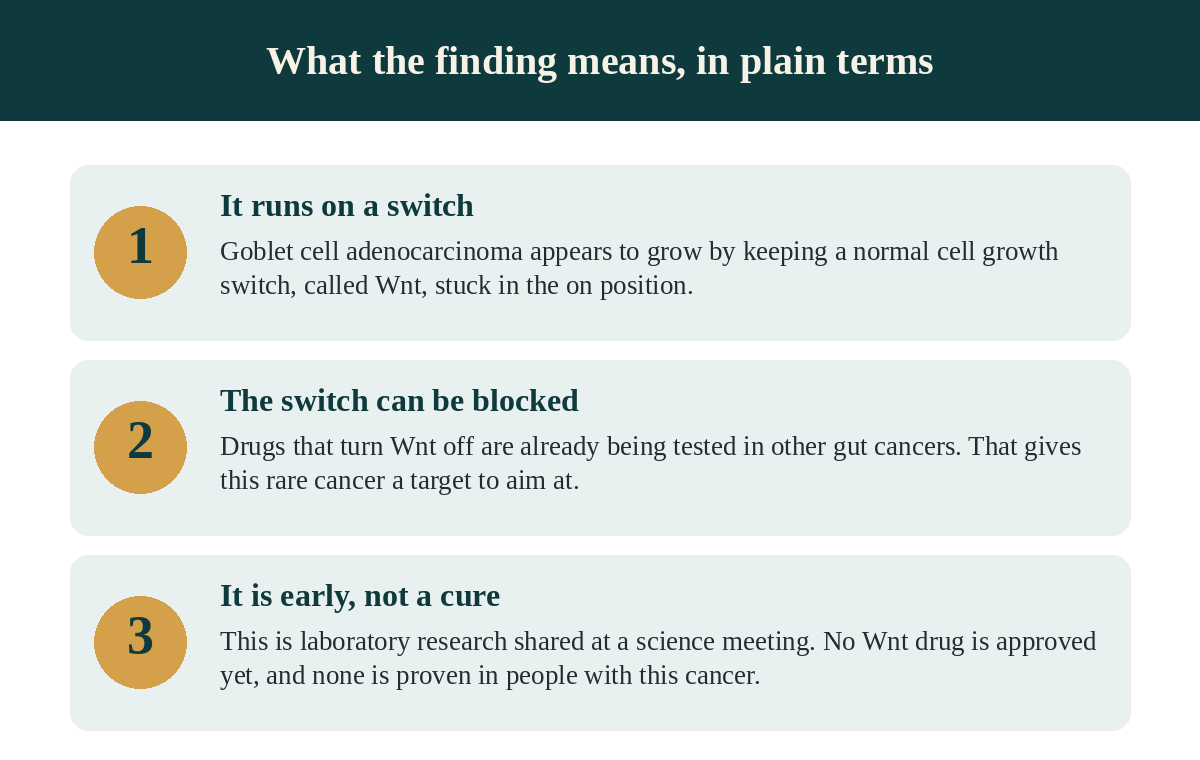
Because goblet cell adenocarcinoma has so few options, even a possible target is meaningful. Several experimental drugs are being developed to interfere with Wnt signaling or to target LGR5-positive cells, including porcupine inhibitors, receptor-level agents, downstream inhibitors, and antibody-based approaches. They are not interchangeable, and none has been established as a treatment for this cancer. Wnt has also been hard to drug, because it is important in normal gut, bone, and stem-cell biology.
There is related work worth knowing. In a separate appendiceal cancer organoid study from Memorial Sloan Kettering, part of the appendiceal cancer research effort there that includes Dr. Michael Foote, a Wnt inhibitor called WNTinib showed activity in laboratory models made from appendiceal adenocarcinoma. I wrote about it in my post on lab-grown appendix cancer organoids. Those models were not goblet cell tumors, so this does not tell us whether goblet cell adenocarcinoma will respond. It does show that Wnt-directed treatment can be tested in appendiceal cancer laboratory models.
The immune picture
The same analysis found these tumors had relatively few immune cells inside them, an immune-excluded pattern. In other cancers, Wnt signaling has been linked to keeping immune cells out. That may help explain why standard immune checkpoint drugs have not shown an established benefit for most goblet cell patients, especially when tumors are microsatellite stable. Rare tumors that are MSI-high or mismatch-repair-deficient can behave differently. Whether blocking Wnt could make these tumors more open to immune treatment is a question researchers still need to test.
A pattern worth knowing
It is fair to ask how long this kind of work takes. Cancer research has a pattern that gives me hope. Hard targets tend to fall in a chain, and each one makes the next feel possible.
In 2001, a drug called imatinib, sold as Gleevec, showed that aiming at a single driver protein could change a cancer. It turned chronic myeloid leukemia, once often fatal, into a disease many people live with for years. It proved that targeted therapy was possible at all.
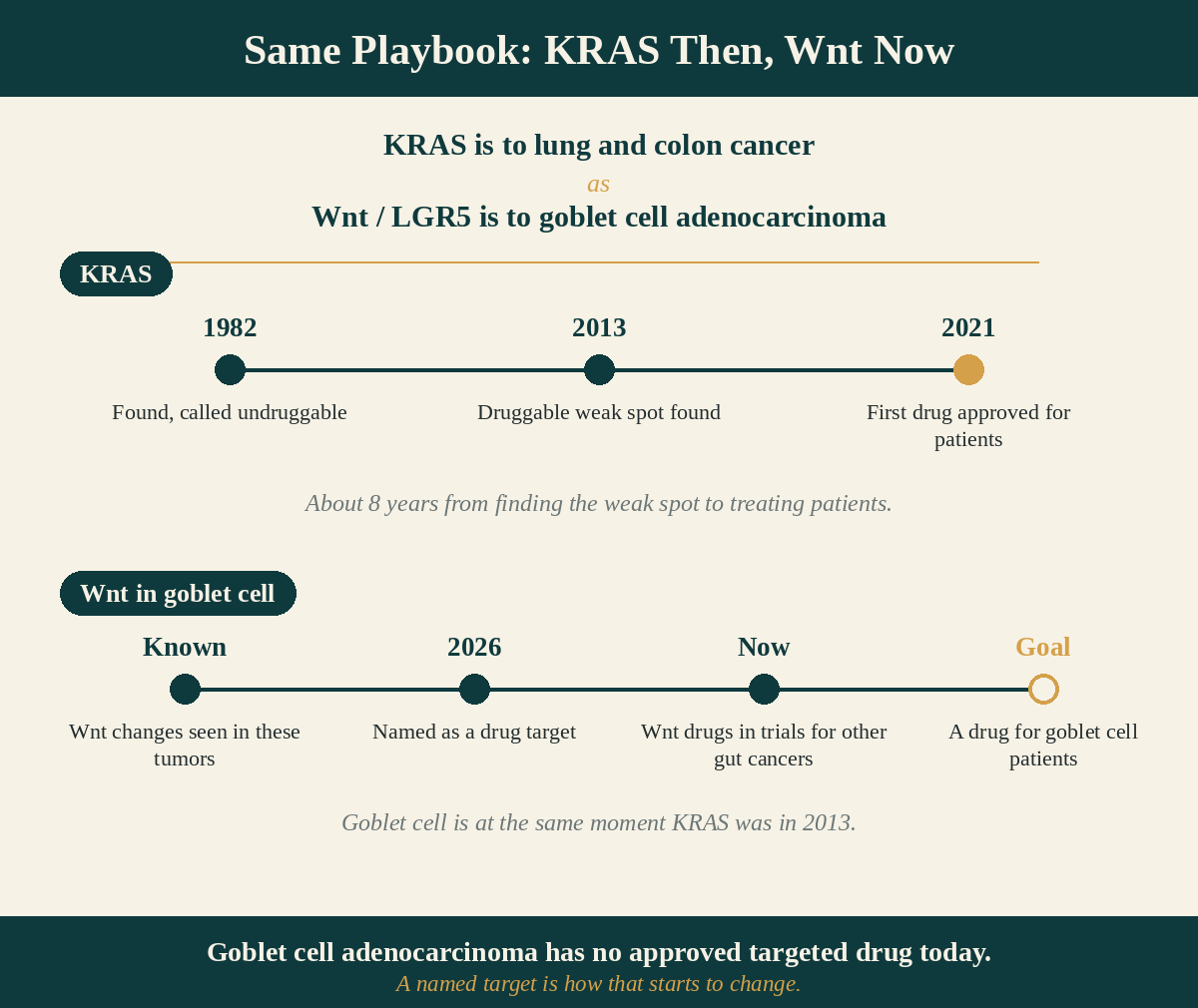
That proof is part of why researchers kept working on KRAS, a common cancer gene that was called undruggable for about 40 years. In 2013 they found a pocket on one mutant form of KRAS, and the first KRAS drug was approved in 2021.
The goblet cell finding sits one step earlier again. It is to KRAS what KRAS once was to imatinib, a newer and less proven lead on the same long road. Imatinib helped make KRAS feel possible. KRAS helps make a target like this one feel possible.
The comparison has limits, though. Imatinib and the KRAS drugs each aim at one specific protein. The goblet cell finding is activity across a broad signaling pathway with many parts and normal functions, so it sits at a much earlier and different point. This history cannot predict how quickly a goblet cell treatment might develop. What it shows is that targets once thought hopeless can eventually become treatments.
Researchers do have tools now that were not available during the early decades of KRAS work, including large genomic datasets, organoid models, and AI-assisted drug discovery. These may help test ideas faster, but clinical development still needs laboratory validation and carefully designed trials. I write about that on our data registry and AI page.
What this does and does not mean
This is an early, subtype-specific hypothesis, not a treatment anyone can receive today. It is a conference abstract, and the pathway finding still needs laboratory and clinical work.
It also applies only to goblet cell adenocarcinoma. It does not automatically apply to low grade appendiceal mucinous neoplasms, high grade appendiceal mucinous neoplasms, mucinous or non-mucinous appendiceal adenocarcinomas, tumors with signet ring cell features, or appendiceal neuroendocrine tumors. Those are different diagnoses with different biology.

If you take one word from this, let it be Wnt. Patients with the mucinous appendix cancers learn to know KRAS and GNAS. Patients with lung or pancreatic cancer learn their exact KRAS variant, like G12C or G12D. For goblet cell adenocarcinoma, Wnt, along with the marker LGR5, is the word to follow. There is no Wnt test to demand today, and no Wnt drug for this cancer yet. But it is the lead most likely to matter for this subtype, and knowing it helps you follow the research and ask good questions.
What patients can do now
This research does not change the standard treatment for goblet cell adenocarcinoma today. It does support a few reasonable steps.
- Ask whether comprehensive tumor profiling is appropriate. Testing may find an uncommon actionable change or help match you to a future trial.
- Ask whether both DNA and RNA profiling are available. The Wnt signal in this study came mostly from gene-activity (RNA) analysis, which is not part of every routine tumor test.
- Confirm that enough tumor tissue remains for future testing. Your hospital’s pathology department can explain how long tissue is kept.
- Consider a second opinion at a center experienced in appendiceal cancers, especially for advanced or recurrent disease.
- Ask whether any early-phase solid-tumor trials studying Wnt or LGR5-directed therapy accept appendiceal cancers. Eligibility depends on the specific trial.
- Consider adding your clinical, pathology, and molecular information to a research registry. Better data helps researchers find biomarkers, estimate how many patients might qualify, and judge whether a goblet cell trial is feasible.
Free tools to download and share
I made a few things to help. They are free to download, print, and share.
Questions to bring to your appointment
A fill-in sheet with the questions that matter most for goblet cell adenocarcinoma, with space to write your care team’s answers.
Download the question sheetA briefing to share with your doctor
A one-page summary of the finding and the reasonable next steps, written for your care team. Print it and hand it over.
Download the doctor briefingThe case for a goblet cell trial
A one-page brief you can send to researchers, foundations, or drug companies to make the case for a Wnt-targeted trial.
Download the research briefAdd your data to the research registry
Appendicure runs a patient research registry focused on the molecular, genomic, and pathology details of appendix cancer. Better patient-level data helps researchers identify biomarkers, estimate the affected population, and judge whether a goblet cell trial is feasible. It is free, and it is open to patients around the world.
Join the Registry: United States Join the Registry: InternationalCommon questions
What is goblet cell adenocarcinoma?
Goblet cell adenocarcinoma is a rare and aggressive type of appendix cancer. It shows features of two cell types at once, which makes it harder to treat than more common cancers, and it has no approved targeted therapy.
What did the 2026 study find?
Researchers analyzed the genes and gene activity of goblet cell tumors. They found a strong LGR5 and Wnt pathway signal and an immune-excluded environment, and they suggested that Wnt-directed treatment deserves more study. They did not test a drug in patients, animals, or goblet cell tumors.
Is there a targeted treatment for goblet cell adenocarcinoma yet?
No. As of 2026, no Wnt or LGR5 drug is approved or proven for it. This is an early research hypothesis, not a treatment you can get today.
What can patients do now?
Ask about comprehensive DNA and RNA tumor profiling if it is appropriate, make sure enough tissue is kept for future testing, consider a second opinion at a center experienced in appendiceal cancers, ask about relevant early-phase trials, and consider joining a research registry.
Read more from Appendicure
Types of Appendix Cancer: Understanding Goblet Cell Adenocarcinoma
Lab-Grown Appendix Cancer Organoids Reveal Hidden Mutations and New Drug Leads
1 Promising RAS Cancer Study and Why Appendix Cancer Research Still Needs More Data
Research like this depends on funding and shared data. If it matters to you, you can support Appendicure here. Thank you.
Sources
El Khoury S, Chowdhury S, Ito I, Shen JP. Goblet cell appendiceal adenocarcinoma is a distinct disease entity defined by LGR5/Wnt-mediated oncogenesis driving an immune-excluded tumor microenvironment. Cancer Research, 2026 (AACR Abstract A039). Read the abstract.
Appendiceal cancer organoid biobank identifying WNTinib and RAS-directed activity in appendiceal adenocarcinoma models. Developmental Cell, 2026 (Memorial Sloan Kettering).
WHO Classification of Digestive System Tumours, 5th edition, 2019. Ostrem JM et al., Nature, 2013 (KRAS G12C pocket). FDA approval of imatinib (Gleevec) for chronic myeloid leukemia, 2001. FDA approval of sotorasib, 2021. KRAS and GNAS mutations in mucinous appendiceal neoplasms and pseudomyxoma peritonei; goblet cell adenocarcinoma is genetically distinct (Modern Pathology, 2017; appendiceal molecular classification, 2023). Peritoneal Surface Malignancies Consortium consensus (Godfrey et al.), Cancer, 2025.
Appendicure provides patient education and does not offer medical advice. Talk with your own care team about decisions related to testing and treatment.
Leave a Reply