

Quick answer: Blood clots after CRS/HIPEC are more common than many patients are told. In a large study of people treated for pseudomyxoma peritonei, about 1 in 9 had a clot in the first couple of weeks. Most leg clots caused no symptoms, and a lung clot can happen even when your legs feel fine. Knowing the warning signs can help you act quickly.
I want to talk about something that does not get enough attention after cytoreductive surgery and HIPEC. Blood clots. A new study from a large peritoneal cancer center in England put real numbers to it, and I think every patient and caregiver heading into this surgery should see them. Not to be scared. To be ready.
The researchers looked back at 554 people treated with CRS and HIPEC for pseudomyxoma peritonei, or PMP, that started as an appendix tumor. Everyone in the study had either a low grade appendiceal mucinous neoplasm (LAMN) or a high grade one (HAMN). The surgeries happened between 2020 and 2024 at one high volume center. This is one of the first studies focused specifically on blood clots after CRS/HIPEC in patients with appendix origin PMP.
How common are blood clots after CRS/HIPEC
Out of 554 patients, 63 had a clot. That is about 11 percent, or roughly 1 in 9. The clots fell into two buckets.
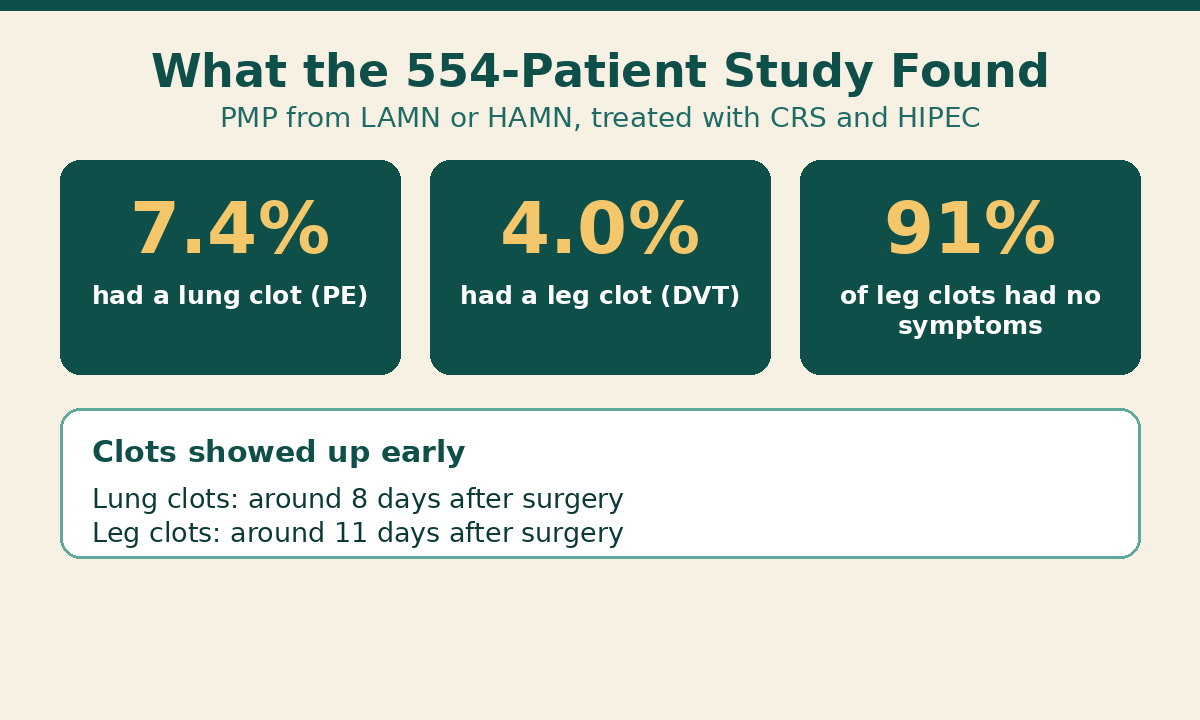
A clot in the lungs, called a pulmonary embolism or PE, showed up in 41 people (7.4 percent). A clot in a deep vein, usually the leg, called a deep vein thrombosis or DVT, showed up in 22 people (4.0 percent). Here is the part that surprised me most. Of the 22 leg clots, 20 caused no symptoms at all. They were only found because this center did a routine leg ultrasound on every patient around day 10. If they had waited for symptoms, most would have been missed.
Why blood clots after CRS/HIPEC show up early
Timing is the reason the first two weeks matter so much. In this study, lung clots were found around day 8 after surgery. Leg clots were found around day 11. That window often overlaps with going home from the hospital. So the moment you may feel most relieved to be discharged is also a moment to stay alert.
There was another finding I did not expect. The lung clots and the leg clots were mostly separate problems. Only two patients had both a documented DVT and PE. That suggests many pulmonary emboli may not have arisen from leg clots detected on routine ultrasound, although the study could not determine exactly where those clots originated. The routine scans looked at the legs, not the pelvic or arm veins, so a leg-only picture is incomplete. The authors note that some clots may form closer to the belly or chest, possibly tied to the size of the surgery and how blood clotting is managed during it.
This is why I keep coming back to one message. Do not use your legs as your only warning system. You can have a clot in your lungs with legs that look and feel completely normal.
The warning signs to take seriously
Most diagnosed lung clots were found after patients developed symptoms or changes in oxygen levels. The most common were a drop in oxygen or needing more oxygen (about 59 percent), a fast heartbeat (about 56 percent), shortness of breath (about 36 percent), and chest pain (about 19 percent). Leg and arm clots showed up as swelling, pain, or tightness in one limb. A few clots in the arm were tied to a PICC line or central line.

If you notice any of these in the weeks after surgery, do not wait to see if it passes. Call your surgical team, and if it is breathing or chest related, go to the emergency room. A clot caught early is very treatable, which is why new symptoms should be evaluated promptly.
Who was at higher risk
The study found a few things linked to higher clot risk. For leg clots, high grade histology mattered. Patients with HAMN had a leg clot rate of about 7 percent, compared to about 3 percent for LAMN. Getting more of a blood product called cryoprecipitate during surgery was also linked to more leg clots. Cryoprecipitate helps control bleeding, so this is not something a patient chooses. It reflects how much bleeding happened. Receiving more cryoprecipitate may simply reflect a more complex operation rather than being a direct cause of clotting.
For lung clots, two things stood out. Men were more likely to have a PE than women, and patients with a higher peritoneal cancer index, or PCI, which is a measure of how much disease is in the belly, were also at higher risk. I want to be clear about what this does and does not mean. These are patterns across a large group. Being male, or having HAMN, or a higher PCI does not mean you will get a clot. It means these are worth knowing about so you and your team can watch closely.
If you want to understand the HAMN piece more, I wrote a plain language explainer on what a high grade appendiceal mucinous neoplasm is and how it behaves.
What is done to prevent clots
Even though everyone in this study received clot prevention in the hospital, some patients still developed blood clots. Prevention lowers the risk. It does not remove it. That is exactly why the warning signs still matter.
Prevention is standard, and it was used for everyone in this study. During the hospital stay, patients got blood thinner injections. At this center, patients were also sent home on a preventive blood thinner for 28 days after surgery. Compression and getting up and moving early are part of the same plan. If a clot did happen, it was treated with a stronger dose of blood thinner, often followed by a pill called apixaban for a few months.
Protocols differ from one hospital to another, so the exact drug and number of days at this English center may not match yours. That is fine. The point is to ask. Before you leave the hospital, ask your team what your clot prevention plan is, whether you go home on a blood thinner, and for how long. Extended prevention after discharge is a real and reasonable thing to ask about after a surgery this big. You can read more about the surgery itself on the CRS and HIPEC treatment page.
The limits of this study
This was one center in England, looking back at records rather than running a trial, so the exact numbers may not carry over everywhere. Everyone in it had appendix origin PMP from a LAMN or a HAMN. It did not include appendiceal adenocarcinoma, which was studied as a separate group. It also did not break out goblet cell, signet ring, or neuroendocrine (carcinoid) tumors of the appendix, which behave differently. And because lung scans were only done when patients had symptoms, silent lung clots were likely undercounted. The main takeaway is that clots after this surgery are common and under-reported, not that the precise risk is settled for every subtype.
What you can do
You cannot control your histology or how much bleeding your surgery involves. You can control how ready you are. Before discharge, ask what your clot prevention plan is and how long it lasts. Learn the warning signs on the graphic above and keep them somewhere your caregiver can see them too. In the first two to three weeks at home, treat new breathlessness, a fast heart rate, chest pain, or a swollen painful leg as urgent until a clinician tells you otherwise. Getting up and walking a little, as your team allows, helps.
Help answer the questions this study could not
The clearest way to learn which appendix cancer patients are most at risk, and how to prevent harm, is to gather real data from patients themselves. The Patient-Led Global Appendix Cancer Registry collects the pathology, genomics, and treatment details that make studies like this possible. It is IRB approved and exempt. Adding your information takes a few minutes and helps everyone who comes after you.
Frequently asked questions
How common are blood clots after CRS/HIPEC?
In this study of 554 appendix origin PMP patients, about 11 percent had a clot in the weeks after surgery. Lung clots occurred in 7.4 percent and leg clots in 4.0 percent. Most leg clots caused no symptoms and were found on a routine ultrasound.
Can I have a lung clot if my legs feel fine?
Yes. In this study the lung clots and leg clots were mostly separate. Only 2 of the patients had both. So normal legs do not rule out a clot in the lungs. Breathlessness, a fast heartbeat, or chest pain should be checked right away.
When are clots most likely after this surgery?
Early. Lung clots were found around 8 days after surgery and leg clots around 11 days. That is often right around the time patients go home, which is why the first couple of weeks deserve extra attention.
I was given blood thinners. Can I still get a clot?
Yes. Every patient in this study received clot prevention, and about 11 percent still developed a clot. Prevention lowers the risk but does not remove it, so the warning signs are still worth knowing even if you are on a blood thinner.
What lowers the risk of a clot?
Blood thinners in the hospital, a preventive blood thinner for a set number of days after discharge, compression, and moving early are the usual steps. Ask your own team what your plan is and how long it lasts, since protocols vary by hospital.
Read more
Understanding High Grade Appendiceal Mucinous Neoplasms (HAMN): What Patients Need to Know
None of this is medical advice. It is patient education to help you ask better questions. Your surgical team knows your case and your prevention plan.
If Appendicure has helped you, you can help keep this work going. Support Appendicure here.
Source: Brindl N, Chandrakumaran K, Shah N, Mohamed F, Cecil T, Moran B, Roy A. Deep Vein Thrombosis and Pulmonary Embolism Following Cytoreductive Surgery and HIPEC for PMP of Appendiceal Origin. European Journal of Surgical Oncology, 2026. doi:10.1016/j.ejso.2026.112043. Peritoneal Malignancy Institute, Basingstoke and North Hampshire Hospital.

Leave a Reply