
Patient-Led Research
Patient-Led PMP Research at Johns Hopkins
A caregiver’s idea, funded by our community, now being tested at the Johns Hopkins Kimmel Cancer Center.
Where the funding stands
Appendicure has already funded the first phase of this work. Now we need to raise $80,000 to fund a full year of research at the Johns Hopkins Kimmel Cancer Center. Every dollar raised beyond that goes to more appendix cancer research.
Every update on the PMP research Johns Hopkins is running for our community lands on this page, good news or bad.
How this started
The idea came from Ricki Dhal, a caregiver whose wife has appendix cancer and PMP. Ricki built an AI platform, part of Bina Therapeutics, to look for new treatment ideas. It pointed to polyamines.
Appendicure hired the lab of Dr. Tracy Murray Stewart at Johns Hopkins to test the idea. Our community is paying for the work.
The science in plain words
Polyamines are tiny molecules cells use as fuel to grow and divide. Cancer cells tend to burn through more of them.
Our theory: appendix cancer cells, and the mucin they make, depend heavily on this fuel.
Cells get polyamines two ways. They make their own, and they pull them in from outside.
- DFMO shuts down the factory. DFMO is also called eflornithine, brand name Iwilfin. The FDA approved it on December 13, 2023, to reduce the risk of relapse in high-risk neuroblastoma. It is not approved for appendix cancer.
- AMXT 1501 locks the loading dock. It is an experimental drug made by Aminex Therapeutics.
Next, the lab is testing whether adding a common, already-approved anti-inflammatory drug pushes polyamine levels down further.
Who is doing the work
This is Dr. Tracy Murray Stewart’s lab, and she supplies our results.
Tracy Murray Stewart, PhD
Assistant Professor of Oncology, Cancer Genetics & Epigenetics
Sidney Kimmel Comprehensive Cancer Center, Johns Hopkins University School of Medicine
She runs the cell work herself. Ashley Nwafor in her lab runs the polyamine measurements.
“This is a really robust response. Actually, better than I expected, to be honest.”
Tracy Murray Stewart, PhD, Johns Hopkins
Meet the AppendiScouts
You can’t test a new idea for appendix cancer without appendix cancer cells, and PMP cells that will grow in a dish are rare. Very few labs have them.
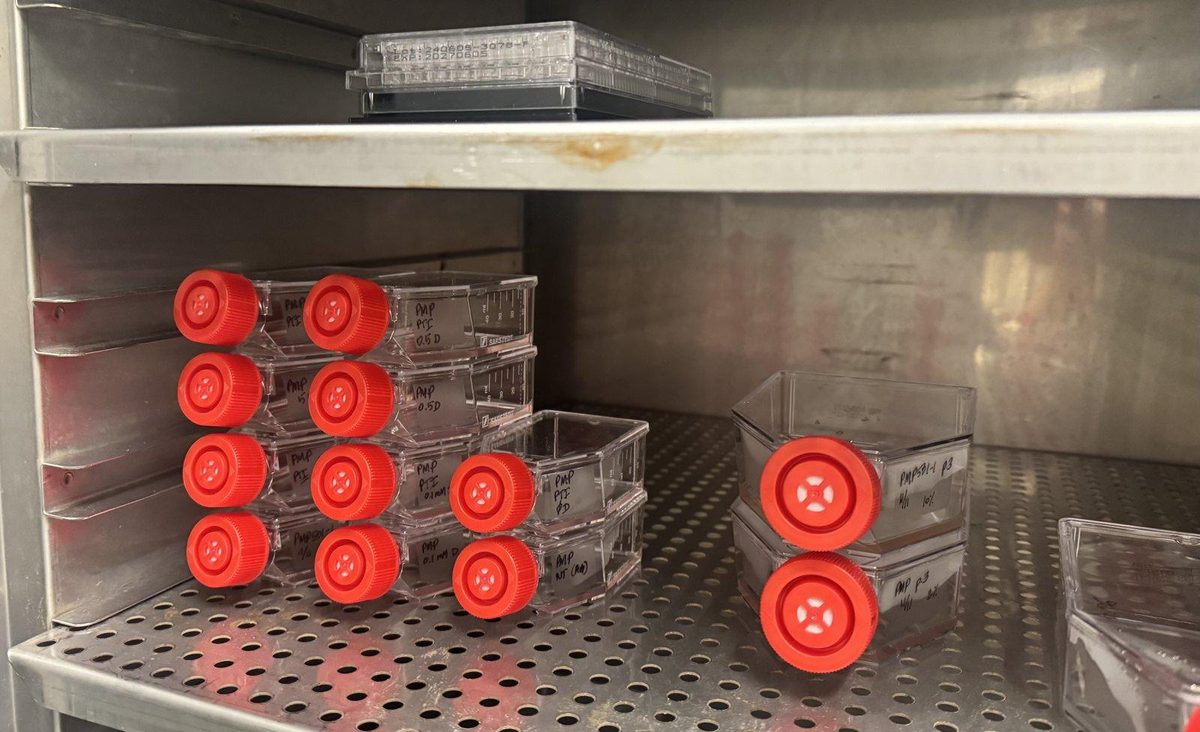
In the lab, this PMP cell line is known as PMP501. It came from a real patient’s PMP tumor. We call them the AppendiScouts. In these tests they go out ahead of us, scouting the way so that one day the rest of us won’t have to. Everyone else calls them numbers. The name is our way of honoring the people who donated their tissue so research like this can happen.
Which cancers this covers
This year of research covers PMP (pseudomyxoma peritonei), HAMN (high-grade appendiceal mucinous neoplasm), goblet cell adenocarcinoma, and signet ring cell adenocarcinoma. The results so far come from one PMP cell line.
Learn more: PMP · HAMN · Goblet cell adenocarcinoma · Signet ring cell
What we’ve found so far

- DFMO cut two of the three polyamines, putrescine and spermidine, by 94 to 99% at every dose tested.
- It worked at a tenth of the usual dose. The lab normally uses 5 mM of DFMO on cancer cells. Here, 0.5 mM did the job.
- With both drugs together, spermine, the most stubborn polyamine, dropped by about half at one combination tested (AMXT 1501 plus 1 mM DFMO).
In research terms, this is called target engagement. The drug reached its target in PMP cells and did its job.
What we’re testing next
The first results point in the direction we hoped. These PMP cells responded to DFMO at a tenth of the usual lab dose. The next question is what cutting off their fuel actually does to them.
There are early signs. Cells given AMXT 1501 swelled up, as if something was trapped inside. With both drugs together, the cells seemed to grow more slowly. These are first observations, not measured results.
The next test measures mucin, the thick jelly PMP is known for. It will show whether cutting off the fuel stopped or slowed the cells from releasing it.
Timeline of the PMP research Johns Hopkins is running
- Oct 23, 2026: frozen PMP501 cells arrive at Johns Hopkins
- Late Oct to early Nov: cells revived and grown; mucin bubbles seen
- Mid-Nov: cells treated with DFMO, AMXT 1501, and both together
- Nov 16: cells collected and sent for measurement
- Nov 18: first results; target engagement confirmed
- Next: mucin tests, dose fine-tuning, anti-inflammatory drug test, cleaner growth test
Lab updates
We share every lab result, good or bad, twice a month. Every drug is named.
-
A Strong First Signal From Johns Hopkins: The First PMP Lab Results Are In
The first results from the PMP study Appendicure is funding at Johns Hopkins are in. DFMO, an FDA-approved drug, cut two key polyamines in PMP cells by 94 to 99%, at a tenth of the usual lab dose.
Full transparency
- Ricki Dhal is an Appendicure board member. He volunteers his time and gave the idea to Appendicure for free. Appendicure has no financial tie to Bina Therapeutics.
- Aminex Therapeutics supplies AMXT 1501 for this study. Appendicure meets regularly with Mark Burns, Aminex’s President and Chief Scientific Officer.
- Appendicure is paying Johns Hopkins to do this work. Johns Hopkins is not a funder of Appendicure.
Be part of it
Donate to the Johns Hopkins research
Join the Appendicure patient registry
Join the Appendicure patient registry so studies like this are built around real patients.
Join the Registry: United States Join the Registry: International
- US residents only: https://form.jotform.com/261653563455159
- International, non-US only: https://form.jotform.com/261874541837063
- Update an existing record: https://form.jotform.com/262274032810044
Questions? Write to us at info@appendicure.com.
These are early lab results, not treatment results. DFMO is a prescription drug with known side effects, and it is not approved for appendix cancer. Please talk with your oncologist before making any change to your care.