

The first PMP lab results from the Johns Hopkins study Appendicure funded are in. DFMO, a drug the FDA has already approved for a childhood cancer, did exactly what we hoped it would inside PMP cells: it drained nearly all of two key fuel sources these cancer cells use to grow, at doses well below what the lab usually needs.

“This is a really robust response. Actually, better than I expected, to be honest.”
Tracy Murray Stewart, PhD, Johns Hopkins
Meet the AppendiScouts
You can’t test a new idea for appendix cancer without appendix cancer cells, and PMP cells that will grow in a dish are rare. Very few labs have them. Dr. Traci Testerman at the University of South Carolina grew the cells in this study from a patient’s PMP tumor, and Bina Therapeutics now maintains and prepares the master supply. For anyone who wants the technical details, a University of South Carolina thesis describes the cell line.
In the lab, this cell line is known as PMP501-1. I call them the AppendiScouts. I gave them a name because they are more than just numbers to me. These cells came from a real patient, and in these tests they go out ahead of us, scouting the way so that one day the rest of us won’t have to. Naming them is my way of honoring the people who donated their tissue so research like this can happen.
How the first test came together
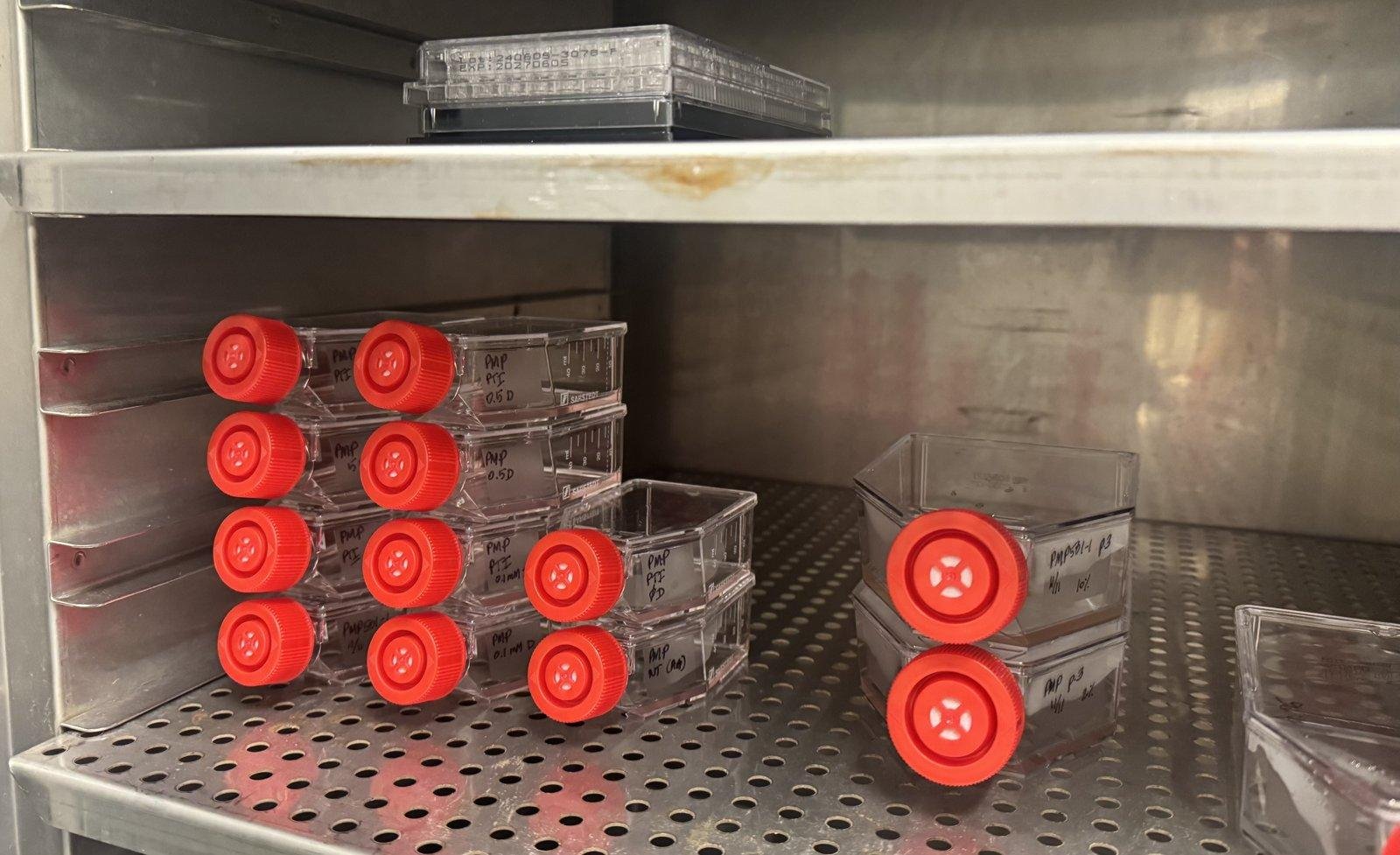
On October 23, a shipment of frozen AppendiScouts arrived at Dr. Tracy Murray Stewart’s lab at the Johns Hopkins Kimmel Cancer Center. Frozen cells don’t just start growing. She had to thaw them, feed them and coax them back to life, and they were slow to get going. At one point she even added extra insulin to their food to help them grow. She grew them on two different diets, one rich and one lean, to see what they needed. They did well on both.
Once they were growing, she could see little bubbles of mucin forming. The AppendiScouts were acting like PMP, which is exactly what this work needed.
In mid-November she treated the cells with DFMO at four different doses, with an experimental drug called AMXT 1501, and with the two together. After four days, on November 16, she collected the cells and handed them off to her technician, Ashley Nwafor, to be measured. On November 18, during my weekly call with her and Ricki Dhal, she was smiling before she even shared her screen. The numbers had come off the machine that morning.
What the PMP lab results showed
Every cell makes tiny molecules called polyamines. Think of them as fuel. Cells need them to grow and divide, and cancer cells tend to burn through more of them than healthy cells do. The theory behind this study is that appendix cancer cells, and the mucin they make, depend heavily on that fuel.
Cancer cells get polyamines two ways. They make their own, and they pull them in from around them. DFMO shuts down the factory. AMXT 1501 locks the loading dock. The lab measured three polyamines, called putrescine, spermidine and spermine, to see how much fuel the AppendiScouts had left after four days.
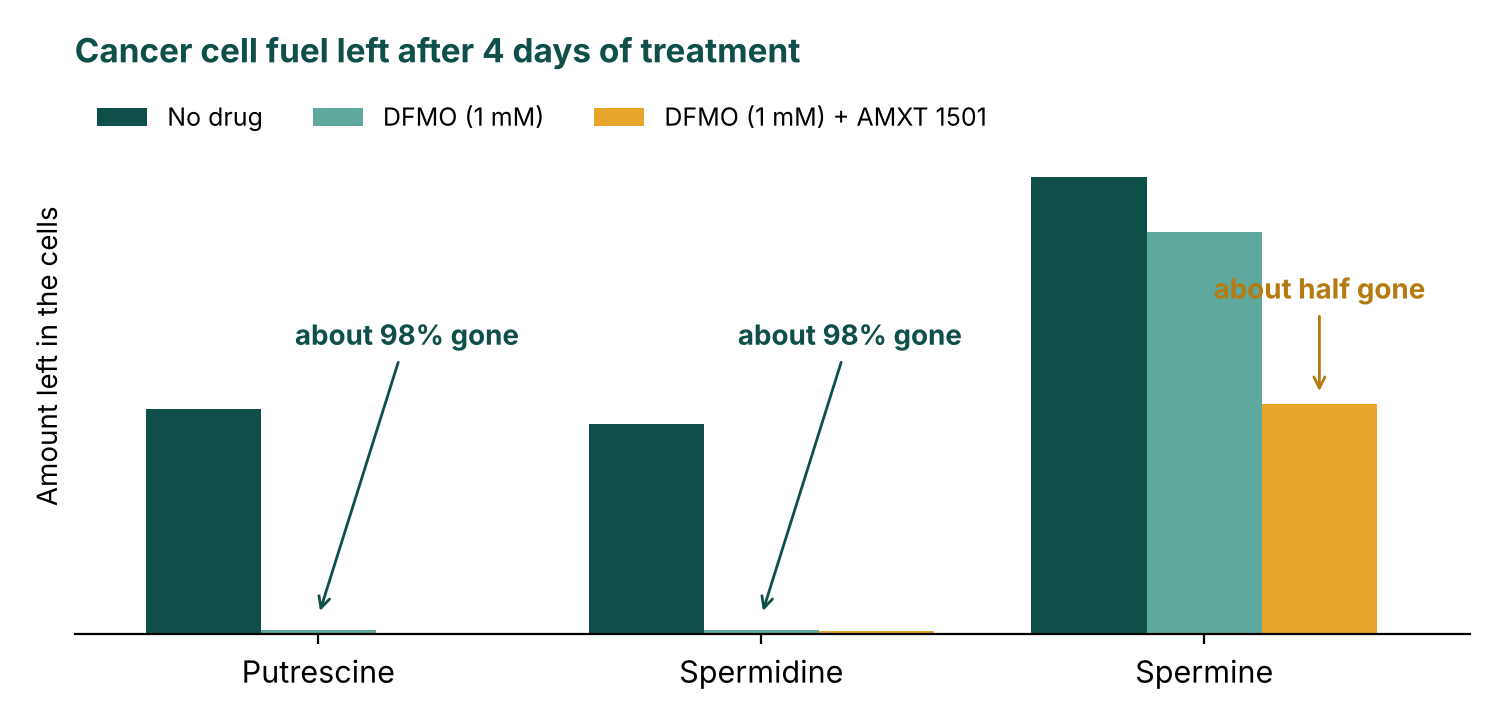
Two of the three polyamines were nearly wiped out. Putrescine and spermidine dropped by 94 to 99 percent at every DFMO dose tested.
It worked at very low doses. The lowest dose tested, 0.1 mM, was already enough. Dr. Stewart usually works with DFMO at 1 to 5 mM, and she told me the drug had a bigger effect than she expected at these lower concentrations. That suggests PMP cells may be unusually sensitive to it.
The two drugs together went further. Spermine is the most stubborn polyamine, and some was expected to remain after only four days. With DFMO and AMXT 1501 together, it dropped by about half at the best combination tested. Dr. Stewart sees ways to push that further.
In research terms, this is called target engagement. It means the drug reached its target in PMP cells and did its job. Every new treatment idea has to clear this bar first, and DFMO cleared it.
These PMP lab results come from one PMP cell line in a lab dish, and there is more work ahead before anything reaches patients. But every treatment starts with a first result like this one, and this one points in the right direction.
Why DFMO is worth testing
DFMO is not a new, untested drug. The FDA approved it in December 2023 to help keep high-risk neuroblastoma, a childhood cancer, from coming back. Doctors already know how to prescribe it and monitor it. If it turns out to help in PMP, the road to patients could be much shorter than it is for a brand new drug. Dr. Stewart made that point herself on the call: the goal is something that can reach patients fast.
Where the idea came from
The idea came from Ricki Dhal, an Appendicure board member whose wife, Bina, has appendix cancer and PMP. Ricki built an AI platform, part of Bina Therapeutics, to hunt for new treatment ideas, and it pointed to polyamines. Ricki volunteers his time and gave the idea to Appendicure for free, and Appendicure has no financial tie to Bina Therapeutics. Just 26 days after the AppendiScouts arrived at Johns Hopkins, a caregiver’s idea had its first real result at one of the top cancer centers in the world.
What comes next
The next question is the one that matters most to anyone living with PMP: does cutting off this fuel reduce the mucin? Dr. Stewart is setting up those tests now. Her first try with a mucin dye ran into a technical snag, so she is moving to a more precise lab method.
She has already seen a hint. Just by looking at the cells, she noticed that cells given AMXT 1501 swelled up with small sacs, as if something was trapped inside. It is only an observation so far, but it is exactly the kind of thing the mucin tests are designed to measure. When Ricki raised the idea that mucin gets trapped inside the cells, she told him, “It’s not a crazy hypothesis at all.”
Ricki is hoping that’s only the beginning.

“These are really big numbers. I really hope that what happens next is that those cells swell up, burst and die.”
Ricki Dhal, Appendicure board member
Alongside the mucin work, Dr. Stewart is repeating the fuel measurements, fine-tuning the doses now that she knows how sensitive these cells are, and testing whether adding a common, already-approved anti-inflammatory drug pushes spermine down further.
A cleaner growth test is coming too. In this first round, the untreated cells grew so fast they ran out of room in the flask, which muddied the growth numbers. Even so, she could see signs that the two drugs together slowed the AppendiScouts down. I will share the next round of PMP lab results, and every update after that, every two weeks.
Frequently asked questions
Q. What is DFMO?
DFMO, also called eflornithine, blocks the enzyme cells use to make polyamines. The FDA approved it in December 2023 for high-risk neuroblastoma. It is not approved for appendix cancer.
Q. Did DFMO shrink PMP tumors?
No. This test was done on PMP cells in a lab dish, not in people. It measured how much polyamine fuel was left in the cells. It shows DFMO reaches its target in PMP cells, which is the first step.
Q. Do these PMP lab results mean I should ask my doctor for DFMO?
Not yet. These are early lab results, not treatment results. DFMO is a prescription drug with known side effects. Please talk with your oncologist before making any change to your care.
Q. Who is paying for this research?
Appendicure funded the first phase of this work, and I am asking for donations to fund the rest. The full year at the Johns Hopkins Kimmel Cancer Center costs $80,000, and every dollar raised beyond that goes to more appendix cancer research.
Q. When will there be more results?
I share updates on this work every two weeks. The mucin tests are the next big question.
Help fund the next result
Appendicure funded the first phase. Your gift funds the rest of the work at Johns Hopkins.
Donate to the Johns Hopkins ResearchJoin the registry
Research like this works best when it is built around real patients. Join the Appendicure Patient-Led Global Appendix Cancer Registry so future studies reflect people living with every type of appendix cancer.
Join the Registry: United States Join the Registry: International
Already registered? Update or correct your record.
Read more
Patient-Led PMP Research at Johns Hopkins, every lab update in one place
Fund Appendix Cancer Research: 2 Urgent Ways You Can Help, where this Johns Hopkins study began
Your Appendix and Your PMP Can Have Different Grades
Why appendix cancer patients struggle to get into clinical trials
Thank you to Dr. Tracy Murray Stewart and Ashley Nwafor at Johns Hopkins, to Dr. Traci Testerman at the University of South Carolina, to Ricki Dhal, and to everyone who has donated to fund this research and everyone who will. Questions? Write to me at info@appendicure.com.
These are early lab results, not treatment results. This post is for education only and is not medical advice. DFMO is a prescription drug with known side effects, and it is not approved for appendix cancer. Please talk with your oncologist before making any change to your care.
Leave a Reply