


Your PMP grade, the grade of the mucinous disease in your abdomen, can be different from the grade of the tumor in your appendix. When the two don't match, a study from a large UK peritoneal center found that the PMP grade was more closely tied to how patients did.
A case report published this year in the AME Surgical Journal describes a 49-year-old woman whose appendix held three tumor types at the same time. There was a low-grade appendiceal mucinous neoplasm (LAMN), a high-grade appendiceal mucinous neoplasm (HAMN), and a 2 millimeter spot of invasive adenocarcinoma. The authors say this combination hasn't been reported before. She also had pseudomyxoma peritonei, or PMP, where mucin and tumor cells spread through the abdomen.
Her belly had been growing for two years. She went to the emergency department with severe pain, and a scan showed her abdomen filled with mucin. Surgeons drained 18 liters of fluid in an emergency operation, and her recovery was hard, with 45 days in the hospital. Ten months later she had cytoreductive surgery with HIPEC. Her peritoneal cancer index (PCI), the score surgeons use to measure how much of the abdomen is covered with disease, was 39, the highest possible score. Even so, her surgeons removed all the disease they could see.
Very few people will ever have three tumor types in one appendix. The useful lesson from her case is that the appendix and the disease in the abdomen need separate grades.
What PMP grade means
Pathologists grade a tumor by how abnormal its cells look under the microscope. With mucinous appendix tumors that have spread, there are two places to grade. One is the primary tumor in the appendix. The other is the PMP in the abdomen. Usually the two grades match. In a 2012 review of 274 PMP patients treated at one UK center, only two had grades that didn't match. Both had a high-grade cancer in the appendix and low-grade PMP.
The woman in the new case report fits that same pattern. Her appendix held high-grade cells and invasive cancer, but her PMP grade was low. She received chemotherapy during HIPEC, but after reviewing her pathology, her team recommended surveillance without additional systemic chemotherapy afterward. Systemic chemotherapy is the kind that travels through the whole body, given by vein or by pill. The authors report that after two years of surveillance, her yearly CT scans and her CEA blood test show no sign of the disease coming back.
Your report may use words like low grade and high grade, numbers like G1, G2 and G3, or both. UK pathology guidance uses three grades for PMP. G1 is low-grade PMP. G2 is high-grade PMP. G3 usually describes high-grade PMP with signet ring cells, although sheets of poorly differentiated cells can also warrant G3. Acellular mucin, meaning mucin without identifiable tumor cells, is not graded. The appendix tumor is graded separately, using different criteria. Ask your team which system your report uses and which tissue each grade describes.
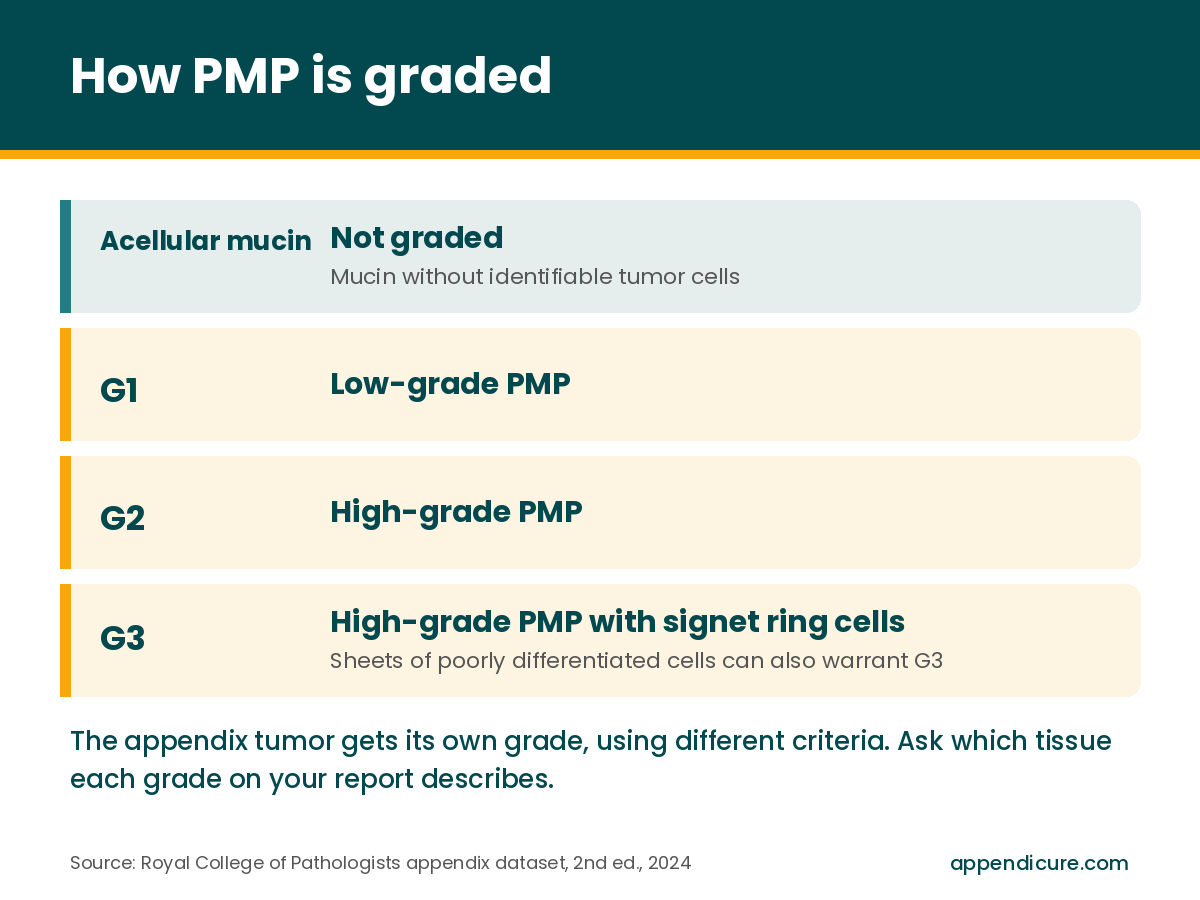
When the appendix grade and the PMP grade don't match
The case report authors cite a study from the Peritoneal Malignancy Institute in Basingstoke, England, published online in 2021 and in print in 2022. Between 2016 and 2020, 830 people there had cytoreductive surgery and HIPEC for PMP. In 37 of them, the appendix grade and the PMP grade didn't match. Fourteen had a high-grade appendix tumor with low-grade PMP, and 23 had the opposite. Overall survival was worse in the patients whose PMP was high grade. The time until the disease came back wasn't significantly different between the two groups.
The group with mismatched grades was small. The study looked back at records from a single center and followed patients for a median of 19 months. Pathologists with a special interest in peritoneal disease did the grading. These findings can't predict any one patient's outcome. UK pathology reporting guidance already says the PMP grade should be assessed separately from the appendix tumor, and the case report authors argue that when the two disagree, the PMP grade should guide the conversation about prognosis.
The authors also suggest closer long-term surveillance for people with high-grade cells in the appendix, even when the PMP grade is low. This case report can't show whether that improves outcomes.
How to check your own PMP grade
Find the surgical pathology report from your appendix surgery or your CRS/HIPEC. Look for a grade on the appendix tumor and a separate grade on the disease in your abdomen. The second one may sit under a heading for the peritoneum, the omentum, or the mucin. Some reports also say whether the mucin in the abdomen contained tumor cells (cellular) or had none (acellular), which is worth asking about too.
If you see only one grade, or you can't tell which part of your body it describes, ask your team whether the disease in your abdomen was graded on its own. You can also ask whether a pathologist who specializes in peritoneal disease reviewed your slides. If your appendix grade and your PMP grade are different, ask which one your team is using to plan treatment and follow-up.
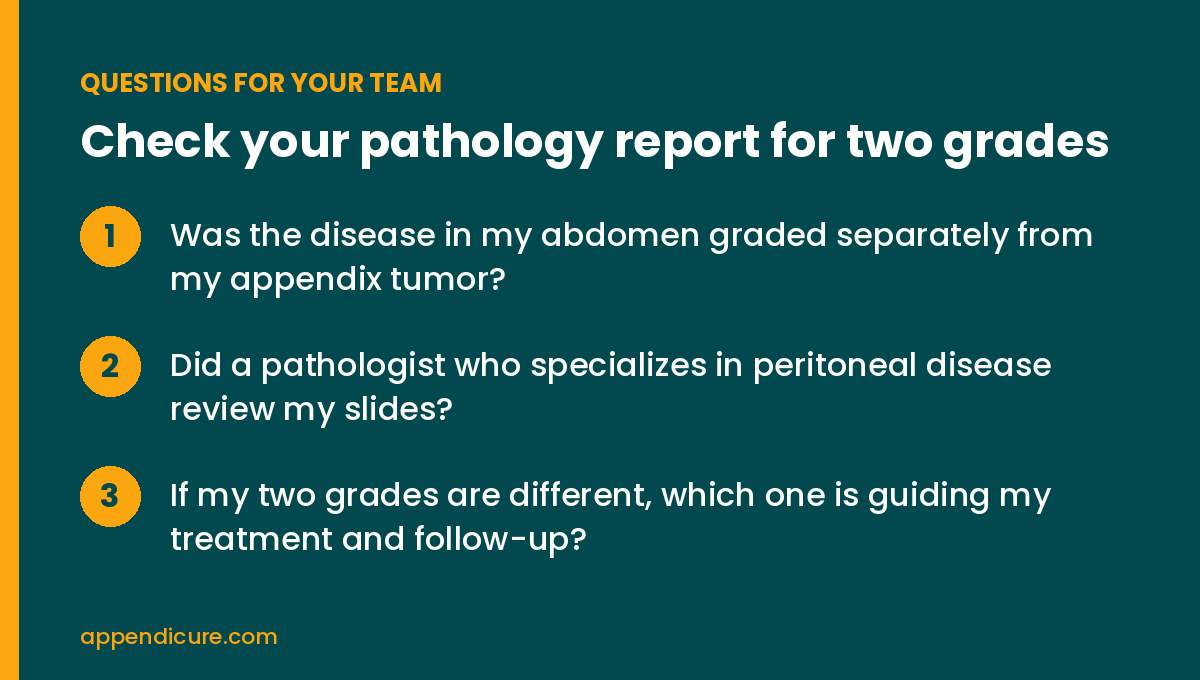
This article focuses on PMP that comes from mucinous appendix tumors, including high-grade PMP with signet ring cells. Other appendix cancer types, such as goblet cell adenocarcinoma (GCA), neuroendocrine tumors and non-mucinous adenocarcinoma, have different grading and treatment considerations.
Why the registry asks for your pathology report
Studying uncommon mismatches like these would benefit from larger patient groups and longer follow-up. Pooling pathology reports across centers and countries could help.
That is why the Appendicure Patient-Led Global Appendix Cancer Registry asks for a copy of your pathology report. The registry is IRB-reviewed and focused on pathology, mutations and treatment data. If you've already joined, you can add new reports or correct an earlier submission using the update form.
Join the Patient-Led Global Appendix Cancer Registry. It collects pathology reports, tumor mutation results and treatment details from appendix cancer patients around the world. It's IRB-reviewed, and you can upload your pathology report.
Join the Registry: United StatesJoin the Registry: International
Already enrolled? Add new reports or update your record
Questions people ask
Can my appendix tumor and my PMP have different grades?
Yes, though it's uncommon. In one large UK center, it happened in 37 of 830 people treated with CRS/HIPEC for PMP.
If the grades don't match, which one matters more?
In that study, overall survival tracked more closely with the PMP grade. The mismatched group was small, so ask your team how your own grades shape your plan.
Does a high-grade appendix tumor with low-grade PMP mean I need more chemotherapy after surgery?
One case report can't answer that for anyone else. The woman in this report had chemotherapy during HIPEC and none afterward, by her tumor board's decision. Your team will weigh your full pathology.
One question for you
Does your pathology report list a separate grade for your appendix and for the disease in your abdomen? Tell me yes, no, or not sure in the comments.
Read More
Appendicure is a 501(c)(3) nonprofit. If you'd like to support this work, you can donate here.
Sources
- Manasawala A, Gandhi J, Tonga I, Chau KY, Kim TJ. Triple synchronous appendiceal neoplasms with pseudomyxoma peritonei: a case report of a rare and unfortunate entity and literature review. AME Surgical Journal, 2026;6. https://doi.org/10.21037/asj-2026-0016 (free to read)
- Memon AA, Godbole C, Cecil T, et al. Overall survival is more closely associated with peritoneal than primary appendiceal pathological grade in pseudomyxoma peritonei with discordant pathology. Annals of Surgical Oncology, 2022;29(4):2607-2613. https://doi.org/10.1245/s10434-021-10994-z
- Carr NJ, Finch J, Ilesley IC, et al. Pathology and prognosis in pseudomyxoma peritonei: a review of 274 cases. Journal of Clinical Pathology, 2012;65(10):919-923. https://doi.org/10.1136/jclinpath-2012-200843
- Carr NJ, Rodriguez-Justo M, Wong N, Feakins R. Dataset for histopathological reporting of carcinomas and mucinous neoplasms of the appendix, 2nd edition. Royal College of Pathologists, December 2024. Royal College of Pathologists dataset (PDF)
Leave a Reply