

Short answer: Appendicure board member Ricki Dhal used AI to find a pattern in PMP that points to a two-drug combination, and as far as we can find, no one has tested that combination in PMP. Ricki and I are paying for the University of Maryland tests and the first month of testing at Johns Hopkins. I’m asking this community to help fund appendix cancer research: the remaining year of laboratory work and the separate ethics review needed for the proposed tissue donation program. If you have appendix cancer surgery coming up, I’m also asking for help with fresh tumor tissue.
Ricki Dhal is on the Appendicure board. His wife, Bina, was diagnosed with LAMN and PMP and has already had two CRS/HIPEC surgeries. She is only 40 years old.
Friends I’ve made in this community are in treatment now. Many of you reading this are living with appendix cancer, searching for options and wondering what comes next. You need answers while you’re still here to use them.
My husband David currently has no evidence of disease after his diagnosis with goblet cell adenocarcinoma in 2024. But if it comes back, there is no treatment designed for his subtype, and his tumor testing hasn’t found a mutation that an approved drug targets. That is one of the reasons I started Appendicure.
What Ricki found
Ricki is a data scientist and software entrepreneur with a background in computational biology, and he built and sold a company. After Bina’s diagnosis, he stopped everything to take care of her and to build Bina Therapeutics, an AI platform specifically for appendix cancer and PMP. He brought those skills to a question that had become painfully personal: what could researchers target in PMP that might lead to a treatment?
Using AI and computing tools, he re-analyzed single-cell data, which shows which genes are switched on inside individual cells. He examined nearly 470,000 cells across four datasets, with normal appendix tissue for comparison, and he found a pattern that pointed to something worth testing.
In PMP, genes involved in a pathway called polyamine metabolism rose and fell alongside the genes that make mucin, the material that can build up in the abdomen. In the other cancers he compared, including pancreatic and colorectal cancer, those same genes tracked with cell growth instead.
That difference led him to a combination of two drugs aimed at the polyamine pathway. One is already FDA-approved for another use. The other is being tested in clinical trials for other cancers. As far as Ricki and I can find, no one has tested this combination in PMP.
We don’t know yet whether it will work. The analysis is unpublished and hasn’t been peer-reviewed. But it has produced a concrete hypothesis that a laboratory can test.
From a computer to a lab
A computer can find a pattern. It can’t prove that the pattern means anything, or that targeting it will change what cancer cells do. So we brought the idea to the lab of Dr. Tracy Murray Stewart at Johns Hopkins, which studies the polyamine pathway.
Ricki and I already have tests underway at the University of Maryland. The first month of testing at Johns Hopkins is covered, but we need to fund an entire year. These are laboratory experiments on cells, and no patients are being treated. I’m not naming the two drugs on purpose, because I don’t want anyone asking their oncologist for a combination that hasn’t been tested in PMP.
The broader work also includes high-grade appendiceal adenocarcinoma, goblet cell adenocarcinoma, and signet ring cell carcinoma. We’re investigating whether patterns of gene activity found in PMP could point to research leads in these cancers too. Many tumor tests look for DNA changes that might help guide treatment. Single-cell RNA sequencing adds a different view: which genes individual cells are using. Looking at cells separately can reveal differences that are harder to see when a tissue sample is analyzed as a whole. Those differences may suggest potential treatment targets for further laboratory testing. There’s more on this in the scientific detail section below.
If these laboratory studies produce promising results, they could help build the case for a future clinical trial. One drug is already FDA approved for another use, and the other is being studied in clinical trials for other cancers. That existing experience may help, but we cannot yet predict when a trial could begin.
Why this can’t wait for the usual route
A lab finding can sit for years before anyone tests it. Drug companies put their money where there are more patients. Researchers depend on grants, and very little grant money goes to appendix cancer. Trials are scarce too. A review I wrote about earlier this year found 46 clinical trials that included appendix cancer patients, and only 11 of them were designed for this disease. You can read more in Appendix Cancer Clinical Trials: A Real Access Gap.
If Ricki’s idea had gone the usual way, it would have started with a grant application. The NIH’s own published timeline for its standard research grant runs the better part of a year from application to the earliest possible funding, and that’s only if the grant is funded. It would have needed a lab willing to take on a rare cancer, and tissue that can take months of contracts to arrive.
Because Ricki and I chose to fund appendix cancer research ourselves, the first tests are already running. The rest of the year at Johns Hopkins depends on this community.
Patients have the power to move this
Patients and families hold three things research can’t move without. We hold the tissue, because it comes from our bodies and we decide whether to donate it. We hold the data, in the pathology, mutation, and treatment reports the registry collects. And we can fund the questions we care about instead of waiting for someone else to decide they’re worth asking.
Patient groups have done this before. In 2000, the Cystic Fibrosis Foundation put $40 million into a small company called Aurora Biosciences, which later became part of Vertex Pharmaceuticals. That work led to Kalydeco in 2012, the first drug to treat the underlying cause of cystic fibrosis, another rare disease.
AI now puts power in the hands of individual patients and families. Computer scientist Matt Might’s team at the University of Alabama at Birmingham built an AI tool that, according to STAT News in 2019, turned up an unusual nausea treatment that a patient’s doctors agreed to try. GitLab co-founder Sid Sijbrandij used ChatGPT to help organize his own bone cancer data and worked with doctors and labs on new options, in an account published by OpenAI. In Sydney, tech entrepreneur Paul Conyngham used ChatGPT and AlphaFold, an AI tool that predicts the shape of proteins, to plan a personalized vaccine for his dog Rosie, which scientists at the University of New South Wales then made. Rosie got an immune drug at the same time, so nobody can say how much the vaccine did. These accounts illustrate how computational tools can help generate leads; they don’t establish that AI improves treatment outcomes. In each one, doctors or scientists still did the testing. Ricki did the same thing for PMP, and now the testing needs to be paid for.
Please donate to fund appendix cancer research
I’m asking you directly: if you can give, please donate to this research.
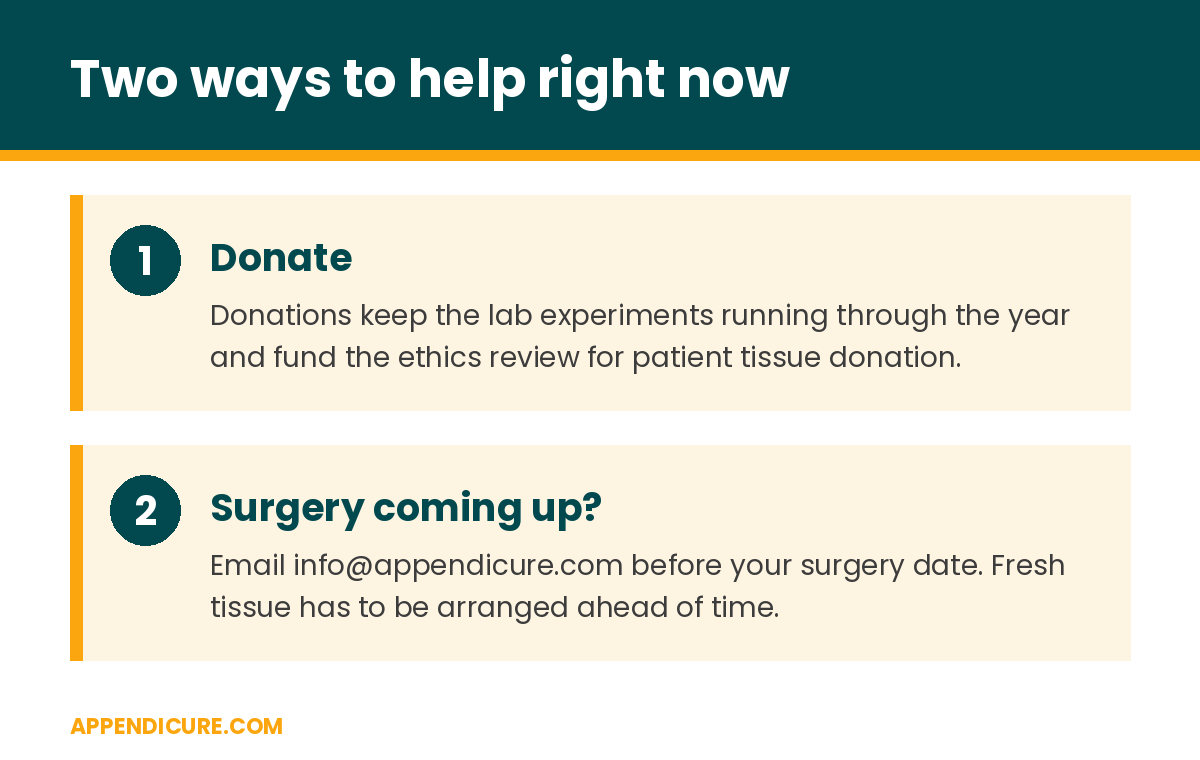
The first tests are already underway. Ricki and I are funding the University of Maryland work and the first month at Johns Hopkins. Donations will help keep the experiments running through the year and support the separate ethics review needed for the proposed tissue donation program.
Appendicure is a U.S. 501(c)(3) nonprofit, EIN 41-5040966. Donations are tax-deductible for U.S. taxpayers to the extent allowed by law. Donors outside the U.S. are welcome to give, but should check their own country’s tax rules.
Why give here instead of to a big cancer center
Large cancer centers do important research, and Johns Hopkins is one of them. But if you give to a large hospital or university without restrictions, the institution decides where the money goes, and it can end up funding work on a more common cancer. Even a gift set aside for appendix cancer can take a long time to reach a lab bench, because someone there has to have a project ready, approved, and staffed before the money can be spent on it.
This work is already past that point. Ricki has the hypothesis, the Johns Hopkins lab is set up to test it, and the University of Maryland tests are running. A donation here pays for experiments that are already lined up, on questions that came from this community.
If you have surgery coming up, please contact me about tissue
Some of these tests need fresh tissue taken during surgery, not tissue that has already been preserved in wax for the pathology lab. Once tissue goes into wax, it can’t be used for these tests, and that can’t be fixed after the fact.
If you have surgery coming up for PMP, high-grade appendiceal adenocarcinoma, goblet cell adenocarcinoma, or signet ring cell carcinoma, including CRS/HIPEC, please email me at info@appendicure.com before your surgery date so we can explore whether donation may be possible. Anything that might work has to be set up ahead of time, because the tissue has to be collected and handled the right way on the day of surgery. If you know someone with appendix cancer who has surgery scheduled, send them this post.
The hold-up, and the route I’m working on
Ricki and I have talked with the high-volume appendix cancer centers in the U.S. and with centers in Italy, Spain, the UK, Norway, and Australia about sharing tissue. Before a hospital can send tissue to a lab at another institution, the two need a material transfer agreement, a legal contract between them. In my experience those agreements take months, and the centers I’ve talked with have long lines of them waiting.
I’m working on a patient-directed tissue donation route and the ethics review it would require. It isn’t approved yet. The goal is to make donation easier, but we still need to establish what agreements and arrangements each participating hospital would require. If you have surgery coming up, please contact me ahead of time so we can explore whether donation may be possible.
Other ways to help
If you have any type of appendix cancer, join the Appendicure Patient-Led Global Appendix Cancer Registry and upload your pathology and mutation reports. A lab result only matters if researchers can later find the patients whose tumors match it, and the registry is how they’ll find them. If you run a lab that works with appendix cancer or PMP models, please contact me through appendicure.com. And please share this post.
Scientific detail
This section is for readers who want the specifics behind the high-grade work.
Most tumor tests used today to look for a targetable mutation read DNA extracted from a piece of tumor, which mixes many cells together. A mutation carried by only some of the cells, or a sample with few tumor cells, can come back negative. In a 2026 study of 167 PMP patients, the researchers found a mutation in 58% of cases when they tested frozen tissue from the belly alone. When they added selected, tumor-rich preserved tissue, including the original appendix tumor when it was available, and used targeted DNA sequencing and a sensitive test called droplet digital PCR, that rose to 98%. That shows how much sampling and testing methods matter. It doesn’t mean 98% of those patients had a targeted treatment available, and it isn’t a study of single-cell RNA sequencing.
Single-cell RNA sequencing works differently. It measures RNA to show which genes individual cells are using. It can reveal patterns of gene activity that suggest biological pathways worth investigating. Some mutations can also be detected in RNA, but detection depends on the method and coverage; even mutations in active genes can be missed. It complements DNA testing rather than replacing it. Any potential treatment leads still need laboratory testing.
We’re investigating whether some gene-activity programs identified in PMP are also present in high-grade appendiceal cancers, and whether those shared programs could suggest treatment targets. Ricki’s single-cell analysis draws on both public and privileged-access single-cell RNA and multi-omics data. Multi-omics data combines several kinds of molecular measurements from the same samples. He has also drawn on large tumor-mutation databases from Memorial Sloan Kettering and AACR Project GENIE and on the raw data from David’s Caris tumor test. The mutation databases can inform the work, but on their own they can’t show shared gene activity at the single-cell level. The work includes the KRAS G12D mutation.
One lead came from David’s tumor. On his Caris report, his FGFR2 RNA expression was at the 100th percentile against Caris’s comparison group, which puts it at the very top. Caris called the FGFR2 copy number “intermediate.” Neither Caris nor a second test, Altera, found an FGFR2 fusion. His result lines up with something we saw in a small public single-cell dataset, where FGFR2 ran higher in goblet cell tumor cells than in mucinous tumor cells.
High expression of a gene isn’t the same as the kind of gene change a drug is approved for. FGFR inhibitors are approved in some other cancers for specific FGFR gene changes, such as fusions, and high FGFR2 expression on its own doesn’t make anyone a candidate for one. David’s result comes from one tumor, and the single-cell pattern comes from a handful of tumors.
KRAS mutations show up less often in goblet cell and signet ring tumors than in mucinous appendix tumors, so a finding in one high-grade subtype can’t be assumed to apply to the others. Every piece of this is a hypothesis that needs testing on fresh tissue.
What this does and doesn’t cover
The polyamine idea is in PMP. The KRAS G12D and single-cell work is in high-grade appendiceal adenocarcinoma, goblet cell adenocarcinoma, and signet ring cell carcinoma. Neither covers appendiceal neuroendocrine tumors. Ricki’s analysis is unpublished and hasn’t been peer-reviewed. A lab result in cells doesn’t tell anyone how a drug will work in a person. Nothing in this post is a reason to change your treatment.
Frequently asked questions
How can I help fund appendix cancer research?
Give at givebutter.com/support-appendicure-5j7b3s. Ricki Dhal and I are funding the University of Maryland work and the first month at Johns Hopkins. Donations help keep the experiments running through the year and support the ethics review for the proposed tissue donation program.
Why donate to Appendicure instead of a large cancer center?
An unrestricted gift to a large center goes wherever the institution decides, which may not be appendix cancer. Even a gift set aside for appendix cancer has to wait for a project that’s ready to use it. This research is already set up and running.
Why not wait for a grant or a trial?
A standard NIH grant takes the better part of a year just to reach funding, if it’s funded at all, and few trials are designed for appendix cancer.
Has this drug combination been tested in PMP before?
Not that Ricki and I can find. We found no published study or clinical trial of this combination in PMP. That’s what the Johns Hopkins lab tests are for.
How can I donate tissue?
Email info@appendicure.com before your surgery date so we can explore whether donation may be possible. The patient-directed donation route isn’t approved yet, and each hospital may have its own requirements.
Why does the research need fresh tissue?
Some lab tests need living tumor tissue taken during surgery. Tissue that has already been preserved in wax for the pathology lab can’t be used for them.
My DNA test found no targetable mutation. Does that mean my tumor doesn’t have one?
Not necessarily. Most DNA tests read many cells mixed together and can miss a mutation carried by only some cells or in a sample with few tumor cells. It can also mean your tumor truly doesn’t carry one of the mutations current drugs target. Ask your oncologist whether retesting a different sample makes sense for you.
Can I get these drugs?
This project is not offering treatment or enrolling patients in a drug trial. We’re testing the combination in the laboratory.
My report shows high FGFR2 expression. Does that mean an FGFR inhibitor would work for me?
Not on its own. FGFR inhibitors are approved in some other cancers for specific FGFR gene changes, such as fusions. High expression alone isn’t one of them. Ask your oncologist what your full report shows.
Join the Appendicure Registry
The Appendicure Patient-Led Global Appendix Cancer Registry collects molecular, genomic, and pathology data from people with every type of appendix cancer. It is IRB-reviewed and open to patients in the United States and internationally. Please use the link for where you live.
Join the Registry: United States Join the Registry: International
Already enrolled? Add new reports or correct your record here.
Read More
Appendix Cancer Clinical Trials: A Real Access Gap, and 1 Hopeful New Tool
The Data That Could Help Doesn’t Exist Yet. We’re Building It.
Why High-Grade Appendix Cancer Patients REALLY Need to Be Counted
Your AI Doesn’t Know Which Appendix Cancer Type You Have. Tell It.
One quick question for you: Did anyone ever ask you about donating tissue for research before your surgery? Yes or no. Tell me in the comments, and if you know someone with surgery coming up, share this with them.
Sources
Torgunrud A, et al. High prevalence of KRAS and GNAS mutations in pseudomyxoma peritonei. Pleura Peritoneum. 2026;11(1):11-18. doi:10.1515/pp-2025-0034
Ang CS-P, et al. Genomic landscape of appendiceal neoplasms. JCO Precis Oncol. 2018;2. doi:10.1200/PO.17.00302
Taniguchi SH, et al. Impact of genetic mutations on prognosis and chemotherapy efficacy in advanced appendiceal carcinoma. Int J Clin Oncol. 2025;30:914-925. doi:10.1007/s10147-025-02724-2
National Institute of Allergy and Infectious Diseases. Overview of the R01 process.
Cystic Fibrosis Foundation. Our Venture Philanthropy Model.
Ross C. How an AI expert took on his toughest project ever: writing code to save his son’s life. STAT, July 25, 2019.
OpenAI Academy. Sid Sijbrandij and ChatGPT in his cancer research.
Bioplatforms Australia. AI and genomics combine to create personalised cancer vaccine for dog. March 2026.
AACR. AACR Project GENIE.
Bina Therapeutics. Team.
Appendicure is a 501(c)(3) nonprofit, EIN 41-5040966. This post is for education and is not medical advice.


Leave a Reply