

A new pathology study found a treatment target, a protein called Claudin 18.2, on some high-grade appendiceal mucinous carcinoma tissue. That same protein is the target of an FDA-approved drug for certain stomach and gastroesophageal cancers. This does not mean that drug works for appendix cancer. It means there is now a reason to look.
I read a lot of research that has nothing to say to this community. This one is different. A team in Dublin looked at appendix tumor tissue and found a protein already being targeted in other cancers. For a cancer with few approved options, that is worth paying attention to.
It ran in the Journal of Clinical Pathology on August 6, 2026. The researchers work at the Mater Misericordiae University Hospital and the UCD School of Medicine in Dublin. Dr. Colman Clarke is the lead author, with Dr. Naoimh O’Farrell as senior author. The full paper is open access. I’ve linked it at the bottom of this post.
What the researchers looked at
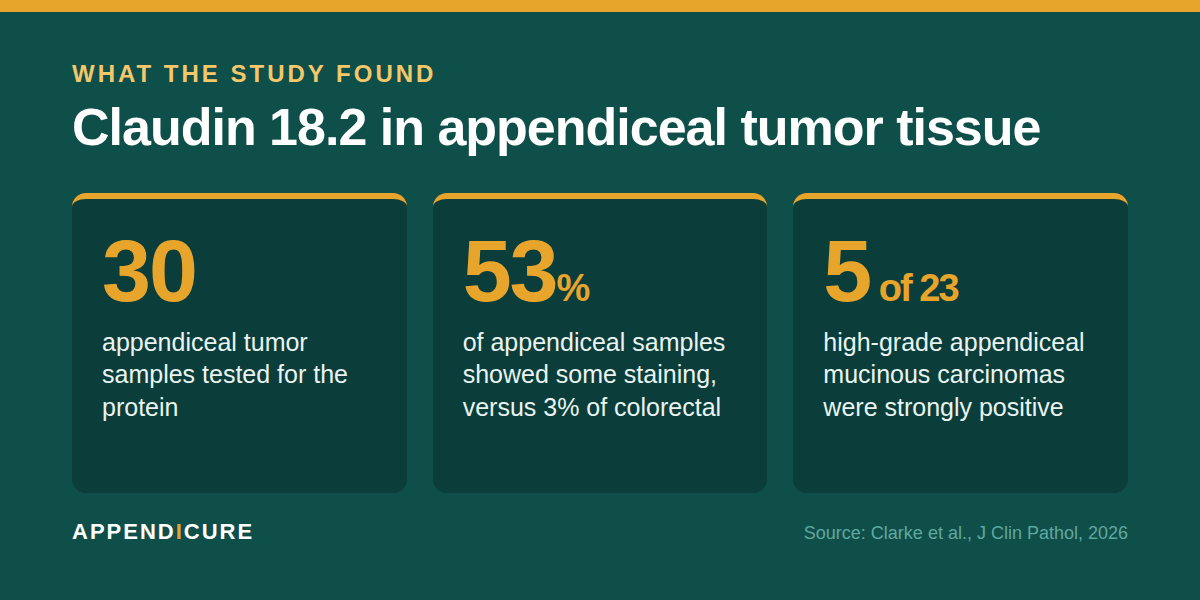
Clarke and his colleagues studied tissue from 64 people who had cytoreductive surgery at a national center for peritoneal cancer. Peritoneal means the cancer had spread to the lining of the belly. They split the tissue into two groups. One group was colorectal cancer that had spread, 34 people. The other was appendiceal mucinous tumors, 30 people.
Then they stained the tissue for Claudin 18.2. Claudin 18.2 is a protein that normally sits in the lining of the stomach. It acts like a seal between cells. When it shows up on a tumor, it becomes a handle that a drug can grab onto. A staining test is how pathologists see whether that handle is present.
What they found in high-grade appendiceal mucinous carcinoma
The appendix tumors carried this protein far more often than the colorectal tumors did. When the team counted any amount of staining, 53 percent of the appendiceal samples were positive. Only 3 percent of the colorectal samples were. That gap was large and unlikely to be chance.
The strong, drug-relevant staining was more selective. Using the strict cutoff that drug trials use, positivity in the appendix group showed up in one place only. It showed up in high-grade appendiceal mucinous carcinoma, in 5 of 23 cases, about 22 percent. The low-grade appendiceal tumors did not reach that bar. That detail matters, because it points to the exact subtype where a future drug might have the best shot.
Why a stomach cancer target matters here
Claudin 18.2 is not a new idea in cancer care. There is a drug called zolbetuximab that was approved for advanced stomach and gastroesophageal cancers that carry this protein. It works by locking onto Claudin 18.2 and flagging those cells for the immune system. In the stomach cancer trials, patients whose tumors expressed Claudin 18.2 had improved outcomes when zolbetuximab was added to chemotherapy.
That is where this connects for appendix cancer. An approved drug already goes after Claudin 18.2, and this study shows some appendix tumors carry Claudin 18.2. Those patients could one day be candidates for the same class of drug, or for a trial testing it. This study is the first focused look showing the target is really there in this tumor group.
What this study does not mean
I want to be careful here, because hope is easy to oversell. No one in this study was treated with zolbetuximab. This was a tissue study, not a drug trial. Finding the target on a slide is a long way from proving that a drug aimed at it helps a single appendix cancer patient. That next study has not been done.
The numbers are also small and come from one center. Five positive cases is a signal, not a settled fact. A staining result on stored tissue is a starting point that other teams now need to confirm. And the standard of care has not changed. The reference for appendiceal cancer care remains the 2025 Godfrey consensus guidelines, and surgery with HIPEC is still the backbone of treatment for many.
Which appendix cancers were not part of this study
The cohort here was mucinous tumors of the appendix. Several other types that members live with were not represented in it. Goblet cell adenocarcinoma, signet ring cell cancer, and neuroendocrine tumors, sometimes called carcinoid, fall outside what these researchers examined. Low-grade appendiceal mucinous neoplasms were in the tissue set, but they did not show the strong staining. If your diagnosis is one of these, this particular finding is not about your tumor. It is early news for one slice of a rare disease.
What I am watching next
A few things will tell me whether this goes anywhere. I want another center to repeat it in a larger group of appendix tumors, because five positive cases from one hospital is a start and not a conclusion. I am watching for a trial that lets appendiceal patients with this marker try a Claudin 18.2 drug. And the quietest possibility may matter most, which is whether pathologists begin adding this stain to appendix cancer reports at all. The test already exists, so that could reach patients sooner than any trial.
This is exactly the kind of finding the Appendicure registry is built to catch. When members share their pathology and molecular details, patterns like this stop being one paper from one city. They become something researchers can act on.
Common questions
What is Claudin 18.2?
It is a protein that normally lines the stomach. Some tumors also carry it. When they do, it can act as a target for certain drugs.
Does this study mean there is a new treatment for appendix cancer?
No. It found the target in some high-grade appendiceal mucinous carcinoma tissue. No one was treated. A treatment study still needs to happen.
How can I find out if my tumor carries Claudin 18.2?
A laboratory test for Claudin 18.2 is available, although it is not routinely performed for appendix cancer. Ask your oncologist or pathologist whether testing would be appropriate in your situation.
Which appendix cancer types were studied?
Mucinous tumors of the appendix. Goblet cell, signet ring, and neuroendocrine types were not included, and low-grade tumors did not show the strong staining.
Read more from Appendicure
Appendix Cancer and Fertility: What a New MD Anderson Study Means for Women
Blood Clots After CRS/HIPEC: Why the First 2 Weeks Matter Most
Prehab Before Surgery: How to Show Up Stronger for CRS
Add your data to the Patient-Led Global Appendix Cancer Registry
The registry is IRB approved and open now. It collects the molecular, genomic, and pathology details that make findings like this one possible. Pick the form for where you live.
Source: Clarke CT, Rogers AC, Cowzer D, Treacy A, Aird J, Patel M, Mulsow J, O’Farrell NJ. Retrospective analysis of Claudin 18.2 expression in 64 patients with advanced gastrointestinal peritoneal disease: a potential therapeutic target for high-grade appendiceal mucinous carcinoma. J Clin Pathol. 2026 Aug 6. Read the open-access paper here: jcp.bmj.com.
Appendicure runs on community support. If this kind of research tracking matters to you, you can help fund it here.
Leave a Reply