
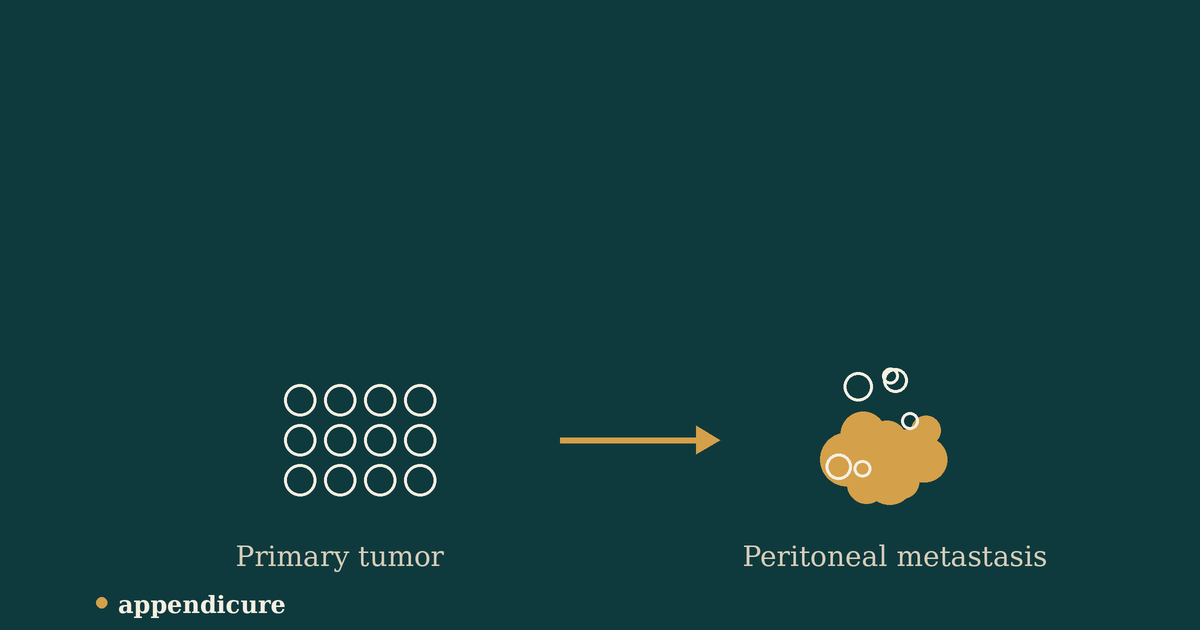

A lot of us first heard the word KRAS when it turned up on a pathology report, with no real explanation of what it means for treatment. A new study does not answer that all the way, but it moves the ball. Researchers built one of the first stable, long-term sets of lab-grown appendix cancer organoids and used them to work out how this disease changes as it spreads through the belly. None of this is a treatment you can ask for yet. It is laboratory work. But it is the kind of work that has been missing in appendix cancer for a long time, and it is worth understanding.
What they actually did
Appendix cancer organoids are tiny tumors grown in a dish from a patient’s own tissue. The study came out of Dr. Karuna Ganesh’s lab at Memorial Sloan Kettering. One of the authors, Dr. Michael Foote, is a medical oncologist at MSK whose research helped sort out the molecular subtypes of appendix cancer. The team collected primary and metastatic tumors from 24 appendix cancer patients during surgery, and from those they grew 16 stable, long-term organoid lines. The 16 lines covered the main subtypes of the disease, including mucinous tumors and goblet cell adenocarcinoma. Three came as matched sets, a primary tumor and its own peritoneal metastasis taken from the same person during the same operation. That pairing is the whole point. It let them put the original tumor next to the cancer that spread from it, in the same patient, and see what changed. They also grew the organoids in mice in a way that copies the diffuse, scattered spread we see in the peritoneum, instead of the neat single lumps most mouse models produce.
The spread tumors were not just copies
Reading the cells one at a time, the metastatic cells had backed away from their mature, specialized identity and slid into more primitive states, the kind you see in intestinal stem cells and in fetal tissue. The researchers think this backward shift is part of how the cells survive and take hold once they are loose in the abdomen.
They were also tougher
The spread tumors were better at colonizing new tissue, leaned less on outside growth signals, and in most of the matched pairs barely flinched at standard chemotherapy. In two of the three pairs, it took twenty to a hundred times more drug to hit the metastatic organoids than their matched primary. That fits something many families have lived through. Chemo borrowed from colon cancer often underwhelms once appendix cancer has spread across the peritoneum.

A finding worth taking to your own team
Mucinous appendix tumors are mostly mucus with relatively few actual cancer cells in them. That makes them hard to sequence, because a real mutation can sit below the cutoff that standard tumor testing uses and get reported as not there. Because organoids concentrate the cancer cells, this group caught mutations that the routine clinical sequencing had missed in the very same patients, including KRAS changes that matter for prognosis and treatment. Sorting out which of those mutations actually carry weight in appendix cancer is the work Dr. Foote’s molecular classification of the disease was built to do. Catching them is not a small thing. This is also the tissue-sample cousin of a problem we have covered on the blood side, where ctDNA testing can read quiet in low-cellularity mucinous disease even when cancer is present. Growing organoids is a research method, not a test you can order. But the lesson stands. In mucinous appendix cancer, a result that says no mutation found is not always the last word, and it is fair to ask whether thorough genomic profiling makes sense for your tumor.
Two weak spots, both still in the lab
When they went looking for vulnerabilities, two stood out. The first is the RAS pathway. The lab compound they used, RMC-7977, shut down growth in the appendix cancer organoids that carried RAS pathway mutations. RMC-7977 itself is a research tool, not a patient drug. Its clinical cousin, daraxonrasib (RMC-6236), is already in human trials, with its strongest results so far in pancreatic cancer. KRAS inhibitors like it have also started reaching appendix cancer patients, with some early responses, which we covered when that research came out. The second weak spot was Wnt signaling, where an experimental compound called WNTinib slowed the organoids. WNTinib is also preclinical and is not in routine testing for appendix cancer.
Why these appendix cancer organoids matter
For years, appendix cancer has been treated with colon cancer’s playbook, because that is what existed. This study is one more piece of evidence that appendix cancer is biologically different, and that it needs research built for it. The biobank itself may end up mattering more than any single result inside it, because it finally gives researchers appendix-specific models to test ideas in, rather than guessing from other cancers.
The honest version of where this sits
It is preclinical. Dishes and mice are not people, and results in them do not always hold up in patients. The two lab leads from this study, RMC-7977 and WNTinib, are not available to anyone as treatment. And it is worth knowing who these models represent. These appendix cancer organoids grew best from poorly differentiated, higher-grade tumors. Low-grade mucinous tumors rarely formed stable lines, so they are underrepresented here. If you have low-grade disease, which often behaves very differently and can carry a much better outlook, this work is not really describing your cancer. If that is you, our guide to LAMN, HAMN, and PMP is a better place to start.
If any of this feels relevant, the things worth raising with your oncologist are whether your tumor carries a KRAS or other RAS pathway change, whether comprehensive genomic profiling is appropriate for you, and whether any RAS-targeted trials fit your situation.
We track this kind of research so you do not have to chase it down yourself. If you want your own case counted in work like this, our patient registry is open, and the more of us in it, the more useful it becomes to the people running these studies.
Sources
Mahmoud A, et al. An appendiceal cancer organoid biobank identifies phenotypic evolution and druggable dependencies of peritoneal carcinomatosis. Developmental Cell 61, 1289-1302, 2026. Open access.
Jüngen HD, Dayton TL. Patient-derived models uncover developmental state shifts in appendiceal cancer metastasis. Developmental Cell, 2026. Commentary.
Read Next: Preserving Tumor Tissue Before Appendix Cancer Surgery
Read Next: Another New Study Suggests KRAS Inhibitors Could Be an Effective Treatment for Appendix Cancer

Leave a Reply