
In February, Dr. Patrick Wagner and his physician assistant Shannon Altpeter, from Allegheny Health Network, walked our community through two ways of delivering chemotherapy straight into the abdomen: HIPEC and PIPAC. Most people with appendix cancer learn about HIPEC early. It’s the heated chemo that gets washed through the abdomen during cytoreductive surgery, and for many patients it’s the centerpiece of treatment. PIPAC for appendix cancer is the newer approach, still being studied in clinical trials, and it matters most for people who’ve been told cytoreductive surgery isn’t an option. Two terms worth understanding from that conversation are PIPAC and bidirectional chemotherapy.
What PIPAC is
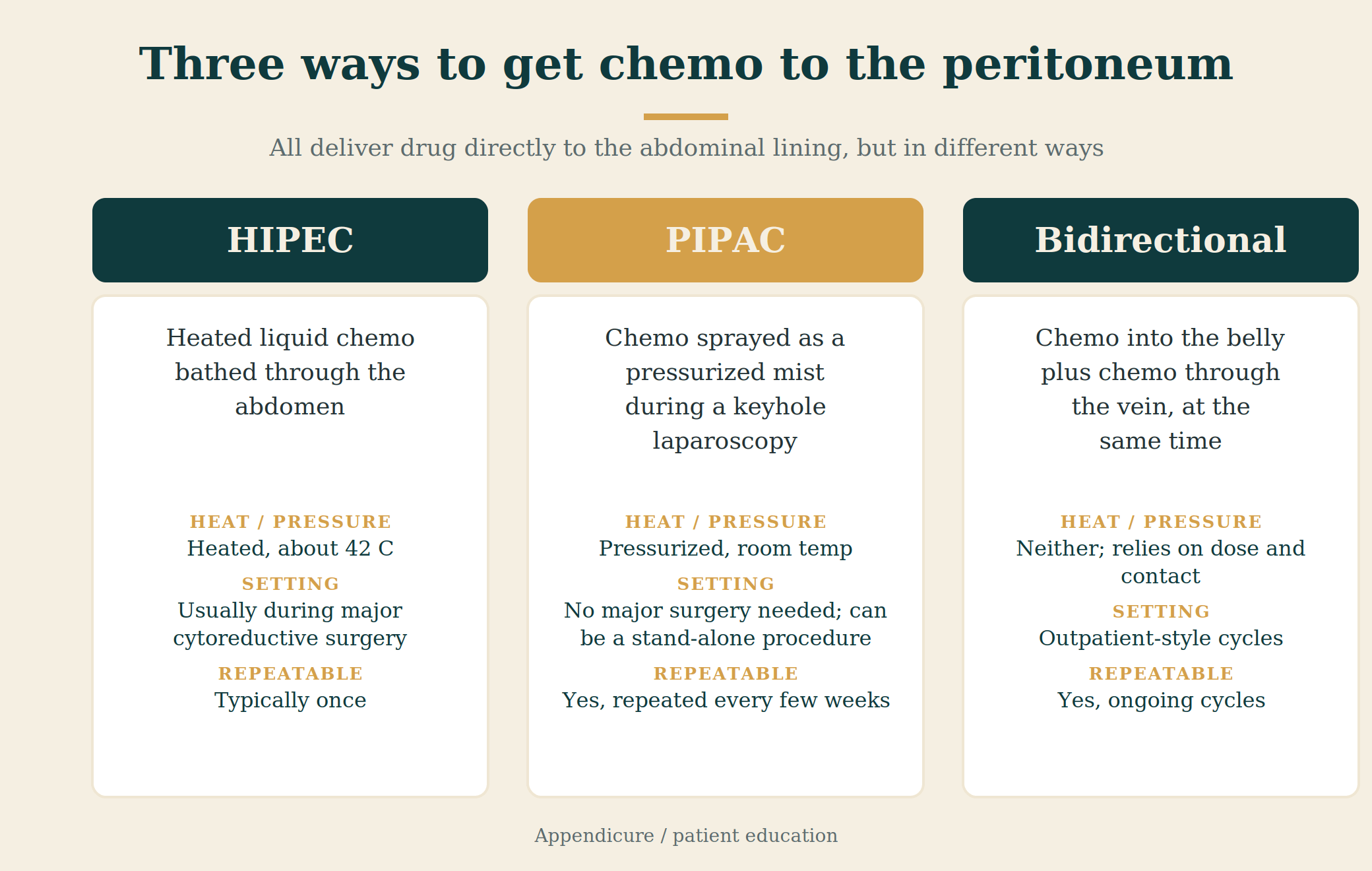
PIPAC stands for pressurized intraperitoneal aerosol chemotherapy. Instead of bathing the abdomen in heated liquid the way HIPEC does, it turns the drug into a pressurized mist and sprays it into the abdomen through a laparoscope, the same kind of keyhole instrument used for minimally invasive surgery. The idea, first put into practice in 2011, is that an aerosol spreads more evenly and pushes a little deeper into tissue than liquid that simply sits in the cavity.
The practical difference for patients is that PIPAC doesn’t require major surgery. It can be done on its own, and it can be repeated, usually every several weeks. That makes it a possible option for people who aren’t candidates for cytoreductive surgery, whether because the disease is too widespread, because an earlier operation didn’t clear it, or because they aren’t well enough for a long surgery. PIPAC for appendix cancer is still investigational, which is why it shows up mainly inside clinical trials rather than as routine care.
What bidirectional chemotherapy means
Bidirectional chemotherapy is simpler than it sounds. It means giving chemo two ways at the same time, into the abdomen and through the vein. The thinking is that the intraperitoneal drug hits the surface tumors directly while the intravenous drug reaches anything that has gotten into the bloodstream or deeper tissue. PIPAC is increasingly paired with systemic chemo in exactly this way, so the two ideas often travel together.
Where the proof actually is
What matters for keeping expectations honest is where this evidence comes from. The strongest randomized results for putting chemo directly into the abdomen are in stomach cancer, not appendix cancer.
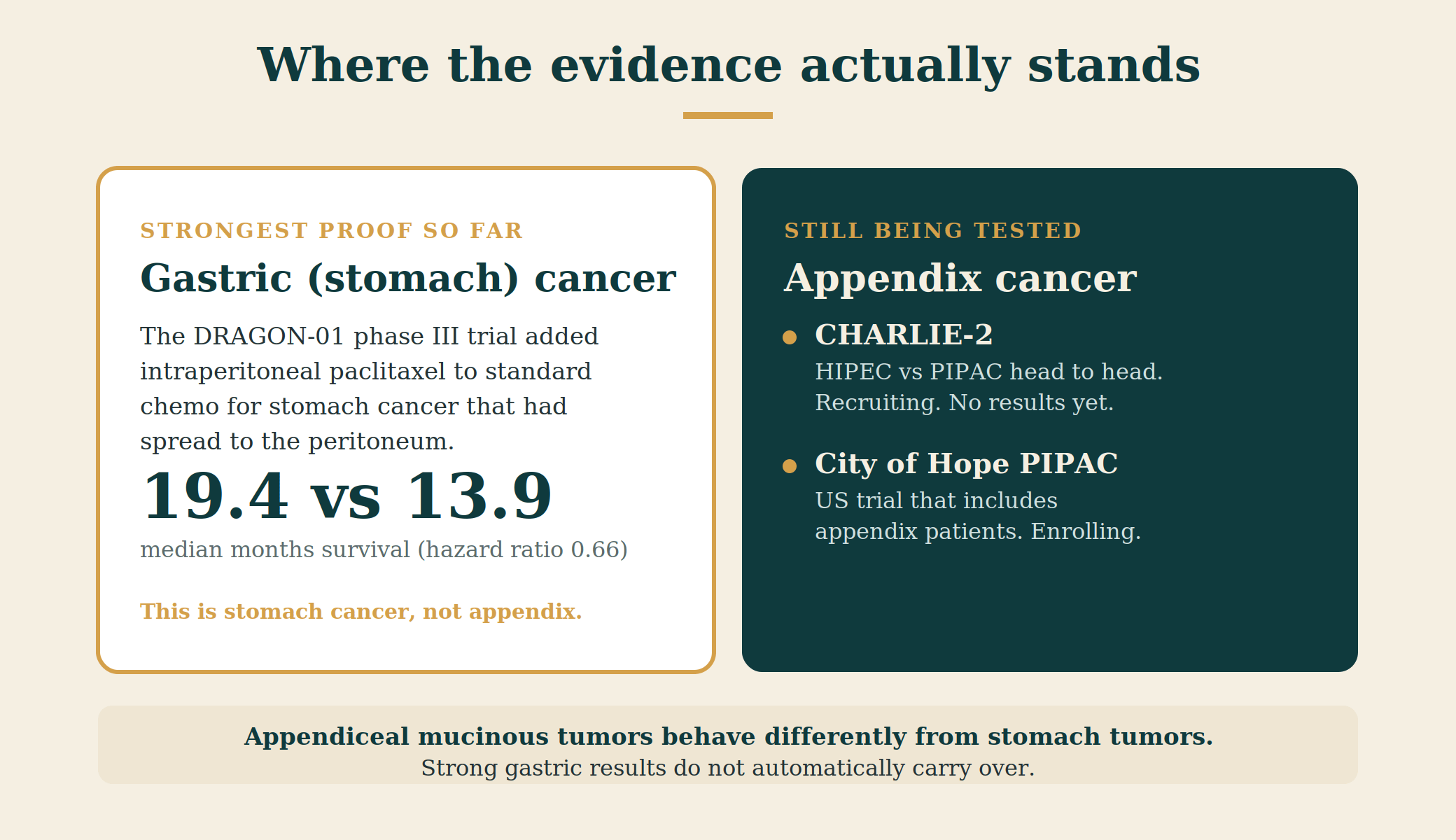
The clearest example is the DRAGON-01 trial, a phase III study from China. It added intraperitoneal paclitaxel to standard chemotherapy in stomach cancer patients whose disease had spread to the peritoneum. Median survival rose to 19.4 months with the intraperitoneal drug added, compared with 13.9 months without it. That’s a real, statistically significant difference, and it’s the first large randomized trial to show this kind of benefit for the approach. An earlier Japanese phase III trial, PHOENIX-GC, tested a similar bidirectional regimen and did not meet its main goal, though patients with more fluid buildup in the abdomen appeared to do better with the intraperitoneal drug.
None of this was studied in appendix cancer. Appendiceal tumors, especially the mucinous kind, behave differently from stomach tumors. They often grow slowly, produce large amounts of mucin, and respond to chemotherapy on their own terms. A result that holds up in gastric cancer can’t simply be assumed to hold up in appendiceal disease. It’s encouraging that the underlying idea is earning real evidence, but the proof you’d want for our disease specifically isn’t in yet.
PIPAC for appendix cancer: the open trials
Three trials are recruiting right now that include appendiceal patients, two in the United States and one in Europe.
CHARLIE-2 is a new randomized trial from Patrick Wagner’s group at Allegheny Health Network. It compares HIPEC and PIPAC head to head in patients who aren’t candidates for cytoreductive surgery and still have disease after at least three months of standard chemotherapy. Both arms use the same drug, mitomycin C, so the trial is really testing the delivery method rather than the medicine itself. Patients are grouped by where their cancer started, with appendiceal as one of the three categories, so appendix patients are eligible. The design was just published and recruitment is underway. It runs at a single center in Pittsburgh, which matters if travel is a factor for you.
During the webinar, Shannon Altpeter, the PA who runs the trial day to day, and Dr. Wagner filled in details that aren’t in the protocol paper. Enrollment is already underway, with about six patients enrolled since the start of the year. The trial takes appendiceal, colorectal, and other primaries, and goblet cell adenocarcinoma is included at every grade, so a goblet cell diagnosis doesn’t rule you out. What decides eligibility is whether the disease is unresectable and whether you’re safe for the procedure, not the subtype on the pathology report.
Two points stood out for patients. First, resectability is judged by two surgeons independently at the first laparoscopy, not one. Dr. Wagner looks first, and if he says the disease can’t be cleared with surgery, a second surgeon makes the same call without knowing the first answer. Altpeter described it as a fair second look for people who arrive having been told elsewhere that surgery is off the table. Second, you can stay on your systemic chemotherapy while on the trial. The protocol asks for about two weeks off before each procedure and a week after, which usually leaves room for two systemic treatments in between. Screening and follow-up can be done remotely, enrollment can be scheduled the day before the first procedure for people traveling, and the treatments are done at West Penn Hospital in Pittsburgh, usually with a single overnight stay.
Both doctors were direct about what the trial can and can’t promise. The assignment to HIPEC or PIPAC is random. As Altpeter put it, “I don’t get to pick and you don’t get to pick.” Wagner explained the reason is equipoise, meaning there’s genuinely no good evidence yet that one method beats the other. They do measure how often a patient becomes eligible for cytoreductive surgery after the trial treatments, which is the outcome many patients hope for, but Wagner was clear that it won’t happen for everyone and isn’t the main goal. The main questions are which method is safer, better tolerated, and more effective.
We covered all of this with Dr. Wagner and Shannon Altpeter in our February webinar. You can watch the full conversation here.
Shannon Altpeter, PA-C, a surgical oncology physician assistant at Allegheny Health Network, presented CHARLIE-2 with principal investigator Dr. Patrick Wagner.
The other is a PIPAC trial led by City of Hope, the first multicenter PIPAC study in the United States. It enrolls appendiceal patients alongside ovarian, uterine, colorectal, and gastric cancers, and it runs in partnership with the National Cancer Institute, Mayo Clinic, and Northwell Health. Because it spans several sites, it may be easier to reach than a single-center study.
Outside the United States, PIPAC is further along. It has been studied and offered at specialist peritoneal cancer centers across Europe and Asia for over a decade. One trial worth flagging for international readers is at Ghent University Hospital in Belgium, an early-phase study testing a newer aerosolized drug, nanoliposomal irinotecan, delivered by PIPAC. It is open to appendiceal and other gastrointestinal cancers and is recruiting now. Because it is a single-center safety study, the practical step for patients abroad is to ask a peritoneal surface specialist near them whether PIPAC, in a trial or through an established program, is an option.
Two PIPAC trials you might find that don’t fit
If you search the trial databases yourself, two PIPAC studies are likely to come up. Neither one fits appendix cancer, which is why they aren’t on the list above. The UK’s PICCOS trial is a randomized Phase II PIPAC study, but it covers colon, ovarian, and stomach cancer, not appendix. A trial in Guangzhou, China (NCT06743867) is recruiting for peritoneal metastatic adenocarcinoma in general, with no specific mention of appendiceal disease, so we don’t count it as an appendix trial.
How to think about this
PIPAC and bidirectional chemotherapy are real options, and the science behind them gets more solid every year. They aren’t a last resort that only desperate patients consider, and they aren’t a proven cure for appendix cancer either. They sit in the honest middle, promising enough to study carefully and unproven enough that the careful studying still has to happen.
That gap is the whole reason CHARLIE-2 exists. As Rick Page wrote in Hope Is Not a Strategy, wanting something to work isn’t the same as showing that it does. For years these procedures have been done in single-arm settings where it’s hard to learn much. Running an actual head-to-head trial is how the field gets an answer instead of an impression, and it’s how PIPAC for appendix cancer moves from idea to evidence.
If you’ve been told you aren’t a candidate for cytoreductive surgery, these trials are worth raising with your care team, and worth asking about by name. And if you want to help the next person get a faster, clearer answer, adding your history to the patient registry is one of the most useful things you can do.
Leave a Reply