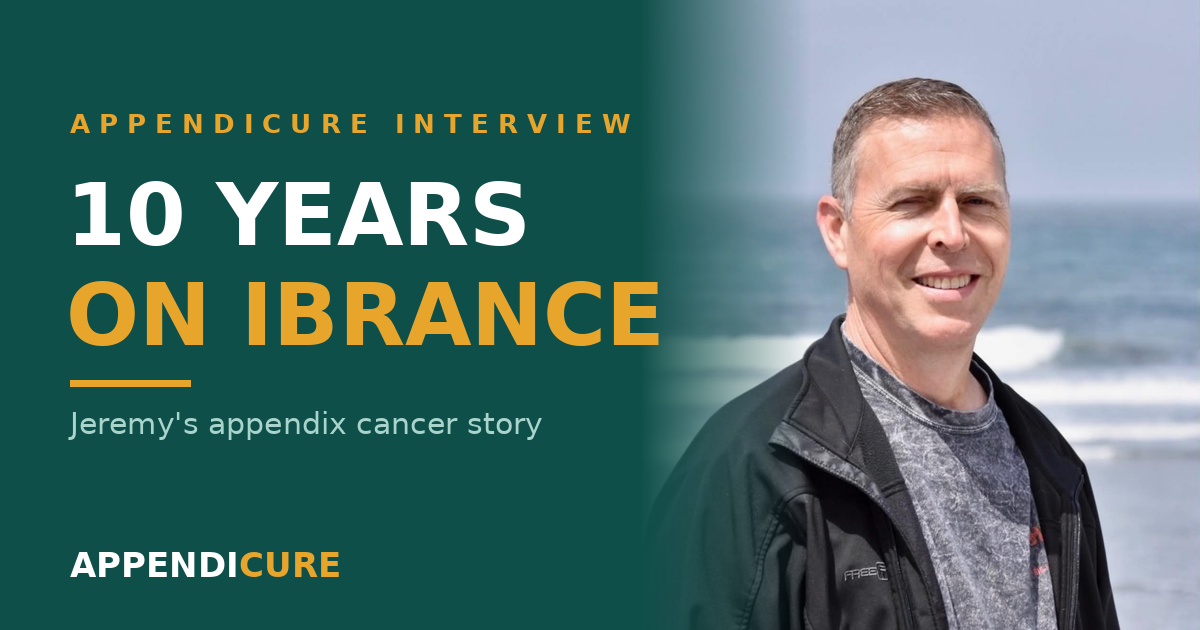

This is an appendix cancer patient story about Jeremy Kitzhaber, a 22-year U.S. Air Force veteran from Idaho. He has taken a targeted drug called Ibrance (palbociclib) for almost 10 years, and he believes he was the first appendix cancer patient ever matched to it.
I recently sat down with Jeremy Kitzhaber from Idaho, and I have to tell you, he is a bit of a legend in this community. Jeremy is believed to be the very first appendix cancer patient identified for the targeted drug that so many of you now know by name. He has been on it for almost 10 years. If you have ever wondered whether these treatments actually work, Jeremy is your answer, sitting right in front of you.
You can watch our full conversation below, and here is his story in his own words, as much as I can keep it.
One appendix cancer patient story that starts with 22 years of service
Jeremy spent 22 years in the Air Force. He started as a civil engineer working on water, wastewater, and plumbing. He met his wife early, raised two boys, and finished his career as a First Sergeant at McConnell Air Force Base before moving back home to Idaho.

Early on, he was put on a disaster-preparedness team and told to handle radiation samples during monthly drills. They handed the samples to him and had him carry them loose in his uniform pocket. No protective gear. No real training. He was told it was perfectly safe, and the sergeant’s only instruction was “just don’t lick them.” Years later he learned those materials were far more dangerous than he was told, the kind of radioactive sources no one should carry bare-handed in a pocket.
Less than two years after he retired, he was diagnosed. He was 43.
It was found almost by accident. He went to the VA for a minor bladder issue, they did a scan, and they saw something that should not be there. A CT scan looked like a burst appendix full of mucus. The tech told him to wait right there and left him lying in the machine, and Jeremy said he knew right then that could not be good.
Two general surgeons, each with about 25 years of experience, 50 years combined, had never seen anything like it. The pathology team needed five tries to name it. There was not one person in the entire VA system who treated this cancer. Jeremy and his doctors had never even heard of appendix cancer. If that sounds familiar, you are not alone.
When the first plan did not work
In Omaha, he found a specialist who took his military insurance and did the big surgery, cytoreduction and HIPEC. A piece near his diaphragm could not be removed, and three lymph nodes were positive. He was so weak afterward that he could not walk from the car to the cancer ward, so chemo had to wait. When chemo did start, his body could not tolerate it, and they stopped early. Within about 10 months, the cancer was back to where it had been before surgery.
He described chemo the way a lot of you have described it to me. “I felt like I was dying every day. I was being kept alive at best.”
When his Omaha doctor ran out of options, he did what the strongest patients I know always do. He refused to accept it. He sent his records across the country, to the East Coast, Texas, and California, and got turned down by some of the biggest names in this field. “Your cancer is too far along,” they told him. He came away believing that some doctors only want to work on you if they think they can cure you. He was not asking for a cure. He just wanted someone to try.
The turning point
Through a friend who also had appendix cancer, Jeremy found Dr. Andrew Lowy in San Diego. He paid out of pocket to get there for a third opinion. Dr. Lowy did a debulking surgery, because there was too much scar tissue for another HIPEC, and ran a circulating-tumor-DNA test on Jeremy’s blood.
That test showed a target, and it flagged him as the very first patient it had ever matched to this drug.
He had already failed three chemotherapies and a major surgery, so his insurance approved the drug quickly. They even had compassionate-use paperwork ready that they did not end up needing. My favorite part comes next. Sitting in the exam room, Jeremy realized the hospital took veterans’ insurance, but his surgeon was not a registered VA provider. He asked how long it would take to fix that. The nurse said about 10 minutes. Dr. Lowy said, “Make it happen.” By the time Jeremy left, he had gotten one of the country’s top appendix cancer experts inside his covered VA care. A nurse later told him he “broke the system.”
“Never wait for the doctors or staff to get hold of you. Nobody is going to fight more to keep me alive than me.” Jeremy Kitzhaber
Almost 10 years
The drug’s side effects were a little fatigue and brittle nails. That was it. “Nothing compared to chemotherapy,” Jeremy said. The mutation it targeted disappeared, and while he still has disease, it slowed to about a tenth of its old speed.
“I was not expecting to reach 50, let alone 55,” he told me.
That slowdown gave him years, real years. Snorkeling in St. Thomas in April of 2025. Scuba diving in Hawaii four different times. Gold dredging in Idaho creeks, hunting trips, camping with his family, and watching his boys grow up. “I’m still here because Dr. Lowy found a drug for me.”
I will not sugarcoat where Jeremy is now, because he would not want me to. This past year has been hard. After more surgeries and a bowel obstruction, his intestines became too fragile to repair. He now gets his nutrition through a PICC line and TPN, 12 hours every night. He manages drains, and he survived blood clots in his lungs and an ICU stay. Through all of it, he is still here, and still on the drug that got him here.
One honest note so no one takes the wrong message from this. Jeremy’s drug worked because his tumor testing showed a specific target. Not every appendix cancer carries that target, and this drug is not right for every subtype, whether that is goblet cell, signet ring, neuroendocrine, or a low-grade mucinous neoplasm. Targeted treatment depends on your own tumor’s genetics. This is Jeremy’s story, not a promise for every patient. Ask your own care team about molecular testing.
Patients like Jeremy are still being denied this drug
One part of this keeps me up at night. Jeremy got approved fast, but only because he had already failed three chemotherapies and a major surgery. Most patients are not in that spot when they need this drug, and many of them are told no.
Ibrance belongs to a class of targeted drugs called CDK4/6 inhibitors. Doctors use them off-label for appendix cancer patients whose tumors show the right target, which means the drug is chosen from a patient’s tumor testing rather than an approval written specifically for appendix cancer. That part is not in question. The problem is coverage. The national treatment guidelines that insurers lean on have not caught up to appendix cancer, so even when a patient’s own tumor testing points to a CDK4/6 inhibitor, the insurance company can point to the guideline and deny it. Closing that coverage gap for CDK4/6 inhibitors is one of the things I am fighting for right now.
Some patients win on appeal. But appeals take months, and they take energy that a sick person does not always have. People are forced to fight for a drug that is already keeping someone like Jeremy alive, and some run out of time before the answer changes.
The lasting fix is not one appeal at a time. It is changing the guidelines so coverage follows the science. That is a big part of the work I am doing, and Jeremy’s story is exactly why it matters.
If you have been denied coverage
Do not take the first no as final. Ask the insurer for the denial in writing and the exact reason. Ask your oncologist to request a peer-to-peer review, where your doctor talks directly to the insurer’s doctor. Get a copy of your tumor’s molecular testing report, because that is the evidence that shows the drug fits your cancer. File a formal appeal, and ask about the drug maker’s patient assistance program while you wait. Many denials get overturned once the right paperwork reaches the right person.
Why Jeremy wanted this appendix cancer patient story told
Jeremy did not share his story so people would feel sorry for him. He shared it because he is living proof. When someone calls these targeted treatments experimental, there is a man in Idaho who has been alive on one for almost a decade.
He also said something I have not been able to shake. “Never wait for the doctors or staff to get hold of you. Nobody is going to fight more to keep me alive than me.” He did his own research. He got his own second and third opinions. He asked the hard questions when it would have been easier to go home and rest. If you take one thing from him, take that.
Jeremy, thank you. For your service, for your honesty, and for showing all of us what fighting looks like.
Amanda
How you can help
Hospitals still cannot see what is working for each other’s patients, because the computers do not talk. The Appendicure Patient-Led Data Registry is built to change that, so no one has to start from scratch. If you are a patient or caregiver, adding your voice is the most useful thing you can do.
Add your voice to the registry
If you are a patient or caregiver, please add your voice. The registry is IRB-approved with exempt status. Choose the link for where you live.
Join the Registry: United States Join the Registry: InternationalAnd if you are able to help keep this work going, please consider a donation.
Questions people ask
What is Ibrance and is it used for appendix cancer?
Ibrance (palbociclib) is a targeted drug called a CDK4/6 inhibitor. It is used for some appendix cancer patients whose tumor testing shows the right target. Jeremy is one of them, and he has taken it for almost 10 years.
How was Jeremy matched to the drug?
A circulating-tumor-DNA blood test ordered by Dr. Andrew Lowy in San Diego found the target. Jeremy believes he was the first appendix cancer patient ever flagged for this particular drug.
Does this mean the drug works for every appendix cancer?
No. It worked for Jeremy because his tumor carried a specific target. Not every appendix cancer does. The only way to know is molecular testing of your own tumor, so ask your care team about it.
More CDK4/6 patient stories
Jeremy is not the only appendix cancer patient living on a CDK4/6 inhibitor. Connie and Amy are too, and their stories are worth your time.
Watch Connie tell her own story: Connie’s CDK4/6 video interview.
Coming later this week: Amy’s CDK4/6 interview. Follow along on the Appendicure news page.
Learn how these drugs work: CDK4/6 inhibitors for appendiceal cancer.
On a CDK4/6 inhibitor yourself? Your story could help change the guidelines.

Leave a Reply