
When David was diagnosed with appendix cancer, I did a lot of research fast. I found a surgeon we trusted. I assumed that surgeon would be the doctor who ran everything from then on. That is not how it works. I just did not know it yet.
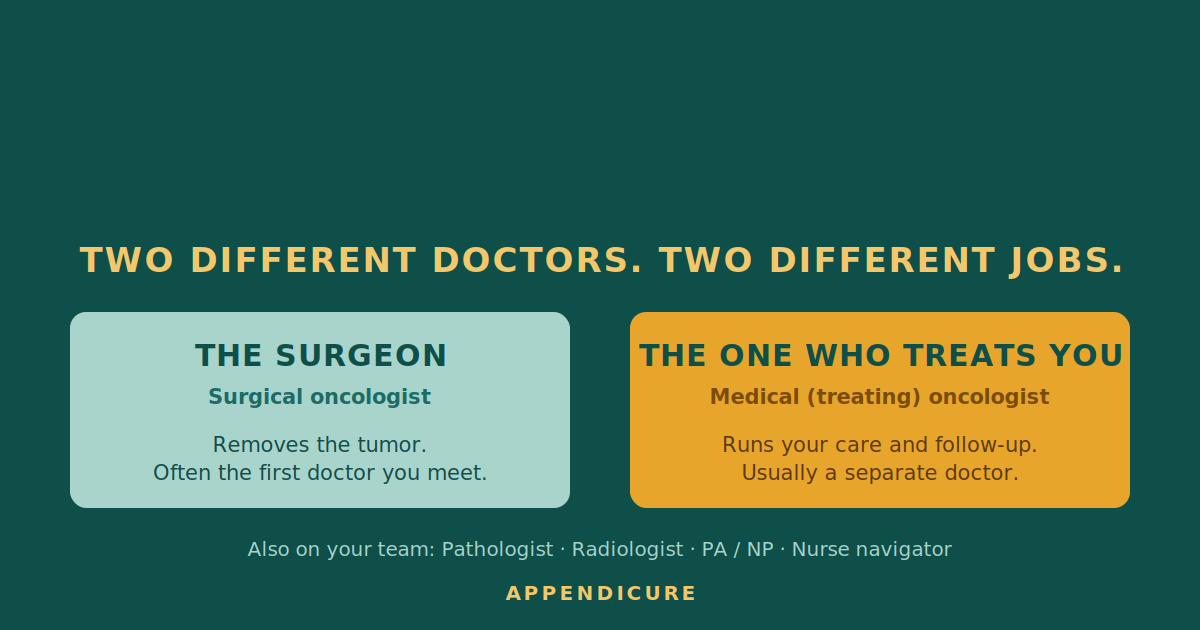
The surgeon does the operation. That is a specific job. A different doctor manages the rest of your care. That doctor is called a medical oncologist, and in most cancer centers that person is the one who follows you over time. Nobody told us this up front. We put it together on our own, later than I wish we had.
If you are newly diagnosed, I want to save you that confusion. These are the people on an appendix cancer team, and what each one actually does.
The surgeon
Your surgeon is a surgical oncologist. This is the doctor who removes the tumor. For appendix cancer, the surgery is often more than a simple appendectomy. Many patients need cytoreductive surgery with HIPEC, which is a long operation done at a specialized center.
The surgeon is usually the first cancer doctor you meet. That is part of why it is easy to assume they are in charge of your whole journey. They are in charge of the operation. That is their lane, and a good one matters enormously.
The part that surprised me came next. Once the surgery is done and you have healed, the surgeon is often not the person who manages what happens after.
The medical oncologist, also called your treating oncologist
The medical oncologist runs your ongoing care. If you need chemotherapy, they prescribe it and manage it. They order your follow-up scans. They watch your bloodwork. They decide, with you, what happens at each step. In most centers, the medical oncologist is the coordinator of the whole team.
This is the seat we did not know existed at first. We chose a surgeon and thought we were set. We were not. David still needed a treating oncologist to follow him, and for a rare cancer like this one, you want that person to know appendix cancer specifically.
Two doctors. Two different jobs. Both matter. Knowing the difference early would have saved us a lot of stress.
The pathologist
The pathologist reads your tissue under a microscope. You will probably never meet this doctor. Their report is still the most important document you own. It names the type of appendix cancer, the grade, and whether the tumor pushed past the wall of the appendix. Every treatment decision starts from that report.
Appendix cancer is rare, and it is easy to get the details wrong the first time. The Godfrey 2025 consensus guidelines recommend that your slides be reviewed by a pathologist who has real experience with appendiceal tumors. I cannot stress this enough. Ask for an expert pathology review. It is one of the highest-value steps you can take, and most patients do not know to ask.
The radiologist
The radiologist reads your scans. CT, MRI, and PET images all pass through this doctor. Like the pathologist, they usually work behind the scenes. Their read still shapes what your oncologist recommends next. For appendix cancer, imaging can miss low-volume mucinous disease, so an experienced eye helps here too.
The PA or NP
Many days, the person you actually see is a physician assistant or a nurse practitioner. These are advanced providers who work alongside your doctors. They are not a lesser substitute. They often have the most time to answer your questions, and they frequently know your case in fine detail. Treat them as a real member of your team, because they are.
The oncology nurse and the navigator
Somebody has to keep all of this moving. That is often an oncology nurse or a patient navigator. They coordinate appointments. They chase down records. They pick up the phone when you are scared at nine at night. When care spans two or three institutions, which is common with appendix cancer, the navigator may be the one person who knows where everything stands.
Other people you may meet
Depending on your case, your team can include an anesthesiologist for surgery, a nutritionist, a social worker, a genetic counselor, and a palliative care doctor. Palliative care is not the same as hospice. It focuses on symptoms and quality of life, and it can help at any stage.
The one lesson I wish someone had handed me
Your surgeon and your treating oncologist are two different jobs. For appendix cancer, you want each seat filled by someone who knows this disease, not just cancer in general.
So ask the question directly. Who is my medical oncologist? Who owns my long-term follow-up? If the answer is unclear, keep asking until it is not. You are allowed to know who is quarterbacking your care.
A few practical steps
Ask who your medical oncologist is and get a name. Ask who owns your long-term follow-up. Request that your pathology slides be reviewed by a pathologist experienced with appendix tumors. Keep your own copies of every pathology and imaging report. If your care spans more than one center, ask your navigator to help the teams talk to each other.
I built the Patient-Led Global Appendix Cancer Registry so patients would stop starting from zero. If you have been diagnosed, adding your story helps researchers see patterns that are invisible one patient at a time. The registry is IRB approved and open now.
If this saved you even one confusing week, please consider supporting Appendicure so the next newly diagnosed family finds this on day one.


Leave a Reply