Skip to content
♥

Help us fund the research needed to find new treatments for appendix cancer.

Donate
  • Facebook
  • Instagram
  • LinkedIn
  • YouTube


RECENT POSTS

LAMN Surveillance MRI: When a Scan Looks Like PMP and Isn’t

Why a Cheap Diabetes Pill Is Now Being Tested Against PMP

Who BromAc Actually Helps, and Who It Does Not

  • AI drug discovery and appendix cancer: neural network diagram showing how AI models connect patient data to drug target candidates, with Appendicure branding.
    • Appendix Cancer 101Your guide to understanding a rare disease, appendix cancer. Learn about types, symptoms, diagnosis, staging, and treatment options like surgery, HIPEC, and chemotherapy—all in one accessible, patient-friendly resource.
      • What is Appendix Cancer?Appendix cancer is a rare abdominal cancer. Learn how appendiceal cancer develops, how it’s diagnosed, and what treatment options exist. APPENDICURE raises awareness for research, recognizing symptoms, diagnosis, surgery, chemotherapy, HIPEC and PIPAC treatment options.
      • Glossary of Medical TermsDecode complex medical terms with our easy-to-understand glossary. Designed for patients and caregivers, this section explains the language used in appendix cancer diagnosis, treatment, surgery, and recovery. Decipher acronyms such as CRS, HIPEC, PIPAC, SRCC.
      • Types of Appendix CancerUnderstand the different forms of appendiceal cancer—from slow-growing tumors to aggressive variants—and what each diagnosis means for treatment and care of this rare appendix cancer. Become familiar medical terms – LAMN Low-grade Appendiceal Mucinous Neoplasm, HAMN High-grade Appendiceal Mucinous Neoplasm, HIPEC Hyperthermic Intraperitoneal Chemotherapy, CRS Cytoreductive Surgery, and SRCC Signet Ring Cell Adenocarcinoma.
      • Pseudomyxoma Peritonei (PMP)
      • Diagnosis & TreatmentFacing a rare gastric cancer can be overwhelming. This section offers clear, compassionate guidance on how appendix cancer is identified and the treatment paths available to you. Learn about chemo, hemicolectomy surgery, cytoreductive surgery CRS, HIPEC, clinical trials, and immunotherapy.
      • CDK4/6 Inhibitors and GNAS-Mutated Appendiceal Cancer
      • Research & InnovationsExplore the latest breakthroughs in appendix cancer—from emerging treatments to promising clinical trials. We spotlight progress that brings hope to patients, caregivers, and advocates. We share research on LAMN Low-grade Appendiceal Mucinous Neoplasm, HAMN High-grade Appendiceal Mucinous Neoplasm, HIPEC Hyperthermic Intraperitoneal Chemotherapy, CRS Cytoreductive Surgery, SRCC Signet Ring Cell Adenocarcinoma, PIPAC Pressurized Intraperitoneal Aerosolized Chemotherapy, Hemicolectomy, and more.
    • Patient & Caregiver ResourcesAPPENDICURE supports appendix cancer patients and caregivers with resources for medical centers, appendiceal surgical oncologists, and HIPEC certified specialists. From diagnosis to survivorship, explore resources designed to inform, uplift, and guide. Whether you’re a rare abdominal cancer patient or caregiver, you’re not alone—and you don’t have to figure it out alone.
      • Medical Centers & ProvidersFind hospitals, specialists, and care teams experienced in treating appendix cancer. We help connect you to the rare abdominal cancer and HIPEC expertise you deserve—because where you go matters. Appendiceal cancer medical and surgical oncologists will discuss diagnosis, treatment plans, and surgery options that align with current research.
      • Support NetworksYou’re not alone. Connect with others who understand the appendix cancer journey—through peer groups, online communities, and caregiver circles built around empathy and shared experience. Explore resources created by appendiceal cancer oncologists, research teams, and cancer awareness advocates that offer guidance on treatment options, financial assistance programs, emotional support groups, and survivorship tips.
      • WebinarsJoin expert-led sessions that break down complex topics, share lived experiences, and offer guidance for patients, caregivers, and advocates navigating appendix cancer. Ask questions about diagnosis, treatment, chemotherapy, hemicolectomy surgery, CRS surgery, HIPEC, PIPAC, caregiver roles, support groups, recovery processes, and spreading awareness.
      • Appendix Cancer Web ResourcesAccess trusted appendix cancer information, downloadable guides, caregiver tools, and appendiceal cancer advocacy materials—all in one place. These resources are designed to educate, empower, and support your cancer journey. We’ve collected resources for you covering treatment, and support on one convenient page.
      • Mental Health Support
      • Patient & Caregiver StoriesReal voices. Real journeys. Discover powerful stories from those affected by appendix cancer—offering hope, insight, and connection for every step of the appendiceal cancer path. Listen to our community of appendiceal cancer survivors as they share their journey through symptoms, diagnosis, treatment, surgery, HIPEC, and recovery.
    • Appendix Cancer Registry
    • For Researchers & Clinicians
      • Standard of Care: 2025 Guidelines
      • Clinician Guides by Specialty
      • Appendix Cancer for Pathologists
      • Registry for Investigators
      • Refer a Patient
      • Clinical Trials
    • Stay ConnectedSubscribe for updates on appendix cancer research, support resources, awareness, and upcoming events. Join our email list and follow us on social media to stay informed and inspired.
      • Blog PostsRead expert insights, patient stories, and the latest updates on appendix cancer care, research, and advocacy. Our blog is a source for appendiceal cancer education and community connection. Share our blog to spread appendix cancer awareness.
      • Data Registry & AI
    • Meet the TeamThe people behind APPENDICURE. Patients, caregivers, survivors, and advocates working to support the appendix cancer community.
      • Board of Directors
      • CUREator Crew
    • Contact UsConnect with the APPENDICURE team to learn more about appendix cancer, share your story, or get involved. We welcome inquiries from patients, caregivers, researchers, and anyone passionate about rare appendiceal cancer advocacy.
    Amanda Moore Avatar
    Amanda Moore

    An AI Drug Discovery CEO Told Me They Are Working on Appendix Cancer. Here Is What That Means and What It Doesn’t.

    May 30, 2026

    For two years I have been telling people that the only way appendix cancer gets onto the roadmap at AI drug discovery companies is if we show up early, with data, and make ourselves impossible to ignore. This week, the strategy started to pay off.

    I reached out to the CEO of one of the leading AI biology companies in the world. I will not name him or the company in this post, because the message he sent me back was a direct, private response to a cold message and I want to respect that. What I can tell you is this. I told him about Appendicure. I told him my husband was diagnosed with appendix cancer in 2024. I told him we have around 1,300 members in our community and have started a patient registry, and that we are in the process of becoming IRB certified. I asked if we could talk.

    He responded the next minute. His message:

    LinkedIn exchange: Amanda Moore's message describing Appendicure, the patient registry, and IRB certification, followed by a reply one minute later reading 'Hey Amanda. We are working on appendix cancer right now so super interested. My email [blurred]'. The CEO's name, photo, and email are blurred.

    My message and his reply, sent one minute later. His name, photo, and email are blurred.

    No one has told me that before.

    This is the part where I have to be careful with myself. I lean optimistic on these stories. As Rick Page wrote in Hope Is Not a Strategy, a book I read years ago when I was building my company, hope is not a strategy. Our community deserves the real picture, not the rosy one.

    So before I tell you what I think this means, let me tell you what I do not know.

    What kind of company this is

    This is an AI biology company built around one of the largest multimodal oncology datasets in the world. Their platform pulls spatial multiomics data from a network of leading research centers. They have an oncology and immunology pipeline. They have an exclusive licensing deal with a Swiss pharmaceutical partner on a clinical-stage compound that is already moving toward Phase 1 trials. They have a multi-year decision-making partnership with one of the largest pharmaceutical companies in the world. They recently announced an integration with Anthropic, which means their pathology AI is now accessible through the same protocol that powers Claude.

    This is not a small startup. This is a company that is already in the clinic with cancer drugs, working with one of the largest pharmaceutical companies in the world, and operating at the scale where appendix cancer needs to be visible.

    What “working on appendix cancer” can mean

    At an AI drug discovery company in 2026, working on a disease can mean several different things. It can mean running their models on appendix cancer cases to find molecular targets. It can mean including appendix samples in their pathology analysis. It can mean a small internal team exploring whether there are druggable patterns specific to our disease. It can mean a target has been nominated and early lead optimization is underway.

    I do not know which of those it is. The CEO did not specify, and I would not have gotten a more specific answer if I had asked. What I know is that a major AI drug discovery company has confirmed they are working on our disease. That is not the same as a drug in development or a clinical trial coming next year.

    Why this happened now

    A piece in the Journal of Medical Internet Research published this week walked through how AI is changing preclinical drug discovery. The takeaway in that article that matters more for us than anything else is this. Every one of these AI systems runs on patient data. The models are only as good as the cohorts they learn from.

    Appendix cancer has historically been a rounding error in those cohorts. Our cases are scattered, often miscoded as colorectal cancer, and almost never linked to outcomes at the scale these models require. We have been missing not because we are unimportant but because we are not assembled.

    The registry we maintain is one of the assets that changes that equation. So is the patient survey work we do. So is the community itself, which is now approaching thirteen hundred members. And Appendicure is in the process of becoming IRB certified, which gives our data the credibility framework these companies need. Together, these turn appendix cancer into a cohort an AI drug discovery company can actually use, instead of a footnote in a colon cancer dataset.

    When I reached out, that is what I brought to the table. The registry, the community, the data we collect, the survey work, the IRB framework we are building, the relationships we have with the leading clinicians in the field, the willingness of our members to share their pathology reports and treatment histories. I cannot tell you whether any of that influenced the company’s existing work on appendix cancer. What I can tell you is that the patient infrastructure exists on our side to make appendix cancer a real research target instead of a rounding error, and the CEO now knows it.

    The other conversation

    This company is not the only AI drug discovery company we are talking to. I have also been in conversation with a Carnegie Mellon University spinout that focuses on AI-accelerated drug discovery for radiopharmaceuticals.

    Radiopharmaceuticals are cancer drugs that pair a targeting molecule with a radioactive component. The targeting piece finds the cancer cell. The radioactive piece destroys it locally. Think of it as a guided missile rather than carpet bombing. The category is growing quickly, and theranostic approaches are particularly interesting for peritoneal disease, which is where most appendix cancer patients run into trouble.

    This is a young company. It exists today because two graduate students built it three years ago. That is exactly the stage where adding appendix cancer to the roadmap is possible. It is much harder to do once a pipeline is set. I told the CEO what we have and what we can offer. We are early in that conversation.

    What this is and what it isn’t

    This is positioning. We are making sure appendix cancer is on the map at companies that will be designing cancer drugs for the next twenty years. And in the case of the company that responded this week, a CEO has told me directly that one of those companies is already working on it.

    This is not a drug. This is not a clinical trial you can enroll in. There is no timeline I can give you. Preclinical work at an AI drug discovery company can run for years before anything reaches the clinic, and most preclinical programs in cancer do not produce a drug at all. About ninety percent of cancer drug candidates fail in clinical trials. AI does not change the underlying biology of how cancer drugs succeed or fail in human bodies. It changes which candidates get pursued and how quickly. The attrition rate is still the attrition rate.

    The worst thing I could do right now is let my own optimism turn this into something it is not. A CEO saying yes is not a drug. But it is more than I had a week ago. It tells me the strategy of showing up early with data and a community is working.

    What you can do

    If you have not added your record to the registry yet, this is the kind of thing it goes toward. Every record we add makes appendix cancer more visible to the AI systems that will be designing cancer drugs for the rest of our lifetimes.

    Patient Registry: Click here to add your record

    Amanda

    More from Appendicure

    Appendix Cancer and Surgical Decisions: How AI May Help Guide the Hardest Choice

    Part one of the series A Clearer Path: AI in Appendix Cancer. Where AI is already changing how surgeons make the hardest calls in our disease.

    Appendix Cancer Finally Gets Its Own Spotlight

    The first time appendix cancer received its own dedicated NCCN guidelines, and what the update means for patients and caregivers.

    Early Access to Investigational Treatments

    A country-by-country guide to expanded access programs for patients who cannot wait for a trial.


    Background reading: Cuffari B. From Virtual Molecules to Clinical Trials: How AI Is Reshaping Preclinical Drug Discovery. J Med Internet Res 2026;28:e101366. doi: 10.2196/101366

    0 0

    Share it!

    • Facebook
    • LinkedIn
    • X
    • Pinterest
    • Threads
    • WhatsApp
    • Reddit
    • Print
    • Email
    • SMS Text

    Stay informed about the latest research and patient stories.

    Log in
    Back to top arrow
  • Signet ring appendix cancer pathology series Part 2 featured image
    • Appendix Cancer 101Your guide to understanding a rare disease, appendix cancer. Learn about types, symptoms, diagnosis, staging, and treatment options like surgery, HIPEC, and chemotherapy—all in one accessible, patient-friendly resource.
      • What is Appendix Cancer?Appendix cancer is a rare abdominal cancer. Learn how appendiceal cancer develops, how it’s diagnosed, and what treatment options exist. APPENDICURE raises awareness for research, recognizing symptoms, diagnosis, surgery, chemotherapy, HIPEC and PIPAC treatment options.
      • Glossary of Medical TermsDecode complex medical terms with our easy-to-understand glossary. Designed for patients and caregivers, this section explains the language used in appendix cancer diagnosis, treatment, surgery, and recovery. Decipher acronyms such as CRS, HIPEC, PIPAC, SRCC.
      • Types of Appendix CancerUnderstand the different forms of appendiceal cancer—from slow-growing tumors to aggressive variants—and what each diagnosis means for treatment and care of this rare appendix cancer. Become familiar medical terms – LAMN Low-grade Appendiceal Mucinous Neoplasm, HAMN High-grade Appendiceal Mucinous Neoplasm, HIPEC Hyperthermic Intraperitoneal Chemotherapy, CRS Cytoreductive Surgery, and SRCC Signet Ring Cell Adenocarcinoma.
      • Pseudomyxoma Peritonei (PMP)
      • Diagnosis & TreatmentFacing a rare gastric cancer can be overwhelming. This section offers clear, compassionate guidance on how appendix cancer is identified and the treatment paths available to you. Learn about chemo, hemicolectomy surgery, cytoreductive surgery CRS, HIPEC, clinical trials, and immunotherapy.
      • CDK4/6 Inhibitors and GNAS-Mutated Appendiceal Cancer
      • Research & InnovationsExplore the latest breakthroughs in appendix cancer—from emerging treatments to promising clinical trials. We spotlight progress that brings hope to patients, caregivers, and advocates. We share research on LAMN Low-grade Appendiceal Mucinous Neoplasm, HAMN High-grade Appendiceal Mucinous Neoplasm, HIPEC Hyperthermic Intraperitoneal Chemotherapy, CRS Cytoreductive Surgery, SRCC Signet Ring Cell Adenocarcinoma, PIPAC Pressurized Intraperitoneal Aerosolized Chemotherapy, Hemicolectomy, and more.
    • Patient & Caregiver ResourcesAPPENDICURE supports appendix cancer patients and caregivers with resources for medical centers, appendiceal surgical oncologists, and HIPEC certified specialists. From diagnosis to survivorship, explore resources designed to inform, uplift, and guide. Whether you’re a rare abdominal cancer patient or caregiver, you’re not alone—and you don’t have to figure it out alone.
      • Medical Centers & ProvidersFind hospitals, specialists, and care teams experienced in treating appendix cancer. We help connect you to the rare abdominal cancer and HIPEC expertise you deserve—because where you go matters. Appendiceal cancer medical and surgical oncologists will discuss diagnosis, treatment plans, and surgery options that align with current research.
      • Support NetworksYou’re not alone. Connect with others who understand the appendix cancer journey—through peer groups, online communities, and caregiver circles built around empathy and shared experience. Explore resources created by appendiceal cancer oncologists, research teams, and cancer awareness advocates that offer guidance on treatment options, financial assistance programs, emotional support groups, and survivorship tips.
      • WebinarsJoin expert-led sessions that break down complex topics, share lived experiences, and offer guidance for patients, caregivers, and advocates navigating appendix cancer. Ask questions about diagnosis, treatment, chemotherapy, hemicolectomy surgery, CRS surgery, HIPEC, PIPAC, caregiver roles, support groups, recovery processes, and spreading awareness.
      • Appendix Cancer Web ResourcesAccess trusted appendix cancer information, downloadable guides, caregiver tools, and appendiceal cancer advocacy materials—all in one place. These resources are designed to educate, empower, and support your cancer journey. We’ve collected resources for you covering treatment, and support on one convenient page.
      • Mental Health Support
      • Patient & Caregiver StoriesReal voices. Real journeys. Discover powerful stories from those affected by appendix cancer—offering hope, insight, and connection for every step of the appendiceal cancer path. Listen to our community of appendiceal cancer survivors as they share their journey through symptoms, diagnosis, treatment, surgery, HIPEC, and recovery.
    • Appendix Cancer Registry
    • For Researchers & Clinicians
      • Standard of Care: 2025 Guidelines
      • Clinician Guides by Specialty
      • Appendix Cancer for Pathologists
      • Registry for Investigators
      • Refer a Patient
      • Clinical Trials
    • Stay ConnectedSubscribe for updates on appendix cancer research, support resources, awareness, and upcoming events. Join our email list and follow us on social media to stay informed and inspired.
      • Blog PostsRead expert insights, patient stories, and the latest updates on appendix cancer care, research, and advocacy. Our blog is a source for appendiceal cancer education and community connection. Share our blog to spread appendix cancer awareness.
      • Data Registry & AI
    • Meet the TeamThe people behind APPENDICURE. Patients, caregivers, survivors, and advocates working to support the appendix cancer community.
      • Board of Directors
      • CUREator Crew
    • Contact UsConnect with the APPENDICURE team to learn more about appendix cancer, share your story, or get involved. We welcome inquiries from patients, caregivers, researchers, and anyone passionate about rare appendiceal cancer advocacy.
    Amanda Moore Avatar
    Amanda Moore

    Signet Ring Appendix Cancer Pathology: What Your Report Actually Says

    May 29, 2026

    When a patient is told they have signet ring appendix cancer, that single phrase can mean several different things. Signet ring appendix cancer pathology is more layered than the label suggests, and the document that defines your diagnosis carries details most patients are never walked through.

    This post is about the pathology report. It is the single most important document in your file, and a few specific details on it carry significant weight for signet ring patients.

    A quick note on terminology. In the medical literature, this disease is often described as signet ring cell appendiceal adenocarcinoma or appendiceal adenocarcinoma with signet ring cell features. This series uses the shorter form for accessibility, but the formal terms are useful when searching the published literature.

    What Is Signet Ring Cell Carcinoma (SRCC)?

    Signet ring cell carcinoma (SRCC) is a rare and aggressive subtype of appendiceal adenocarcinoma. It is defined by tumor cells that contain large amounts of intracellular mucin, which push the cell’s nucleus to one edge and create a signet-ring appearance under the microscope.

    SRCC of the appendix is associated with high-grade disease, diffuse peritoneal spread, more aggressive behavior than other appendiceal subtypes, and worse overall prognosis when signet ring cells make up a higher percentage of the tumor.

    What Signet Ring Cells Are

    Signet ring cells are named for their appearance under the microscope. Each cell contains a large pool of mucin that pushes the nucleus to one side, making the cell look like a ring with a stone. The mucin is held inside the cell, which is part of what makes signet ring biologically different from other mucinous appendix cancers, where mucin pools outside the cells.

    Signet ring appendix cancer pathology diagram showing cell membrane, intracellular mucin, and eccentric nucleus

    That intracellular mucin is part of why signet ring appendix cancer behaves more aggressively than low-grade mucinous tumors. The cells move differently, spread differently, and respond differently to treatment.

    Pure Signet Ring Versus Mixed Histology

    This is the distinction most patients are not told about clearly. A tumor can be pure signet ring, where signet ring cells make up the overwhelming majority of the tumor. It can be predominantly signet ring, where signet ring cells make up more than half the tumor but other cell types are also present. Or it can be mixed histology with a signet ring component, where signet ring cells are present but not dominant. This mixed pattern often appears in goblet cell adenocarcinoma and in moderately differentiated mucinous adenocarcinoma, and the report may describe the signet ring portion as a percentage of the total tumor.

    These are not the same disease, even though they all get the same words attached to them in casual conversation. The percentage of signet ring cells in the tumor is one of the strongest predictors of outcome that signet ring appendix cancer pathology can give you.

    Why the Percentage Matters

    The evidence on signet ring percentage is striking. A 2019 study by Munoz-Zuluaga and colleagues at Mercy Medical Center, published in the Annals of Surgical Oncology, looked at 151 patients with high-grade appendix cancer treated with cytoreductive surgery and HIPEC. They separated patients into high-grade mucinous carcinoma peritonei without signet ring cells, and high-grade with signet ring cells. The five-year survival difference between those groups was meaningful, and the presence of signet ring cells changed both prognosis and the rate of positive lymph nodes. (Read the study)

    A 2021 analysis by Shamavonian and colleagues at St George Hospital in Australia, published in the European Journal of Surgical Oncology, looked at 255 patients and broke the signet ring group into low count and high count. Median overall survival was 93.8 months without signet ring cells, 58.2 months with a low count, and 23.7 months with a high count. Five-year survival was 60 percent, 35.5 percent, and 10 percent across those same three groups. (Read the study)

    The US HIPEC Collaborative, a 12-center database analysis published in 2020, confirmed the pattern in a larger and more diverse population. Of 514 patients undergoing CRS-HIPEC for appendiceal adenocarcinoma, 125 had signet ring features, and overall and recurrence-free survival were significantly worse in that group. (Read the study)

    That single number on a pathology report can change how a patient’s case is discussed at tumor board, what treatments are offered, and how aggressively a surveillance plan is built. If your report does not include the percentage, that is worth asking about.

    Why a Second Pathology Opinion Matters

    Signet ring appendix cancer is rare enough that many community pathologists may see only a handful of cases in their career. The diagnosis of signet ring, especially in mixed histology tumors, can be subjective at the margins. Some institutions are more rigorous than others about quantifying the signet ring component and distinguishing it from goblet cell features.

    A second pathology review at a high-volume peritoneal surface malignancy center is one of the most useful steps a signet ring appendix cancer pathology patient can take. Centers that see a high volume of appendix cancer have pathologists who specialize in this disease, and a second read can change the diagnosis, change the percentage assessment, or confirm the original report with much higher confidence. Appendicure maintains a directory of specialists at high-volume centers.

    This is less about distrusting your local pathologist and more about recognizing that rare cancers are read more accurately by pathologists who see them often.

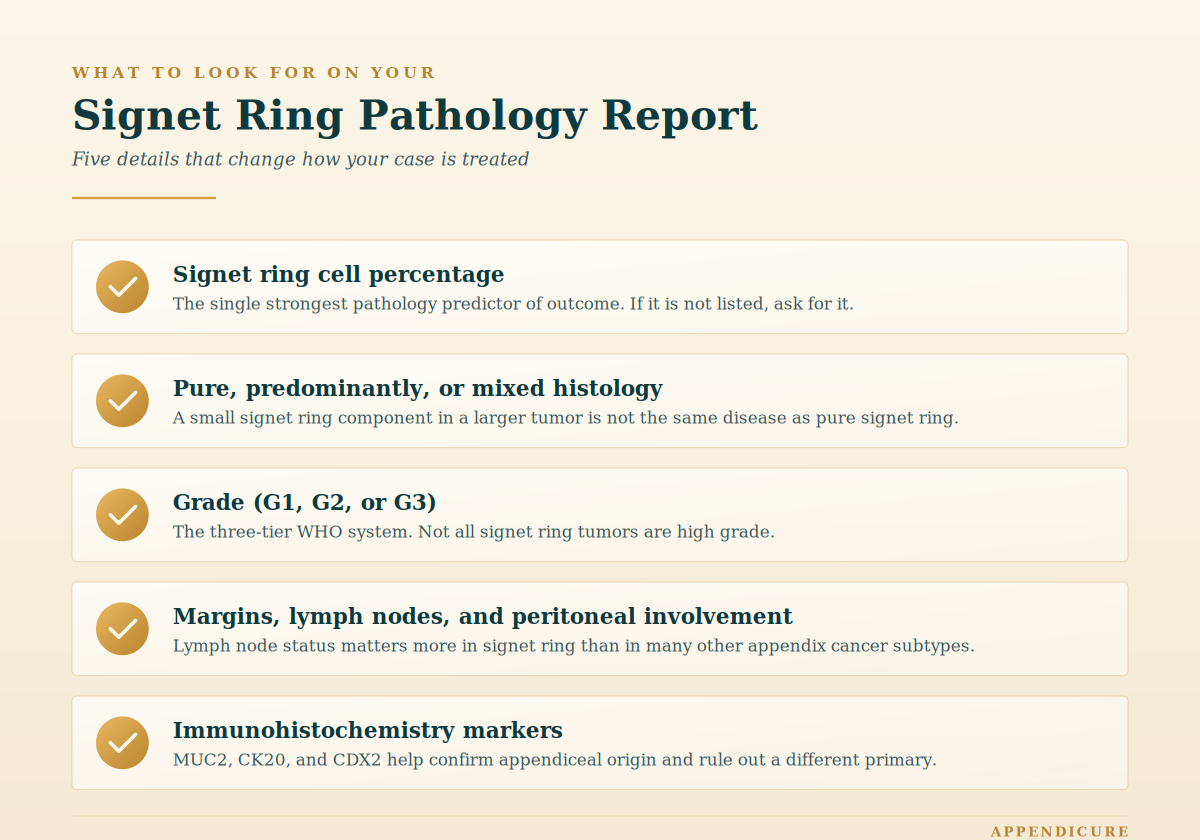
    What to Look For on Your Report

    Signet ring appendix cancer pathology checklist showing five key details to look for on a pathology report

    A few specific items on a signet ring appendix cancer pathology report carry weight. The percentage of signet ring cells in the tumor matters most. So does whether the tumor is described as pure, predominantly signet ring, or mixed with another histology. The grade is also critical. Most signet ring tumors fall into the higher grade categories, but not all, and the three-tier WHO grading system distinguishes G1, G2, and G3 in ways that matter for treatment planning.

    You also want to look at the status of the margins, lymph nodes, and any peritoneal involvement. Lymph node status is particularly important in signet ring cancer because positive nodes are more common in this subtype and meaningfully change prognosis.

    Finally, check whether the tumor expresses certain markers such as MUC2, CK20, and CDX2. These help confirm the appendiceal origin and rule out metastasis from a different primary site, which is a real consideration when signet ring features are present.

    These details matter because the 2025 Peritoneal Surface Malignancies Consortium consensus guidelines, often referred to as the Godfrey guidelines after their first author, treat appendiceal cancer as biologically distinct from colorectal cancer and use specific pathology features to guide decisions about surgery, surveillance, and systemic therapy. They represent one of the first comprehensive appendiceal-specific consensus frameworks, which is a meaningful shift for a disease that was treated as a footnote to colorectal cancer for decades.

    If any of these are missing or unclear in your report, those are reasonable questions to bring to your care team.

    What This Means for Next Steps

    Understanding your signet ring appendix cancer pathology report does not change your diagnosis, but it changes what you can do with it. Patients who know the specific characteristics of their tumor are better positioned to ask informed questions, to seek out specialists with relevant experience, and to evaluate treatment recommendations against what the published evidence actually says for their particular situation.

    Part 3 in this series covers the broader research framework now organizing around appendix cancer, why outcomes are still so hard to predict, and what patients can do to be part of changing that.

    Catch up on the series:
    Part 1: What the Evidence Says About Treatment
    Part 3: Why the Picture Is Still Incomplete, and How to Be Part of Completing It

    Related Guides on APPENDICURE

    For a deeper look at the topics in this article:

    Types of Appendix Cancer, a plain-language guide to LAMN, HAMN, appendiceal adenocarcinoma, signet ring cell carcinoma, goblet cell adenocarcinoma, neuroendocrine tumors, and pseudomyxoma peritonei.

    Diagnosis and Treatment, how appendix cancer is diagnosed, what treatments exist (CRS, HIPEC, systemic chemo, targeted therapy, clinical trials), and what to ask your doctor.

    If you would like to be part of the data that drives better research and care for rare appendix cancers, you can join the Appendicure Patient Data Registry.


    References

    Munoz-Zuluaga C, et al. Outcomes in Peritoneal Dissemination from Signet Ring Cell Carcinoma of the Appendix Treated with Cytoreductive Surgery and Hyperthermic Intraperitoneal Chemotherapy. Annals of Surgical Oncology, 2019.

    Shamavonian R, et al. Impact of signet ring cells on overall survival in peritoneal disseminated appendix cancer treated with cytoreductive surgery and hyperthermic intraperitoneal chemotherapy. European Journal of Surgical Oncology, 2021.

    Levinsky NC, et al. Should we be doing cytoreductive surgery with HIPEC for signet ring cell appendiceal adenocarcinoma? A study from the US HIPEC Collaborative. Journal of Gastrointestinal Surgery, 2020.

    Godfrey EL, et al; Peritoneal Surface Malignancies Consortium Group. Consensus Guideline for the Management of Patients with Appendiceal Tumors, Part 1: Appendiceal Tumors Without Peritoneal Involvement. Cancer, 2025. doi:10.1002/cncr.35867

    Godfrey EL, et al; Peritoneal Surface Malignancies Consortium Group. Consensus Guideline for the Management of Patients with Appendiceal Tumors, Part 2: Appendiceal Tumors With Peritoneal Involvement. Cancer, 2025. doi:10.1002/cncr.35874

    0 0

    Share it!

    • Facebook
    • LinkedIn
    • X
    • Pinterest
    • Threads
    • WhatsApp
    • Reddit
    • Print
    • Email
    • SMS Text

    Stay informed about the latest research and patient stories.

    Log in
    Back to top arrow
  • Appendix cancer organoids illustration on dark teal banner announcing new drug leads from MSK biobank study
    • Appendix Cancer 101Your guide to understanding a rare disease, appendix cancer. Learn about types, symptoms, diagnosis, staging, and treatment options like surgery, HIPEC, and chemotherapy—all in one accessible, patient-friendly resource.
      • What is Appendix Cancer?Appendix cancer is a rare abdominal cancer. Learn how appendiceal cancer develops, how it’s diagnosed, and what treatment options exist. APPENDICURE raises awareness for research, recognizing symptoms, diagnosis, surgery, chemotherapy, HIPEC and PIPAC treatment options.
      • Glossary of Medical TermsDecode complex medical terms with our easy-to-understand glossary. Designed for patients and caregivers, this section explains the language used in appendix cancer diagnosis, treatment, surgery, and recovery. Decipher acronyms such as CRS, HIPEC, PIPAC, SRCC.
      • Types of Appendix CancerUnderstand the different forms of appendiceal cancer—from slow-growing tumors to aggressive variants—and what each diagnosis means for treatment and care of this rare appendix cancer. Become familiar medical terms – LAMN Low-grade Appendiceal Mucinous Neoplasm, HAMN High-grade Appendiceal Mucinous Neoplasm, HIPEC Hyperthermic Intraperitoneal Chemotherapy, CRS Cytoreductive Surgery, and SRCC Signet Ring Cell Adenocarcinoma.
      • Pseudomyxoma Peritonei (PMP)
      • Diagnosis & TreatmentFacing a rare gastric cancer can be overwhelming. This section offers clear, compassionate guidance on how appendix cancer is identified and the treatment paths available to you. Learn about chemo, hemicolectomy surgery, cytoreductive surgery CRS, HIPEC, clinical trials, and immunotherapy.
      • CDK4/6 Inhibitors and GNAS-Mutated Appendiceal Cancer
      • Research & InnovationsExplore the latest breakthroughs in appendix cancer—from emerging treatments to promising clinical trials. We spotlight progress that brings hope to patients, caregivers, and advocates. We share research on LAMN Low-grade Appendiceal Mucinous Neoplasm, HAMN High-grade Appendiceal Mucinous Neoplasm, HIPEC Hyperthermic Intraperitoneal Chemotherapy, CRS Cytoreductive Surgery, SRCC Signet Ring Cell Adenocarcinoma, PIPAC Pressurized Intraperitoneal Aerosolized Chemotherapy, Hemicolectomy, and more.
    • Patient & Caregiver ResourcesAPPENDICURE supports appendix cancer patients and caregivers with resources for medical centers, appendiceal surgical oncologists, and HIPEC certified specialists. From diagnosis to survivorship, explore resources designed to inform, uplift, and guide. Whether you’re a rare abdominal cancer patient or caregiver, you’re not alone—and you don’t have to figure it out alone.
      • Medical Centers & ProvidersFind hospitals, specialists, and care teams experienced in treating appendix cancer. We help connect you to the rare abdominal cancer and HIPEC expertise you deserve—because where you go matters. Appendiceal cancer medical and surgical oncologists will discuss diagnosis, treatment plans, and surgery options that align with current research.
      • Support NetworksYou’re not alone. Connect with others who understand the appendix cancer journey—through peer groups, online communities, and caregiver circles built around empathy and shared experience. Explore resources created by appendiceal cancer oncologists, research teams, and cancer awareness advocates that offer guidance on treatment options, financial assistance programs, emotional support groups, and survivorship tips.
      • WebinarsJoin expert-led sessions that break down complex topics, share lived experiences, and offer guidance for patients, caregivers, and advocates navigating appendix cancer. Ask questions about diagnosis, treatment, chemotherapy, hemicolectomy surgery, CRS surgery, HIPEC, PIPAC, caregiver roles, support groups, recovery processes, and spreading awareness.
      • Appendix Cancer Web ResourcesAccess trusted appendix cancer information, downloadable guides, caregiver tools, and appendiceal cancer advocacy materials—all in one place. These resources are designed to educate, empower, and support your cancer journey. We’ve collected resources for you covering treatment, and support on one convenient page.
      • Mental Health Support
      • Patient & Caregiver StoriesReal voices. Real journeys. Discover powerful stories from those affected by appendix cancer—offering hope, insight, and connection for every step of the appendiceal cancer path. Listen to our community of appendiceal cancer survivors as they share their journey through symptoms, diagnosis, treatment, surgery, HIPEC, and recovery.
    • Appendix Cancer Registry
    • For Researchers & Clinicians
      • Standard of Care: 2025 Guidelines
      • Clinician Guides by Specialty
      • Appendix Cancer for Pathologists
      • Registry for Investigators
      • Refer a Patient
      • Clinical Trials
    • Stay ConnectedSubscribe for updates on appendix cancer research, support resources, awareness, and upcoming events. Join our email list and follow us on social media to stay informed and inspired.
      • Blog PostsRead expert insights, patient stories, and the latest updates on appendix cancer care, research, and advocacy. Our blog is a source for appendiceal cancer education and community connection. Share our blog to spread appendix cancer awareness.
      • Data Registry & AI
    • Meet the TeamThe people behind APPENDICURE. Patients, caregivers, survivors, and advocates working to support the appendix cancer community.
      • Board of Directors
      • CUREator Crew
    • Contact UsConnect with the APPENDICURE team to learn more about appendix cancer, share your story, or get involved. We welcome inquiries from patients, caregivers, researchers, and anyone passionate about rare appendiceal cancer advocacy.
    Amanda Moore Avatar
    Amanda Moore

    Lab-Grown Appendix Cancer Organoids Reveal Hidden Mutations and New Drug Leads

    May 28, 2026

    A new biobank of patient-derived appendix cancer models is the first of its kind. Here is what the research found, and what it does and does not mean for patients right now.

    Appendix cancer organoids, grown in the lab from patient tumors, are giving researchers their first real tool for studying this rare disease on its own terms. Appendix cancer has always been hard to study. It is rare, so few labs work on it. The tumors are often packed with mucus and contain relatively few actual cancer cells, which makes them difficult to test and even to sequence accurately. And for years, the drugs given to patients were borrowed almost entirely from colon cancer, on the assumption that what works in the colon should work in the appendix. That assumption has never been well supported by evidence.

    A study published in Developmental Cell in June 2026, led by Karuna Ganesh’s lab at Memorial Sloan Kettering Cancer Center, takes a direct run at all three of those problems. The team built the first stable, long-term biobank of appendix cancer organoids grown from patient tumors. Using those models, they found mutations that standard clinical sequencing had missed, and they identified two drugs that worked against the cancer in the lab and in mice where standard chemotherapy did not. The paper is open access, so anyone can read it in full.

    The whole point of the study is that appendix cancer is not colon cancer, and treating it as if it were has real costs.

    What the appendix cancer organoids actually are

    When researchers want to test cancer drugs before trying them in people, they need a living model of the disease. For most common cancers, those models already exist and can be grown indefinitely in the lab. For appendix cancer, they essentially did not. That gap is part of why progress has been slow.

    The MSK team collected tumor tissue from 24 patients during surgery and grew it into organoids, which are small three-dimensional clusters of cells that reproduce the structure and behavior of the original tumor. Out of those samples, they established 16 organoid lines that could be frozen, thawed, and regrown over and over. That durability is what makes a biobank useful, because the same model can be shared, repeated, and tested by many groups over time.

    Importantly, three of the lines came in matched pairs: one organoid grown from a patient’s primary appendix tumor, and another grown from that same patient’s peritoneal metastasis, the disease that had spread into the abdominal cavity. Comparing the two sides by side, from the same person, is what allowed the researchers to ask what changes when this cancer spreads.

    One detail is worth stating plainly, because it shapes how broadly these findings apply. The appendix cancer organoids grew most successfully from poorly differentiated, higher-grade tumors. Well-differentiated and moderately differentiated tumors mostly failed to form stable models. So the biobank leans toward the more aggressive end of the disease, and the drug findings below are most relevant there. This is not a study about low-grade appendix cancer or classic pseudomyxoma peritonei, and it should not be read as one.

    Two findings from the appendix cancer organoids study: hidden mutations come into view, and two drugs worked where standard chemo did not
    The two findings most relevant to patients, in plain terms.

    Finding one: appendix cancer organoids surface mutations the standard test misses

    This is the finding with the most immediate relevance to patients, and it is worth understanding carefully.

    When a tumor is sent for genomic testing, the lab looks for mutations that might guide treatment. But those tests have a detection floor. The clinical sequencing platform used here, MSK-IMPACT, generally needs a mutation to show up in at least about 5 percent of the genetic material in the sample before it gets called. In most cancers that is fine. In appendix cancer it is a real problem, because so much of the sample is mucus and normal tissue rather than cancer cells. When the cancer cells are diluted, a genuine mutation can sit below that floor and never get reported.

    Growing the tumor as an organoid concentrates the cancer cells, which raises the proportion of cancer DNA in the sample. When the researchers sequenced the appendix cancer organoids, they found mutations, including KRAS mutations linked to worse outcomes, that the standard clinical test had not called from the original tissue. Going back and manually re-examining the original sequencing data confirmed those mutations had been there all along, just below the reporting threshold.

    The practical takeaway is not that current testing is useless. It is that a negative result in a mucinous, low-cellularity appendix tumor may not be the final word, and that there are emerging ways to get a cleaner read. This is a reasonable thing for patients to discuss with their oncologist, especially when a targeted-therapy decision hinges on whether a mutation is present.

    A negative genomic result in a mucus-heavy appendix tumor may reflect the limits of the test, not the absence of a mutation.

    Finding two: targeted drugs outperformed the borrowed colon-cancer chemo

    Tested against the appendix cancer organoids, the standard chemotherapy regimens patients have long received, which were originally developed for colon cancer, were largely ineffective, and the metastatic organoids were especially resistant. That result lines up with what many patients and clinicians have observed, and it strengthens the case that appendix cancer needs its own treatment strategies rather than colon cancer’s hand-me-downs.

    The researchers then tested drugs aimed at the specific signaling pathways that these tumors appear to depend on. Two stood out. The first, RMC-7977, blocks RAS, a signaling protein driven by the KRAS mutations that are common in appendix cancer. The second, WNTinib, targets the Wnt pathway, another growth signal the tumors rely on. Both reduced tumor growth in the lab, and both reduced disease in mice. They worked best in the adjuvant setting, meaning as a short course aimed at wiping out residual cancer cells after cytoreductive surgery, which is exactly the moment when recurrence tends to take hold.

    There is a real translational thread here, and it is worth being precise about it. RMC-7977 is a close analog of a drug called daraxonrasib (RMC-6236), which is already being tested in humans and has received FDA breakthrough therapy designation in pancreatic cancer. So the underlying approach is not science fiction. But, and this matters, those human trials are in pancreatic and lung cancer, not appendix cancer. RMC-7977 itself, the exact compound used in this study, remains a preclinical research tool.

    What this means, and what it does not

    It is easy to read a study like this and hear “new treatment.” That is not what this is, and being honest about the gap is the most useful thing this post can do.

    Everything in the drug portion of this work happened in organoids and in mice. No appendix cancer patient was treated with these drugs in this study. Lab and animal results frequently look more promising than what later plays out in people, which is the entire reason clinical trials exist. The path from a mouse result to an approved therapy is long, and most candidates do not complete it.

    What the study genuinely provides is a foundation. It gives researchers, for the first time, a stable and shareable set of appendix cancer organoids that behave like the real disease. It offers a credible rationale for designing appendix-specific trials, particularly trials testing RAS-directed drugs after surgery in patients whose tumors carry the relevant mutations. And it delivers a concrete, present-day point for patients: in mucinous appendix tumors, standard genomic testing can undercall mutations, and that is worth a conversation with your care team.

    For a rare cancer that has spent decades borrowing from its more common neighbor, having models that finally let researchers study the disease on its own terms is meaningful progress. The drugs may or may not pan out. The tools to find out now exist, and that is the part that lasts.

    The Study

    Mahmoud A, Sukhwa C, Giarrizzo M, et al. “An appendiceal cancer organoid biobank identifies phenotypic evolution and druggable dependencies of peritoneal carcinomatosis.” Developmental Cell, June 10, 2026. Open access.

    Read the full study at Developmental Cell →

    If you or a loved one is living with appendix cancer, your experience can help shape research like this. Consider adding your information to the Appendicure patient data registry.

    Appendicure provides patient education and does not offer medical advice. Talk with your own care team about decisions related to testing and treatment.

    0 0

    Share it!

    • Facebook
    • LinkedIn
    • X
    • Pinterest
    • Threads
    • WhatsApp
    • Reddit
    • Print
    • Email
    • SMS Text

    Stay informed about the latest research and patient stories.

    Log in
    Back to top arrow
  • Signet ring appendix cancer treatment evidence series featured image
    • Appendix Cancer 101Your guide to understanding a rare disease, appendix cancer. Learn about types, symptoms, diagnosis, staging, and treatment options like surgery, HIPEC, and chemotherapy—all in one accessible, patient-friendly resource.
      • What is Appendix Cancer?Appendix cancer is a rare abdominal cancer. Learn how appendiceal cancer develops, how it’s diagnosed, and what treatment options exist. APPENDICURE raises awareness for research, recognizing symptoms, diagnosis, surgery, chemotherapy, HIPEC and PIPAC treatment options.
      • Glossary of Medical TermsDecode complex medical terms with our easy-to-understand glossary. Designed for patients and caregivers, this section explains the language used in appendix cancer diagnosis, treatment, surgery, and recovery. Decipher acronyms such as CRS, HIPEC, PIPAC, SRCC.
      • Types of Appendix CancerUnderstand the different forms of appendiceal cancer—from slow-growing tumors to aggressive variants—and what each diagnosis means for treatment and care of this rare appendix cancer. Become familiar medical terms – LAMN Low-grade Appendiceal Mucinous Neoplasm, HAMN High-grade Appendiceal Mucinous Neoplasm, HIPEC Hyperthermic Intraperitoneal Chemotherapy, CRS Cytoreductive Surgery, and SRCC Signet Ring Cell Adenocarcinoma.
      • Pseudomyxoma Peritonei (PMP)
      • Diagnosis & TreatmentFacing a rare gastric cancer can be overwhelming. This section offers clear, compassionate guidance on how appendix cancer is identified and the treatment paths available to you. Learn about chemo, hemicolectomy surgery, cytoreductive surgery CRS, HIPEC, clinical trials, and immunotherapy.
      • CDK4/6 Inhibitors and GNAS-Mutated Appendiceal Cancer
      • Research & InnovationsExplore the latest breakthroughs in appendix cancer—from emerging treatments to promising clinical trials. We spotlight progress that brings hope to patients, caregivers, and advocates. We share research on LAMN Low-grade Appendiceal Mucinous Neoplasm, HAMN High-grade Appendiceal Mucinous Neoplasm, HIPEC Hyperthermic Intraperitoneal Chemotherapy, CRS Cytoreductive Surgery, SRCC Signet Ring Cell Adenocarcinoma, PIPAC Pressurized Intraperitoneal Aerosolized Chemotherapy, Hemicolectomy, and more.
    • Patient & Caregiver ResourcesAPPENDICURE supports appendix cancer patients and caregivers with resources for medical centers, appendiceal surgical oncologists, and HIPEC certified specialists. From diagnosis to survivorship, explore resources designed to inform, uplift, and guide. Whether you’re a rare abdominal cancer patient or caregiver, you’re not alone—and you don’t have to figure it out alone.
      • Medical Centers & ProvidersFind hospitals, specialists, and care teams experienced in treating appendix cancer. We help connect you to the rare abdominal cancer and HIPEC expertise you deserve—because where you go matters. Appendiceal cancer medical and surgical oncologists will discuss diagnosis, treatment plans, and surgery options that align with current research.
      • Support NetworksYou’re not alone. Connect with others who understand the appendix cancer journey—through peer groups, online communities, and caregiver circles built around empathy and shared experience. Explore resources created by appendiceal cancer oncologists, research teams, and cancer awareness advocates that offer guidance on treatment options, financial assistance programs, emotional support groups, and survivorship tips.
      • WebinarsJoin expert-led sessions that break down complex topics, share lived experiences, and offer guidance for patients, caregivers, and advocates navigating appendix cancer. Ask questions about diagnosis, treatment, chemotherapy, hemicolectomy surgery, CRS surgery, HIPEC, PIPAC, caregiver roles, support groups, recovery processes, and spreading awareness.
      • Appendix Cancer Web ResourcesAccess trusted appendix cancer information, downloadable guides, caregiver tools, and appendiceal cancer advocacy materials—all in one place. These resources are designed to educate, empower, and support your cancer journey. We’ve collected resources for you covering treatment, and support on one convenient page.
      • Mental Health Support
      • Patient & Caregiver StoriesReal voices. Real journeys. Discover powerful stories from those affected by appendix cancer—offering hope, insight, and connection for every step of the appendiceal cancer path. Listen to our community of appendiceal cancer survivors as they share their journey through symptoms, diagnosis, treatment, surgery, HIPEC, and recovery.
    • Appendix Cancer Registry
    • For Researchers & Clinicians
      • Standard of Care: 2025 Guidelines
      • Clinician Guides by Specialty
      • Appendix Cancer for Pathologists
      • Registry for Investigators
      • Refer a Patient
      • Clinical Trials
    • Stay ConnectedSubscribe for updates on appendix cancer research, support resources, awareness, and upcoming events. Join our email list and follow us on social media to stay informed and inspired.
      • Blog PostsRead expert insights, patient stories, and the latest updates on appendix cancer care, research, and advocacy. Our blog is a source for appendiceal cancer education and community connection. Share our blog to spread appendix cancer awareness.
      • Data Registry & AI
    • Meet the TeamThe people behind APPENDICURE. Patients, caregivers, survivors, and advocates working to support the appendix cancer community.
      • Board of Directors
      • CUREator Crew
    • Contact UsConnect with the APPENDICURE team to learn more about appendix cancer, share your story, or get involved. We welcome inquiries from patients, caregivers, researchers, and anyone passionate about rare appendiceal cancer advocacy.
    Amanda Moore Avatar
    Amanda Moore

    The Rarest of the Rare: Signet Ring Appendix Cancer – Part 1: What the Evidence Says About Treatment

    May 27, 2026

    Signet ring appendix cancer is one of the rarest histologies of an already rare disease, accounting for roughly four percent of appendix cancer cases. For a long time, patients in this group had almost no published evidence to point to when they sat down with their oncology team. That gap is finally starting to close.

    Over the past several years, a handful of multi-institutional studies and high-volume single-center series have started to fill in the picture for this subtype. The findings include some real and useful news. One of the most important is that signet ring features by themselves are no longer considered a reason to deny patients the surgery that has shown the best results, which is something some patients have been told in the past. There is genuinely useful information here for patients and the people who love them.

    This is the first of three posts in our series on this subtype. Part 1 covers what the treatment evidence says today. Part 2 looks at what your pathology report actually says and which details matter most for your care. Part 3 covers the broader research framework now organizing around appendix cancer, why outcomes are still so hard to predict, and what patients can do to be part of changing that.

    What signet ring cell carcinoma actually is

    Signet ring cell carcinoma is defined by the appearance of the tumor cells under a microscope. The cells fill with mucin that pushes the nucleus to the edge, creating a shape that pathologists thought looked like a signet ring. The World Health Organization defines a tumor as signet ring cell carcinoma when more than half the tumor is made up of these cells.

    Tumors with a smaller signet ring component, sometimes called signet ring features or tumors with signet cells, fall into a different category but behave more like signet ring carcinoma than like ordinary adenocarcinoma. That distinction matters, and we will come back to it.

    Signet ring appendix cancers often present with peritoneal spread. These tumors are frequently associated with mucinous ascites and diffuse seeding across the peritoneal surface rather than a single large mass. This is why so many of these patients are diagnosed with peritoneal disease already present at the time of their first surgery, and why incidental finding during an appendectomy for what looked like appendicitis is one of the most common presenting stories in this subtype.

    What the largest signet ring appendix cancer treatment studies tell us

    The most directly relevant study published recently is a 2025 Mayo Clinic series. Researchers at Mayo’s Minnesota, Arizona, and Florida sites reviewed 84 patients with signet ring cell adenocarcinoma of the appendix treated between 1998 and 2024. The median age was 61. Most patients were women. Most tumors were high grade, and most patients had metastatic disease at diagnosis.

    The five-year overall survival in patients who achieved complete cytoreduction was 25 percent. In this retrospective cohort, systemic chemotherapy was not associated with improved survival when added to cytoreductive surgery. Adding HIPEC to cytoreductive surgery showed a difference that was clinically meaningful, with 20 percent five-year survival in the CRS plus HIPEC group versus 5 percent with surgery alone (p=0.059, which did not reach statistical significance). The authors concluded that CRS with HIPEC was associated with the most favorable observed outcomes in their dataset, and that overall outcomes remain poor and new treatment approaches are needed.

    The honest reading of this paper is not that CRS with HIPEC is a cure for signet ring appendix cancer. It is that surgery with HIPEC produced the best results in the dataset, and the gap between getting it and not getting it was meaningful. For patients who are candidates, that gap is worth knowing about.

    The largest multi-institutional dataset is the US HIPEC Collaborative study, published in 2020 with results from twelve academic centers. Of 514 patients who underwent CRS with HIPEC for appendiceal adenocarcinoma, 125 had signet ring features, a quarter of the total. Overall survival was meaningfully worse for the signet ring group, with a median of 32 months compared to 91 months for non-signet ring patients.

    But the authors made a point that has been important for the field. They concluded that while signet ring cells are a negative prognostic factor, the presence of signet ring cells should not by itself be a contraindication to CRS with HIPEC in patients with well or moderately differentiated tumors, negative lymph nodes, and disease where complete cytoreduction can be achieved.

    The takeaway is that signet ring features affect prognosis, but signet ring appendix cancer patients can still benefit from CRS with HIPEC when their other features are favorable and a complete surgical clearance is possible. This is a meaningful finding because some surgeons and centers have historically considered signet ring features a reason not to offer CRS with HIPEC at all. The US HIPEC Collaborative data argues against that as a blanket rule, which has opened the door for patients who might otherwise have been turned away.

    A third study worth understanding comes from Shamavonian and colleagues at St George Hospital in Sydney, Australia, published in the European Journal of Surgical Oncology in 2021. They looked at 255 patients with high-grade appendiceal cancer who underwent CRS with HIPEC and broke them into three groups based on how many signet ring cells were present in the tumor.

    Patients with no signet ring cells had a median overall survival of 93.8 months. Patients with a low count of signet ring cells had a median survival of 58.2 months. Patients with a high count had a median survival of 23.7 months. The five-year overall survival rates were 60 percent, 35.5 percent, and 10 percent, respectively.

    This is one of the most important findings in the signet ring literature, and it gets discussed less than it should. Signet ring cell carcinoma is not one disease. The amount of signet ring component in a tumor strongly predicts how the disease will behave. A patient whose pathology report mentions some signet ring cells is in a meaningfully different prognostic category from a patient whose tumor is more than fifty percent signet ring. For patients in the lower-percentage groups, the published outcomes are substantially better than the overall signet ring numbers patients often hear quoted. That is information worth having before any treatment conversation.

    For more on why how patients are counted and classified in research has direct consequences for outcomes like these, see our earlier piece on why high-grade appendix cancer patients really need to be counted.

    3 honest truths about signet ring appendix cancer treatment

    Three things stand out consistently across these studies. Complete cytoreduction is the single most important treatment factor that has been consistently associated with better outcomes in this disease. When complete cytoreduction can be achieved at a high-volume center, it is the most evidence-supported path forward. When it cannot, the conversation becomes harder and more individual. Patients whose disease cannot be fully resected face a fundamentally different prognostic situation, and that should be discussed honestly rather than glossed over.

    Systemic chemotherapy has not shown a consistent survival benefit across the major signet ring datasets. In the Mayo series, adding systemic therapy to surgery did not improve outcomes. In the US HIPEC Collaborative analysis, receipt of neoadjuvant or adjuvant chemotherapy did not improve overall survival in the signet ring group. This does not mean systemic chemotherapy is never used or never helpful for any individual patient. It means the evidence base for routinely giving it to signet ring patients is weaker than many patients have been led to believe, and the standard colorectal regimens being applied to appendix cancer patients were never designed for or tested in this histology. Recent work on molecular drivers like KRAS and PIK3CA, which we covered in our post on a new study about KRAS and PIK3CA in high-grade mucinous and signet ring cell carcinoma, is starting to point toward why this may be.

    The signet ring appendix cancer research field is also paying more attention now than it has in years. Researchers are openly saying that current treatments need to improve, and they are actively working on it. Molecular profiling, immunotherapy candidates in select cases, and new translational research are all moving forward, and Parts 2 and 3 of this series cover where that work is heading.

    Questions worth asking your team about signet ring appendix cancer

    If you or someone you love has this diagnosis, a few questions are worth raising with the treatment team, drawn directly from what these studies establish.

    How much of the tumor is signet ring cells, by percentage? This affects what the prognosis literature actually says about your specific situation, and many patients have never been told the number.

    Has the case been reviewed at a high-volume peritoneal surface malignancy center, even if treatment is happening locally? Outcomes after CRS with HIPEC for appendiceal cancer vary meaningfully by center experience, and signet ring cases are exactly the situation where center experience matters most.

    Is complete cytoreduction considered achievable based on imaging and surgical evaluation? If yes, the evidence supports having that conversation seriously at a high-volume center. If not, what is the goal of the proposed treatment, and what is the realistic expected outcome?

    Has the tumor been tested for MSI status and mismatch repair? This question matters for a small but real subset of signet ring patients.

    What this series will and will not do

    We are not going to tell anyone what treatment to pursue. That conversation belongs between patients, their families, and their oncology team. What we can do is make sure the published evidence is sitting in front of patients in plain language, so that those conversations happen on a foundation of what is actually known rather than what is assumed.

    Signet ring appendix cancer is one of the rarest histologies of an already rare cancer. The patients living with it deserve more attention than they have historically received, and the research community is finally starting to deliver it. Part 2 of this series covers what your pathology report actually says and why specific details matter for your care. Part 3 covers the broader research framework now organizing around appendix cancer and what patients can do to be part of moving it forward. There is more reason to pay attention now than there has been in years.

    Why your data matters: the Appendicure registry

    The studies in this post were possible because a handful of high-volume centers kept careful records on a small number of patients. That is how the field has worked for decades. Most signet ring appendix cancer patients are not treated at the Mayo Clinic, the academic centers in the US HIPEC Collaborative, or St George Hospital in Sydney. Their experiences, their pathology, and their outcomes sit scattered across health systems where no one is positioned to put the picture together.

    That is the gap the Appendicure community data registry is built to close. By contributing your own information about diagnosis, treatment, and outcomes, you become part of a dataset that researchers can use to ask questions these studies could not. The kinds of questions a registry like this could help study include: How do outcomes compare for patients with twenty percent signet ring versus eighty percent? What happens to patients treated at community hospitals rather than referral centers? Which treatment sequences are working for the patients who are doing well, and what do they have in common?

    These are questions a few retrospective studies, however carefully done, cannot answer alone. They require more patients, from more places, sharing their experience over time. Signet ring patients are the smallest subgroup in an already rare disease, which means every single contribution moves the needle more than it would in a more common cancer. If you have signet ring appendix cancer, or care for someone who does, your data is exactly what the next generation of research needs.

    Contribute to the Appendicure registry →

    Read next

    Part 2: Signet Ring Appendix Cancer Pathology: What Your Report Actually Says

    Why high-grade appendix cancer patients really need to be counted

    What a new study tells us about KRAS and PIK3CA in high-grade mucinous and signet ring cell carcinoma


    References

    Hor and colleagues. Effectiveness of treatment modalities for signet ring cell adenocarcinoma of the appendix. American Journal of Surgery, 2025.

    Levinsky and colleagues. Should we be doing cytoreductive surgery with HIPEC for signet ring cell appendiceal adenocarcinoma? A study from the US HIPEC Collaborative. Journal of Gastrointestinal Surgery, 2020.

    Shamavonian and colleagues. Impact of signet ring cells on overall survival in peritoneal disseminated appendix cancer treated with cytoreductive surgery and hyperthermic intraperitoneal chemotherapy. European Journal of Surgical Oncology, 2021.

    0 0

    Share it!

    • Facebook
    • LinkedIn
    • X
    • Pinterest
    • Threads
    • WhatsApp
    • Reddit
    • Print
    • Email
    • SMS Text

    Stay informed about the latest research and patient stories.

    Log in
    Back to top arrow
  • Appendix cancer drug discovery cycle showing patient data feeding AI models that produce targeted KRAS inhibitors
    • Appendix Cancer 101Your guide to understanding a rare disease, appendix cancer. Learn about types, symptoms, diagnosis, staging, and treatment options like surgery, HIPEC, and chemotherapy—all in one accessible, patient-friendly resource.
      • What is Appendix Cancer?Appendix cancer is a rare abdominal cancer. Learn how appendiceal cancer develops, how it’s diagnosed, and what treatment options exist. APPENDICURE raises awareness for research, recognizing symptoms, diagnosis, surgery, chemotherapy, HIPEC and PIPAC treatment options.
      • Glossary of Medical TermsDecode complex medical terms with our easy-to-understand glossary. Designed for patients and caregivers, this section explains the language used in appendix cancer diagnosis, treatment, surgery, and recovery. Decipher acronyms such as CRS, HIPEC, PIPAC, SRCC.
      • Types of Appendix CancerUnderstand the different forms of appendiceal cancer—from slow-growing tumors to aggressive variants—and what each diagnosis means for treatment and care of this rare appendix cancer. Become familiar medical terms – LAMN Low-grade Appendiceal Mucinous Neoplasm, HAMN High-grade Appendiceal Mucinous Neoplasm, HIPEC Hyperthermic Intraperitoneal Chemotherapy, CRS Cytoreductive Surgery, and SRCC Signet Ring Cell Adenocarcinoma.
      • Pseudomyxoma Peritonei (PMP)
      • Diagnosis & TreatmentFacing a rare gastric cancer can be overwhelming. This section offers clear, compassionate guidance on how appendix cancer is identified and the treatment paths available to you. Learn about chemo, hemicolectomy surgery, cytoreductive surgery CRS, HIPEC, clinical trials, and immunotherapy.
      • CDK4/6 Inhibitors and GNAS-Mutated Appendiceal Cancer
      • Research & InnovationsExplore the latest breakthroughs in appendix cancer—from emerging treatments to promising clinical trials. We spotlight progress that brings hope to patients, caregivers, and advocates. We share research on LAMN Low-grade Appendiceal Mucinous Neoplasm, HAMN High-grade Appendiceal Mucinous Neoplasm, HIPEC Hyperthermic Intraperitoneal Chemotherapy, CRS Cytoreductive Surgery, SRCC Signet Ring Cell Adenocarcinoma, PIPAC Pressurized Intraperitoneal Aerosolized Chemotherapy, Hemicolectomy, and more.
    • Patient & Caregiver ResourcesAPPENDICURE supports appendix cancer patients and caregivers with resources for medical centers, appendiceal surgical oncologists, and HIPEC certified specialists. From diagnosis to survivorship, explore resources designed to inform, uplift, and guide. Whether you’re a rare abdominal cancer patient or caregiver, you’re not alone—and you don’t have to figure it out alone.
      • Medical Centers & ProvidersFind hospitals, specialists, and care teams experienced in treating appendix cancer. We help connect you to the rare abdominal cancer and HIPEC expertise you deserve—because where you go matters. Appendiceal cancer medical and surgical oncologists will discuss diagnosis, treatment plans, and surgery options that align with current research.
      • Support NetworksYou’re not alone. Connect with others who understand the appendix cancer journey—through peer groups, online communities, and caregiver circles built around empathy and shared experience. Explore resources created by appendiceal cancer oncologists, research teams, and cancer awareness advocates that offer guidance on treatment options, financial assistance programs, emotional support groups, and survivorship tips.
      • WebinarsJoin expert-led sessions that break down complex topics, share lived experiences, and offer guidance for patients, caregivers, and advocates navigating appendix cancer. Ask questions about diagnosis, treatment, chemotherapy, hemicolectomy surgery, CRS surgery, HIPEC, PIPAC, caregiver roles, support groups, recovery processes, and spreading awareness.
      • Appendix Cancer Web ResourcesAccess trusted appendix cancer information, downloadable guides, caregiver tools, and appendiceal cancer advocacy materials—all in one place. These resources are designed to educate, empower, and support your cancer journey. We’ve collected resources for you covering treatment, and support on one convenient page.
      • Mental Health Support
      • Patient & Caregiver StoriesReal voices. Real journeys. Discover powerful stories from those affected by appendix cancer—offering hope, insight, and connection for every step of the appendiceal cancer path. Listen to our community of appendiceal cancer survivors as they share their journey through symptoms, diagnosis, treatment, surgery, HIPEC, and recovery.
    • Appendix Cancer Registry
    • For Researchers & Clinicians
      • Standard of Care: 2025 Guidelines
      • Clinician Guides by Specialty
      • Appendix Cancer for Pathologists
      • Registry for Investigators
      • Refer a Patient
      • Clinical Trials
    • Stay ConnectedSubscribe for updates on appendix cancer research, support resources, awareness, and upcoming events. Join our email list and follow us on social media to stay informed and inspired.
      • Blog PostsRead expert insights, patient stories, and the latest updates on appendix cancer care, research, and advocacy. Our blog is a source for appendiceal cancer education and community connection. Share our blog to spread appendix cancer awareness.
      • Data Registry & AI
    • Meet the TeamThe people behind APPENDICURE. Patients, caregivers, survivors, and advocates working to support the appendix cancer community.
      • Board of Directors
      • CUREator Crew
    • Contact UsConnect with the APPENDICURE team to learn more about appendix cancer, share your story, or get involved. We welcome inquiries from patients, caregivers, researchers, and anyone passionate about rare appendiceal cancer advocacy.
    Amanda Moore Avatar
    Amanda Moore

    Appendix Cancer AI: How KRAS Drug Discovery Could Change Treatment

    May 24, 2026

    When Lung Cancer Research Matters to Appendix Cancer Patients

    AI, KRAS, and Why Your Data Belongs in the Appendicure Registry

    A new review in Expert Opinion on Drug Discovery covers a moment in appendix cancer drug discovery worth paying attention to, even though the paper itself focuses on KRAS mutations in non-small cell lung cancer.

    Here is why.

    Before I get into it, a confession. I am wired to believe that good things happen sooner than the timeline says. That bias colors how I read papers like this one. I have learned to talk myself down when needed. I still think the optimistic read is closer to right than wrong on this story, and I will tell you where I am applying the brakes as we go.

    The KRAS problem is our problem too

    KRAS is the most commonly mutated gene in the RAS family. It drives some of the most aggressive cancers, including pancreatic, colorectal, and lung. For decades it was considered undruggable. The protein is small, smooth, and gives a drug molecule very little to grab onto.

    That changed in 2021 when the FDA approved sotorasib for non-small cell lung cancer with the KRAS G12C mutation. Adagrasib followed in 2022. Both drugs target one specific version of mutated KRAS, the G12C form.

    Here is where appendix cancer enters the picture. KRAS mutations are reported in a large majority of mucinous appendiceal tumors and pseudomyxoma peritonei cases, often in the 70 to 80 percent range depending on subtype and cohort. The most commonly reported variant is not G12C. It is G12D. Other patients carry G12V or other variants. The KRAS G12C drugs that work in lung cancer do not help most appendix cancer patients, because most of us do not have that specific mutation.

    That sentence used to be the end of the story. It is not anymore. The same researchers who built the G12C drugs have spent the last few years working on the next mutations on the list, and our most common variant is one of them.

    Why this is changing
    MRTX1133 is a small molecule designed to target KRAS G12D specifically. A 2023 study showed antitumor activity in xenograft models of mucinous appendiceal neoplasms.RMC-6236 is a RAS(ON) multi-selective inhibitor designed to target multiple RAS-driven tumors.

    An April 2026 preprint reported activity in appendiceal cancer organoid and patient-derived xenograft models, along with clinical observations from six appendiceal cancer patients treated with KRAS inhibitors.Zoldonrasib, another RAS(ON) inhibitor, was tested in a Phase 1 trial that included patients with appendiceal cancer and high-grade mucinous carcinoma peritonei alongside pancreatic and lung cancer patients.

    Early signals were reported in May 2026.An important caution sits underneath all of this. Many therapies that show promise in organoids or mouse xenograft models ultimately fail in human trials. Early preclinical signals are reasons to pay attention, not reasons to assume success.

    Every one of these drugs traces back to research that started in other cancers. Lung. Pancreatic. Colorectal. The science moves first in cancers that have large patient populations and big research budgets. The work then extends into rare diseases like ours, sometimes slowly and sometimes faster than anyone expected. The KRAS G12D story is closer to the second case than the first, and that is worth sitting with for a minute.

    What this means for appendix cancer drug discovery

    The review by Samudrala and colleagues at the University at Buffalo walks through how artificial intelligence is now central to the search for new KRAS drugs. Their expert opinion is straightforward. AI plus laboratory work is faster and produces molecules with greater structural diversity and fewer off-target effects than traditional drug screening. They expect AI to become standard practice in drug discovery for aggressive driver mutations across multiple cancers.

    The same research group built a computational platform called CANDO that screens drug compounds against large protein libraries. In earlier work they used it to predict that osimertinib, a drug approved for EGFR-mutant lung cancer, would synergize with several KRAS inhibitors. Lab testing confirmed the prediction. That is the loop the new review is describing. AI proposes, the lab confirms, and the cycle repeats much faster than it used to.

    AI drug discovery has already crossed real milestones

    This is the part where my optimistic streak shows. I have watched AI go from a buzzword pharma companies put in their slide decks to a tool that has actually produced a drug now in late-stage clinical trials. The work is not finished. It is also not science fiction anymore.

    This is not theoretical anymore. A few examples that are worth understanding.

    Insilico Medicine and the first AI-designed drug in late-stage trials

    Insilico used generative AI to design INS018_055, a drug for idiopathic pulmonary fibrosis. The compound went from project start to a preclinical candidate in 18 months. The company has since reported positive Phase 2a results, with patients treated with the drug showing dose-dependent improvement in lung function compared to placebo. This is widely cited as the first drug discovered and designed by generative AI to reach this stage.

    Pancreatic cancer drug combinations

    A 2025 study from researchers at NCATS, MIT, and the University of North Carolina built machine learning models on data from 496 drug combinations tested in pancreatic cancer cells. The models then predicted synergy across 1.6 million possible combinations. The best-performing model achieved an 83 percent validation rate in laboratory testing of predicted synergistic combinations, identifying 307 verified hits. The point is not the specific drugs and the point is not clinical efficacy. The point is the scale. No human team could have tested 1.6 million combinations in the lab.

    AlphaFold and protein structure

    AlphaFold is the AI system that dramatically improved researchers’ ability to predict how proteins fold. It does not itself design drugs. What it does is provide the foundational step for structure-based drug discovery. Knowing a protein’s three-dimensional shape is what makes it possible to design molecules that bind to it. AlphaFold made that step faster and more accurate, which makes everything downstream, including the work on KRAS, more tractable.

    What is realistic to expect
    Reported benchmarks for AI-driven drug discovery include compressed timelines from roughly 10 years down to 3 to 6 years, and higher Phase 1 success rates in some pipelines. These numbers come from companies promoting their own platforms and from early-stage data. They are real signals. They are not yet proof that the long tail of clinical trial failures has been solved. The honest summary is that AI is changing how drugs are found, and the first generation of AI-designed drugs is now generating clinical data we can evaluate.

    Why none of this works without patient data

    Here is the part of the story I have the most hope about, because it is the part we can actually control.

    Appendix cancer drug discovery, like all AI-driven research, is only as good as the data the models learn from.. For KRAS drug discovery in lung, pancreatic, and colorectal cancer, the input data exists in enormous quantities. Tumor sequencing data. Treatment records. Outcomes. Imaging. Tissue samples in biobanks. Decades of clinical trial data.

    For appendix cancer, those datasets are tiny. The disease is rare. The histologic subtypes are split across five categories under the NCCN framework, including LAMN, HAMN, appendiceal adenocarcinoma, goblet cell adenocarcinoma, and undifferentiated carcinoma not otherwise specified. Each subtype has its own biology and its own treatment patterns. When you split a rare cancer five ways, then split it again by grade and KRAS variant, you end up with patient subgroups that may number in the hundreds nationally.

    This is the reason the same KRAS G12D drug that gets developed for pancreatic cancer may take years longer to be properly tested in appendix cancer. There are simply not enough patients in any single institution’s records to power the analyses that AI tools need.

    Rarity is not the only problem. Appendix cancer is also unusually hard for computational analyses because the underlying data is messy in ways specific to our disease. Some centers report grade as a three-tier system, G1 through G3. Others collapse it into low and high grade. Pathology reports may classify the same tumor as mucinous adenocarcinoma at one institution and as a goblet cell adenocarcinoma variant at another. Treatment sequences vary widely, especially around CRS and HIPEC, and the outcome reporting from those procedures is not standardized. Even when a patient has full sequencing, the record may sit in a format that machine learning tools cannot use without significant manual cleanup.

    That is what the Appendicure data registry is built to change.

    What the registry does
    It collects standardized data from patients across the country in one place. Sequencing results when available. Subtype and grade. Treatments received and in what order. Outcomes over time. Where you are treated. What worked and what did not. It makes that data available to researchers driving appendix cancer drug discovery, including the ones building AI models, so they can ask questions that no single institution has enough patients to answer.It puts patients at the center. The registry is built for our community, not for any single hospital system or pharmaceutical company.

    Every patient who contributes data makes the next analysis sharper. If you have a KRAS G12D mutation and your record sits in one hospital, it is a single data point in that hospital. If your record is in the registry alongside hundreds of others, it becomes part of a signal a researcher can actually study. This is not theoretical. We are doing this right now with CDK4/6 inhibitors, working alongside Dr. Shen at MD Anderson and Dr. Lowy at UC San Diego to push NCCN to recognize these drugs for appendiceal disease with GNAS and KRAS mutations.

    The honest caveats

    This is the part of the post that hurts to write. I lean optimistic on these stories and I have to make myself slow down. An old sales book I read years ago taught me “Hope is Not a Strategy“, and our community deserves the real picture, not the rosy one. The caveats below are me applying the brakes on myself, because hope is not a strategy and our community deserves the actual picture and not the rosy one. Both things can be true at once. The science is genuinely promising, and I have to tell you exactly where it is and is not.

    First, the lung cancer review does not mention appendix cancer. The science is relevant because we share the KRAS biology, not because the authors are working on our disease. We should not overstate the connection.

    Second, the appendix cancer data on KRAS inhibitors is still very early. The April 2026 preprint reports clinical observations from six patients. That is a starting point, not a clinical practice change. The MRTX1133 work in appendiceal models is preclinical. The zoldonrasib trial included appendiceal patients but did not report disease-specific efficacy. As noted earlier, organoid and xenograft results often do not translate to humans, which is why these early signals need to be interpreted cautiously.

    Third, AI in drug discovery has produced impressive early signals but has not yet delivered a generation of approved cancer drugs designed entirely by AI. The Insilico fibrosis drug is the furthest along, and it is for a non-cancer disease. The field is moving fast. It is not finished.

    None of this changes the core argument about appendix cancer drug discovery.. KRAS mutations drive most appendiceal adenocarcinoma. Drugs targeting KRAS G12D and multi-selective RAS inhibitors are now in clinical testing and include appendix cancer patients. AI is accelerating the pace at which new candidates reach those trials. Our data is what makes our disease visible to those efforts. That is the part I will let myself feel hopeful about, with both eyes open.

    What you can do

    • Ask your medical team about next generation sequencing if you have not already had it. Knowing your tumor’s mutation profile, including whether you carry a KRAS mutation and which variant, matters for current and future treatment options.
    • Ask whether trials of multi-selective RAS inhibitors or KRAS variant-specific inhibitors are open at academic centers that treat appendix cancer.
    • Add your data to the Appendicure Patient-Led Data Registry. It is the single biggest contribution you can make to appendix cancer drug discovery. It takes very little time. It is one of the highest-impact things any of us can do for patients who come after us. If you can’t figure out how to access your medical records, Contact Us One of us will respond the same day.
    • Share this with anyone in our community who is weighing whether registry participation is worth the effort. The argument is no longer abstract. It is the difference between our disease being included in the next wave of drug development or being left behind.

    “Hope is not a strategy. It is also not optional. The strategy is the registry. The hope is what keeps us building it.”

    Keep Reading: What a New AI Biomarker Could Mean for Appendix Cancer Patients

    Sources

    Samudrala R, Bruggemann L, Falls Z, Mahajan SD. Combining cutting edge computational and experimental methods for targeting KRAS mutations in non-small cell lung cancer. Expert Opinion on Drug Discovery, 2026.

    doi.org/10.1080/17460441.2026.2654614

    KRAS inhibition is an effective therapy for appendiceal adenocarcinoma. bioRxiv preprint, April 2026.

    biorxiv.org/content/10.64898/2026.04.07.717107v1

    Vazquez-Borrego MC et al. Antitumor effect of a small-molecule inhibitor of KRAS G12D in xenograft models of mucinous appendicular neoplasms. Experimental Hematology and Oncology, 2023.

    doi.org/10.1186/s40164-023-00465-4

    Bruggemann L et al. Multiscale Analysis and Validation of Effective Drug Combinations Targeting Driver KRAS Mutations in Non-Small Cell Lung Cancer. Pharmaceuticals, 2023.

    pmc.ncbi.nlm.nih.gov/articles/PMC9867122

    Insilico Medicine. Positive Topline Results of ISM001-055 for Idiopathic Pulmonary Fibrosis, November 2024.

    Insilico Medicine press release

    OncLive. RAS(ON) Inhibitor Zoldonrasib Is Safe, Shows Early Activity Signals in KRAS G12D Mutated PDAC and other histologies including appendiceal cancer, May 2026.

    onclive.com (zoldonrasib coverage)

    Artificial Intelligence-Driven Innovations in Oncology Drug Discovery. Drug Design, Development and Therapy, 2025.

    pmc.ncbi.nlm.nih.gov/articles/PMC12232943

    0 0

    Share it!

    • Facebook
    • LinkedIn
    • X
    • Pinterest
    • Threads
    • WhatsApp
    • Reddit
    • Print
    • Email
    • SMS Text

    Stay informed about the latest research and patient stories.

    Log in
    Back to top arrow
  • Abstract teal and amber waves on cream background, featured image for Appendicure blog post on mucinous appendiceal adenocarcinoma survival research
    • Appendix Cancer 101Your guide to understanding a rare disease, appendix cancer. Learn about types, symptoms, diagnosis, staging, and treatment options like surgery, HIPEC, and chemotherapy—all in one accessible, patient-friendly resource.
      • What is Appendix Cancer?Appendix cancer is a rare abdominal cancer. Learn how appendiceal cancer develops, how it’s diagnosed, and what treatment options exist. APPENDICURE raises awareness for research, recognizing symptoms, diagnosis, surgery, chemotherapy, HIPEC and PIPAC treatment options.
      • Glossary of Medical TermsDecode complex medical terms with our easy-to-understand glossary. Designed for patients and caregivers, this section explains the language used in appendix cancer diagnosis, treatment, surgery, and recovery. Decipher acronyms such as CRS, HIPEC, PIPAC, SRCC.
      • Types of Appendix CancerUnderstand the different forms of appendiceal cancer—from slow-growing tumors to aggressive variants—and what each diagnosis means for treatment and care of this rare appendix cancer. Become familiar medical terms – LAMN Low-grade Appendiceal Mucinous Neoplasm, HAMN High-grade Appendiceal Mucinous Neoplasm, HIPEC Hyperthermic Intraperitoneal Chemotherapy, CRS Cytoreductive Surgery, and SRCC Signet Ring Cell Adenocarcinoma.
      • Pseudomyxoma Peritonei (PMP)
      • Diagnosis & TreatmentFacing a rare gastric cancer can be overwhelming. This section offers clear, compassionate guidance on how appendix cancer is identified and the treatment paths available to you. Learn about chemo, hemicolectomy surgery, cytoreductive surgery CRS, HIPEC, clinical trials, and immunotherapy.
      • CDK4/6 Inhibitors and GNAS-Mutated Appendiceal Cancer
      • Research & InnovationsExplore the latest breakthroughs in appendix cancer—from emerging treatments to promising clinical trials. We spotlight progress that brings hope to patients, caregivers, and advocates. We share research on LAMN Low-grade Appendiceal Mucinous Neoplasm, HAMN High-grade Appendiceal Mucinous Neoplasm, HIPEC Hyperthermic Intraperitoneal Chemotherapy, CRS Cytoreductive Surgery, SRCC Signet Ring Cell Adenocarcinoma, PIPAC Pressurized Intraperitoneal Aerosolized Chemotherapy, Hemicolectomy, and more.
    • Patient & Caregiver ResourcesAPPENDICURE supports appendix cancer patients and caregivers with resources for medical centers, appendiceal surgical oncologists, and HIPEC certified specialists. From diagnosis to survivorship, explore resources designed to inform, uplift, and guide. Whether you’re a rare abdominal cancer patient or caregiver, you’re not alone—and you don’t have to figure it out alone.
      • Medical Centers & ProvidersFind hospitals, specialists, and care teams experienced in treating appendix cancer. We help connect you to the rare abdominal cancer and HIPEC expertise you deserve—because where you go matters. Appendiceal cancer medical and surgical oncologists will discuss diagnosis, treatment plans, and surgery options that align with current research.
      • Support NetworksYou’re not alone. Connect with others who understand the appendix cancer journey—through peer groups, online communities, and caregiver circles built around empathy and shared experience. Explore resources created by appendiceal cancer oncologists, research teams, and cancer awareness advocates that offer guidance on treatment options, financial assistance programs, emotional support groups, and survivorship tips.
      • WebinarsJoin expert-led sessions that break down complex topics, share lived experiences, and offer guidance for patients, caregivers, and advocates navigating appendix cancer. Ask questions about diagnosis, treatment, chemotherapy, hemicolectomy surgery, CRS surgery, HIPEC, PIPAC, caregiver roles, support groups, recovery processes, and spreading awareness.
      • Appendix Cancer Web ResourcesAccess trusted appendix cancer information, downloadable guides, caregiver tools, and appendiceal cancer advocacy materials—all in one place. These resources are designed to educate, empower, and support your cancer journey. We’ve collected resources for you covering treatment, and support on one convenient page.
      • Mental Health Support
      • Patient & Caregiver StoriesReal voices. Real journeys. Discover powerful stories from those affected by appendix cancer—offering hope, insight, and connection for every step of the appendiceal cancer path. Listen to our community of appendiceal cancer survivors as they share their journey through symptoms, diagnosis, treatment, surgery, HIPEC, and recovery.
    • Appendix Cancer Registry
    • For Researchers & Clinicians
      • Standard of Care: 2025 Guidelines
      • Clinician Guides by Specialty
      • Appendix Cancer for Pathologists
      • Registry for Investigators
      • Refer a Patient
      • Clinical Trials
    • Stay ConnectedSubscribe for updates on appendix cancer research, support resources, awareness, and upcoming events. Join our email list and follow us on social media to stay informed and inspired.
      • Blog PostsRead expert insights, patient stories, and the latest updates on appendix cancer care, research, and advocacy. Our blog is a source for appendiceal cancer education and community connection. Share our blog to spread appendix cancer awareness.
      • Data Registry & AI
    • Meet the TeamThe people behind APPENDICURE. Patients, caregivers, survivors, and advocates working to support the appendix cancer community.
      • Board of Directors
      • CUREator Crew
    • Contact UsConnect with the APPENDICURE team to learn more about appendix cancer, share your story, or get involved. We welcome inquiries from patients, caregivers, researchers, and anyone passionate about rare appendiceal cancer advocacy.
    Amanda Moore Avatar
    Amanda Moore

    Mucinous Appendiceal Adenocarcinoma Survival: When the Numbers Tell Only Part of the Story, Part II

    May 23, 2026

    Mucinous appendiceal adenocarcinoma survival has long been described in terms of two numbers: the Peritoneal Cancer Index and the completeness of the cytoreductive surgery. A new 198-patient series from the Washington Cancer Institute suggests that those numbers, while important, may not be doing as much of the prognostic work as the field has assumed.

    Yesterday’s post looked at a Rome study finding that PCI loses its predictive grip past a score of 30 in low-grade pseudomyxoma peritonei. This week’s paper, from Paul Sugarbaker and David Chang, comes at a similar question from a different angle. In their cohort of 198 patients with mucinous appendiceal adenocarcinoma treated over 25 years, PCI did not significantly predict survival. Neither did preoperative tumor markers. What did matter was histologic subtype and whether the patient received HIPEC.

    Two studies, two cohorts, two questions. The thread that connects them is worth pulling on.

    What the 25-Year Mucinous Appendiceal Adenocarcinoma Series Looked At

    Mucinous appendiceal adenocarcinoma, abbreviated MACA in the paper, is the histologic family that includes well-differentiated (grade 1), moderately differentiated (grade 2), poorly differentiated (grade 3), and signet ring cell variants. The authors also use an intermediate category, MACA-Int, which sits between the classical low-grade and high-grade designations. About 30 percent of patients with pseudomyxoma peritonei have MACA histology rather than the more indolent LAMN tumors covered in Part I of this series.

    All 198 patients in the study had a complete cytoreductive surgery. Preoperative clinical features and tumor markers (CEA, CA19-9, CA125) were recorded in the week before the operation. Perioperative intraperitoneal chemotherapy, histologic findings, and any reoperative surgery were captured afterward. The authors then ran univariate and multivariate analyses to see which variables actually moved overall survival.

    The median overall survival across the cohort was 11 years. That number alone is worth sitting with. It is the kind of long-horizon outcome that patients ask for and rarely see cleanly published in mucinous appendiceal adenocarcinoma survival data.

    PCI and Tumor Markers Did Not Predict Mucinous Appendiceal Adenocarcinoma Survival

    In a single-center series of nearly 200 patients, the Peritoneal Cancer Index did not significantly affect overall survival. Neither did preoperative CEA, CA19-9, or CA125, individually or in combination.

    This is a striking finding, and it needs to be read carefully. The authors are not saying PCI is useless. They are saying that within a population of MACA patients who all received a complete cytoreductive surgery at a high-volume center, the PCI number did not separate longer survivors from shorter survivors.

    Read alongside yesterday’s Rome paper, a pattern starts to emerge. In LAMN-origin pseudomyxoma peritonei, the Rome group found that PCI predicted survival across the full cohort but lost discriminatory power past PCI 30. In MACA-origin pseudomyxoma peritonei at the Washington series, PCI did not significantly predict survival at all. Neither study argues that PCI should be abandoned in surgical planning, because the score still describes how much work the operation will involve and helps assess whether complete cytoreduction is feasible. Both studies suggest, though, that once you condition on getting a complete cytoreduction, PCI carries less prognostic weight than the field has historically given it.

    The takeaway in plain terms
    For patients with mucinous appendiceal adenocarcinoma who are able to undergo a complete cytoreduction, what the tumor is made of and how it is treated intraoperatively appears to matter more for survival than how much disease was there to begin with. Tumor markers drawn before surgery did not help predict outcome.

    HIPEC Versus EPIC: A 12-Year Versus 4-Year Gap in Mucinous Appendiceal Adenocarcinoma Survival

    The largest single difference in the study was between two methods of delivering intraperitoneal chemotherapy at the time of surgery. Patients who received HIPEC, hyperthermic intraperitoneal chemotherapy delivered as heated solution during the operation, had a median survival of 12 years. Patients who received EPIC, early postoperative intraperitoneal chemotherapy delivered through catheters in the days immediately after surgery, had a median survival of 4 years. The hazard ratio was 2.09 with a p-value of 0.002, meaning the difference is statistically significant and not likely to be a chance finding.

    EPIC is not commonly used as standalone perioperative chemotherapy at most contemporary peritoneal surface programs in the United States. HIPEC has become the dominant approach, and this paper supports that pattern strongly within MACA-origin disease. For patients comparing centers or asking what perioperative chemotherapy approach a program uses, the data here weighs heavily in favor of HIPEC when thinking about mucinous appendiceal adenocarcinoma survival.

    A few caveats are worth flagging. The 25-year window means the EPIC patients were generally treated earlier in the series, when surgical technique, patient selection, and supportive care were different than they are today. Some of the survival gap may reflect era effects rather than the chemotherapy modality itself. The authors do not break out the data in a way that fully separates these factors. Even so, the gap is large enough that it is hard to attribute entirely to confounding.

    Histology and the Intermediate Subtype

    The second strong finding from the Washington series was about histology. The MACA-Int subtype, the intermediate category between well-differentiated and high-grade tumors, was associated with the longest survival of any histologic group in the cohort. MACA-3, the poorly differentiated subtype, was associated with the shortest survival.

    This continues a conversation Appendicure has been engaged in for some time. The three-tier WHO grading system (G1, G2, G3) is meant to capture the meaningful differences in tumor biology, but in research literature and in trial eligibility criteria, the moderately differentiated tier is often collapsed into the high-grade category. That practice obscures real differences in mucinous appendiceal adenocarcinoma survival. The Sugarbaker series, in identifying the intermediate subtype as the longest-surviving group in the MACA family, is another piece of evidence that the middle tier deserves to be named and described, not folded into a binary.

    For patients with appendiceal cancer working from a pathology report, this matters at the level of language. A report that says “mucinous adenocarcinoma, intermediate grade” or “moderately differentiated” is describing a tumor with different expected behavior than one labeled “high grade” or “poorly differentiated.” The distinction is worth confirming with the treating team, and worth asking about explicitly when reading a second opinion or a pathology re-read.

    How the Two Studies Fit Together

    Yesterday’s Rome paper and this week’s Washington paper come from different programs, different histologic populations, and different statistical approaches. They are not telling the same story, but they are telling stories with the same shape.

    In LAMN-origin pseudomyxoma peritonei, the Rome group found that PCI mattered up to a point, and then anatomy of disease distribution took over as the dominant prognostic signal at very high tumor burden. In the Washington mucinous appendiceal adenocarcinoma survival data, PCI did not significantly drive survival across the whole spectrum, while histology and the choice of intraoperative chemotherapy did.

    Both findings push in the same direction. The classical surgical-burden metrics, PCI and to a lesser degree CC score, are real and useful, but they are not the whole prognostic picture, especially once you select for patients who can get a complete cytoreduction. Biology, location, and the details of how the operation is performed are doing more of the predictive work than the field has historically credited them with.

    This is consistent with what high-volume peritoneal surface programs have been saying in conference talks for several years. Two papers in two weeks now put that conversation on paper.

    What These Studies Cannot Tell Us About Mucinous Appendiceal Adenocarcinoma Survival

    The Washington series is a single-institution retrospective review of patients treated by one of the founding programs in peritoneal surface oncology. Sugarbaker’s outcomes are not generalizable to most centers. Surgical experience, case volume, and decades of institutional learning shape what is achievable in his operating room in ways that smaller programs cannot replicate. Findings from a 198-patient cohort at a high-volume reference center are best read as what is possible at that center, not what is typical across centers.

    The 25-year time window also raises real questions. Surgical technique, anesthesia, critical care, imaging, and patient selection have all changed substantially since the early 2000s. Some of the survival differences observed in the cohort, particularly between HIPEC and EPIC, may reflect those era effects in addition to or instead of the variables the authors highlight.

    Neither study changes who should be offered cytoreductive surgery, and neither replaces PCI or CC scoring as part of surgical planning. PCI is still how surgical teams describe and stage the operation. CC score is still how the outcome of the surgery is described. What is shifting is how much prognostic weight those numbers should carry in conversations about mucinous appendiceal adenocarcinoma survival afterward.

    Questions to Bring to Your Surgical Consult

    For patients with mucinous appendiceal adenocarcinoma considering cytoreductive surgery, the questions worth bringing into a consultation have shifted with these findings. The following can be used alongside the questions from Part I of this series.

    What is my specific histologic subtype, and how is it described in my pathology report?
    If my tumor is described as moderately differentiated or intermediate grade, what does that mean for my expected course?
    Does your program use HIPEC, EPIC, or another perioperative chemotherapy approach?
    If HIPEC, what drug regimen do you use, and at what temperature and duration?
    How many MACA cases does your center treat each year, and how many over the past five years?
    How do you think about PCI in my case, and what role does it play in your surgical plan?
    Has my pathology been reviewed at your center, or by a pathologist who specializes in appendiceal tumors?

    Closing Thoughts on Mucinous Appendiceal Adenocarcinoma Survival

    Two papers in two weeks do not change the standard of care. They do, however, change the texture of how patients and clinicians can talk about prognosis. The questions worth asking are getting more specific, and the answers are getting more nuanced.

    If Part I was about location mattering more than volume at the extreme end, Part II is about biology mattering more than burden across the spectrum, at least in the cohort the Washington group has been treating for a quarter century. Both posts point at the same broader idea. In appendiceal cancer, the easy numbers are not the whole story, and the patients living with this disease deserve a conversation that reflects that.

    Appendicure will continue to track this literature as it develops. If validation comes from other high-volume centers, the prognostic vocabulary used in patient-facing materials and surgeon consultations will need to catch up to what the data on mucinous appendiceal adenocarcinoma survival is now showing.

    Read Part 1 Here: Pseudomyxoma Peritonei PCI: When the Number Stops Telling the Whole Story – 1 New Study

    Glossary

    MACAMucinous Appendiceal Adenocarcinoma. The histologic family of mucin-producing adenocarcinomas arising from the appendix, including well-differentiated, intermediate, moderately differentiated, poorly differentiated, and signet ring cell variants.
    MACA-IntThe intermediate-grade subtype within MACA. Sits between the classical low-grade and high-grade designations and, in the Washington series, was associated with the longest survival of any MACA subtype.
    PCIPeritoneal Cancer Index. A surgical scoring system that divides the abdomen into 13 regions and assigns 0 to 3 points per region based on the size of tumor deposits. Maximum score is 39.
    CC scoreCompleteness of Cytoreduction. A measure of how much visible disease remained after surgery. CC-0 means no visible residual disease.
    HIPECHyperthermic Intraperitoneal Chemotherapy. Heated chemotherapy delivered into the abdominal cavity at the end of cytoreductive surgery to address microscopic residual disease.
    EPICEarly Postoperative Intraperitoneal Chemotherapy. Non-heated chemotherapy delivered through catheters into the abdominal cavity in the days immediately following cytoreductive surgery.
    CEA, CA19-9, CA125Blood-based tumor markers sometimes elevated in appendiceal and other gastrointestinal cancers. Used for monitoring and, less reliably, for prognosis.
    LAMNLow-grade Appendiceal Mucinous Neoplasm. A low-grade tumor of the appendix that can rupture and seed the peritoneal cavity. Covered in Part I of this series.
    PMPPseudomyxoma Peritonei. A clinical syndrome characterized by progressive accumulation of mucinous material throughout the peritoneal cavity, most often from a ruptured appendiceal neoplasm.

    Sources

    Sugarbaker PH, Chang D. Assessment of Outcome in 198 Patients With Mucinous Appendiceal Adenocarcinoma and Peritoneal Metastases Over 25 Years. Journal of Surgical Oncology. 2026. DOI: 10.1002/jso.70283

    D’Annibale G, Abatini C, Lodoli C, et al. Prognostic Ceiling Effect of the Peritoneal Cancer Index in Super-Extended Pseudomyxoma Peritonei of Appendiceal Origin. Journal of Gastrointestinal Surgery. 2026. DOI: 10.1016/j.gassur.2026.102456

    Internal link to add at publish time: Link the phrase “Part I of this series” (appears in body) to the Part I post URL.

    Appendicure

    Patient education and advocacy for appendiceal cancer

    0 0

    Share it!

    • Facebook
    • LinkedIn
    • X
    • Pinterest
    • Threads
    • WhatsApp
    • Reddit
    • Print
    • Email
    • SMS Text

    Stay informed about the latest research and patient stories.

    Log in
    Back to top arrow
Previous Page
1 … 10 11 12 13 14 … 28
Next Page

The content provided on the APPENDICURE website is intended for informational and educational purposes only. It is not a substitute for professional medical advice, diagnosis, or treatment. We encourage readers to consult qualified healthcare providers to discuss any medical concerns. This site does not offer comprehensive medical guidance and should not be used in place of advice from your physician or care team.

APPENDICURE, a NON-Profit organization, follows best practices and guidelines to ensure compliance and maintain transparency. For questions, please contact us.

Appendicure Logo - Amber Ribbon on a Dark Green Background

CONTACT US

Copyright © 2025 APPENDICURE

All Rights Reserved

Privacy Policy | Terms of Use | Accessibility

GDPR Compliant – EU & UK Representative, verified by Euverify
Loading Comments...