Skip to content
♥

Help us fund the research needed to find new treatments for appendix cancer.

Donate
  • Facebook
  • Instagram
  • LinkedIn
  • YouTube


RECENT POSTS

LAMN Surveillance MRI: When a Scan Looks Like PMP and Isn’t

Why a Cheap Diabetes Pill Is Now Being Tested Against PMP

Who BromAc Actually Helps, and Who It Does Not

  • Appendicure graphic, Getting Chemo Into the Belly, on PIPAC and bidirectional therapy for appendix cancer patients
    • Appendix Cancer 101Your guide to understanding a rare disease, appendix cancer. Learn about types, symptoms, diagnosis, staging, and treatment options like surgery, HIPEC, and chemotherapy—all in one accessible, patient-friendly resource.
      • What is Appendix Cancer?Appendix cancer is a rare abdominal cancer. Learn how appendiceal cancer develops, how it’s diagnosed, and what treatment options exist. APPENDICURE raises awareness for research, recognizing symptoms, diagnosis, surgery, chemotherapy, HIPEC and PIPAC treatment options.
      • Glossary of Medical TermsDecode complex medical terms with our easy-to-understand glossary. Designed for patients and caregivers, this section explains the language used in appendix cancer diagnosis, treatment, surgery, and recovery. Decipher acronyms such as CRS, HIPEC, PIPAC, SRCC.
      • Types of Appendix CancerUnderstand the different forms of appendiceal cancer—from slow-growing tumors to aggressive variants—and what each diagnosis means for treatment and care of this rare appendix cancer. Become familiar medical terms – LAMN Low-grade Appendiceal Mucinous Neoplasm, HAMN High-grade Appendiceal Mucinous Neoplasm, HIPEC Hyperthermic Intraperitoneal Chemotherapy, CRS Cytoreductive Surgery, and SRCC Signet Ring Cell Adenocarcinoma.
      • Pseudomyxoma Peritonei (PMP)
      • Diagnosis & TreatmentFacing a rare gastric cancer can be overwhelming. This section offers clear, compassionate guidance on how appendix cancer is identified and the treatment paths available to you. Learn about chemo, hemicolectomy surgery, cytoreductive surgery CRS, HIPEC, clinical trials, and immunotherapy.
      • CDK4/6 Inhibitors and GNAS-Mutated Appendiceal Cancer
      • Research & InnovationsExplore the latest breakthroughs in appendix cancer—from emerging treatments to promising clinical trials. We spotlight progress that brings hope to patients, caregivers, and advocates. We share research on LAMN Low-grade Appendiceal Mucinous Neoplasm, HAMN High-grade Appendiceal Mucinous Neoplasm, HIPEC Hyperthermic Intraperitoneal Chemotherapy, CRS Cytoreductive Surgery, SRCC Signet Ring Cell Adenocarcinoma, PIPAC Pressurized Intraperitoneal Aerosolized Chemotherapy, Hemicolectomy, and more.
    • Patient & Caregiver ResourcesAPPENDICURE supports appendix cancer patients and caregivers with resources for medical centers, appendiceal surgical oncologists, and HIPEC certified specialists. From diagnosis to survivorship, explore resources designed to inform, uplift, and guide. Whether you’re a rare abdominal cancer patient or caregiver, you’re not alone—and you don’t have to figure it out alone.
      • Medical Centers & ProvidersFind hospitals, specialists, and care teams experienced in treating appendix cancer. We help connect you to the rare abdominal cancer and HIPEC expertise you deserve—because where you go matters. Appendiceal cancer medical and surgical oncologists will discuss diagnosis, treatment plans, and surgery options that align with current research.
      • Support NetworksYou’re not alone. Connect with others who understand the appendix cancer journey—through peer groups, online communities, and caregiver circles built around empathy and shared experience. Explore resources created by appendiceal cancer oncologists, research teams, and cancer awareness advocates that offer guidance on treatment options, financial assistance programs, emotional support groups, and survivorship tips.
      • WebinarsJoin expert-led sessions that break down complex topics, share lived experiences, and offer guidance for patients, caregivers, and advocates navigating appendix cancer. Ask questions about diagnosis, treatment, chemotherapy, hemicolectomy surgery, CRS surgery, HIPEC, PIPAC, caregiver roles, support groups, recovery processes, and spreading awareness.
      • Appendix Cancer Web ResourcesAccess trusted appendix cancer information, downloadable guides, caregiver tools, and appendiceal cancer advocacy materials—all in one place. These resources are designed to educate, empower, and support your cancer journey. We’ve collected resources for you covering treatment, and support on one convenient page.
      • Mental Health Support
      • Patient & Caregiver StoriesReal voices. Real journeys. Discover powerful stories from those affected by appendix cancer—offering hope, insight, and connection for every step of the appendiceal cancer path. Listen to our community of appendiceal cancer survivors as they share their journey through symptoms, diagnosis, treatment, surgery, HIPEC, and recovery.
    • Appendix Cancer Registry
    • For Researchers & Clinicians
      • Standard of Care: 2025 Guidelines
      • Clinician Guides by Specialty
      • Appendix Cancer for Pathologists
      • Registry for Investigators
      • Refer a Patient
      • Clinical Trials
    • Stay ConnectedSubscribe for updates on appendix cancer research, support resources, awareness, and upcoming events. Join our email list and follow us on social media to stay informed and inspired.
      • Blog PostsRead expert insights, patient stories, and the latest updates on appendix cancer care, research, and advocacy. Our blog is a source for appendiceal cancer education and community connection. Share our blog to spread appendix cancer awareness.
      • Data Registry & AI
    • Meet the TeamThe people behind APPENDICURE. Patients, caregivers, survivors, and advocates working to support the appendix cancer community.
      • Board of Directors
      • CUREator Crew
    • Contact UsConnect with the APPENDICURE team to learn more about appendix cancer, share your story, or get involved. We welcome inquiries from patients, caregivers, researchers, and anyone passionate about rare appendiceal cancer advocacy.
    Amanda Moore Avatar
    Amanda Moore

    PIPAC for Appendix Cancer: What It Is, and 3 Trials Now Open

    June 18, 2026

    In February, Dr. Patrick Wagner and his physician assistant Shannon Altpeter, from Allegheny Health Network, walked our community through two ways of delivering chemotherapy straight into the abdomen: HIPEC and PIPAC. Most people with appendix cancer learn about HIPEC early. It’s the heated chemo that gets washed through the abdomen during cytoreductive surgery, and for many patients it’s the centerpiece of treatment. PIPAC for appendix cancer is the newer approach, still being studied in clinical trials, and it matters most for people who’ve been told cytoreductive surgery isn’t an option. Two terms worth understanding from that conversation are PIPAC and bidirectional chemotherapy.

    What PIPAC is

    PIPAC stands for pressurized intraperitoneal aerosol chemotherapy. Instead of bathing the abdomen in heated liquid the way HIPEC does, it turns the drug into a pressurized mist and sprays it into the abdomen through a laparoscope, the same kind of keyhole instrument used for minimally invasive surgery. The idea, first put into practice in 2011, is that an aerosol spreads more evenly and pushes a little deeper into tissue than liquid that simply sits in the cavity.

    The practical difference for patients is that PIPAC doesn’t require major surgery. It can be done on its own, and it can be repeated, usually every several weeks. That makes it a possible option for people who aren’t candidates for cytoreductive surgery, whether because the disease is too widespread, because an earlier operation didn’t clear it, or because they aren’t well enough for a long surgery. PIPAC for appendix cancer is still investigational, which is why it shows up mainly inside clinical trials rather than as routine care.

    What bidirectional chemotherapy means

    Bidirectional chemotherapy is simpler than it sounds. It means giving chemo two ways at the same time, into the abdomen and through the vein. The thinking is that the intraperitoneal drug hits the surface tumors directly while the intravenous drug reaches anything that has gotten into the bloodstream or deeper tissue. PIPAC is increasingly paired with systemic chemo in exactly this way, so the two ideas often travel together.
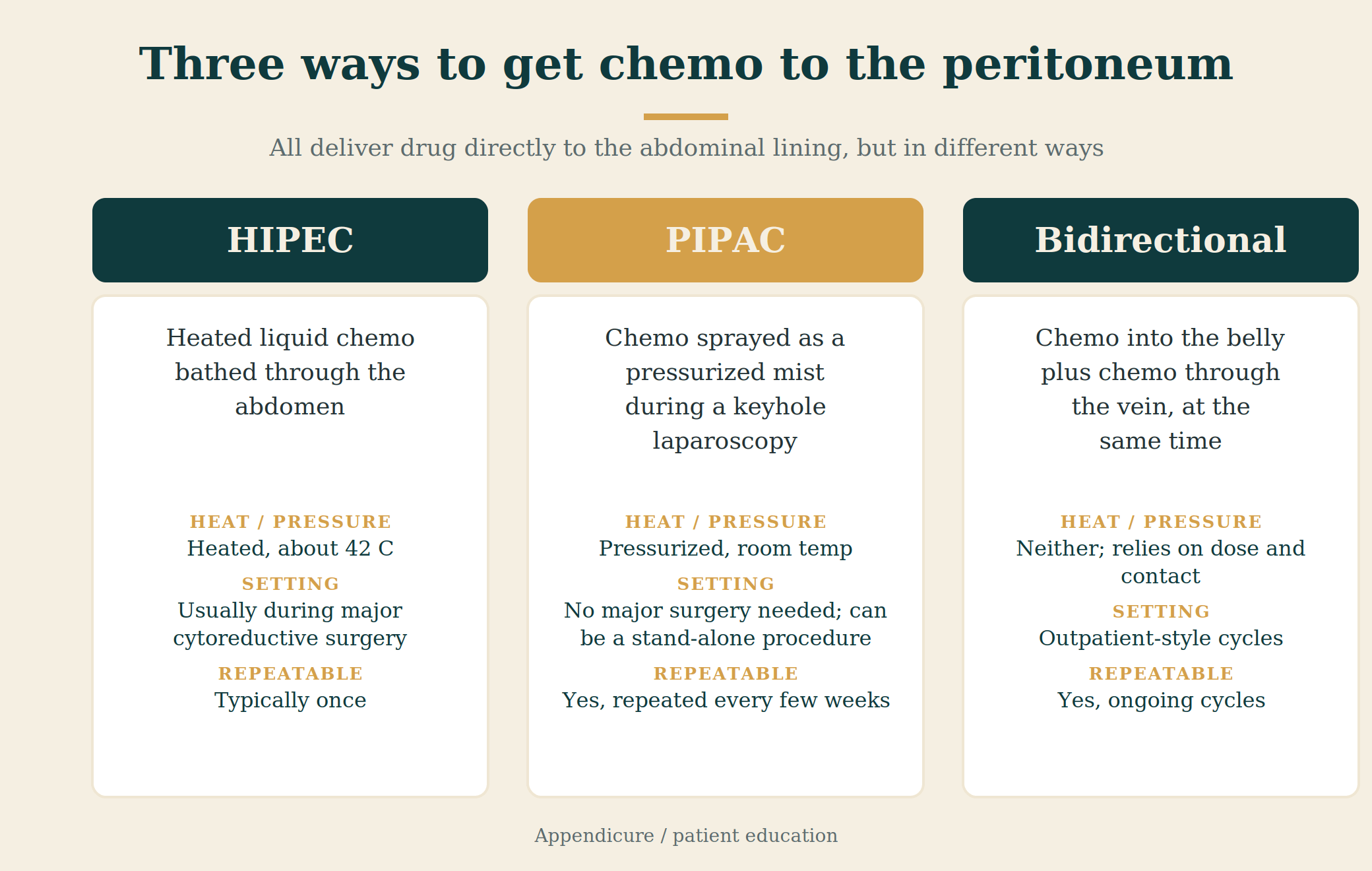
    Comparison of HIPEC, PIPAC, and bidirectional chemotherapy and how each delivers chemo to the peritoneum

    Where the proof actually is

    What matters for keeping expectations honest is where this evidence comes from. The strongest randomized results for putting chemo directly into the abdomen are in stomach cancer, not appendix cancer.

    The clearest example is the DRAGON-01 trial, a phase III study from China. It added intraperitoneal paclitaxel to standard chemotherapy in stomach cancer patients whose disease had spread to the peritoneum. Median survival rose to 19.4 months with the intraperitoneal drug added, compared with 13.9 months without it. That’s a real, statistically significant difference, and it’s the first large randomized trial to show this kind of benefit for the approach. An earlier Japanese phase III trial, PHOENIX-GC, tested a similar bidirectional regimen and did not meet its main goal, though patients with more fluid buildup in the abdomen appeared to do better with the intraperitoneal drug.

    None of this was studied in appendix cancer. Appendiceal tumors, especially the mucinous kind, behave differently from stomach tumors. They often grow slowly, produce large amounts of mucin, and respond to chemotherapy on their own terms. A result that holds up in gastric cancer can’t simply be assumed to hold up in appendiceal disease. It’s encouraging that the underlying idea is earning real evidence, but the proof you’d want for our disease specifically isn’t in yet.
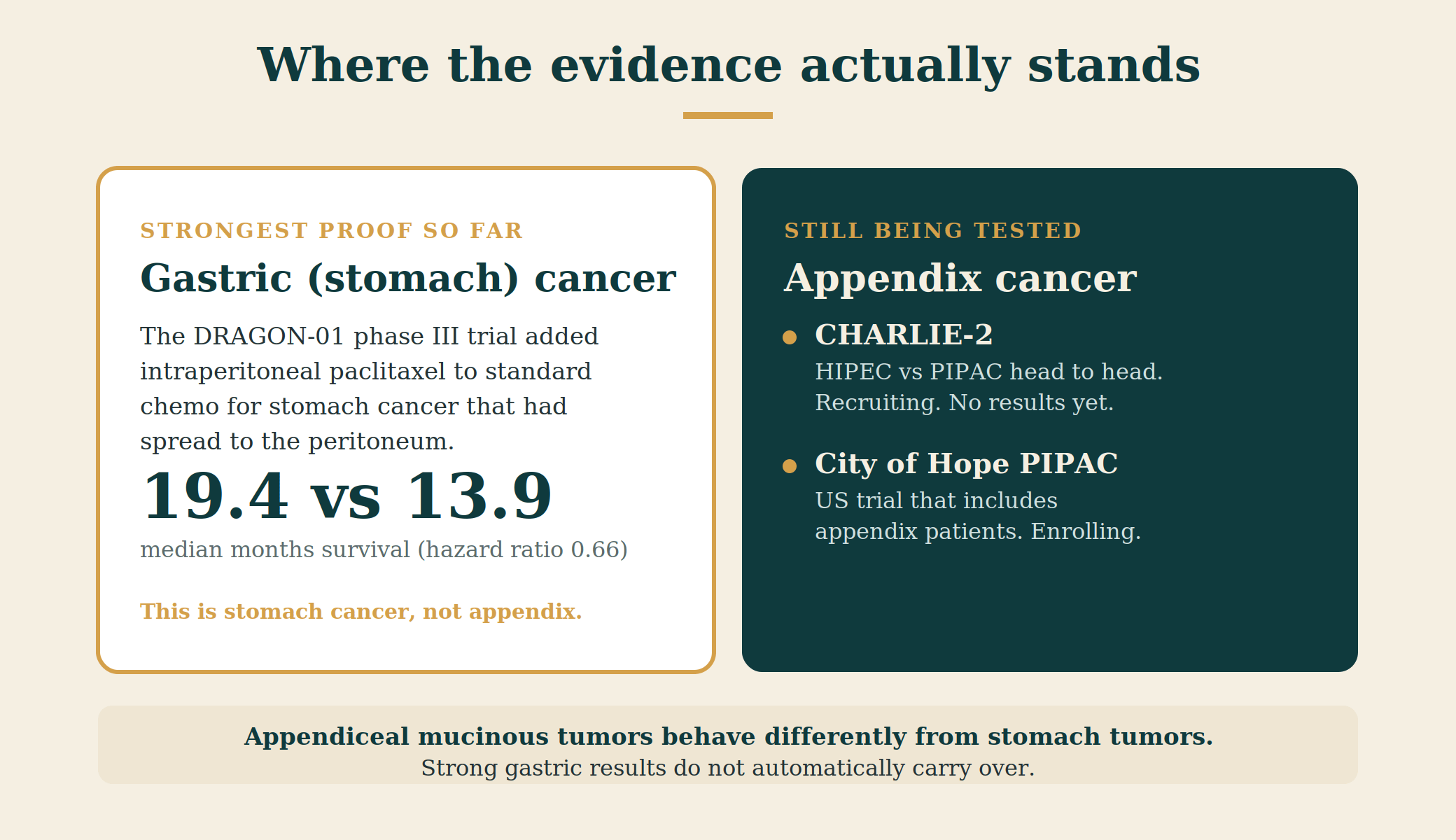
    Where the evidence stands: the strongest randomized proof is in gastric cancer, while PIPAC for appendix cancer is still being tested in CHARLIE-2 and a City of Hope trial

    PIPAC for appendix cancer: the open trials

    Three trials are recruiting right now that include appendiceal patients, two in the United States and one in Europe.

    CHARLIE-2 is a new randomized trial from Patrick Wagner’s group at Allegheny Health Network. It compares HIPEC and PIPAC head to head in patients who aren’t candidates for cytoreductive surgery and still have disease after at least three months of standard chemotherapy. Both arms use the same drug, mitomycin C, so the trial is really testing the delivery method rather than the medicine itself. Patients are grouped by where their cancer started, with appendiceal as one of the three categories, so appendix patients are eligible. The design was just published and recruitment is underway. It runs at a single center in Pittsburgh, which matters if travel is a factor for you.

    During the webinar, Shannon Altpeter, the PA who runs the trial day to day, and Dr. Wagner filled in details that aren’t in the protocol paper. Enrollment is already underway, with about six patients enrolled since the start of the year. The trial takes appendiceal, colorectal, and other primaries, and goblet cell adenocarcinoma is included at every grade, so a goblet cell diagnosis doesn’t rule you out. What decides eligibility is whether the disease is unresectable and whether you’re safe for the procedure, not the subtype on the pathology report.

    Two points stood out for patients. First, resectability is judged by two surgeons independently at the first laparoscopy, not one. Dr. Wagner looks first, and if he says the disease can’t be cleared with surgery, a second surgeon makes the same call without knowing the first answer. Altpeter described it as a fair second look for people who arrive having been told elsewhere that surgery is off the table. Second, you can stay on your systemic chemotherapy while on the trial. The protocol asks for about two weeks off before each procedure and a week after, which usually leaves room for two systemic treatments in between. Screening and follow-up can be done remotely, enrollment can be scheduled the day before the first procedure for people traveling, and the treatments are done at West Penn Hospital in Pittsburgh, usually with a single overnight stay.

    Both doctors were direct about what the trial can and can’t promise. The assignment to HIPEC or PIPAC is random. As Altpeter put it, “I don’t get to pick and you don’t get to pick.” Wagner explained the reason is equipoise, meaning there’s genuinely no good evidence yet that one method beats the other. They do measure how often a patient becomes eligible for cytoreductive surgery after the trial treatments, which is the outcome many patients hope for, but Wagner was clear that it won’t happen for everyone and isn’t the main goal. The main questions are which method is safer, better tolerated, and more effective.

    We covered all of this with Dr. Wagner and Shannon Altpeter in our February webinar. You can watch the full conversation here.

    Shannon Altpeter, PA-C, a surgical oncology physician assistant at Allegheny Health Network, presented CHARLIE-2 with principal investigator Dr. Patrick Wagner.

    The other is a PIPAC trial led by City of Hope, the first multicenter PIPAC study in the United States. It enrolls appendiceal patients alongside ovarian, uterine, colorectal, and gastric cancers, and it runs in partnership with the National Cancer Institute, Mayo Clinic, and Northwell Health. Because it spans several sites, it may be easier to reach than a single-center study.

    Outside the United States, PIPAC is further along. It has been studied and offered at specialist peritoneal cancer centers across Europe and Asia for over a decade. One trial worth flagging for international readers is at Ghent University Hospital in Belgium, an early-phase study testing a newer aerosolized drug, nanoliposomal irinotecan, delivered by PIPAC. It is open to appendiceal and other gastrointestinal cancers and is recruiting now. Because it is a single-center safety study, the practical step for patients abroad is to ask a peritoneal surface specialist near them whether PIPAC, in a trial or through an established program, is an option.

    Two PIPAC trials you might find that don’t fit

    If you search the trial databases yourself, two PIPAC studies are likely to come up. Neither one fits appendix cancer, which is why they aren’t on the list above. The UK’s PICCOS trial is a randomized Phase II PIPAC study, but it covers colon, ovarian, and stomach cancer, not appendix. A trial in Guangzhou, China (NCT06743867) is recruiting for peritoneal metastatic adenocarcinoma in general, with no specific mention of appendiceal disease, so we don’t count it as an appendix trial.

    How to think about this

    PIPAC and bidirectional chemotherapy are real options, and the science behind them gets more solid every year. They aren’t a last resort that only desperate patients consider, and they aren’t a proven cure for appendix cancer either. They sit in the honest middle, promising enough to study carefully and unproven enough that the careful studying still has to happen.

    That gap is the whole reason CHARLIE-2 exists. As Rick Page wrote in Hope Is Not a Strategy, wanting something to work isn’t the same as showing that it does. For years these procedures have been done in single-arm settings where it’s hard to learn much. Running an actual head-to-head trial is how the field gets an answer instead of an impression, and it’s how PIPAC for appendix cancer moves from idea to evidence.

    If you’ve been told you aren’t a candidate for cytoreductive surgery, these trials are worth raising with your care team, and worth asking about by name. And if you want to help the next person get a faster, clearer answer, adding your history to the patient registry is one of the most useful things you can do.

    Read next

    Systemic chemotherapy for low-grade mucinous appendiceal cancer

    Understanding high-grade appendiceal mucinous neoplasms (HAMN)

    How ctDNA is changing the way we think about surgery in appendix cancer

    Related Guides on APPENDICURE

    PIPAC is one of several treatment paths. These guides cover the full picture, from the types of appendix cancer to how it is diagnosed and treated.

    Appendix Cancer 101
    Types of Appendix Cancer
    Diagnosis and Treatment

    0 0

    Share it!

    • Facebook
    • LinkedIn
    • X
    • Pinterest
    • Threads
    • WhatsApp
    • Reddit
    • Print
    • Email
    • SMS Text

    Stay informed about the latest research and patient stories.

    Log in
    Back to top arrow
  • Mental health and appendix cancer support graphic from Appendicure
    • Appendix Cancer 101Your guide to understanding a rare disease, appendix cancer. Learn about types, symptoms, diagnosis, staging, and treatment options like surgery, HIPEC, and chemotherapy—all in one accessible, patient-friendly resource.
      • What is Appendix Cancer?Appendix cancer is a rare abdominal cancer. Learn how appendiceal cancer develops, how it’s diagnosed, and what treatment options exist. APPENDICURE raises awareness for research, recognizing symptoms, diagnosis, surgery, chemotherapy, HIPEC and PIPAC treatment options.
      • Glossary of Medical TermsDecode complex medical terms with our easy-to-understand glossary. Designed for patients and caregivers, this section explains the language used in appendix cancer diagnosis, treatment, surgery, and recovery. Decipher acronyms such as CRS, HIPEC, PIPAC, SRCC.
      • Types of Appendix CancerUnderstand the different forms of appendiceal cancer—from slow-growing tumors to aggressive variants—and what each diagnosis means for treatment and care of this rare appendix cancer. Become familiar medical terms – LAMN Low-grade Appendiceal Mucinous Neoplasm, HAMN High-grade Appendiceal Mucinous Neoplasm, HIPEC Hyperthermic Intraperitoneal Chemotherapy, CRS Cytoreductive Surgery, and SRCC Signet Ring Cell Adenocarcinoma.
      • Pseudomyxoma Peritonei (PMP)
      • Diagnosis & TreatmentFacing a rare gastric cancer can be overwhelming. This section offers clear, compassionate guidance on how appendix cancer is identified and the treatment paths available to you. Learn about chemo, hemicolectomy surgery, cytoreductive surgery CRS, HIPEC, clinical trials, and immunotherapy.
      • CDK4/6 Inhibitors and GNAS-Mutated Appendiceal Cancer
      • Research & InnovationsExplore the latest breakthroughs in appendix cancer—from emerging treatments to promising clinical trials. We spotlight progress that brings hope to patients, caregivers, and advocates. We share research on LAMN Low-grade Appendiceal Mucinous Neoplasm, HAMN High-grade Appendiceal Mucinous Neoplasm, HIPEC Hyperthermic Intraperitoneal Chemotherapy, CRS Cytoreductive Surgery, SRCC Signet Ring Cell Adenocarcinoma, PIPAC Pressurized Intraperitoneal Aerosolized Chemotherapy, Hemicolectomy, and more.
    • Patient & Caregiver ResourcesAPPENDICURE supports appendix cancer patients and caregivers with resources for medical centers, appendiceal surgical oncologists, and HIPEC certified specialists. From diagnosis to survivorship, explore resources designed to inform, uplift, and guide. Whether you’re a rare abdominal cancer patient or caregiver, you’re not alone—and you don’t have to figure it out alone.
      • Medical Centers & ProvidersFind hospitals, specialists, and care teams experienced in treating appendix cancer. We help connect you to the rare abdominal cancer and HIPEC expertise you deserve—because where you go matters. Appendiceal cancer medical and surgical oncologists will discuss diagnosis, treatment plans, and surgery options that align with current research.
      • Support NetworksYou’re not alone. Connect with others who understand the appendix cancer journey—through peer groups, online communities, and caregiver circles built around empathy and shared experience. Explore resources created by appendiceal cancer oncologists, research teams, and cancer awareness advocates that offer guidance on treatment options, financial assistance programs, emotional support groups, and survivorship tips.
      • WebinarsJoin expert-led sessions that break down complex topics, share lived experiences, and offer guidance for patients, caregivers, and advocates navigating appendix cancer. Ask questions about diagnosis, treatment, chemotherapy, hemicolectomy surgery, CRS surgery, HIPEC, PIPAC, caregiver roles, support groups, recovery processes, and spreading awareness.
      • Appendix Cancer Web ResourcesAccess trusted appendix cancer information, downloadable guides, caregiver tools, and appendiceal cancer advocacy materials—all in one place. These resources are designed to educate, empower, and support your cancer journey. We’ve collected resources for you covering treatment, and support on one convenient page.
      • Mental Health Support
      • Patient & Caregiver StoriesReal voices. Real journeys. Discover powerful stories from those affected by appendix cancer—offering hope, insight, and connection for every step of the appendiceal cancer path. Listen to our community of appendiceal cancer survivors as they share their journey through symptoms, diagnosis, treatment, surgery, HIPEC, and recovery.
    • Appendix Cancer Registry
    • For Researchers & Clinicians
      • Standard of Care: 2025 Guidelines
      • Clinician Guides by Specialty
      • Appendix Cancer for Pathologists
      • Registry for Investigators
      • Refer a Patient
      • Clinical Trials
    • Stay ConnectedSubscribe for updates on appendix cancer research, support resources, awareness, and upcoming events. Join our email list and follow us on social media to stay informed and inspired.
      • Blog PostsRead expert insights, patient stories, and the latest updates on appendix cancer care, research, and advocacy. Our blog is a source for appendiceal cancer education and community connection. Share our blog to spread appendix cancer awareness.
      • Data Registry & AI
    • Meet the TeamThe people behind APPENDICURE. Patients, caregivers, survivors, and advocates working to support the appendix cancer community.
      • Board of Directors
      • CUREator Crew
    • Contact UsConnect with the APPENDICURE team to learn more about appendix cancer, share your story, or get involved. We welcome inquiries from patients, caregivers, researchers, and anyone passionate about rare appendiceal cancer advocacy.
    Brook Sullivan Avatar
    Brook Sullivan

    Mental Health and Appendix Cancer

    June 17, 2026

    Mental health and appendix cancer are deeply connected. How to get the care you need.

    Brook Sullivan, who writes about mental health and appendix cancer, with her mom
    Brook Sullivan with her mom.

    Hi everyone. I wanted to introduce myself as we get this new resource up and running.

    My name is Brook Sullivan, and I am a clinical mental health therapist in Birmingham, Alabama. My mom was first diagnosed with LAMN in 2023. Her cancer came back in August 2025 as poorly differentiated with signet ring cell features. In September 2025 we traveled to MD Anderson, where she had CRS/HIPEC surgery, and she went through several rounds of chemotherapy that winter. She is in a clinical trial now. We found Appendicure along the way, and we have learned so much from this group and from Amanda.

    Mental health and appendix cancer are connected

    I have spent years working with clients through cancer, grief, big life transitions, and other hard seasons. Going through this with my mom showed me something my training never fully could. Cancer reaches straight into your mental health, and a rare diagnosis like appendix cancer carries its own particular weight. The uncertainty rarely lets up. The information is thin. The people around you often have no frame of reference for what you are living through.

    Therapy is a space that belongs entirely to you, where you can set down everything you are carrying and start to sort through it.

    Therapists are only licensed to practice in the states where we hold licensure, so I cannot provide therapy outside of Alabama. What I can do is help you find care where you are. That might be a therapist, a support group, a psychiatrist, or another service near you. I am glad to talk through your options and help you figure out where to start.

    I am also happy to talk about the many ways cancer and rare disease affect mental health, and how therapy can actually help. Plenty of us are lucky to have family and friends in our corner, and that matters. Therapy adds something on top of that. This season can be terrifying, shocking, infuriating, overwhelming, and devastating, sometimes all in the same day. You should not have to hold all of it on your own.

    What therapy can actually help with

    People sometimes think therapy is only for a crisis, or that they should be able to handle a diagnosis like this on their own. Neither is true. A good therapist gives you a place to say the things you cannot say to the people you love, because you are trying to protect them. We can work on the anxiety that shows up before every scan. We can sit with the anger, the guilt, and the grief that come with a rare diagnosis, none of which follow a tidy timeline. We can talk about how to keep functioning at work and at home when your mind is somewhere else. And if you are the caregiver rather than the patient, therapy is for you too. Caregivers carry an enormous load and rarely give themselves permission to put any of it down.

    Finding the right person can take a couple of tries, and that is normal. The fit between you and a therapist matters more than almost anything else, so if the first one is not right, it is okay to keep looking. That is part of what I can help you sort out.

    If you want help finding mental health care or resources where you live, fill out the short form below. I would love to connect with you, and I am grateful to be part of this community.

    Find mental health support near you

    By Brook Sullivan, Clinical Mental Health Therapist, Birmingham, Alabama.

    If you are in crisis or thinking about harming yourself, you do not have to wait for a form. Call or text 988 to reach the Suicide and Crisis Lifeline, available 24 hours a day, or call 911 for an emergency.

    0 0

    Share it!

    • Facebook
    • LinkedIn
    • X
    • Pinterest
    • Threads
    • WhatsApp
    • Reddit
    • Print
    • Email
    • SMS Text

    Stay informed about the latest research and patient stories.

    Log in
    Back to top arrow
  • Abstract Appendicure featured image for MSI testing in appendix cancer, one amber marker set apart from a group of teal markers
    • Appendix Cancer 101Your guide to understanding a rare disease, appendix cancer. Learn about types, symptoms, diagnosis, staging, and treatment options like surgery, HIPEC, and chemotherapy—all in one accessible, patient-friendly resource.
      • What is Appendix Cancer?Appendix cancer is a rare abdominal cancer. Learn how appendiceal cancer develops, how it’s diagnosed, and what treatment options exist. APPENDICURE raises awareness for research, recognizing symptoms, diagnosis, surgery, chemotherapy, HIPEC and PIPAC treatment options.
      • Glossary of Medical TermsDecode complex medical terms with our easy-to-understand glossary. Designed for patients and caregivers, this section explains the language used in appendix cancer diagnosis, treatment, surgery, and recovery. Decipher acronyms such as CRS, HIPEC, PIPAC, SRCC.
      • Types of Appendix CancerUnderstand the different forms of appendiceal cancer—from slow-growing tumors to aggressive variants—and what each diagnosis means for treatment and care of this rare appendix cancer. Become familiar medical terms – LAMN Low-grade Appendiceal Mucinous Neoplasm, HAMN High-grade Appendiceal Mucinous Neoplasm, HIPEC Hyperthermic Intraperitoneal Chemotherapy, CRS Cytoreductive Surgery, and SRCC Signet Ring Cell Adenocarcinoma.
      • Pseudomyxoma Peritonei (PMP)
      • Diagnosis & TreatmentFacing a rare gastric cancer can be overwhelming. This section offers clear, compassionate guidance on how appendix cancer is identified and the treatment paths available to you. Learn about chemo, hemicolectomy surgery, cytoreductive surgery CRS, HIPEC, clinical trials, and immunotherapy.
      • CDK4/6 Inhibitors and GNAS-Mutated Appendiceal Cancer
      • Research & InnovationsExplore the latest breakthroughs in appendix cancer—from emerging treatments to promising clinical trials. We spotlight progress that brings hope to patients, caregivers, and advocates. We share research on LAMN Low-grade Appendiceal Mucinous Neoplasm, HAMN High-grade Appendiceal Mucinous Neoplasm, HIPEC Hyperthermic Intraperitoneal Chemotherapy, CRS Cytoreductive Surgery, SRCC Signet Ring Cell Adenocarcinoma, PIPAC Pressurized Intraperitoneal Aerosolized Chemotherapy, Hemicolectomy, and more.
    • Patient & Caregiver ResourcesAPPENDICURE supports appendix cancer patients and caregivers with resources for medical centers, appendiceal surgical oncologists, and HIPEC certified specialists. From diagnosis to survivorship, explore resources designed to inform, uplift, and guide. Whether you’re a rare abdominal cancer patient or caregiver, you’re not alone—and you don’t have to figure it out alone.
      • Medical Centers & ProvidersFind hospitals, specialists, and care teams experienced in treating appendix cancer. We help connect you to the rare abdominal cancer and HIPEC expertise you deserve—because where you go matters. Appendiceal cancer medical and surgical oncologists will discuss diagnosis, treatment plans, and surgery options that align with current research.
      • Support NetworksYou’re not alone. Connect with others who understand the appendix cancer journey—through peer groups, online communities, and caregiver circles built around empathy and shared experience. Explore resources created by appendiceal cancer oncologists, research teams, and cancer awareness advocates that offer guidance on treatment options, financial assistance programs, emotional support groups, and survivorship tips.
      • WebinarsJoin expert-led sessions that break down complex topics, share lived experiences, and offer guidance for patients, caregivers, and advocates navigating appendix cancer. Ask questions about diagnosis, treatment, chemotherapy, hemicolectomy surgery, CRS surgery, HIPEC, PIPAC, caregiver roles, support groups, recovery processes, and spreading awareness.
      • Appendix Cancer Web ResourcesAccess trusted appendix cancer information, downloadable guides, caregiver tools, and appendiceal cancer advocacy materials—all in one place. These resources are designed to educate, empower, and support your cancer journey. We’ve collected resources for you covering treatment, and support on one convenient page.
      • Mental Health Support
      • Patient & Caregiver StoriesReal voices. Real journeys. Discover powerful stories from those affected by appendix cancer—offering hope, insight, and connection for every step of the appendiceal cancer path. Listen to our community of appendiceal cancer survivors as they share their journey through symptoms, diagnosis, treatment, surgery, HIPEC, and recovery.
    • Appendix Cancer Registry
    • For Researchers & Clinicians
      • Standard of Care: 2025 Guidelines
      • Clinician Guides by Specialty
      • Appendix Cancer for Pathologists
      • Registry for Investigators
      • Refer a Patient
      • Clinical Trials
    • Stay ConnectedSubscribe for updates on appendix cancer research, support resources, awareness, and upcoming events. Join our email list and follow us on social media to stay informed and inspired.
      • Blog PostsRead expert insights, patient stories, and the latest updates on appendix cancer care, research, and advocacy. Our blog is a source for appendiceal cancer education and community connection. Share our blog to spread appendix cancer awareness.
      • Data Registry & AI
    • Meet the TeamThe people behind APPENDICURE. Patients, caregivers, survivors, and advocates working to support the appendix cancer community.
      • Board of Directors
      • CUREator Crew
    • Contact UsConnect with the APPENDICURE team to learn more about appendix cancer, share your story, or get involved. We welcome inquiries from patients, caregivers, researchers, and anyone passionate about rare appendiceal cancer advocacy.
    Amanda Moore Avatar
    Amanda Moore

    MSI Testing in Appendix Cancer: The Rare 3% That Matters

    June 14, 2026

    MSI testing in appendix cancer returns a high-instability result, written MSI-high, in only about 3 percent of appendiceal adenocarcinomas. That is far below the rate in colorectal cancer. Ruling it out is still worth doing, and so is knowing what to do if two different tests give you two different answers.

    MSI testing in appendix cancer is something most patients never hear about, and there is a reason for that. An MSI-high result is rare in this disease, so the test usually changes nothing. For the small number of people whose result does come back MSI-high, it can open a treatment option and raise a question about the rest of the family.

    Below is what the test measures, how often it turns up MSI-high, what happens when the results conflict, and why the answer is worth having even when it is likely to be negative.

    What MSI and dMMR actually mean

    Your cells have a built-in spell-check system that fixes small mistakes when DNA copies itself. The genes that run that system are called mismatch repair genes. When the system is working normally, the tumor is usually microsatellite stable, often written as MSS. When it stops working, mistakes pile up in short repeated stretches of DNA called microsatellites. A tumor like that is called microsatellite instability-high, or MSI-high, and the underlying breakdown is called mismatch repair deficient, or dMMR.

    MSI-high and dMMR point at the same underlying problem, but they are measured in two different ways. MSI testing reads the DNA repeats directly. MMR testing checks whether four repair proteins, MLH1, PMS2, MSH2 and MSH6, are still present in the tumor tissue, using a method called immunohistochemistry. A pathologist can run either one on tumor tissue you have already given.

    How often MSI testing in appendix cancer comes back MSI-high

    This is where appendix cancer differs from its better-known neighbor. Across colorectal cancers overall, MSI-high shows up in roughly 15 percent of tumors, and in at least 20 percent of right-sided ones, which is why testing is routine there.

    In the appendix it is far less common. An MD Anderson series of 108 appendiceal carcinomas found 3 MSI-high cases, or 2.8 percent. A much larger National Cancer Database analysis of 1,681 patients with known MSI status found 53 MSI-high tumors, about 3.2 percent.

    The wording on your report matters here. In that same database analysis, 211 patients, or 12.5 percent, were recorded as MSI-positive in some form. Most of those were MSI-low or were not specified further. Only the 53 MSI-high cases fall into the group where a checkpoint inhibitor is usually discussed. So if a report says MSI-positive, ask which category it means.

    One subtype note worth having. Goblet cell adenocarcinoma has generally been described in the literature as mismatch repair proficient and microsatellite stable. A 2026 case report from Tokyo documented what its authors describe as the first appendiceal GCA with both dMMR and MSI-high status. One case does not change the general picture, but it is a reason not to assume the answer for any single person based on subtype alone.

    When the two tests do not agree

    Most of the time the two results match. Sometimes they do not. Published colorectal cancer studies put the disagreement rate between MMR protein testing and molecular MSI testing at roughly 3 to 10 percent. Comparable numbers for appendiceal cancer specifically have not been established.

    The scale of it shows up in trial data. In the CheckMate 8HW colorectal cancer trial, 303 patients were enrolled into the first-line comparison based on testing at their own hospital. When a central laboratory checked, 255 of them had confirmed MSI-high or dMMR tumors. That leaves roughly one in six whose local result was not confirmed centrally.

    This is worth knowing because the two results can pull toward different treatments. A tumor can show missing repair proteins on the MMR test and still come back microsatellite stable with a low mutation count, and in that situation immunotherapy may not do what the MMR result alone would suggest. Ando and colleagues describe exactly that sequence in a 2026 preprint on appendiceal signet ring cell adenocarcinoma. I wrote it up separately in appendix cancer biomarker testing, including what her team did next.

    If your reports show one result and not the other, or the two do not line up, that is a reasonable thing to raise with your oncologist rather than something to sort out on your own.

    Why MSI testing in appendix cancer is still worth doing

    In the United States, pembrolizumab carries an FDA tumor-agnostic indication for unresectable or metastatic MSI-high or dMMR solid tumors, identified by an FDA-authorized test, in patients whose disease has progressed after prior treatment and who have no satisfactory alternative options. An MSI-high result can therefore put an already-approved drug within reach without waiting for a trial slot, though whether it applies to you depends on your stage and what treatment you have already had. Approvals differ outside the U.S., so ask your own team what applies where you are treated.

    The result can also point at Lynch syndrome, an inherited condition that raises the risk of several cancers. It does not mean you have Lynch syndrome. Most MSI-high tumors are not inherited at all, and in colorectal cancer the most common cause is a chemical change to the MLH1 gene that happens in the tumor itself rather than something passed down. What an MSI-high result can do is give a reason to consider genetic counseling and germline testing. If Lynch syndrome is confirmed, that information reaches your relatives, because it can change what screening they should have and when. Our post on appendix cancer genetic testing walks through what germline testing adds.

    What a microsatellite stable result means

    For most people with appendix cancer, especially low grade or mucinous disease, the tumor will be microsatellite stable. That is what the biology of this disease usually looks like, and it says nothing about the quality of your care or whether something was missed.

    A stable result means MSI and MMR status are unlikely to give a standard reason to use checkpoint immunotherapy. It does not mean immunotherapy could never come up for you in any form, because trials, combinations, and other biomarkers exist and your situation is your own. MSI testing in appendix cancer is worth doing precisely because it tells you, one way or the other, which group you are in.

    What to ask your care team

    Ask whether your tumor has been tested for MMR or MSI, and what the result showed. If the answer is MSI-positive, ask whether that means MSI-high, MSI-low, or unspecified. If only one of the two tests was run, ask whether that result is enough on its own or whether there is a reason to run the other one as well. And if the two results conflict, ask whether the testing should be reviewed or repeated before it drives a treatment decision.

    Read more

    Appendix Cancer Biomarker Testing: What Happens When Two Tests Disagree

    Appendix Cancer Genetic Testing: Why Dr. Shen Suggested a Germline Test for David

    Appendix Cancer Mutation Testing: Know What Your Tumor Is Made Of

    Help us see how common this really is

    The 3 percent figure rests on two studies, and neither was built to answer how often the tests disagree. Adding your own diagnosis and testing details to the Patient-Led Global Appendix Cancer Registry is one of the most useful things you can do in ten minutes. The enrollment links are region-specific, so please use the one that matches where you live.

    Join the Registry: United States Join the Registry: International

    Already enrolled and need to add a new report or fix an earlier entry? Use the registry update form. If you want to help fund this work, you can give here.

    Sources

    Taggart MW, Galbincea J, Mansfield PF, et al. High-level microsatellite instability in appendiceal carcinomas. American Journal of Surgical Pathology. 2013;37(8):1192-1200. https://doi.org/10.1097/PAS.0b013e318282649b

    Emile SH, Horesh N, Garoufalia Z, et al. The prognostic impact of microsatellite instability on the outcome of appendiceal adenocarcinoma: a National Cancer Database analysis. Journal of Gastrointestinal Surgery. 2023;27(2):354-362. https://doi.org/10.1007/s11605-023-05586-z

    Hashimoto H, Koda H, Nakajima K, et al. Appendiceal goblet cell adenocarcinoma with mismatch repair deficiency and microsatellite instability-high status: a novel molecular signature guiding immuno-oncology strategy. Pathology International. 2026;76(3):e70108. https://doi.org/10.1111/pin.70108

    Evrard C, Tachon G, Randrian V, Karayan-Tapon L, Tougeron D. Microsatellite instability: diagnosis, heterogeneity, discordance, and clinical impact in colorectal cancer. Cancers. 2019;11:1567. https://doi.org/10.3390/cancers11101567

    Andre T, Elez E, Van Cutsem E, et al. Nivolumab plus ipilimumab in microsatellite-instability-high metastatic colorectal cancer. New England Journal of Medicine. 2024;391(21):2014-2026. https://doi.org/10.1056/NEJMoa2402141

    Ando T, Tajiri Y, Noda Y, et al. Comprehensive genomic profiling-guided treatment selection in appendiceal adenocarcinoma with discordant mismatch repair findings. Research Square preprint, posted August 28, 2026. Not peer reviewed. https://doi.org/10.21203/rs.3.rs-10434247/v1

    KEYTRUDA (pembrolizumab) prescribing information, label updated July 10, 2026. DailyMed, U.S. National Library of Medicine. dailymed.nlm.nih.gov

    This post is patient education from Appendicure and is not medical advice. Testing and treatment decisions should be made with your own care team.

    0 0

    Share it!

    • Facebook
    • LinkedIn
    • X
    • Pinterest
    • Threads
    • WhatsApp
    • Reddit
    • Print
    • Email
    • SMS Text

    Stay informed about the latest research and patient stories.

    Log in
    Back to top arrow
  • Teal and gold DNA double helix beside the words Genetic Testing and Appendix Cancer, Appendicure
    • Appendix Cancer 101Your guide to understanding a rare disease, appendix cancer. Learn about types, symptoms, diagnosis, staging, and treatment options like surgery, HIPEC, and chemotherapy—all in one accessible, patient-friendly resource.
      • What is Appendix Cancer?Appendix cancer is a rare abdominal cancer. Learn how appendiceal cancer develops, how it’s diagnosed, and what treatment options exist. APPENDICURE raises awareness for research, recognizing symptoms, diagnosis, surgery, chemotherapy, HIPEC and PIPAC treatment options.
      • Glossary of Medical TermsDecode complex medical terms with our easy-to-understand glossary. Designed for patients and caregivers, this section explains the language used in appendix cancer diagnosis, treatment, surgery, and recovery. Decipher acronyms such as CRS, HIPEC, PIPAC, SRCC.
      • Types of Appendix CancerUnderstand the different forms of appendiceal cancer—from slow-growing tumors to aggressive variants—and what each diagnosis means for treatment and care of this rare appendix cancer. Become familiar medical terms – LAMN Low-grade Appendiceal Mucinous Neoplasm, HAMN High-grade Appendiceal Mucinous Neoplasm, HIPEC Hyperthermic Intraperitoneal Chemotherapy, CRS Cytoreductive Surgery, and SRCC Signet Ring Cell Adenocarcinoma.
      • Pseudomyxoma Peritonei (PMP)
      • Diagnosis & TreatmentFacing a rare gastric cancer can be overwhelming. This section offers clear, compassionate guidance on how appendix cancer is identified and the treatment paths available to you. Learn about chemo, hemicolectomy surgery, cytoreductive surgery CRS, HIPEC, clinical trials, and immunotherapy.
      • CDK4/6 Inhibitors and GNAS-Mutated Appendiceal Cancer
      • Research & InnovationsExplore the latest breakthroughs in appendix cancer—from emerging treatments to promising clinical trials. We spotlight progress that brings hope to patients, caregivers, and advocates. We share research on LAMN Low-grade Appendiceal Mucinous Neoplasm, HAMN High-grade Appendiceal Mucinous Neoplasm, HIPEC Hyperthermic Intraperitoneal Chemotherapy, CRS Cytoreductive Surgery, SRCC Signet Ring Cell Adenocarcinoma, PIPAC Pressurized Intraperitoneal Aerosolized Chemotherapy, Hemicolectomy, and more.
    • Patient & Caregiver ResourcesAPPENDICURE supports appendix cancer patients and caregivers with resources for medical centers, appendiceal surgical oncologists, and HIPEC certified specialists. From diagnosis to survivorship, explore resources designed to inform, uplift, and guide. Whether you’re a rare abdominal cancer patient or caregiver, you’re not alone—and you don’t have to figure it out alone.
      • Medical Centers & ProvidersFind hospitals, specialists, and care teams experienced in treating appendix cancer. We help connect you to the rare abdominal cancer and HIPEC expertise you deserve—because where you go matters. Appendiceal cancer medical and surgical oncologists will discuss diagnosis, treatment plans, and surgery options that align with current research.
      • Support NetworksYou’re not alone. Connect with others who understand the appendix cancer journey—through peer groups, online communities, and caregiver circles built around empathy and shared experience. Explore resources created by appendiceal cancer oncologists, research teams, and cancer awareness advocates that offer guidance on treatment options, financial assistance programs, emotional support groups, and survivorship tips.
      • WebinarsJoin expert-led sessions that break down complex topics, share lived experiences, and offer guidance for patients, caregivers, and advocates navigating appendix cancer. Ask questions about diagnosis, treatment, chemotherapy, hemicolectomy surgery, CRS surgery, HIPEC, PIPAC, caregiver roles, support groups, recovery processes, and spreading awareness.
      • Appendix Cancer Web ResourcesAccess trusted appendix cancer information, downloadable guides, caregiver tools, and appendiceal cancer advocacy materials—all in one place. These resources are designed to educate, empower, and support your cancer journey. We’ve collected resources for you covering treatment, and support on one convenient page.
      • Mental Health Support
      • Patient & Caregiver StoriesReal voices. Real journeys. Discover powerful stories from those affected by appendix cancer—offering hope, insight, and connection for every step of the appendiceal cancer path. Listen to our community of appendiceal cancer survivors as they share their journey through symptoms, diagnosis, treatment, surgery, HIPEC, and recovery.
    • Appendix Cancer Registry
    • For Researchers & Clinicians
      • Standard of Care: 2025 Guidelines
      • Clinician Guides by Specialty
      • Appendix Cancer for Pathologists
      • Registry for Investigators
      • Refer a Patient
      • Clinical Trials
    • Stay ConnectedSubscribe for updates on appendix cancer research, support resources, awareness, and upcoming events. Join our email list and follow us on social media to stay informed and inspired.
      • Blog PostsRead expert insights, patient stories, and the latest updates on appendix cancer care, research, and advocacy. Our blog is a source for appendiceal cancer education and community connection. Share our blog to spread appendix cancer awareness.
      • Data Registry & AI
    • Meet the TeamThe people behind APPENDICURE. Patients, caregivers, survivors, and advocates working to support the appendix cancer community.
      • Board of Directors
      • CUREator Crew
    • Contact UsConnect with the APPENDICURE team to learn more about appendix cancer, share your story, or get involved. We welcome inquiries from patients, caregivers, researchers, and anyone passionate about rare appendiceal cancer advocacy.
    Amanda Moore Avatar
    Amanda Moore

    Appendix Cancer Genetic Testing: Why Dr. Shen Suggested a Germline Test for David

    June 13, 2026

    When David’s care team brought up appendix cancer genetic testing, it was not really about David. It was about our daughter, Kathleen.

    David is 53. He was diagnosed with goblet cell appendiceal cancer. Dr. Shen suggested a germline genetic test, and the point was not to change David’s treatment tomorrow. The point was to find out whether there is something written into his DNA that he could have passed down. If you are sitting with a new diagnosis, or you have lived with one for years, this is a question worth understanding, so I want to walk through what I learned.

    Amanda, her daughter Kathleen, and her husband David together at a hot air balloon festival
    David, Kathleen and I, enjoying time as a family.

    Two kinds of tests, and why the difference matters

    There are two very different genetic tests in cancer, and people mix them up all the time.

    • Tumor testing (somatic testing) looks at the DNA inside the cancer itself. It tells you about mutations the tumor picked up over time, and it can help guide treatment. It does not tell you what you were born with.
    • Germline testing looks at the DNA you were born with, the copy that sits in every cell of your body. If something shows up here, you have carried it your whole life, and there is a chance you passed it to your children.

    David has already had tumor testing. The germline test asks a separate question. Is there an inherited variant sitting underneath all of this?

    What the research says about appendix cancer genetic testing

    For a long time the assumption was that appendix cancer is not inherited. That assumption is being questioned.

    In a study published in JAMA Oncology, Dr. Andreana Holowatyj and her team at Vanderbilt reviewed germline panel testing from 131 people with appendix cancer. About 1 in 10, or 11.5 percent, carried an inherited variant in a cancer susceptibility gene. When they narrowed the group to people whose appendix was their first and only tumor, the rate held at 10.8 percent. Four of those patients had Lynch syndrome, a known inherited condition that raises the risk of several cancers. The authors concluded that genetic counseling and panel testing should be offered to every appendix cancer patient, regardless of age or family history.

    Testing is worth offering to everyone. That is not the same as saying appendix cancer is inherited.

    The honest part, carrying a variant is not the same as knowing the cause

    This is where I have to be careful, because the easy headline would be wrong.

    A 2023 study led by Dr. Michael Foote looked at 237 people with appendiceal adenocarcinoma. He found a similar rate of inherited variants. But when he compared each germline result against what the tumor was actually doing, he argued that many of those variants may be incidental. In plain terms, the variant is real, but it may not be the thing that caused the appendix cancer.

    What gives me confidence in the careful version is who is saying it. Dr. Foote, who made the incidental argument, and Dr. Shen, who treats David, are both authors on the 2025 appendiceal cancer consensus guidelines. The people writing the rulebook hold the careful view. So the honest statement is this. Inherited variants show up in roughly 1 in 10 appendix cancer patients, testing is worth doing, and we should not overstate what a positive result proves about cause.

    Why tumor testing does not replace a germline test

    A fair question came up for us. David already had his tumor sequenced, so why test again?

    Because the two tests answer different questions, and tumor testing misses inherited variants. The 2024 ASCO guideline on germline testing put a number on it. Tumor profiling misses up to about 10 percent of people who actually carry an inherited pathogenic variant. A clean tumor report does not mean your germline is clear.

    What this means for families

    If David carries an inherited variant, our daughter can be tested for that one specific thing. This is called cascade testing. With most inherited variants, a child has about a 50 percent chance of carrying it.

    A positive result for her would not mean she is going to get cancer. It would mean she and her doctors know to watch, and to start screening earlier than they otherwise would. A negative result would take a worry off the table. Either way she ends up with information, and information is what lets you act early instead of late. That is the whole reason Dr. Shen raised it. At 53, the test changes very little for David. For a daughter in her twenties, it could change the timing of everything.

    Where appendix cancer genetic testing stands today

    Appendix cancer does not yet have its own dedicated germline testing rule the way breast and prostate cancer do. The direction, though, is clear. The peritoneal metastases consensus guidelines from the PSM Consortium say germline testing should be considered as indicated. Leading GI cancer experts are openly debating whether every GI cancer patient should be offered germline testing. And the largest appendix specific study we have recommends testing everyone. If your team has not raised it, you are allowed to ask.

    What we decided

    David is getting the germline test. Not because it will change his chemo, and not because we believe his cancer was inherited. We are doing it for the one person it could protect the most. If the result is negative, that is a gift to our daughter. If it is positive, it is a map she can use for the rest of her life.

    If you want to help the wider community see patterns like this more clearly, adding your own history to our patient data registry is one of the most useful things you can do in ten minutes.

    Read next

    Genetic testing is one piece of understanding your own diagnosis. Grade is another, and grade 2 disease too often gets swept into the high-grade bucket where it disappears. Read: The Middle Tier Deserves Its Own Name

    I am a patient advocate, not a doctor. I write this to help you ask sharper questions, not to replace the advice of your own care team.

    0 0

    Share it!

    • Facebook
    • LinkedIn
    • X
    • Pinterest
    • Threads
    • WhatsApp
    • Reddit
    • Print
    • Email
    • SMS Text

    Stay informed about the latest research and patient stories.

    Log in
    Back to top arrow
  • Timeline showing early onset appendix cancer follow-up extending past five years toward ten years after surgery
    • Appendix Cancer 101Your guide to understanding a rare disease, appendix cancer. Learn about types, symptoms, diagnosis, staging, and treatment options like surgery, HIPEC, and chemotherapy—all in one accessible, patient-friendly resource.
      • What is Appendix Cancer?Appendix cancer is a rare abdominal cancer. Learn how appendiceal cancer develops, how it’s diagnosed, and what treatment options exist. APPENDICURE raises awareness for research, recognizing symptoms, diagnosis, surgery, chemotherapy, HIPEC and PIPAC treatment options.
      • Glossary of Medical TermsDecode complex medical terms with our easy-to-understand glossary. Designed for patients and caregivers, this section explains the language used in appendix cancer diagnosis, treatment, surgery, and recovery. Decipher acronyms such as CRS, HIPEC, PIPAC, SRCC.
      • Types of Appendix CancerUnderstand the different forms of appendiceal cancer—from slow-growing tumors to aggressive variants—and what each diagnosis means for treatment and care of this rare appendix cancer. Become familiar medical terms – LAMN Low-grade Appendiceal Mucinous Neoplasm, HAMN High-grade Appendiceal Mucinous Neoplasm, HIPEC Hyperthermic Intraperitoneal Chemotherapy, CRS Cytoreductive Surgery, and SRCC Signet Ring Cell Adenocarcinoma.
      • Pseudomyxoma Peritonei (PMP)
      • Diagnosis & TreatmentFacing a rare gastric cancer can be overwhelming. This section offers clear, compassionate guidance on how appendix cancer is identified and the treatment paths available to you. Learn about chemo, hemicolectomy surgery, cytoreductive surgery CRS, HIPEC, clinical trials, and immunotherapy.
      • CDK4/6 Inhibitors and GNAS-Mutated Appendiceal Cancer
      • Research & InnovationsExplore the latest breakthroughs in appendix cancer—from emerging treatments to promising clinical trials. We spotlight progress that brings hope to patients, caregivers, and advocates. We share research on LAMN Low-grade Appendiceal Mucinous Neoplasm, HAMN High-grade Appendiceal Mucinous Neoplasm, HIPEC Hyperthermic Intraperitoneal Chemotherapy, CRS Cytoreductive Surgery, SRCC Signet Ring Cell Adenocarcinoma, PIPAC Pressurized Intraperitoneal Aerosolized Chemotherapy, Hemicolectomy, and more.
    • Patient & Caregiver ResourcesAPPENDICURE supports appendix cancer patients and caregivers with resources for medical centers, appendiceal surgical oncologists, and HIPEC certified specialists. From diagnosis to survivorship, explore resources designed to inform, uplift, and guide. Whether you’re a rare abdominal cancer patient or caregiver, you’re not alone—and you don’t have to figure it out alone.
      • Medical Centers & ProvidersFind hospitals, specialists, and care teams experienced in treating appendix cancer. We help connect you to the rare abdominal cancer and HIPEC expertise you deserve—because where you go matters. Appendiceal cancer medical and surgical oncologists will discuss diagnosis, treatment plans, and surgery options that align with current research.
      • Support NetworksYou’re not alone. Connect with others who understand the appendix cancer journey—through peer groups, online communities, and caregiver circles built around empathy and shared experience. Explore resources created by appendiceal cancer oncologists, research teams, and cancer awareness advocates that offer guidance on treatment options, financial assistance programs, emotional support groups, and survivorship tips.
      • WebinarsJoin expert-led sessions that break down complex topics, share lived experiences, and offer guidance for patients, caregivers, and advocates navigating appendix cancer. Ask questions about diagnosis, treatment, chemotherapy, hemicolectomy surgery, CRS surgery, HIPEC, PIPAC, caregiver roles, support groups, recovery processes, and spreading awareness.
      • Appendix Cancer Web ResourcesAccess trusted appendix cancer information, downloadable guides, caregiver tools, and appendiceal cancer advocacy materials—all in one place. These resources are designed to educate, empower, and support your cancer journey. We’ve collected resources for you covering treatment, and support on one convenient page.
      • Mental Health Support
      • Patient & Caregiver StoriesReal voices. Real journeys. Discover powerful stories from those affected by appendix cancer—offering hope, insight, and connection for every step of the appendiceal cancer path. Listen to our community of appendiceal cancer survivors as they share their journey through symptoms, diagnosis, treatment, surgery, HIPEC, and recovery.
    • Appendix Cancer Registry
    • For Researchers & Clinicians
      • Standard of Care: 2025 Guidelines
      • Clinician Guides by Specialty
      • Appendix Cancer for Pathologists
      • Registry for Investigators
      • Refer a Patient
      • Clinical Trials
    • Stay ConnectedSubscribe for updates on appendix cancer research, support resources, awareness, and upcoming events. Join our email list and follow us on social media to stay informed and inspired.
      • Blog PostsRead expert insights, patient stories, and the latest updates on appendix cancer care, research, and advocacy. Our blog is a source for appendiceal cancer education and community connection. Share our blog to spread appendix cancer awareness.
      • Data Registry & AI
    • Meet the TeamThe people behind APPENDICURE. Patients, caregivers, survivors, and advocates working to support the appendix cancer community.
      • Board of Directors
      • CUREator Crew
    • Contact UsConnect with the APPENDICURE team to learn more about appendix cancer, share your story, or get involved. We welcome inquiries from patients, caregivers, researchers, and anyone passionate about rare appendiceal cancer advocacy.
    Amanda Moore Avatar
    Amanda Moore

    Early Onset Appendix Cancer: What a New Adenocarcinoma Study Suggests

    June 9, 2026

    A new study on early onset appendix cancer gives us one of the first real looks at how this disease behaves in people diagnosed before 50. A team at the University of Chicago, with co-authors including Dr. Kiran Turaga, published it in Annals of Surgical Oncology in June 2026, and it is open access, so you can read the whole thing yourself. I read research like this closely. My husband David was diagnosed with goblet cell adenocarcinoma, and that is what pulled me into this work. The study is small, a single hospital looking back at its own patient records, and the authors are upfront that their findings are early signals rather than settled answers. Even so, a few of those signals are worth knowing, because they touch on decisions you or someone you love may be facing right now.

    What this study looked at

    Who this study is about matters, because appendix cancer is not one disease. This study grouped several histologies together and analyzed them as one, under the umbrella of appendiceal adenocarcinoma. That included mucinous adenocarcinoma, colonic-type (nonmucinous) adenocarcinoma, signet ring cell adenocarcinoma, poorly differentiated adenocarcinoma, and goblet cell adenocarcinoma. Goblet cell was folded in because it tends to behave like high-grade disease and is often treated the same way. If your diagnosis is one of those, including signet ring, you were part of the population this study describes. The authors did not break out separate results for each subtype, though, so nothing here is specific to signet ring or any single type on its own. The study did not include low-grade or high-grade appendiceal mucinous neoplasms, the LAMN and HAMN tumors that can lead to pseudomyxoma peritonei, and it did not include neuroendocrine tumors. If your diagnosis is LAMN, HAMN, or PMP, this study is not describing your cancer.

    Graphic listing the appendix cancer subtypes the study counted as adenocarcinoma, including mucinous, colonic-type, signet ring cell, poorly differentiated, and goblet cell, and excluding LAMN, HAMN, and neuroendocrine tumors

    Why early onset appendix cancer is getting attention

    Appendix cancer is rare, but it is being diagnosed more often, and the increase is steepest in younger adults. Early onset appendix cancer is the fastest-rising early onset gastrointestinal cancer, climbing faster than the early onset colon and rectal cancers that have been getting headlines. In this study, more than a quarter of the patients were under 50. That is a lot for a cancer that most people, including many doctors, still think of as something that shows up later in life.

    Part of how we close that gap is data. If you have been diagnosed, you can add your information to our patient data registry.

    Follow-up may need to last longer

    The most directly useful finding is about how long follow-up should continue. In this group, recurrences did not always happen in the first couple of years. Some showed up well after the five-year mark, the point where many people assume they are in the clear. Because of that, the Chicago team keeps watching their patients longer, often out to ten years, rather than closing the book at five. The study also pointed to younger patients who stayed cancer-free through the first two years still carrying a higher chance of the cancer returning later than older patients did, though the authors are careful to treat that as a signal rather than a settled finding. So if you were diagnosed young, it is worth asking your team whether your follow-up should run longer than the standard window.

    Younger women and the ovaries

    For women diagnosed young, the study raised a specific concern. A meaningful share of the younger women in this group already had the cancer involving their ovaries at the time of diagnosis, more often than you would expect from comparisons with colorectal cancer. This is the kind of thing that should be on the table early, not after the fact. It opens real questions about fertility, about whether and when to consider removing the ovaries, and about how to weigh those choices while you are also dealing with the cancer itself. If you are a younger woman with this diagnosis, fertility planning and the ovarian question are worth raising before treatment decisions get locked in.

    More treatment did not mean more time

    One finding sticks with me more than the others. The younger patients in this study were treated more aggressively than the older ones. They were more likely to receive bevacizumab and non-standard or experimental drugs, and they tended to go through more lines of therapy. Despite all of that extra treatment, they did not live longer overall than the older patients.

    For any treatment being recommended, ask what it is meant to buy you, more time or better time, and what it is likely to cost you to get there.

    What the study could not tell us is just as important. It did not measure quality of life at all. So it cannot say whether that more aggressive treatment bought these patients better time, worse time, or simply more treatment. The authors flag this themselves, noting that intense treatment carries real costs in side effects and quality of life, and that those costs deserve careful thought before pushing harder in a young patient. That is not a reason to refuse treatment. It is a reason to ask a sharper question, the one in the box above.

    What the tumors looked like

    The study also sequenced tumors where that data was available. The most commonly altered gene was KRAS, followed by GNAS, TP53, and SMAD4. TP53 changes showed up more often in the younger group, though that difference did not reach statistical significance. Every tumor tested was microsatellite stable, which matters because microsatellite-stable tumors generally do not respond to the immunotherapy drugs that help in some other cancers. Goblet cell is personal for me, since it is David’s diagnosis, so I want to be clear about one thing here. Goblet cell adenocarcinoma tends to carry KRAS mutations far less often than the other appendiceal types, so the KRAS figure in this study describes the broader group and should not be read as applying to goblet cell specifically.

    Questions to bring to your team

    The thread running through all of this is that early onset appendix cancer may not behave like the same disease in a younger body, and that is worth saying out loud with your care team. These are the questions I would bring to my own next appointment.

    Five questions for younger appendix cancer patients to ask about follow-up, fertility, treatment goals, and clinical trials

    None of this is settled. It is one small study from one hospital, looking backward at records, and the authors are careful to call their results signals for future research rather than conclusions. But signals are still worth paying attention to when they point at decisions you are facing now. The clearest message is that younger patients deserve care plans built for them, not borrowed from how the disease behaves in people decades older. Clinical trials are a big part of how that gets worked out, and being young and otherwise healthy can make you a strong candidate, so it is worth asking what trials you might fit. Dr. Kiran Turaga, Chief of Surgical Oncology at Yale and one of the co-authors on this study, leads a trial there for high-grade appendiceal cancer, and our recorded conversation with his team is linked below.

    Help the next study get sharper

    If you have been diagnosed, adding your information to our patient data registry helps research like this build the bigger picture, one entry at a time. The more data we have, the faster we can move.

    Add Your Data to the Registry

    Related reading

    Our series on signet ring cell appendix cancer
    Watch our live event with Dr. Kiran Turaga’s team on their high-grade appendiceal trial

    The study

    Gujarathi R, et al. Survival Outcomes in Early Onset Appendiceal Adenocarcinoma (EOAA). Annals of Surgical Oncology, 2026.

    Ask your questions about this study in the comments below, and I will answer what I can.

    0 0

    Share it!

    • Facebook
    • LinkedIn
    • X
    • Pinterest
    • Threads
    • WhatsApp
    • Reddit
    • Print
    • Email
    • SMS Text

    Stay informed about the latest research and patient stories.

    Log in
    Back to top arrow
  • Cream and teal Appendicure banner titled Appendix Cancer and Colon Polyps, with a line illustration of the colon, cecum, and appendix showing three polyps along the colon wall.
    • Appendix Cancer 101Your guide to understanding a rare disease, appendix cancer. Learn about types, symptoms, diagnosis, staging, and treatment options like surgery, HIPEC, and chemotherapy—all in one accessible, patient-friendly resource.
      • What is Appendix Cancer?Appendix cancer is a rare abdominal cancer. Learn how appendiceal cancer develops, how it’s diagnosed, and what treatment options exist. APPENDICURE raises awareness for research, recognizing symptoms, diagnosis, surgery, chemotherapy, HIPEC and PIPAC treatment options.
      • Glossary of Medical TermsDecode complex medical terms with our easy-to-understand glossary. Designed for patients and caregivers, this section explains the language used in appendix cancer diagnosis, treatment, surgery, and recovery. Decipher acronyms such as CRS, HIPEC, PIPAC, SRCC.
      • Types of Appendix CancerUnderstand the different forms of appendiceal cancer—from slow-growing tumors to aggressive variants—and what each diagnosis means for treatment and care of this rare appendix cancer. Become familiar medical terms – LAMN Low-grade Appendiceal Mucinous Neoplasm, HAMN High-grade Appendiceal Mucinous Neoplasm, HIPEC Hyperthermic Intraperitoneal Chemotherapy, CRS Cytoreductive Surgery, and SRCC Signet Ring Cell Adenocarcinoma.
      • Pseudomyxoma Peritonei (PMP)
      • Diagnosis & TreatmentFacing a rare gastric cancer can be overwhelming. This section offers clear, compassionate guidance on how appendix cancer is identified and the treatment paths available to you. Learn about chemo, hemicolectomy surgery, cytoreductive surgery CRS, HIPEC, clinical trials, and immunotherapy.
      • CDK4/6 Inhibitors and GNAS-Mutated Appendiceal Cancer
      • Research & InnovationsExplore the latest breakthroughs in appendix cancer—from emerging treatments to promising clinical trials. We spotlight progress that brings hope to patients, caregivers, and advocates. We share research on LAMN Low-grade Appendiceal Mucinous Neoplasm, HAMN High-grade Appendiceal Mucinous Neoplasm, HIPEC Hyperthermic Intraperitoneal Chemotherapy, CRS Cytoreductive Surgery, SRCC Signet Ring Cell Adenocarcinoma, PIPAC Pressurized Intraperitoneal Aerosolized Chemotherapy, Hemicolectomy, and more.
    • Patient & Caregiver ResourcesAPPENDICURE supports appendix cancer patients and caregivers with resources for medical centers, appendiceal surgical oncologists, and HIPEC certified specialists. From diagnosis to survivorship, explore resources designed to inform, uplift, and guide. Whether you’re a rare abdominal cancer patient or caregiver, you’re not alone—and you don’t have to figure it out alone.
      • Medical Centers & ProvidersFind hospitals, specialists, and care teams experienced in treating appendix cancer. We help connect you to the rare abdominal cancer and HIPEC expertise you deserve—because where you go matters. Appendiceal cancer medical and surgical oncologists will discuss diagnosis, treatment plans, and surgery options that align with current research.
      • Support NetworksYou’re not alone. Connect with others who understand the appendix cancer journey—through peer groups, online communities, and caregiver circles built around empathy and shared experience. Explore resources created by appendiceal cancer oncologists, research teams, and cancer awareness advocates that offer guidance on treatment options, financial assistance programs, emotional support groups, and survivorship tips.
      • WebinarsJoin expert-led sessions that break down complex topics, share lived experiences, and offer guidance for patients, caregivers, and advocates navigating appendix cancer. Ask questions about diagnosis, treatment, chemotherapy, hemicolectomy surgery, CRS surgery, HIPEC, PIPAC, caregiver roles, support groups, recovery processes, and spreading awareness.
      • Appendix Cancer Web ResourcesAccess trusted appendix cancer information, downloadable guides, caregiver tools, and appendiceal cancer advocacy materials—all in one place. These resources are designed to educate, empower, and support your cancer journey. We’ve collected resources for you covering treatment, and support on one convenient page.
      • Mental Health Support
      • Patient & Caregiver StoriesReal voices. Real journeys. Discover powerful stories from those affected by appendix cancer—offering hope, insight, and connection for every step of the appendiceal cancer path. Listen to our community of appendiceal cancer survivors as they share their journey through symptoms, diagnosis, treatment, surgery, HIPEC, and recovery.
    • Appendix Cancer Registry
    • For Researchers & Clinicians
      • Standard of Care: 2025 Guidelines
      • Clinician Guides by Specialty
      • Appendix Cancer for Pathologists
      • Registry for Investigators
      • Refer a Patient
      • Clinical Trials
    • Stay ConnectedSubscribe for updates on appendix cancer research, support resources, awareness, and upcoming events. Join our email list and follow us on social media to stay informed and inspired.
      • Blog PostsRead expert insights, patient stories, and the latest updates on appendix cancer care, research, and advocacy. Our blog is a source for appendiceal cancer education and community connection. Share our blog to spread appendix cancer awareness.
      • Data Registry & AI
    • Meet the TeamThe people behind APPENDICURE. Patients, caregivers, survivors, and advocates working to support the appendix cancer community.
      • Board of Directors
      • CUREator Crew
    • Contact UsConnect with the APPENDICURE team to learn more about appendix cancer, share your story, or get involved. We welcome inquiries from patients, caregivers, researchers, and anyone passionate about rare appendiceal cancer advocacy.
    Amanda Moore Avatar
    Amanda Moore

    Appendix Cancer and Colon Polyps

    June 9, 2026

    David’s appendix cancer was not found because anyone was looking for appendix cancer. It was found during a colonoscopy. The pathology came back as goblet cell adenocarcinoma. Stage 3B. A right hemicolectomy followed.

    Then the polyps started.

    A year after his surgery, his surveillance colonoscopy turned up fourteen polyps. The next scope, six months later, found more. The one this past April found five, two of them precancerous. All of them were removed. The count has dropped enough that his care team has now moved him from a six-month schedule to a full year between scopes.

    Then the same question surfaced from another corner of our world. Dr. Steve Himmelstein sits on the Appendicure board. He is also a goblet cell survivor. He had a colonoscopy recently, went looking for the connection between appendix cancer and colon polyps, and his wife Carol sent what he found to me. Two goblet cell survivors on the same small board, both looking this up within weeks of each other.

    That is when this stopped being abstract for me. This is the exact thing patients and caregivers type into a search bar after a diagnosis or a scope: appendix cancer and colon polyps. They deserve a clear answer. The honest one has two parts that are easy to confuse, so it is worth taking them one at a time.

    How appendix cancer and colon polyps are linked

    The appendix branches off the cecum, the first part of the large intestine. Its inner lining follows the same basic pattern as the colon. That shared tissue is why a tumor in one place draws attention to the other. The foundational paper on this question notes that the appendix has a mucosal pattern similar to the colon, and that appendiceal adenocarcinoma may account for roughly one percent of all colorectal malignancies.

    The link shows up when colon cancer comes first. The most cited figure comes from a 2007 study by Khan and Moran. In their series, about four percent of patients having colorectal cancer surgery were found to have an appendiceal tumor as well, ranging from benign cystadenomas to carcinoid tumors to cystadenocarcinomas. The rate is not settled. A larger series of 293 patients found under one percent. The honest read is that the true rate sits in a range, and it is high enough to matter. That same 2007 work noted that a person with colorectal cancer carries roughly a three percent risk of synchronous colonic neoplasia and a further two to three percent risk of a metachronous cancer down the line. That metachronous risk is the reason colon surveillance exists.

    The link runs the other way too. Patients with appendiceal neoplasms show higher rates of colonic lesions than the general population. The signal is strongest for serrated lesions of the appendix, which are tied to synchronous colonic pathology at four times the general population rate and can be associated with serrated polyposis syndrome. Notably, those serrated lesions appear to follow a tumor pathway distinct from their colorectal counterparts. The diseases travel together, but that does not make them the same disease with the same biology.

    One specific blind spot is worth naming. Polyps can sit at or near the appendiceal orifice, the small opening where the appendix meets the cecum. They are easy to miss on colonoscopy. Finding and removing them matters, because their removal can lower the risk of a future appendiceal or colorectal cancer. For anyone with appendix cancer in their history, this is a detail worth raising directly with the endoscopist before the next scope.

    But it does not come back in the colon

    This is the distinction that matters most, and the one that is easy to get wrong. When appendiceal cancer recurs, it does not return as colon polyps. It spreads first to the peritoneum, the lining of the abdominal cavity, then less often to the liver, and rarely to the lungs. This is the guidance Dr. JP Shen of MD Anderson, who serves on Appendicure’s medical advisory board, gave us directly. The published record agrees. A systematic review of more than 1,200 goblet cell adenocarcinoma cases found the most common sites of spread were the peritoneum, liver, small bowel, and ovaries, and that follow-up relies on surveillance CT scanning to monitor for recurrence.

    So an appendix cancer patient is really being watched on two separate tracks. Imaging, usually CT, looks for recurrence in the abdomen. Colonoscopy looks for polyps and colon tumors. They answer different questions. The scan is the tool that monitors the appendix cancer. The colonoscopy is the tool that monitors the colon.

    For David, that reframes everything. The polyps his colonoscopies keep finding are not his appendix cancer returning. They are colon polyps, caught and removed on schedule. His appendix cancer is tracked by the scans, not the scopes. As I write this, David and I are on a plane from North Carolina to MD Anderson in Texas for those scans. That trip, not the colonoscopy, is how we watch for the thing that could actually come back. Knowing which test does which job changes how you read a polyp result. It is a routine finding, not the cancer coming back.

    Amanda and David smiling together in their seats on a plane, traveling to MD Anderson for his appendix cancer scans.
    David and me on the flight to MD Anderson for his scans. This trip, not the colonoscopy, is how we watch for recurrence.

    What this means for you

    Two kinds of surveillance are doing two different jobs. Imaging watches for recurrence in the peritoneum, liver, and beyond. Colonoscopy watches the colon, because the association between appendiceal tumors and colonic polyps is real and runs both ways. Guidelines are beginning to say the second part out loud. The German consensus guideline for low-grade appendiceal mucinous neoplasms and pseudomyxoma peritonei now recommends a screening colonoscopy to rule out synchronous colorectal tumors.

    None of this is a reason to panic when polyps turn up on a scope. Polyps found and removed are polyps that cannot become something worse. And because appendix cancer does not recur in the colon, a polyp on a colonoscopy is not the cancer coming back. David is currently NED, confirmed by the imaging that actually tracks his disease. The colonoscopies that keep finding polyps are doing a separate and important job of their own.

    Ask your care team two questions. How often should I be scanned, and how often should I be scoped. The answers are not the same, and they are not for the same reason.

    I will be honest about where this leaves me. David’s team moved him to a one-year interval because his polyp count fell and the precancerous ones came out cleanly. David is relieved. I am not there yet. After watching those counts, I would feel safer at six months. His next scope is a year out, and that wait is the part I cannot make peace with. I would rather raise it with his care team than sit on it for twelve months. That gap between us is the real texture of cancer surveillance. The schedule is a judgment call, the two people living it do not always feel it the same way, and asking your care team to explain their reasoning is always fair.

    Why the registry exists

    David and Steve are two people. To a researcher, they are also two data points, and two data points cannot answer the questions they were both asking about appendix cancer and colon polyps. How often do polyps recur after a hemicolectomy for a goblet cell tumor. Which subtypes carry the most colonic risk. How should surveillance be timed for appendix cancer specifically rather than borrowed from colon protocols. Appendix cancer is rare enough that no single clinic sees the volume needed to find those patterns.

    That is the gap a patient-led registry is built to close. When enough patients and caregivers put what they know in one place, single cases start to add up to something researchers can actually use. The questions Steve typed into a search bar after his colonoscopy are exactly the ones a registry can eventually answer with numbers instead of guesses.

    Add your story to the evidence base

    The Appendicure Patient Registry exists so that no one has to answer these questions alone or from a single clinic’s small sample. If you are a patient or caregiver, your information helps researchers see patterns that individual cases never could. Join the registry here.

    This article is for education and is not medical advice. Talk with your own care team about the surveillance schedule that is right for you.

    Read more from Appendicure

    Non-Mucinous Appendix Cancer. The colonic-type subtype that behaves more like colon cancer than the mucinous type most guides describe.

    When Surveillance Feels Like a Placeholder: A Closer Look at LAMN Follow-Up After Appendectomy. What low-grade surveillance is actually watching for, and why the wait can feel like nothing is happening.

    Watching for What Comes Back: How AI Could Change Recurrence Monitoring in Appendix Cancer. A closer look at the imaging that tracks recurrence, and where AI might sharpen it.


    Sources: Khan MN, Moran BJ. Dis Colon Rectum. 2007;50(11):1856-1859. · Lohsiriwat V, et al. World J Surg Oncol. 2009;7:51. · Rossi RE, et al. J Surg Oncol. 2023. · Reid MD, et al. Mod Pathol. 2016;29(10):1243-1253. · Goblet cell adenocarcinoma systematic review, Front Oncol. 2022;12:915028. · German S2k guideline on LAMN, Eur J Cancer. 2025.

    0 0

    Share it!

    • Facebook
    • LinkedIn
    • X
    • Pinterest
    • Threads
    • WhatsApp
    • Reddit
    • Print
    • Email
    • SMS Text

    Stay informed about the latest research and patient stories.

    Log in
    Back to top arrow
Previous Page
1 … 8 9 10 11 12 … 28
Next Page

The content provided on the APPENDICURE website is intended for informational and educational purposes only. It is not a substitute for professional medical advice, diagnosis, or treatment. We encourage readers to consult qualified healthcare providers to discuss any medical concerns. This site does not offer comprehensive medical guidance and should not be used in place of advice from your physician or care team.

APPENDICURE, a NON-Profit organization, follows best practices and guidelines to ensure compliance and maintain transparency. For questions, please contact us.

Appendicure Logo - Amber Ribbon on a Dark Green Background

CONTACT US

Copyright © 2025 APPENDICURE

All Rights Reserved

Privacy Policy | Terms of Use | Accessibility

GDPR Compliant – EU & UK Representative, verified by Euverify
Loading Comments...