


Short answer: Abdominal pain after HIPEC that comes and goes has more than one possible cause. Research on CRS/HIPEC patients documents small bowel blockages from about two weeks to five years after surgery, caused by scar tissue (adhesions) or by cancer, and some people have them more than once. These studies can’t tell you what is causing any one person’s pain, so repeat episodes are worth raising with your CRS/HIPEC team.
Members of the Appendicure group have been asking about abdominal pain after HIPEC that comes and goes. My August post on bowel obstruction after HIPEC covers how often blockages happen. This one looks at what research says about later pain and bowel problems, what scans can show, and what to ask your team.
What could cause abdominal pain after HIPEC that comes and goes
Adhesions are bands of scar tissue that form inside the abdomen after surgery. The National Institute of Diabetes and Digestive and Kidney Diseases (NIDDK), part of the U.S. National Institutes of Health, says adhesions “can kink, twist, pull, or compress the intestines.” A blockage can be partial or complete, and NIDDK says symptoms from surgical adhesions can start any time after surgery, even many years later. Most adhesions cause no symptoms. When they do, long-lasting abdominal pain is the most common one.
An intermittent partial blockage is one possibility to discuss with your treating team. The studies below can’t tell us whether it explains the episodes members describe. Cancer in the abdomen can also block the bowel, and other conditions can cause similar pain.
How often blockages happen after CRS/HIPEC
Two retrospective studies, meaning researchers went back through existing hospital records, looked at how many CRS/HIPEC patients were later readmitted with a small bowel blockage. Both included several cancer types.
The first comes from Sheba Medical Center in Israel. Of 366 patients, 73 (19.9%) were readmitted with a small bowel blockage. The median time was 7.7 months after surgery, with a range of about two weeks to five years. Adhesions caused 42 of those blockages (57.5%) and cancer caused 31 (42.5%). The blockage eventually resolved in 56 of the 73 patients, with or without surgery, and 21 needed an operation. In that study, use of the HIPEC drug mitomycin C was associated with a higher risk of obstruction. Because the study was retrospective, that shows a link, not that the drug caused the blockages. The abstract doesn’t say how many patients had appendix cancer.
The second study comes from Vancouver, Canada, and covered 97 CRS/HIPEC operations. Forty-four percent were for low-grade appendiceal mucinous neoplasm (LAMN), 8% for high-grade appendiceal adenocarcinoma, 34% for colorectal cancer, and 9% for mesothelioma. An estimated 24% of patients had been readmitted for a blockage by one year and 38% by two and three years. Of the 29 patients readmitted, 14 came back more than once. Patients with high-grade appendiceal or colorectal tumors, and those with more widespread disease at surgery (a PCI score of 20 or higher), were more likely to be readmitted with a blockage in the first year.
Both studies counted hospital readmissions only. Episodes managed at home or in a doctor’s office wouldn’t appear in these numbers.
That gap is why I started the bowel blockage survey. If you’ve had a blockage after CRS/HIPEC, or think you might have, including one you rode out at home, I’d like to hear about it. You don’t need to be in the registry to fill it out.
Pain and bowel changes in the first year
A prospective study from Aarhus University Hospital in Denmark tracked symptoms during the first year after CRS/HIPEC. Of 438 patients treated between 2006 and January 2019, 257 answered at least one questionnaire and were included. Of those 257, 137 had colorectal cancer, 72 had PMP, 35 had appendix cancer including goblet cell adenocarcinoma, and 13 had mesothelioma. Not everyone answered every time: 196 people answered at 3 months, 134 at 6 months, and 92 at 12 months. People whose cancer came back were generally not asked to fill out the questionnaire.
Among the people who answered, average scores for pain, tiredness, nausea and vomiting, shortness of breath, and appetite loss improved between 3 and 12 months. There was no statistically significant improvement in diarrhea scores. People who had major surgery, meaning the abdominal lining was stripped in at least one region and part of the colon or rectum was also removed, reported more diarrhea than people who had intermediate surgery, meaning one of those two but not both. The difference between major and minor surgery fell just short of statistical significance. The questionnaire asked about pain in general, not cramping that comes and goes, and it stopped at one year.
What scans can and can’t show
NIDDK says imaging tests “most often cannot show abdominal adhesions.” A CT scan or x-ray can show a blockage, and a CT scan can help doctors find where the blockage is, what is causing it, and how severe it is. Scans can also rule out other causes of pain.
One question to ask your team is whether imaging during an episode, while the pain is happening, would help them check for an intermittent partial blockage. I didn’t find a study that tested this in CRS/HIPEC patients.
What to ask your CRS/HIPEC team
If episodes keep coming back, ask your CRS/HIPEC team whether an intermittent partial blockage could explain them, whether you should be scanned during an episode and where to go for that, and at what point you should go to an emergency room instead of calling. A record of each episode, with the date, how long it lasted, and whether you had bloating, nausea, vomiting, or changes in passing gas or stool, gives them specifics to work from.
When to get help right away
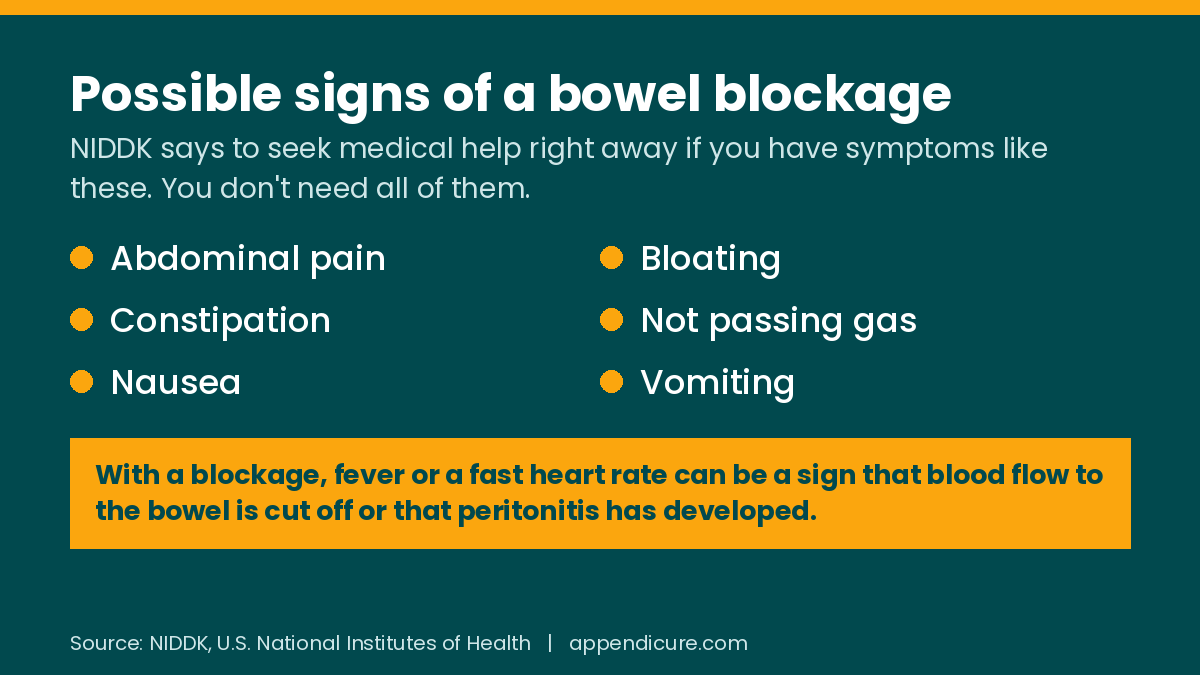
NIDDK lists abdominal pain, bloating, constipation, not passing gas, nausea, and vomiting as possible symptoms of a bowel blockage, and says to seek medical help right away if you have them. You don’t need to wait until you have all of them. Pain while you’re passing no stool or gas can be a sign of a complete blockage. NIDDK also says a fast heart rate or fever can develop if a blockage cuts off blood flow to part of the bowel or leads to peritonitis, an infection of the lining of the abdomen. The National Cancer Institute says bowel obstructions can be life-threatening and require immediate medical attention.
What these studies don’t answer
None of these studies looked only at appendix cancer. The abstracts of the two blockage studies don’t give enough detail to estimate the risk for each appendix tumor subtype, and the Danish study grouped appendix cancers other than PMP together. The blockage studies counted hospital readmissions, so they miss episodes managed at home. These studies document bowel problems after CRS/HIPEC. They don’t show what causes any one person’s episodes of pain, whether an episode means the cancer has come back, or whether the surgery or the heated chemotherapy is responsible. I read the full Danish paper and the abstracts of the two blockage studies.
Frequently asked questions
Can adhesions cause abdominal pain after HIPEC years later?
They can. NIDDK says symptoms from surgical adhesions can start any time after surgery, even many years later.
Will a CT scan show adhesions?
Usually not. NIDDK says imaging tests most often cannot show adhesions, but a CT scan can show a blockage and help find its cause.
Does abdominal pain after HIPEC mean the cancer is back?
Not necessarily. Adhesions and cancer can both cause blockages, and only your treating team can work out the cause in your case.
Bringing information together from patients across hospitals and countries can help researchers study questions that individual centers struggle to answer. The Appendicure Patient-Led Global Appendix Cancer Registry collects pathology, tumor mutation, and treatment information from patients around the world. It’s IRB-reviewed and free to join.
Join the Registry: United States Join the Registry: International
Already enrolled? Add new reports or correct your record here.
Read More
Bowel Obstruction After HIPEC: What Research Shows and What Patients Experience
Living With a Fistula After CRS/HIPEC: What Helps While It Heals
Were you scanned while the pain was happening? Yes or no.
Appendicure is a 501(c)(3) nonprofit. If this was useful, you can support Appendicure’s work here.
Sources
Mor E, et al. Natural History and Management of Small-Bowel Obstruction in Patients After Cytoreductive Surgery and Intraperitoneal Chemotherapy. Annals of Surgical Oncology, 2022. Read the study
Jedrzejko N, et al. Predictors of Small Bowel Obstruction Post-Cytoreductive Surgery and Hyperthermic Intraperitoneal Chemotherapy. Journal of Gastrointestinal Surgery, 2022. Read the study
Ravn S, Grønfeldt JM, Thaysen HV, Iversen LH. The impact of the extent of surgery on late adverse effects following cytoreductive surgery and HIPEC. European Journal of Surgical Oncology, 2024. Read the full study
National Institute of Diabetes and Digestive and Kidney Diseases. Abdominal Adhesions. Read the page
National Cancer Institute. Bowel Obstruction and Cancer Treatment. Read the page
This post is for education and doesn’t replace advice from your own medical team.
Leave a Reply