A new MD Anderson study answers real appendix cancer fertility questions for young women. It found the disease had already reached the ovaries in most patients who needed major surgery, that preoperative CT scans often failed to detect it, and that fertility discussions should happen before cytoreductive surgery whenever possible.
A woman in the community asked me a simple question last week. She has appendix cancer, she is young, and she wants to know if she can still have children. I went looking for answers and found almost nothing written for patients. So when this study came out, I read all of it. What follows is what it actually says.
What the appendix cancer fertility study looked at
Doctors at MD Anderson reviewed the records of 100 women between the ages of 18 and 45 who were treated for appendix cancer between 2020 and 2025. Their focus was the 47 women who went on to have cytoreductive surgery, the long operation that removes cancer from the belly. Most of these women had advanced disease. The question was how often the cancer had already spread to the ovaries, and what that means for women who still hope to have children.
How often appendix cancer spread to the ovaries
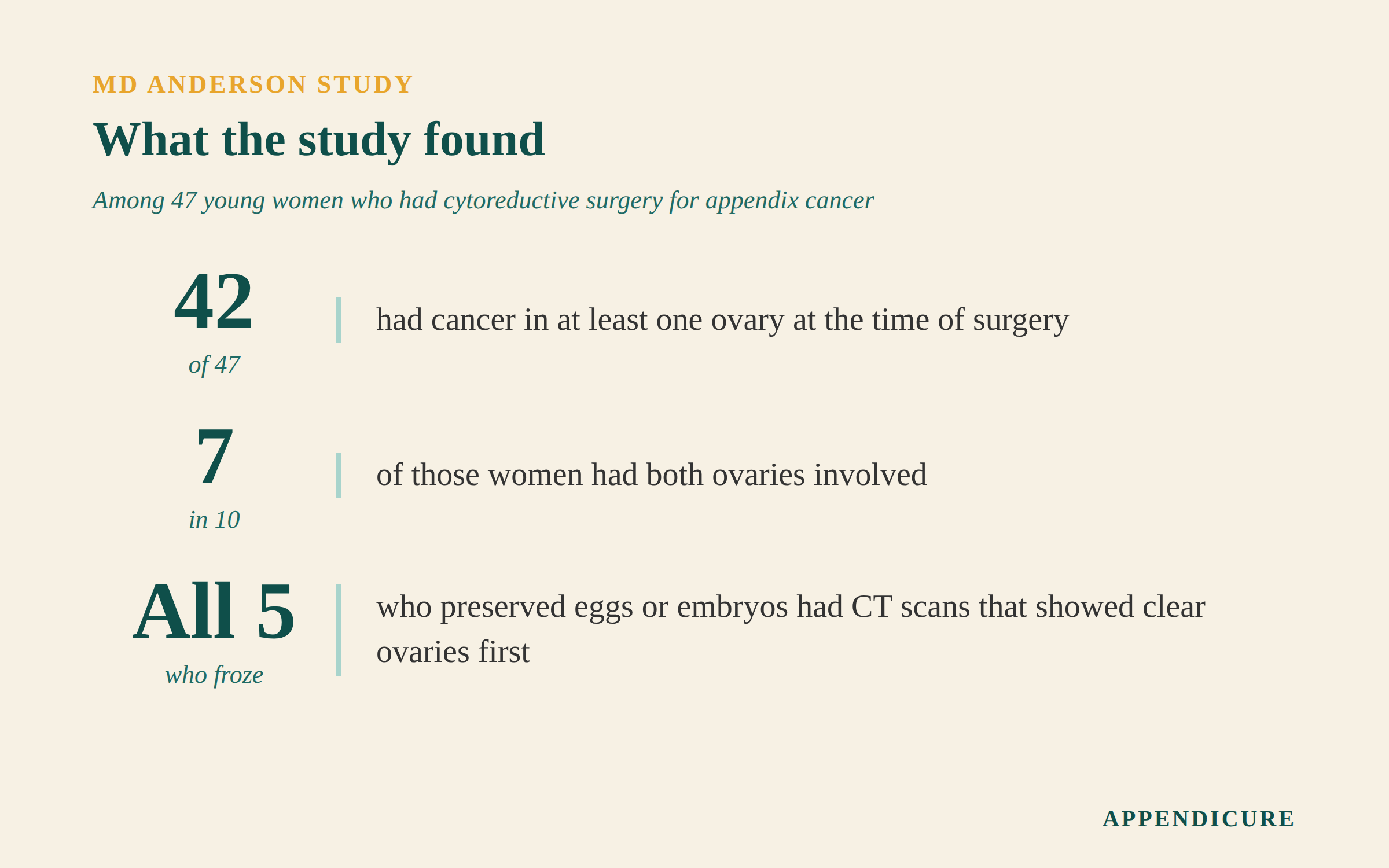
Out of the 47 women who had this surgery, 42 had cancer in at least one ovary. That is close to 9 in 10. This does not mean that 89% of all women with appendix cancer have ovarian spread. These were women selected for cytoreductive surgery because they already had advanced disease throughout the abdominal cavity. Most of these metastases involved both ovaries rather than just one, which is part of what makes fertility preservation so complex in this group.
In almost every case, the disease was visible on the ovary during surgery. Nearly all of these women had Stage 4 disease.
Ovarian involvement was not limited to one subtype. It turned up in low-grade mucinous tumors, in goblet cell and signet ring cancers, and in mucinous adenocarcinoma. Some of these groups were very small, so the exact percentages deserve caution. The overall pattern was consistent.
Why a normal CT scan can miss ovarian spread
Five women in the study froze their eggs or embryos before surgery. Every one of them had a CT scan first that showed normal ovaries. In surgery, most were found to have appendix cancer involving the ovaries after all, and three of the five had it confirmed under the microscope.
The findings suggest ovarian disease may be present even when it sits below what a CT scan can detect. A normal CT scan cannot completely rule out ovarian involvement.
What this number does not mean
It is worth saying again. The near 9-in-10 rate describes women who were sick enough to need cytoreductive surgery, and almost all of them had advanced disease. If you have a low-grade tumor that does not need that operation, these numbers do not describe you. The study also left out the carcinoid and neuroendocrine tumors that usually do not need this surgery. Your situation is your own, and your care team knows its details.
There is good news in the study too. One woman who froze her eggs later got pregnant on her own and delivered a healthy, full-term baby. None of the women who had their eggs retrieved had complications from the procedure. Freezing eggs is not a promise of a baby, but it can keep a door open, and for the right person that door is worth keeping open.
What I would tell a young woman who was just diagnosed
If you want children someday, ask for a fertility referral before your surgery is scheduled. Ask for an oncofertility specialist, and ask early, because freezing eggs or embryos typically takes about 10 to 14 days. Bring your partner or a support person to that talk, because it is a lot to absorb alone. Go in knowing the hard part of this study too. If the cancer has already reached your ovaries, some fertility options may carry added risk, so this is a decision to make with your doctors, with honest numbers in front of you.
I am not a doctor. I am a caregiver and an advocate, and I started Appendicure because research like this almost never reaches the people it is about. If this raises questions, bring the paper to your next appointment. Fertility deserves to be part of the conversation before surgery, not an afterthought.
Common questions
Does appendix cancer spread to the ovaries?
It can. In this 2026 MD Anderson study of young women who needed cytoreductive surgery, 42 of 47 had cancer in at least one ovary. Most had advanced disease, so this rate does not apply to every appendix cancer patient.
Can I still freeze my eggs if I have appendix cancer?
Often yes, and no complications were reported in the study’s egg retrievals. If the cancer has reached the ovaries, some fertility options carry added risk. Talk to an oncofertility specialist before surgery.
Will a CT scan show if the cancer is in my ovaries?
Not always. In the study, all five women who froze eggs had normal CT scans, yet most were later found to have appendix cancer involving the ovaries during surgery.
When should I ask about fertility preservation?
Before your cytoreductive surgery, and as early as you can. Freezing eggs or embryos usually takes about 10 to 14 days.
Help build the answers
Studies like this are small because appendix cancer data is scattered. The Patient-Led Global Appendix Cancer Registry changes that. It is open to patients everywhere, and every entry helps researchers ask better questions.
Source: Bou Zerdan M, Hmaidan S, Ciomperlik H, et al. Incidence of Ovarian Metastases in Reproductive-Aged Women with Appendiceal Cancer: Implications for Fertility Preservation. Annals of Surgical Oncology. Published online July 30, 2026. doi:10.1245/s10434-026-20315-x. This article is for education and is not medical advice. Talk with your own care team about your situation.
Amy Moeller was diagnosed with appendix cancer at 38 and lived well for eleven years before an appendix cancer recurrence showed up on a routine colonoscopy. She is now on a CDK4/6 inhibitor called Ibrance, and she is doing well again.
About a year ago, I typed appendix cancer into the LinkedIn search bar, and Amy popped up. I could not tell you exactly what made me message a stranger that day. But when someone has even heard of this cancer, I want to know them. Amy wrote back, and that was that.
We are the same age. Our careers have run through the same industry. By the end of the first conversation I felt like I had known her for years. She is easy to like, and she is easy to trust, which counts for a lot when the subject is the hardest thing that ever happened to you.
Amy lives all the way across the country from me, out in Orange County, California, and I wish she lived closer. When she sat down to tell me her story, one line stayed with me. She said appendix cancer is a marathon, not a sprint. After you hear what she has been through, you will understand exactly what she means.
Amy is the third appendix cancer patient I have interviewed who is doing better on a CDK4/6 inhibitor. Jeremy has been on Ibrance for almost ten years. Connie shared her story too. Their diagnoses are not identical, but the same kind of targeted drug has helped all three.
Amy talks about her cancer in three acts, including an appendix cancer recurrence eleven years after she was first diagnosed. You can watch our full conversation below, and here is her story in her words as much as I can keep it.
Act one: a tumor the size of a volleyball
In 2012, Amy was 38 and living in San Francisco. Her life was full. She had a good career, she traveled, and she had been an athlete her whole life, including Division I college volleyball. She had no real symptoms. One morning she woke up and her stomach looked bloated, before any coffee or water. Something told her to call a doctor.
She thought she had celiac disease, since she was living in the Italian part of the city and eating a lot of pasta. The doctor felt her abdomen, and within minutes he sent her to the emergency room. She drove herself. They admitted her, and the next day, surrounded by doctors, she was asked if she wanted the good news or the bad news first. The good news was that whatever was growing inside her was slow growing. The bad news was a tumor in her abdomen the size of a volleyball. For a college volleyball player, that detail is hard to forget.
Her parents flew up, and the family moved her care to Southern California. The first surgery, in June 2012, was exploratory. Surgeons removed the tumor and performed a full hysterectomy, and the pathology finally had an answer. It was coming from her appendix. It was pseudomyxoma peritonei, a rare mucinous cancer that starts in the appendix and spreads through the abdomen. At that point Amy and her family knew nothing about HIPEC or cytoreductive surgery. Nobody in that room had heard of any of it.
Three months later, a scan showed they had not gotten it all. The family had already done their homework. They looked at UCI, UC San Diego, and MD Anderson. Stanford and UCSF did not treat it at the time. Every road led to Dr. Andrew Lowy at UC San Diego. In November 2012, Amy had cytoreductive surgery with HIPEC, the heated chemotherapy delivered right to the abdomen. Surgeons also removed her gallbladder and spleen and repaired her small bowel. She was walking the day after surgery, because Dr. Lowy told her the best thing she could do was move. She took that to heart, and she still lives by it.
The gap that let an appendix cancer recurrence hide
After the second surgery, Amy was monitored for about five years. Then her doctors cleared her and put her on what they called an as-symptom basis. No routine scans. Just watch for symptoms. She felt great, and she trusted the people who had trained for years to take care of her. That is what most of us do.
Looking back, both of us know that plan was wrong. This is a cancer that can grow slowly and quietly for years with no symptoms at all. Amy had none. Today, many appendix cancer specialists recommend long-term, and often lifelong, surveillance because recurrence can happen many years after treatment. She is honest that the center monitoring her did not treat this cancer and was not prepared for it. That gap is exactly why asking questions and staying under a specialist matters so much. Amy’s experience shows how recurrent appendix cancer can stay silent for years before a routine test finds it.
Act two: it came back
Eleven years after her first diagnosis, in 2023, Amy went in for a routine colonoscopy around her fiftieth birthday. She had no symptoms. The doctors could not pass the scope through her sigmoid colon because of a severe narrowing caused by pressure from outside the colon. They sent her for a CT scan a couple of days later. The scan showed the same disease from 2012. This was her appendix cancer recurrence, and it arrived with no symptoms at all.
She called Dr. Lowy’s office that same day. He was about to leave for a conference in Europe, and he told her she had called at the right time, because he could get her in quickly. She had surgery on Halloween of 2023. It was another cytoreductive surgery. The team had HIPEC ready, but once they were inside, the tumors were in a location, low in the pelvis, where the heated chemo would not have been effective, so she did not qualify for it that time. She recovered quickly, faster than she expected, partly because she knew the drill by then.
About six months later she started FOLFOX chemotherapy and completed twelve rounds. That is more than a lot of people can tolerate. On the final round she had a reaction, coughing and struggling to breathe, and the team treated it quickly. She did her chemo at a USC cancer center five minutes from her home, overlooking the ocean. Her advice from that stretch is simple and practical. Do your chemo as close to home as you can, because the last thing you want after an infusion is a long drive and traffic.
Act three: why she is on a CDK4/6 inhibitor now
After chemo, three of her doctors came together on a plan: Dr. Lowy at UC San Diego, Dr. Gregory Botta at UC San Diego, and Dr. Louis Vandermolen at USC. There was still mucinous disease low in her pelvis that surgery could not safely remove. Taking it all would likely have cost her more of her colon and possibly a colostomy, a trade that would have changed her daily life. So the goal shifted. Keep the remaining disease from growing.
The drug they chose was Ibrance, also called palbociclib. It belongs to a class of targeted drugs called CDK4/6 inhibitors. Some appendix cancer specialists prescribe CDK4/6 inhibitors off-label for carefully selected patients whose tumor biology suggests they may benefit. Off-label means the choice comes from a patient’s own testing and disease, not from an approval written specifically for appendix cancer. Amy takes it as a pill, 21 days on and 7 days off. She gets bloodwork every month and sees her San Diego oncologist every three months over Zoom, so she does not have to drive down each time.
Her tumor marker, called CEA, had been sitting around 11 or 12 after chemotherapy and on Ibrance. At a recent appointment it had come down to 8.4. Amy is careful and honest about what that means. She does not claim to know exactly what is driving it. It could be the surgery, the drug, or the other things she is doing for her health. What she knows is that she has not missed a day of Ibrance, her numbers are moving in the right direction, and she feels good.
One honest note. Amy’s cancer is pseudomyxoma peritonei, a mucinous appendiceal cancer, and her plan was built around her disease and her tumor testing. A CDK4/6 inhibitor is not right for every appendix cancer or every subtype, whether that is goblet cell, signet ring, or a high-grade adenocarcinoma. What worked for Amy is Amy’s plan. If you are facing this, ask your own specialist about molecular testing and whether a targeted drug fits you.
How Amy takes care of Amy
The medical plan is only part of how Amy stays well. After so many surgeries, losing her gallbladder, spleen, and uterus, she was living with real stomach and digestive problems. She started seeing an integrative practitioner who ran a full blood panel and looked at things her cancer team does not focus on, like inflammation and hormones. She got her vitamins and minerals sorted out, added a gallbladder supplement that helps her digest fatty foods, and started progesterone, which her gynecologist had not given her. Since then she sleeps eight hours a night, uninterrupted, instead of waking at three in the morning.
She is clear that this is not a knock on her cancer doctors. Vitamins and hormones are simply out of their scope. Their job is her cancer. Getting the rest of her body in balance was her job, with the right help, and it changed how she feels every day. She calls it a holistic approach, and she says the physical part feeds the mental part. When her gut feels better, her mind feels better.
The other piece is quieter. When the recurrence hit in 2023, a colleague mentioned meditation almost in passing. Breathing exercises while fighting cancer sounded almost insulting to Amy at first. She tried it anyway. Five minutes, sometimes ten, often from her bed wrapped in blankets with tears sliding down her cheeks. It did not fix anything, but for a few moments it softened everything. Over time it became her anchor during treatment and her refuge on sleepless nights. In her own words, a thought is not a prophecy, and fear is not fate. Meditation did not cure her cancer, but it healed parts of her that medicine alone could not.
What Amy wants you to know
People ask Amy all the time if she is in remission. Her honest answer is that she is not sure anyone with this cancer is ever fully in remission. She thought she was once, and she was not. She has come to treat it as something she will watch for the rest of her life. That is the marathon she means. It is not a race you finish. It is a pace you keep.
Her biggest message is to be your own advocate. Ask the hard questions. Use tools like AI to help you write down good questions before an appointment, then bring them to your doctor. You do not know what you do not know, and neither did she at 38. The more you engage, the more you get. As she puts it, we are the client in that room, and we have every right to ask.
There is one more reason I wanted Amy’s story out in the world, along with Jeremy’s and Connie’s. All three have been on a CDK4/6 inhibitor called Ibrance to help keep their disease under control. Yet today, many appendix cancer patients who may be candidates for these same drugs are still denied coverage because the drugs are used off-label. Those denials continue even though specialists at several major appendix cancer centers prescribe them for carefully selected patients. Stories like Amy’s matter because they show what access can mean for a real patient.
Amy, thank you. For your honesty, for your grace, and for showing what it looks like to keep going.
Amanda
How you can help
Amy’s story is one reason the registry matters. One center by itself cannot prove which treatments are working. Many centers together can. The Appendicure Patient-Led Data Registry is built to gather that proof, both to advance research and to help get drugs like the one keeping Amy well covered and approved. If you are a patient or caregiver, adding your voice is the most useful thing you can do.
Add your voice to the registry
If you are a patient or caregiver, please add your voice. The registry is IRB-approved with exempt status. Choose the link for where you live.
Yes. Amy had an appendix cancer recurrence eleven years after her first diagnosis, found on a routine colonoscopy with no symptoms. That is why ongoing surveillance with a specialist matters, even after you are cleared.
What is Ibrance and how does Amy take it?
Ibrance (palbociclib) is a targeted drug called a CDK4/6 inhibitor. Amy takes it as a pill, 21 days on and 7 days off, to keep her remaining disease from growing.
Does a CDK4/6 inhibitor work for every appendix cancer?
No. It fit Amy’s disease and tumor testing. It is not right for every subtype. The only way to know is testing of your own tumor, so ask your specialist.
Short answer: Prehab before surgery means getting your body and mind ready in the weeks before a big operation. For appendix cancer patients facing cytoreductive surgery with HIPEC, that preparation is linked to fewer complications and an easier recovery.
So many people spend the days before surgery just waiting. Waiting for the date, the scans, the plan. I hear from members all the time who feel like there is nothing to do but sit and worry. There is something to do. It has a name, and there is good research behind it.
What prehab before surgery actually means
Prehab is short for prehabilitation. Rehab helps you recover after an operation. Prehab helps you get ready before it. Think of it the way an athlete trains for a race. You build up your strength and your reserves ahead of time so your body can handle a hard day. Cytoreductive surgery with HIPEC is one of the hardest days a body can face. It can last many hours and touches many organs. Walking into it stronger gives you more to draw on.
Prehab is not a treatment for the cancer. It does not shrink tumors and it does not replace surgery, chemo, or HIPEC. It gets you to the operating room in better shape. The exact operation, and even the nutrition problems that come with it, can differ by tumor subtype, whether that is a LAMN, high grade or goblet cell adenocarcinoma, or signet ring. The operation is still a major physical event, and the same principles of preparation appear to help regardless of tumor subtype.
What the research shows
The evidence for prehab before surgery keeps getting stronger. A 2025 study called SCODA followed 169 people getting cytoreductive surgery. The program was simple. Patients walked a little more each day, ate more protein, and took iron to fix low blood counts before the operation. The group that did prehab had far fewer lung complications, fewer serious problems after surgery, and needed fewer blood transfusions. They also spent significantly less time in intensive care. That study included people with pseudomyxoma peritonei, the slow spreading disease many in the appendix cancer community know well.
The pattern holds in bigger reviews too. When researchers pooled ten studies of major abdominal surgery, over 1,500 patients in all, the people who did prehab had fewer lung complications. When exercise was part of the plan, they left the hospital about a day sooner. The recovery programs that many HIPEC centers follow, known as ERAS, now build in this kind of preparation on purpose.
An honest note. Most prehab research covers mixed groups of cancer surgeries, not appendix cancer on its own. The signal is consistent and the steps are safe, but the appendix-specific data is still thin. The 2025 international consensus recommendations led by Godfrey guide how the cancer itself is treated, and prehab sits alongside that, not in place of it.
The four parts of prehab before surgery
1. Move
You do not need a gym. Daily walking is the backbone of almost every prehab program. Start where you are and add a few minutes each week. If you can, add light strength work, like standing up from a chair or lifting small weights. Breathing exercises help your lungs get ready for the anesthesia. Ask your team about a simple breathing device called an incentive spirometer.
2. Fuel
Surgery breaks down muscle, so you want to build a store of it first. That means more protein than you might expect, spread across the day. A registered dietitian can give you a target based on your weight. Just as important, ask your team to check your iron and blood counts. Low iron is common with this disease. The prehab group in the research needed fewer blood transfusions, and their program included finding and treating iron deficiency before surgery. Do not start supplements on your own. Let your care team guide the dose.
3. Steady
Stress and poor sleep make recovery harder. Simple tools help. Short breathing practice, gentle stretching, and a steady sleep schedule all count. Knowing what to expect helps too. Ask your surgeon to walk you through the day of surgery and the first week after. Fear of the unknown is heavy, and information lightens it. The Appendicure community is here for this part. You are not doing it alone.
4. Quit
If you smoke, stopping even a few weeks before surgery lowers your risk of lung and wound problems. It is one of the highest value things you can do. Cutting back on alcohol in the weeks ahead helps your body heal too. Your team can point you to support if quitting feels out of reach on your own.
A simple timeline
Most programs run four to six weeks, but even two weeks helps. A rough plan looks like this:
As soon as you have a date: tell your care team you want to prehab and ask who can help, such as a dietitian or physical therapist.
Weeks out: build a daily walk, raise your protein, and get your iron and blood counts checked.
Final week: keep moving gently, rest well, and go over the plan for the day of surgery so nothing feels like a surprise.
None of this is about being perfect. It is about showing up to a hard day with a little more in the tank. Prehab before surgery gives you a way to act during a time that can feel out of your hands, and the science says it is worth doing.
Help move appendix cancer research forward
The Patient-Led Global Appendix Cancer Registry gathers the pathology, genomics, and treatment details that researchers need and that no one else is collecting at scale. If you or a loved one has appendix cancer, adding your data helps the whole community. It takes a few minutes.
Prehab before surgery is preparing your body and mind in the weeks before an operation, using exercise, better nutrition, stress and sleep support, and quitting smoking. The goal is to lower your risk of complications and recover faster.
Does prehab help before CRS and HIPEC?
Research on major abdominal surgery, including one study that enrolled pseudomyxoma peritonei patients, links prehab to fewer lung complications, fewer transfusions, and shorter intensive care stays. Many HIPEC centers now build preparation into their recovery programs.
How long before surgery should I start?
Four to six weeks is common, but even two weeks helps. Start as soon as you have a surgery date, and ask your care team who can support you.
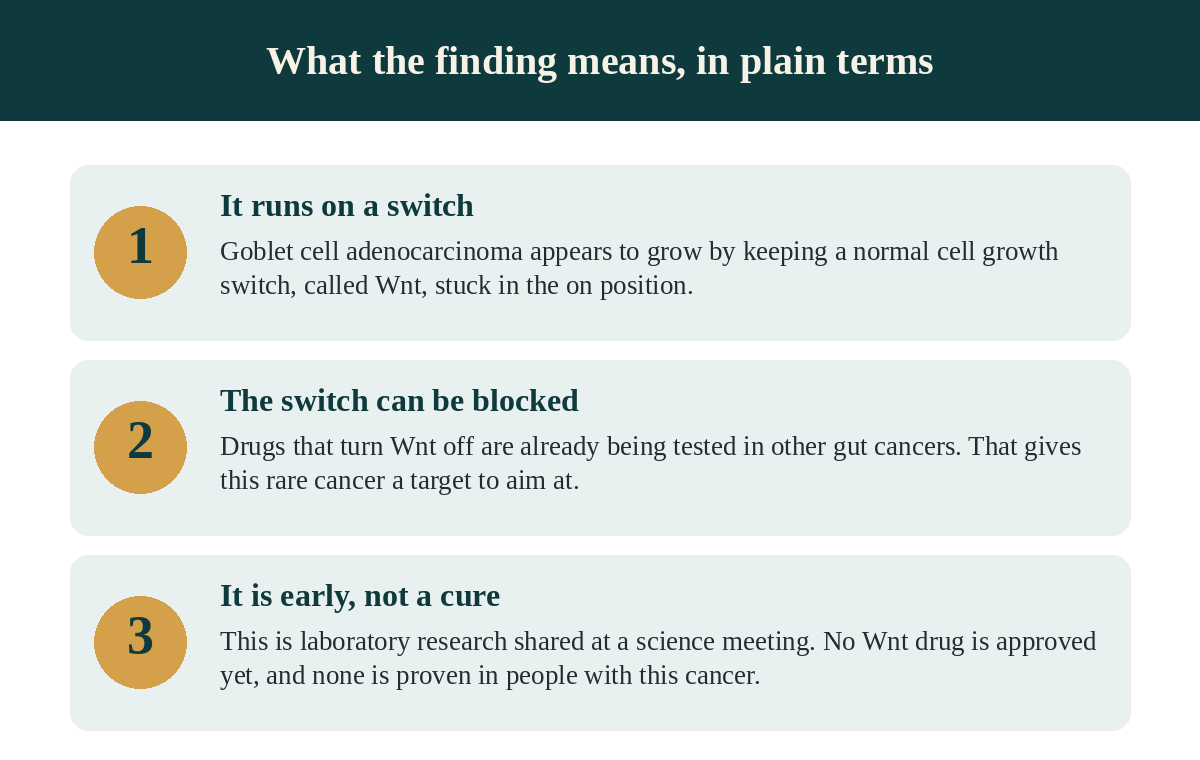
Researchers have identified the LGR5/Wnt pathway as a possible treatment target in goblet cell adenocarcinoma, a rare appendix cancer. The finding comes from a 2026 Cancer Research conference abstract that analyzed these tumors’ genes and gene activity. No drug was tested in patients.
I hear from families who are told there is no targeted treatment for this cancer. I also live it. My husband has appendix cancer, and if it ever comes back, there is no targeted treatment waiting for him. That is why I started Appendicure, and it is why I read a finding like this one so closely.
So when researchers pointed to a possible target in goblet cell adenocarcinoma, one of the rarest of appendix cancer subtypes, I wanted to share it, along with an honest picture of how early this is.
A rare cancer with few options
Goblet cell adenocarcinoma is a rare and aggressive appendix cancer. It has no approved targeted therapy, and the mutations that direct targeted treatment in other cancers, such as BRAF, HER2, and NTRK, are uncommon in it. In the mucinous appendix cancers, KRAS and GNAS mutations drive much of the disease, and patients often learn to know those words. Goblet cell adenocarcinoma runs on a different biology, and KRAS and APC changes are less common in it. Most patients are left with broad chemotherapy. That is why a finding specific to this subtype is worth attention. You can read more about where it fits among the types of appendix cancer.
What the study found
Wnt is a signaling pathway that helps run normal intestinal stem cells and tissue renewal. LGR5 is a marker linked to intestinal stem-like cells that can strengthen Wnt-related signaling. In this study, researchers compared gene-activity data from goblet cell adenocarcinoma with other appendiceal cancers and with colorectal cancers. They found high LGR5 and Wnt pathway activity, even though the usual Wnt mutations, such as APC and CTNNB1, were rare.
That is an interesting clue. It suggests these tumors may rely on Wnt-related biology without following the mutation pattern seen in colorectal cancer. It does not prove that the tumors depend on the pathway. Showing that would take laboratory studies that have not been done yet. Wnt-related changes had already been noted as characteristic of this subtype. What is newer here is the detailed pathway signal and the immune picture.
It helps to know exactly what this was. It is a conference abstract that analyzed tumor genetics and gene activity and examined the tumor’s immune environment. The researchers did not treat goblet cell cells, animals, or patients with a Wnt drug. The work was led by researchers including Dr. John Paul Shen at MD Anderson.
Why a possible target matters
Because goblet cell adenocarcinoma has so few options, even a possible target is meaningful. Several experimental drugs are being developed to interfere with Wnt signaling or to target LGR5-positive cells, including porcupine inhibitors, receptor-level agents, downstream inhibitors, and antibody-based approaches. They are not interchangeable, and none has been established as a treatment for this cancer. Wnt has also been hard to drug, because it is important in normal gut, bone, and stem-cell biology.
There is related work worth knowing. In a separate appendiceal cancer organoid study from Memorial Sloan Kettering, part of the appendiceal cancer research effort there that includes Dr. Michael Foote, a Wnt inhibitor called WNTinib showed activity in laboratory models made from appendiceal adenocarcinoma. I wrote about it in my post on lab-grown appendix cancer organoids. Those models were not goblet cell tumors, so this does not tell us whether goblet cell adenocarcinoma will respond. It does show that Wnt-directed treatment can be tested in appendiceal cancer laboratory models.
The immune picture
The same analysis found these tumors had relatively few immune cells inside them, an immune-excluded pattern. In other cancers, Wnt signaling has been linked to keeping immune cells out. That may help explain why standard immune checkpoint drugs have not shown an established benefit for most goblet cell patients, especially when tumors are microsatellite stable. Rare tumors that are MSI-high or mismatch-repair-deficient can behave differently. Whether blocking Wnt could make these tumors more open to immune treatment is a question researchers still need to test.
A pattern worth knowing
It is fair to ask how long this kind of work takes. Cancer research has a pattern that gives me hope. Hard targets tend to fall in a chain, and each one makes the next feel possible.
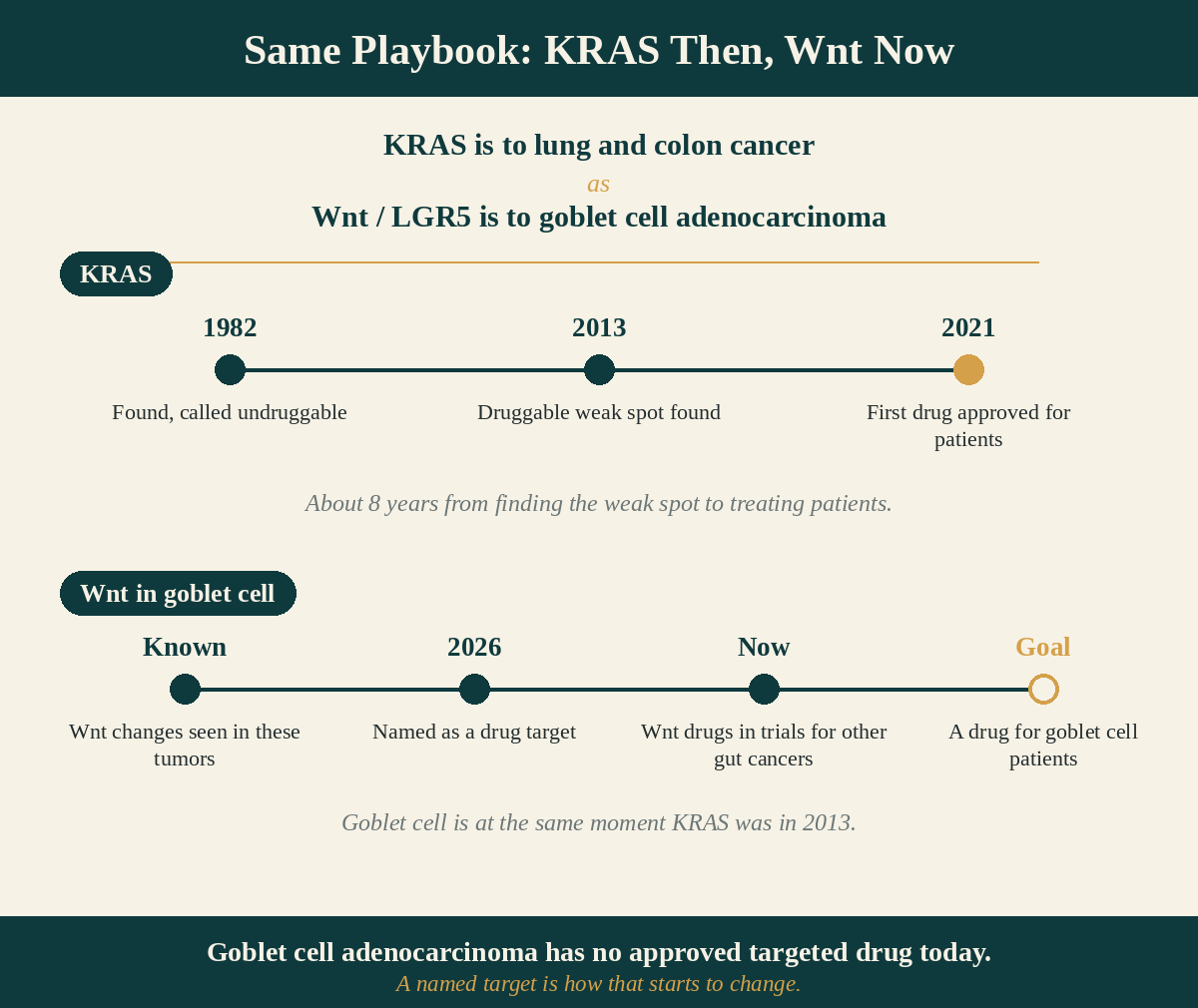
In 2001, a drug called imatinib, sold as Gleevec, showed that aiming at a single driver protein could change a cancer. It turned chronic myeloid leukemia, once often fatal, into a disease many people live with for years. It proved that targeted therapy was possible at all.
That proof is part of why researchers kept working on KRAS, a common cancer gene that was called undruggable for about 40 years. In 2013 they found a pocket on one mutant form of KRAS, and the first KRAS drug was approved in 2021.
The goblet cell finding sits one step earlier again. It is to KRAS what KRAS once was to imatinib, a newer and less proven lead on the same long road. Imatinib helped make KRAS feel possible. KRAS helps make a target like this one feel possible.
The comparison has limits, though. Imatinib and the KRAS drugs each aim at one specific protein. The goblet cell finding is activity across a broad signaling pathway with many parts and normal functions, so it sits at a much earlier and different point. This history cannot predict how quickly a goblet cell treatment might develop. What it shows is that targets once thought hopeless can eventually become treatments.
Researchers do have tools now that were not available during the early decades of KRAS work, including large genomic datasets, organoid models, and AI-assisted drug discovery. These may help test ideas faster, but clinical development still needs laboratory validation and carefully designed trials. I write about that on our data registry and AI page.
What this does and does not mean
This is an early, subtype-specific hypothesis, not a treatment anyone can receive today. It is a conference abstract, and the pathway finding still needs laboratory and clinical work.
It also applies only to goblet cell adenocarcinoma. It does not automatically apply to low grade appendiceal mucinous neoplasms, high grade appendiceal mucinous neoplasms, mucinous or non-mucinous appendiceal adenocarcinomas, tumors with signet ring cell features, or appendiceal neuroendocrine tumors. Those are different diagnoses with different biology.
If you take one word from this, let it be Wnt. Patients with the mucinous appendix cancers learn to know KRAS and GNAS. Patients with lung or pancreatic cancer learn their exact KRAS variant, like G12C or G12D. For goblet cell adenocarcinoma, Wnt, along with the marker LGR5, is the word to follow. There is no Wnt test to demand today, and no Wnt drug for this cancer yet. But it is the lead most likely to matter for this subtype, and knowing it helps you follow the research and ask good questions.
What patients can do now
This research does not change the standard treatment for goblet cell adenocarcinoma today. It does support a few reasonable steps.
Ask whether comprehensive tumor profiling is appropriate. Testing may find an uncommon actionable change or help match you to a future trial.
Ask whether both DNA and RNA profiling are available. The Wnt signal in this study came mostly from gene-activity (RNA) analysis, which is not part of every routine tumor test.
Confirm that enough tumor tissue remains for future testing. Your hospital’s pathology department can explain how long tissue is kept.
Consider a second opinion at a center experienced in appendiceal cancers, especially for advanced or recurrent disease.
Ask whether any early-phase solid-tumor trials studying Wnt or LGR5-directed therapy accept appendiceal cancers. Eligibility depends on the specific trial.
Consider adding your clinical, pathology, and molecular information to a research registry. Better data helps researchers find biomarkers, estimate how many patients might qualify, and judge whether a goblet cell trial is feasible.
Free tools to download and share
I made a few things to help. They are free to download, print, and share.
Questions to bring to your appointment
A fill-in sheet with the questions that matter most for goblet cell adenocarcinoma, with space to write your care team’s answers.
Appendicure runs a patient research registry focused on the molecular, genomic, and pathology details of appendix cancer. Better patient-level data helps researchers identify biomarkers, estimate the affected population, and judge whether a goblet cell trial is feasible. It is free, and it is open to patients around the world.
Goblet cell adenocarcinoma is a rare and aggressive type of appendix cancer. It shows features of two cell types at once, which makes it harder to treat than more common cancers, and it has no approved targeted therapy.
What did the 2026 study find?
Researchers analyzed the genes and gene activity of goblet cell tumors. They found a strong LGR5 and Wnt pathway signal and an immune-excluded environment, and they suggested that Wnt-directed treatment deserves more study. They did not test a drug in patients, animals, or goblet cell tumors.
Is there a targeted treatment for goblet cell adenocarcinoma yet?
No. As of 2026, no Wnt or LGR5 drug is approved or proven for it. This is an early research hypothesis, not a treatment you can get today.
What can patients do now?
Ask about comprehensive DNA and RNA tumor profiling if it is appropriate, make sure enough tissue is kept for future testing, consider a second opinion at a center experienced in appendiceal cancers, ask about relevant early-phase trials, and consider joining a research registry.
Research like this depends on funding and shared data. If it matters to you, you can support Appendicure here. Thank you.
Sources
El Khoury S, Chowdhury S, Ito I, Shen JP. Goblet cell appendiceal adenocarcinoma is a distinct disease entity defined by LGR5/Wnt-mediated oncogenesis driving an immune-excluded tumor microenvironment. Cancer Research, 2026 (AACR Abstract A039). Read the abstract.
Appendiceal cancer organoid biobank identifying WNTinib and RAS-directed activity in appendiceal adenocarcinoma models. Developmental Cell, 2026 (Memorial Sloan Kettering).
WHO Classification of Digestive System Tumours, 5th edition, 2019. Ostrem JM et al., Nature, 2013 (KRAS G12C pocket). FDA approval of imatinib (Gleevec) for chronic myeloid leukemia, 2001. FDA approval of sotorasib, 2021. KRAS and GNAS mutations in mucinous appendiceal neoplasms and pseudomyxoma peritonei; goblet cell adenocarcinoma is genetically distinct (Modern Pathology, 2017; appendiceal molecular classification, 2023). Peritoneal Surface Malignancies Consortium consensus (Godfrey et al.), Cancer, 2025.
Appendicure provides patient education and does not offer medical advice. Talk with your own care team about decisions related to testing and treatment.
A new lab study on RAS-driven cancers is getting attention, and it matters for appendix cancer research even though it did not test a single appendix tumor. The results look promising in mice, but they are early, and appendix cancer research still needs its own data before anyone can say what this means for patients.
A research team recently posted a new study about a smarter way to attack cancers that are driven by a gene pathway called RAS. Many appendix cancers carry changes in this same pathway, so the science caught my attention right away. I read the full paper. I want to share what it found, and I want to be honest about what it cannot answer yet.
What the study tried to fix
RAS works like a stuck gas pedal inside a cancer cell. It keeps telling the cell to grow. Doctors already have drugs that block parts of this pathway. The problem is that two of the strongest drugs cause bad side effects when they are used together. Patients often have to drop to lower doses, and lower doses do not work as well.
The team figured out why the side effects happen. When one of the drugs is added, it accidentally wakes up the same growth signal in healthy cells. That makes normal tissue too sensitive to the treatment, so the whole combination becomes hard to tolerate.
The new idea
Instead of the usual second drug, the team used a different kind of drug called a RAF/MEK glue. One of these is avutometinib, also known as VS-6766. It is already approved for a different cancer, a type of ovarian cancer, when it is paired with another drug.
The glue does something clever. It holds two proteins together inside the cell and keeps the growth signal away from the spot where it normally switches on. In healthy cells, it helps keep the signal from becoming fully activated. In cancer cells driven by RAS, the treatment still works.
When the team paired this glue with a RAF blocker called belvarafenib, the tumors in mice shrank a lot, and both drugs could be given at their full study doses. In one difficult lung cancer model, the older drug combination produced no objective tumor responses. The new combination produced objective responses in 9 of 10 tumors. The combination even stayed active in some cells that had stopped responding to newer RAS drugs.
Why this could matter for appendix cancer research
Many people with appendiceal adenocarcinoma carry a RAS change, most often in a gene called KRAS. Because this approach may work across several RAS mutations instead of just one specific mutation, it could eventually become relevant for more appendix cancer patients if future studies confirm it. That is a real reason to pay attention, and it is why I am writing about it.
What this study did not test
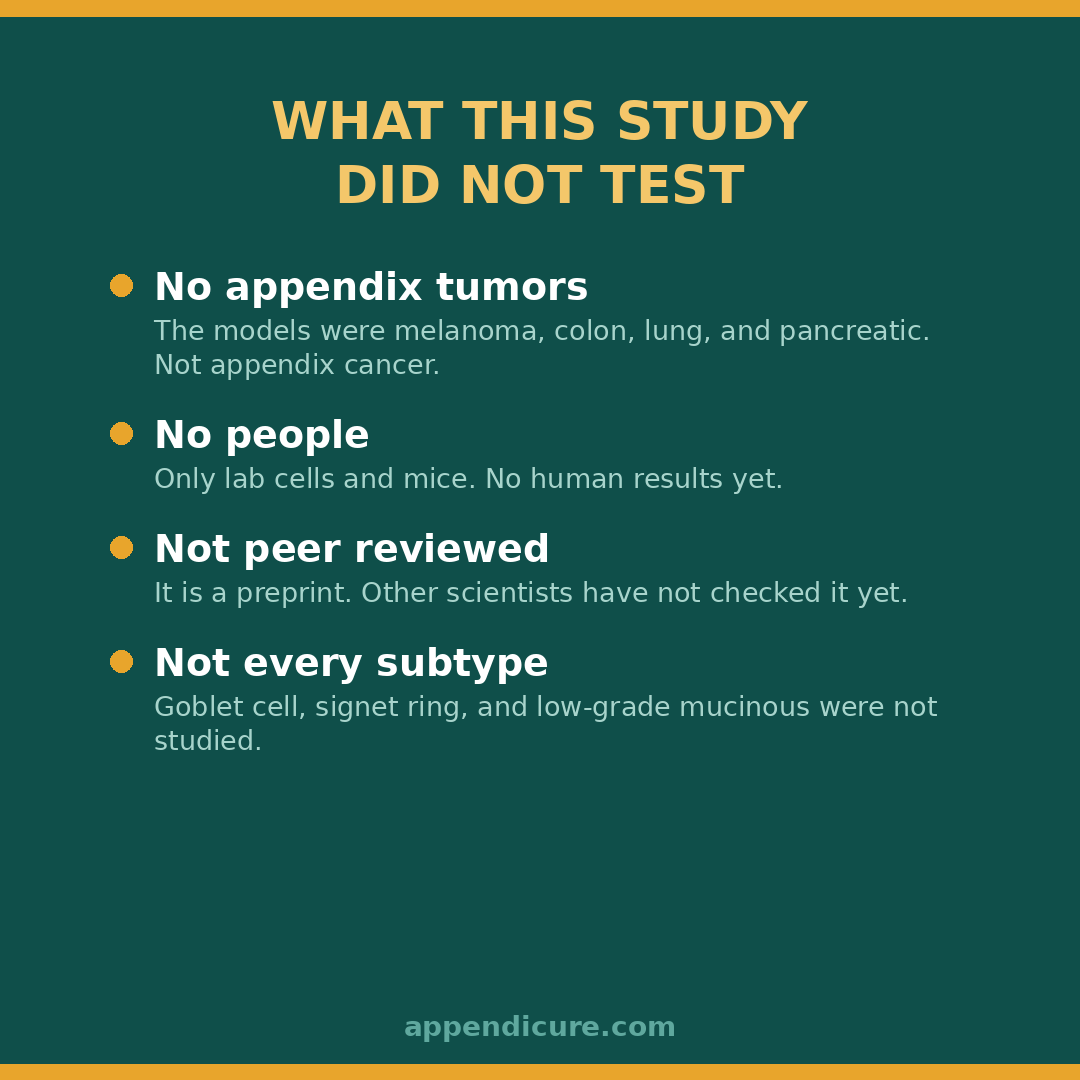
The study did not include a single appendix tumor. The models were melanoma, colon, lung, and pancreatic cancer. All of it was done in lab cells and in mice, not in people. It is a preprint, which means other scientists have not reviewed it yet. And it did not look at every kind of appendix cancer. Goblet cell, signet ring, and low-grade mucinous tumors were not part of it. Neuroendocrine and carcinoid tumors were not part of it either.
So this is promising science. It is not a treatment for appendix cancer, and it is not close to being one today.
Why more data is the whole point
This study is a good example of a bigger problem. Almost all appendix cancer research borrows from studies built on other cancers. Colon. Lung. Ovarian. Researchers assume appendix tumors behave the same way, because there is not enough appendix-specific data to know for sure. Sometimes that assumption is right. Sometimes it is not.
There just is not enough appendix cancer data yet. The field still does not know how often these RAS changes show up in each appendix cancer subtype, or whether certain patients respond differently. A lung cancer mouse study cannot answer that. Only appendix cancer patients can. That is exactly why the registry exists.
The Patient-Led Global Appendix Cancer Registry collects the molecular, genetic, and pathology details of real appendix cancer patients from around the world. That is the raw material real appendix cancer research runs on. The IRB approved the registry protocol, and it is exempt. Every person who joins makes the next study a little more likely to be about appendix cancer patients, and not a borrowed guess.
If you want promising science like this to reach appendix cancer patients, the registry is how the data gets built.
Joining takes a few minutes. Pick the form for where you live.
No. It is an early lab study in cells and mice. It did not test appendix tumors, and it has not been tried in people.
Does it apply to my type of appendix cancer?
Not yet. The study did not include goblet cell, signet ring, low-grade mucinous, neuroendocrine, or carcinoid tumors. It focused on RAS-driven cancers, not appendix cancer.
Why does it matter then?
Many appendiceal adenocarcinomas carry RAS changes, so the idea could be relevant one day. It needs to be tested in appendix cancer first.
What can I do to help?
Join the registry. More patient data is what turns promising science into real answers for appendix cancer.
This is an appendix cancer patient story about Jeremy Kitzhaber, a 22-year U.S. Air Force veteran from Idaho. He has taken a targeted drug called Ibrance (palbociclib) for almost 10 years, and he believes he was the first appendix cancer patient ever matched to it.
I recently sat down with Jeremy Kitzhaber from Idaho, and I have to tell you, he is a bit of a legend in this community. Jeremy is believed to be the very first appendix cancer patient identified for the targeted drug that so many of you now know by name. He has been on it for almost 10 years. If you have ever wondered whether these treatments actually work, Jeremy is your answer, sitting right in front of you.
You can watch our full conversation below, and here is his story in his own words, as much as I can keep it.
One appendix cancer patient story that starts with 22 years of service
Jeremy spent 22 years in the Air Force. He started as a civil engineer working on water, wastewater, and plumbing. He met his wife early, raised two boys, and finished his career as a First Sergeant at McConnell Air Force Base before moving back home to Idaho.
Jeremy during his 22 years in the U.S. Air Force.
Early on, he was put on a disaster-preparedness team and told to handle radiation samples during monthly drills. They handed the samples to him and had him carry them loose in his uniform pocket. No protective gear. No real training. He was told it was perfectly safe, and the sergeant’s only instruction was “just don’t lick them.” Years later he learned those materials were far more dangerous than he was told, the kind of radioactive sources no one should carry bare-handed in a pocket.
Less than two years after he retired, he was diagnosed. He was 43.
It was found almost by accident. He went to the VA for a minor bladder issue, they did a scan, and they saw something that should not be there. A CT scan looked like a burst appendix full of mucus. The tech told him to wait right there and left him lying in the machine, and Jeremy said he knew right then that could not be good.
Two general surgeons, each with about 25 years of experience, 50 years combined, had never seen anything like it. The pathology team needed five tries to name it. There was not one person in the entire VA system who treated this cancer. Jeremy and his doctors had never even heard of appendix cancer. If that sounds familiar, you are not alone.
When the first plan did not work
In Omaha, he found a specialist who took his military insurance and did the big surgery, cytoreduction and HIPEC. A piece near his diaphragm could not be removed, and three lymph nodes were positive. He was so weak afterward that he could not walk from the car to the cancer ward, so chemo had to wait. When chemo did start, his body could not tolerate it, and they stopped early. Within about 10 months, the cancer was back to where it had been before surgery.
He described chemo the way a lot of you have described it to me. “I felt like I was dying every day. I was being kept alive at best.”
When his Omaha doctor ran out of options, he did what the strongest patients I know always do. He refused to accept it. He sent his records across the country, to the East Coast, Texas, and California, and got turned down by some of the biggest names in this field. “Your cancer is too far along,” they told him. He came away believing that some doctors only want to work on you if they think they can cure you. He was not asking for a cure. He just wanted someone to try.
The turning point
Through a friend who also had appendix cancer, Jeremy found Dr. Andrew Lowy in San Diego. He paid out of pocket to get there for a third opinion. Dr. Lowy did a debulking surgery, because there was too much scar tissue for another HIPEC, and ran a circulating-tumor-DNA test on Jeremy’s blood.
That test showed a target, and it flagged him as the very first patient it had ever matched to this drug.
He had already failed three chemotherapies and a major surgery, so his insurance approved the drug quickly. They even had compassionate-use paperwork ready that they did not end up needing. My favorite part comes next. Sitting in the exam room, Jeremy realized the hospital took veterans’ insurance, but his surgeon was not a registered VA provider. He asked how long it would take to fix that. The nurse said about 10 minutes. Dr. Lowy said, “Make it happen.” By the time Jeremy left, he had gotten one of the country’s top appendix cancer experts inside his covered VA care. A nurse later told him he “broke the system.”
“Never wait for the doctors or staff to get hold of you. Nobody is going to fight more to keep me alive than me.”
Jeremy Kitzhaber
Almost 10 years
The drug’s side effects were a little fatigue and brittle nails. That was it. “Nothing compared to chemotherapy,” Jeremy said. The mutation it targeted disappeared, and while he still has disease, it slowed to about a tenth of its old speed.
“I was not expecting to reach 50, let alone 55,” he told me.
That slowdown gave him years, real years. Snorkeling in St. Thomas in April of 2025. Scuba diving in Hawaii four different times. Gold dredging in Idaho creeks, hunting trips, camping with his family, and watching his boys grow up. “I’m still here because Dr. Lowy found a drug for me.”
I will not sugarcoat where Jeremy is now, because he would not want me to. This past year has been hard. After more surgeries and a bowel obstruction, his intestines became too fragile to repair. He now gets his nutrition through a PICC line and TPN, 12 hours every night. He manages drains, and he survived blood clots in his lungs and an ICU stay. Through all of it, he is still here, and still on the drug that got him here.
One honest note so no one takes the wrong message from this. Jeremy’s drug worked because his tumor testing showed a specific target. Not every appendix cancer carries that target, and this drug is not right for every subtype, whether that is goblet cell, signet ring, neuroendocrine, or a low-grade mucinous neoplasm. Targeted treatment depends on your own tumor’s genetics. This is Jeremy’s story, not a promise for every patient. Ask your own care team about molecular testing.
Patients like Jeremy are still being denied this drug
One part of this keeps me up at night. Jeremy got approved fast, but only because he had already failed three chemotherapies and a major surgery. Most patients are not in that spot when they need this drug, and many of them are told no.
Ibrance belongs to a class of targeted drugs called CDK4/6 inhibitors. Doctors use them off-label for appendix cancer patients whose tumors show the right target, which means the drug is chosen from a patient’s tumor testing rather than an approval written specifically for appendix cancer. That part is not in question. The problem is coverage. The national treatment guidelines that insurers lean on have not caught up to appendix cancer, so even when a patient’s own tumor testing points to a CDK4/6 inhibitor, the insurance company can point to the guideline and deny it. Closing that coverage gap for CDK4/6 inhibitors is one of the things I am fighting for right now.
Some patients win on appeal. But appeals take months, and they take energy that a sick person does not always have. People are forced to fight for a drug that is already keeping someone like Jeremy alive, and some run out of time before the answer changes.
The lasting fix is not one appeal at a time. It is changing the guidelines so coverage follows the science. That is a big part of the work I am doing, and Jeremy’s story is exactly why it matters.
If you have been denied coverage
Do not take the first no as final. Ask the insurer for the denial in writing and the exact reason. Ask your oncologist to request a peer-to-peer review, where your doctor talks directly to the insurer’s doctor. Get a copy of your tumor’s molecular testing report, because that is the evidence that shows the drug fits your cancer. File a formal appeal, and ask about the drug maker’s patient assistance program while you wait. Many denials get overturned once the right paperwork reaches the right person.
Why Jeremy wanted this appendix cancer patient story told
Jeremy did not share his story so people would feel sorry for him. He shared it because he is living proof. When someone calls these targeted treatments experimental, there is a man in Idaho who has been alive on one for almost a decade.
He also said something I have not been able to shake. “Never wait for the doctors or staff to get hold of you. Nobody is going to fight more to keep me alive than me.” He did his own research. He got his own second and third opinions. He asked the hard questions when it would have been easier to go home and rest. If you take one thing from him, take that.
Jeremy, thank you. For your service, for your honesty, and for showing all of us what fighting looks like.
Amanda
How you can help
Hospitals still cannot see what is working for each other’s patients, because the computers do not talk. The Appendicure Patient-Led Data Registry is built to change that, so no one has to start from scratch. If you are a patient or caregiver, adding your voice is the most useful thing you can do.
Add your voice to the registry
If you are a patient or caregiver, please add your voice. The registry is IRB-approved with exempt status. Choose the link for where you live.
What is Ibrance and is it used for appendix cancer?
Ibrance (palbociclib) is a targeted drug called a CDK4/6 inhibitor. It is used for some appendix cancer patients whose tumor testing shows the right target. Jeremy is one of them, and he has taken it for almost 10 years.
How was Jeremy matched to the drug?
A circulating-tumor-DNA blood test ordered by Dr. Andrew Lowy in San Diego found the target. Jeremy believes he was the first appendix cancer patient ever flagged for this particular drug.
Does this mean the drug works for every appendix cancer?
No. It worked for Jeremy because his tumor carried a specific target. Not every appendix cancer does. The only way to know is molecular testing of your own tumor, so ask your care team about it.
More CDK4/6 patient stories
Jeremy is not the only appendix cancer patient living on a CDK4/6 inhibitor. Connie and Amy are too, and their stories are worth your time.