


In a 2026 American Medical Association survey, 72% of U.S. physicians said their practice uses AI for at least one task, and about a quarter had no AI training. People with appendix cancer can ask their care team how AI is used in their care, how it’s checked, and whether it has been tested for their subtype.
My husband David was diagnosed with appendix cancer in 2024. Plenty of people in the Appendicure community use AI to make sense of reports and research, and I’ve written about that twice this year, in March and October. This post is about doctors using AI, and the questions patients and caregivers can ask about it.
How Many Doctors Are Using AI
The American Medical Association surveyed 1,692 U.S. physicians between January 15 and February 2, 2026. Not every doctor answered every question. Of those who answered the question about their practice, 72% said they use AI for at least one task, 9% weren’t sure which AI tools their practice offers, and 19% said they use none. The AMA’s summary combines awareness and use into one figure, 81%, which is the number you may see in news stories. The most common uses were summarizing medical research and writing clinical notes.
Training hasn’t kept up. About a quarter of the doctors who answered said they’d had no AI training from any source. Among those with some training, only 11% said they’d had a lot of it. Overall, 92% of the doctors who answered the training question wanted more.
The doctors’ biggest concerns were patient privacy and the relationship between patients and their doctors. Asked which government rules would make them trust AI more, they put clear rules about who is legally responsible for AI mistakes at the top.
What Oncologists Said About AI
The AMA survey covered every kind of doctor. A smaller study asked cancer doctors directly. Researchers at Dana-Farber Cancer Institute surveyed 204 U.S. oncologists between November 2022 and July 2023 and published the results in JAMA Network Open in 2024.
Most of the oncologists, 85%, said an AI tool used to help with treatment decisions should be one they can explain before it’s used in clinic. 23% said patients should also be able to explain how the tool works. That question was about understanding the AI model itself, not about whether patients deserve a clear explanation of their own care. 81% said patients should give consent before AI is used in decisions about their treatment.
The survey also described a situation where an FDA-approved AI tool recommended a different treatment than the oncologist planned. The most common answer, from 37%, was to present both options and let the patient decide. This was a survey question, not something that happened with real patients.
77% agreed that oncologists should protect patients from biased AI tools, meaning tools that work poorly for some groups of patients. Only 28% felt confident they could tell when the data behind an AI tool didn’t represent their patients well. The survey measured their confidence, not their ability. 93% said they would benefit from dedicated AI training, and 75% didn’t know where to find it.
As David’s caregiver, the bias question is the one I’d raise. Appendix cancer is rare, and its subtypes behave very differently. Researchers have built machine learning models specifically for appendix cancer, including a Johns Hopkins model that used U.S. cancer registry data on more than 16,000 patients to predict the risk of death. That model combined several subtypes. It doesn’t tell us whether the AI tool a particular clinic uses has been tested for David’s subtype, or for the decision being made. That is what I’d ask his care team.
The survey reflects oncologists’ views in 2022 and 2023, which may have changed as AI tools became more widely available.
What Researchers Need to Move Faster
Putting training into practice takes time and support, and doctors who conduct research already face competing demands. An EORTC survey published in 2025 asked early-career oncology investigators interested in gastrointestinal cancers, most of them working in Europe, about the barriers they faced. 77% of those who answered said they had too little protected research time. 48% pointed to limited funding, and 47% said they lacked help with grant applications.
Avoidable administrative work slows trials too. In a 2021 statement, the American Society of Clinical Oncology described the way drug companies and research organizations check whether a hospital can run a trial as costly, inefficient, and unnecessarily burdensome. ASCO said these checks delay the start of trials and reduce patients’ timely access to trials and new treatments, and it recommended one standard process across sponsors.
None of these studies measured how much faster new treatments would reach patients if those problems were fixed. For people with a rare cancer who are waiting on trials, I want researchers to have the time, funding, staff support, and workable processes to get studies running, plus training in AI where the tools prove useful.
Many Doctors Don’t Know Their Patients Use AI
The AMA survey asked about patients too. 29% of doctors said not one patient had ever told them they used AI. Only 8% said most of their patients mentioned it.
Most doctors were fine with patients using AI for general health questions or questions about medicines. Pathology and radiology reports were different. 49% said they would never or rarely want patients using AI to interpret pathology results, and 46% said the same about radiology results.
I understand the worry. An appendix tumor pathology report is hard to read, and AI can get a grade or a subtype wrong. Many people in the Appendicure community see their reports in the patient portal before anyone has explained them, so they look things up. If you tell your doctor you used AI and show what it said, your doctor gets a chance to correct anything it got wrong.
In a small 2026 survey from Luxembourg, 19 of the 25 oncologists who answered said patients had brought AI-generated medical information to their appointments, and 22 of the 25 had no formal AI training.
Rules on AI in Medical Care
In the U.S., the FDA reviews some AI tools as medical devices. Rules about telling patients when AI is used are newer, and they vary by state. In Texas, since September 1, 2025, a practitioner who uses AI for diagnosis has to review all records the AI creates and tell patients about it. A second Texas law, in effect since January 1, 2026, requires health care providers to tell patients when an AI system is used in their care or treatment, no later than the day that care starts, or as soon as reasonably possible in an emergency. In Louisiana, since August 1, 2026, a licensed health care professional has to tell a patient out loud before recording any part of an appointment that AI will transcribe. These provisions require disclosure rather than a separate patient consent step.
Rules outside the U.S. vary by country, and I’m not covering them here. If you live elsewhere, the questions below still apply.
Questions to Ask About Doctors Using AI
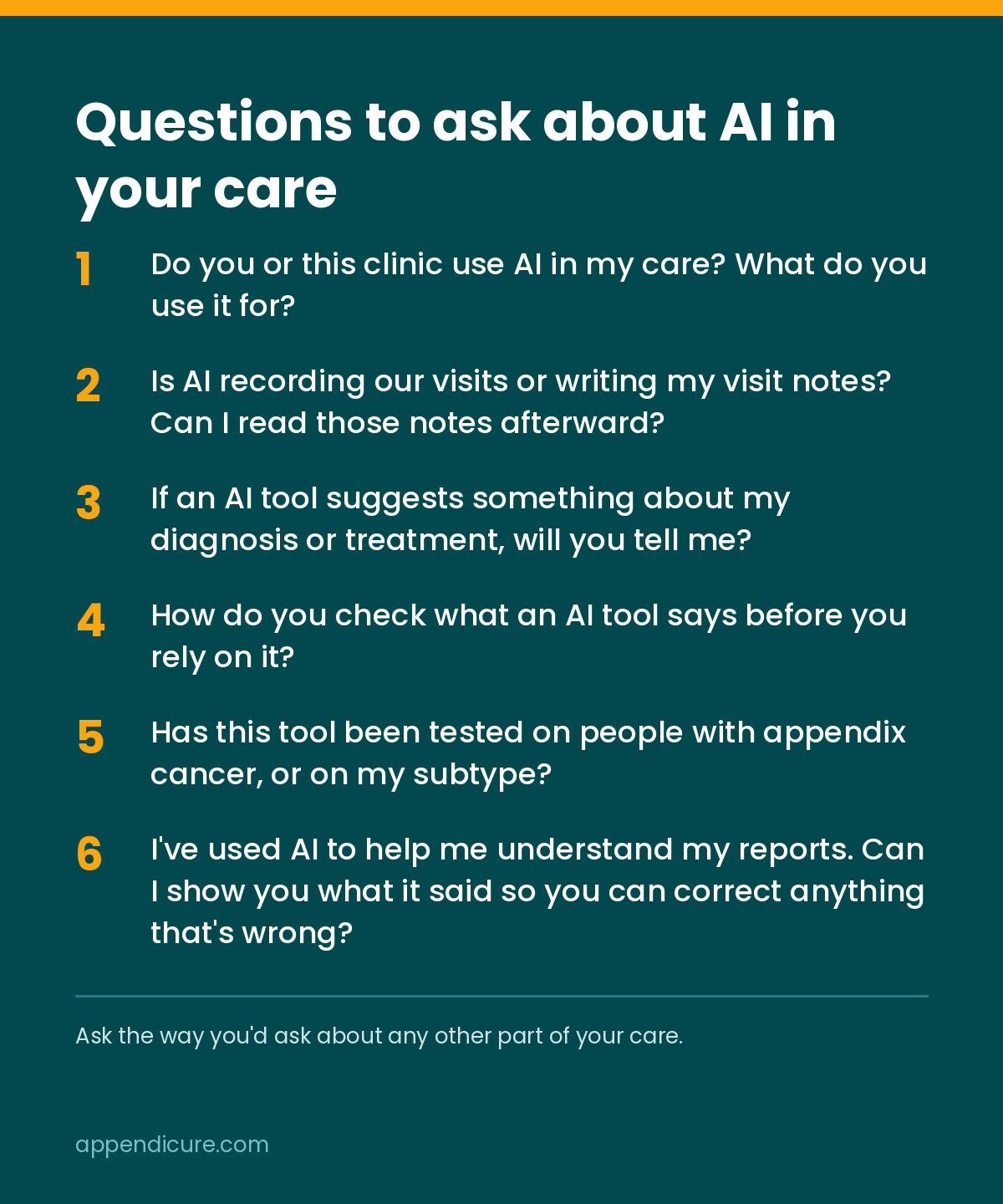
Patients shouldn’t have to become AI experts to ask about it. These are the questions I’d bring.
- Do you or this clinic use AI in my care? What do you use it for?
- Is AI recording our visits or writing my visit notes? Can I read those notes afterward?
- If an AI tool suggests something about my diagnosis or treatment, will you tell me?
- How do you check what an AI tool says before you rely on it?
- Has this tool been tested on people with appendix cancer, or on my subtype?
- I’ve used AI to help me understand my reports. Can I show you what it said so you can correct anything that’s wrong?
Ask the way you’d ask about any other part of your care. If nobody can answer number 5, ask who at the hospital can.
Read Your Visit Notes
Writing clinical notes is one of the most common ways doctors use AI, according to the AMA survey. Some clinics use tools that listen to the visit and draft the note. Any note can contain mistakes, whether a person or a computer wrote it. If your patient portal shows visit notes, read them, and ask for a correction if your subtype, grade, surgery, or medicines are wrong. A wrong subtype in your record can follow you to the next doctor who reads it.
What These Surveys Can’t Tell You
None of these surveys looked at appendix cancer. The AMA survey is U.S. only, covers every specialty, and reports what doctors said about themselves. The oncologist survey is older and had 204 people. The Luxembourg survey had 25. None of them tells you how your own doctor or hospital uses AI. Only your care team can answer that.
Frequently Asked Questions
How many doctors use AI now?
In a 2026 AMA survey, 72% of respondents reported that their practice incorporated AI for at least one task, most often summarizing research and writing notes.
Does my doctor have to tell me if they use AI?
It depends on where you live. Texas and Louisiana have laws requiring doctors to tell patients about certain uses of AI. Many places have no such rule, so ask.
Should I tell my oncologist I use ChatGPT or Claude?
Yes. Showing your doctor what the AI said gives them a chance to correct mistakes before they affect your decisions.
Has a doctor ever told you that AI was used in your care? Yes or no. Tell me in the comments.
Read more
Responsible AI for Appendix Cancer Patients
Your AI Doesn’t Know Which Appendix Cancer Type You Have. Tell It.
What Your Surgeon Should Cover at Your CRS/HIPEC Consultation
How to Follow Appendix Cancer Research: Toolkit for Patients and Caregivers, Part 1
Join the registry
The Appendicure Patient-Led Global Appendix Cancer Registry collects pathology, mutation, and treatment information from people with every type of appendix cancer, in the U.S. and around the world, so researchers can study each subtype on its own terms. It’s IRB-reviewed and enrolling now.
Already enrolled? Add new reports or correct your record here.
Sources
American Medical Association. 2026 Physician Survey on Augmented Intelligence. March 2026. ama-assn.org
Hantel A, Walsh TP, Marron JM, et al. Perspectives of Oncologists on the Ethical Implications of Using Artificial Intelligence for Cancer Care. JAMA Netw Open. 2024;7(3):e244077. doi:10.1001/jamanetworkopen.2024.4077
Winicki NM, Radomski SN, Ciftci Y, et al. Mortality risk prediction for primary appendiceal cancer. Surgery. 2024;175(6):1489-1495. doi:10.1016/j.surg.2024.02.014
Cammarota A, et al. Research training, barriers, and career development needs of early-career investigators in oncology: an EORTC survey-based study. ESMO Gastrointestinal Oncology. 2025;9:100208. doi:10.1016/j.esmogo.2025.100208
Kurbegov D, Hurley P, Waterhouse DM, et al. Recommendations to Streamline and Standardize Clinical Trial Site Feasibility Assessments: An ASCO Research Statement. JCO Oncol Pract. 2021;17(1):41-51. doi:10.1200/OP.20.00821
Kaddu-Mulindwa D, Mao X, Duhem C, et al. Oncologists’ knowledge, attitudes and needs about artificial intelligence in clinical oncology in Luxembourg in 2026 (AICO study). Front Digit Health. 2026;8:1860757. doi:10.3389/fdgth.2026.1860757
Texas SB 1188 (89th Legislature), Health and Safety Code Sec. 183.005. capitol.texas.gov
Texas HB 149 (89th Legislature), Business and Commerce Code Sec. 552.051. capitol.texas.gov
Louisiana Act 649 (HB 475), 2026 Regular Session, R.S. 37:22.1. legis.la.gov
Appendicure is a 501(c)(3) nonprofit. If you’d like to support this work, you can donate here.
This post is patient education, not medical advice.
Leave a Reply