


Short answer: For pseudomyxoma peritonei (PMP) from mucinous appendix tumors, HIPEC drugs, doses and treatment times vary between hospitals. Research hasn't established a single best regimen. Before surgery, it's reasonable to ask your surgeon which drug they'll use and why. It's also a good time to ask whether some of your tumor can be saved for research.
HIPEC is the heated chemotherapy washed through the abdomen at the end of cytoreductive surgery (CRS). Preparing for CRS/HIPEC involves many decisions. One detail to discuss before surgery is the HIPEC chemotherapy itself.
Why HIPEC chemotherapy differs between hospitals
Two papers published this fall show how much it varies. In November, surgeons at the Peritoneal Malignancy Institute in Basingstoke, England, published the plan for a trial comparing two mitomycin C regimens for pseudomyxoma peritonei (PMP). Mitomycin C is the drug most widely used in HIPEC for PMP. One group of patients gets 10 mg/m² for 60 minutes. The other gets 35 mg/m² for 90 minutes, given in three parts. These doses are calculated using body surface area, which is estimated from height and weight. Both regimens are already in use at major centers. In October, a team at City of Hope in California reported using 25 mg/m² for 90 minutes for colorectal cancer.
Other centers use a different drug, or two drugs together. Some base the dose on body size, and others give everyone the same amount. An international expert panel, PSOGI, endorsed two regimens for PMP in 2024: mitomycin C combined with cisplatin, and high-dose mitomycin C. A U.S. trial compared mitomycin C at a set 40 mg dose against oxaliplatin, each for 120 minutes.
What the research shows so far
The PSOGI panel noted that HIPEC has never been tested against surgery alone in a randomized trial for PMP. Most of the experts still recommended it after surgery, and they described the evidence behind their recommendations as low certainty.
A large PSOGI registry study looked back at 1,924 people with PMP from appendix tumors. In that study, HIPEC was linked to better survival than surgery alone. HIPEC with mitomycin alone was also linked to more severe complications. Because the study looked back at past patients rather than randomly assigning treatment, these are associations. They don't prove that HIPEC or mitomycin caused either result.
Surgeons at Wake Forest, MD Anderson and the University of Pittsburgh ran a randomized trial in 121 patients with mucinous appendix tumors that had spread in the abdomen. Each patient got either mitomycin C (40 mg) or oxaliplatin, each for 120 minutes. After ten years, the trial found no statistically significant difference in long-term survival between the two drugs. Patients who got mitomycin had lower white blood cell counts in the days after surgery. At 12 and 24 weeks, they also scored lower on a combined measure of physical and functional well-being.
The UK trial is enrolling 176 people having CRS/HIPEC for the first time, all at one hospital in England. It compares the two complete regimens. Both the dose and the length of time differ between them, so it can't show which of those two changes matters more. Its main question is whether the lower, shorter regimen controls the disease nearly as well as the higher, longer one. These two mitomycin regimens have not previously been compared directly in PMP. Basingstoke already uses the lower regimen, and the trial is funded by Hampshire Hospitals NHS Foundation Trust. Results are still several years away.
A retrospective City of Hope study in colorectal cancer found no statistically significant difference in recurrence-free survival between patients treated with surgery alone and those treated with surgery plus mitomycin HIPEC. Colorectal cancer behaves differently from PMP, so those findings can't be applied directly to appendix cancer.
Why the evidence is still limited
No study has proven which HIPEC chemotherapy works best for PMP.
One major obstacle is enrolling enough patients with comparable disease. PMP is rare, and each hospital treats a limited number of patients. The U.S. trial took six years at three hospitals to enroll 121 people. The UK trial is running at a single hospital. A trial large enough to show a clear difference between regimens, and to look at low-grade and high-grade disease separately, would need many hospitals enrolling patients under the same plan.
When PSOGI asked its panel about research priorities, 61% named studies comparing HIPEC regimens after surgery. The panel's own review also points out that because hospitals use so many different regimens, their results are hard to combine or compare afterward. If centers in different countries agreed to test regimens in one shared trial, or recorded the drug, dose and time the same way, that could help answer questions no single hospital can answer on its own.
Patient registries can help in the meantime. When patients from many hospitals record their treatment details and pathology in one place, researchers can see what's being used and how people are doing across centers at once. That kind of data can't replace a randomized trial, but it can help researchers decide which regimens are worth testing in one.
Questions to ask your surgeon
You don't need to know the right answer to ask these. Your surgeon should be able to explain the reasons for the planned regimen.
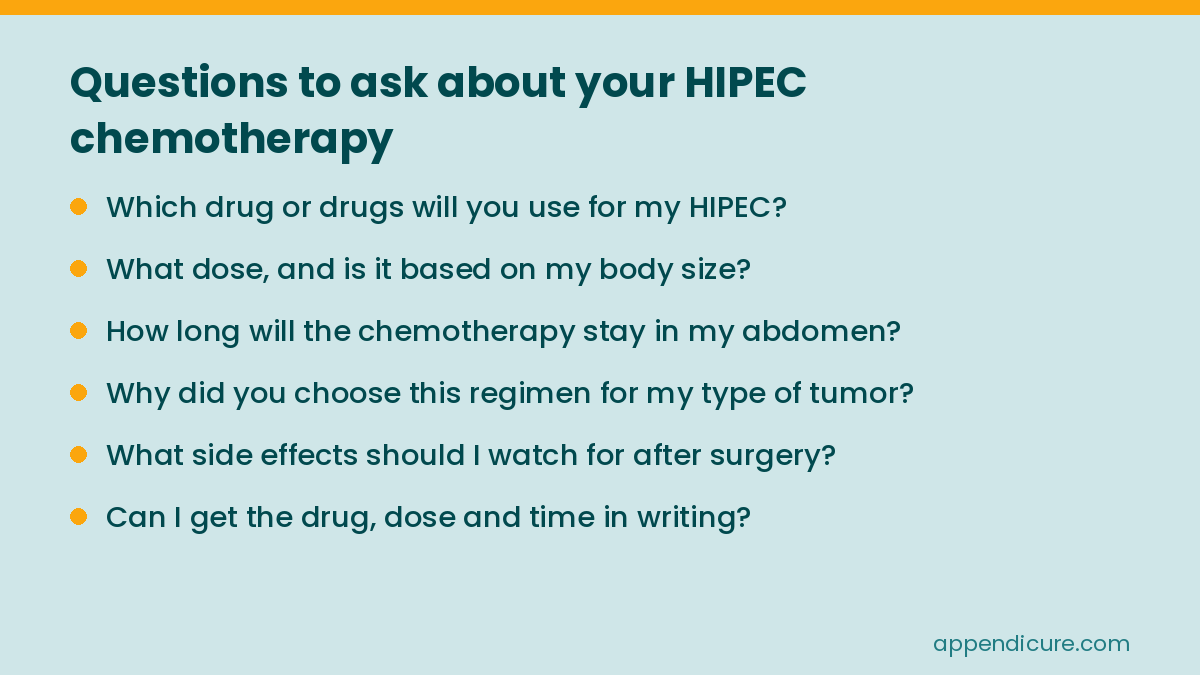
- Which drug or drugs will you use for my HIPEC?
- What dose, and is it based on my body size?
- How long will the chemotherapy stay in my abdomen?
- Why did you choose this regimen for my type of tumor?
- What side effects from the chemotherapy should I watch for after surgery?
- Can I get the drug, dose and time in writing for my records?
Keep the answer to that last question. If you ever need another surgery or want to join a study, you'll be asked what you got the first time.
Ask about saving your tissue too
The same appointment is a good time to ask about your tumor tissue. It's best to ask early, because saving tissue for research often takes planning and a consent form signed before surgery.
After surgery, your tumor goes to pathology, where it's preserved in formalin and wax. That preserved tissue is what's used for your diagnosis, and it's still useful for many kinds of research, including DNA testing. Some studies need tissue that was never put in formalin, either fresh or frozen.
Ask your surgeon whether surplus tumor tissue, and normal tissue that's already being removed if appropriate, can be saved for an approved research study. Ask whether your hospital has a tissue bank, and whether there's a research consent form you'd need to sign before surgery. Your diagnosis always comes first. The pathologist takes what's needed to diagnose and grade your tumor before anything goes to research.
The UK trial team plans to collect tumor tissue and blood from participants for future genetic research, and says it will need separate funding to analyze them. I wrote a full guide on preserving tumor tissue before appendix cancer surgery, with the questions to ask and what to do if your hospital can't bank tissue.
Who the studies above apply to
Most of this research is about PMP from mucinous appendix tumors, including LAMN, HAMN and mucinous adenocarcinoma, low and high grade. If you have goblet cell adenocarcinoma, signet ring cell adenocarcinoma or non-mucinous adenocarcinoma, your team may use a different approach, and these studies may not apply to you. Your surgeon can tell you which regimen they plan for your tumor type and why.
HIPEC by appendix cancer subtype: what's known and what's being studied
The 2025 consensus guideline from the Peritoneal Surface Malignancies Consortium is a U.S. national expert guideline for appendix tumors that have spread in the abdomen. Its recommendations depend on two things: the type of the original appendix tumor, and the grade of the disease in the abdomen. Its authors say the evidence behind it is observational, with very little prospective data. On chemotherapy given into the abdomen, which includes HIPEC, they wrote that its role “remains controversial among consensus members, thus we provide no universal recommendation, but several studies in appendiceal tumors suggest benefit.” The guideline doesn't recommend a specific HIPEC drug or dose. Its recommendations are about whether and when to use surgery and chemotherapy, and none of them shows which HIPEC drug works best.
To find your card, look at two things on your pathology report: the tumor in the appendix (LAMN, HAMN, mucinous adenocarcinoma, signet ring cell, non-mucinous or goblet cell adenocarcinoma) and the grade of any disease in the abdomen. LAMN and HAMN are the tumors most often behind PMP, and the guideline goes by the grade of the disease in the abdomen.
Low-grade PMP (grade 1, usually from LAMN or HAMN)
When the surgeon expects to remove all visible disease, the guideline says CRS with chemotherapy into the abdomen should be done. When complete removal isn't expected, it says partial surgery with chemotherapy into the abdomen should still be considered. PSOGI also recommends HIPEC after CRS. This group can include grade 1 PMP from a mucinous adenocarcinoma, as long as the appendix tumor itself isn't grade 3.
ResearchThe finished U.S. trial of mitomycin versus oxaliplatin was mostly low-grade patients. Examples of randomized trials under way include the UK trial comparing two mitomycin regimens, and a trial in Beijing comparing one HIPEC session with three for PMP of any grade with a larger amount of disease. A trial at the University of Kentucky and the University of Vermont, which also includes colorectal cancer, is comparing a set 40 mg mitomycin dose with a dose based on body size. Its main measurements concern drug exposure in the bloodstream, rather than whether one dose improves cancer control.
Higher-grade PMP (grade 2, or grade 3 with signet ring cells)
The guideline recommends both chemotherapy by vein and surgery for this group. It prefers giving the chemotherapy first to see how the disease responds, though it notes not every center does. Surgery, with or without chemotherapy into the abdomen, is planned when the surgeon expects to be able to remove all visible disease. When the disease in the abdomen is grade 2 or 3, the guideline considers it adenocarcinoma even if the appendix itself showed LAMN or HAMN. This group includes mucinous adenocarcinoma with grade 2 or 3 disease in the abdomen, and any PMP when the appendix tumor itself is grade 3, such as signet ring cell adenocarcinoma.
ResearchFewer than a third of the patients in the U.S. trial had high-grade disease. The UK and Beijing trials both include high-grade PMP, and the Beijing trial includes PMP with signet ring cells.
Non-mucinous adenocarcinoma and goblet cell adenocarcinoma (GCA)
The guideline groups these together when they've spread in the abdomen. It recommends chemotherapy by vein first and says going straight to surgery is not preferred. After chemotherapy, the team reassesses whether complete removal is feasible. If it is, CRS with or without chemotherapy into the abdomen can follow.
ResearchIn a Melbourne, Australia study of 86 people with appendiceal adenocarcinoma, the goblet cell and signet ring cell group had poorer overall survival than the other subtypes. That study doesn't show whether HIPEC helps these subtypes less, or which drug is best for them. The guideline also cites a small UK study of seven people with high-grade goblet cell disease who had repeated HIPEC with mitomycin, and cautions that results like these are hard to apply to other patients. Yale is running an experimental feasibility study for people with high-grade appendiceal or colorectal cancer whose disease is too widespread to remove. The team tests chemotherapy drugs on each patient's tumor biopsy and uses the results to choose the HIPEC drug. It hasn't yet been shown that choosing drugs this way improves outcomes. MD Anderson is testing paclitaxel given into the abdomen, without heat, for appendiceal adenocarcinoma that can't be removed, and will look at whether mucinous, signet ring or goblet cell histology affects response.
LAMN or HAMN with no PMP
When mucin with no tumor cells stays right around the appendix, the guideline handles it under its separate pathway for tumors that haven't spread, where complete removal alone can be enough. If you've been told you have perforated LAMN without PMP, the guideline suggests a review by an expert pathologist, because some apparent cases may be non-cancerous conditions that resemble LAMN. HAMN follows the same pathway with one difference: because HAMN has higher rates of progression and recurrence, the guideline says CRS may be considered even when the mucin stays right around the appendix. It also suggests expert review when it isn't clear whether a tumor is LAMN or HAMN and the answer would change the treatment plan.
ResearchA French study followed 25 people with LAMN, most of them perforated, using MRI instead of more surgery for about five years. Two developed PMP and went on to CRS/HIPEC. It was a small study at one center.
Studies across several subtypes
Memorial Sloan Kettering's ICARuS trial randomly assigned people with appendix or colorectal cancer to HIPEC with mitomycin or to chemotherapy given into the abdomen in the days after surgery. It's closed to enrollment. The National Cancer Institute is recruiting people with appendiceal, colorectal, ovarian or mesothelioma tumors in the abdomen to compare how tumor samples respond to HIPEC drugs in the lab with how they respond in the body.
Neuroendocrine tumors of the appendix are a separate disease and aren't covered by the consensus guideline or this post.
Do you know which HIPEC drug you were given, or will be given? Yes or no.
Join the Patient-Led Global Appendix Cancer Registry. It collects pathology reports, tumor mutation results and treatment details from appendix cancer patients around the world. It's IRB-reviewed, and you can upload your pathology report.
Join the Registry: United StatesJoin the Registry: International
Already enrolled? Add new reports or update your record
Frequently asked questions
Which chemotherapy drugs are used in HIPEC for appendix cancer?
Mitomycin C is widely used for PMP from mucinous appendix tumors. Some centers combine it with cisplatin, and some use oxaliplatin. Doses and times vary.
Is one HIPEC drug or dose proven better for PMP?
Not so far. A U.S. randomized trial in mucinous appendix tumors found no statistically significant difference in long-term survival between mitomycin C and oxaliplatin. A UK trial comparing two mitomycin regimens is under way, and results are several years off.
What should I ask my surgeon about HIPEC?
Ask which drug, what dose, how long, why they chose it for your tumor type, and what side effects to watch for. Ask for the answer in writing.
Can I save my tumor tissue for research?
Often, if you ask before surgery. Ask whether surplus tissue can be saved fresh or frozen for an approved study, whether your hospital has a tissue bank, and whether there's a consent form to sign beforehand.
Read More
Appendicure is a 501(c)(3) nonprofit. If you'd like to support this work, you can donate here.
Sources
- Ewings S, et al. HIPEC-PMP trial protocol. BMJ Open Gastroenterol 2026. https://doi.org/10.1136/bmjgast-2025-002187
- Southampton Clinical Trials Unit, HIPEC-PMP trial page. https://www.southampton.ac.uk/ctu/trialportfolio/listoftrials/hipec-pmp.page
- Kusamura S, et al. 2022 PSOGI consensus on HIPEC regimens: PMP. Ann Surg Oncol 2024. https://doi.org/10.1245/s10434-024-15646-6
- Kusamura S, et al. Review of 2022 PSOGI/RENAPE consensus on HIPEC. J Surg Oncol 2024. https://doi.org/10.1002/jso.27885
- Kusamura S, et al. HIPEC in PMP after CRS (PSOGI registry). JAMA Surg 2021. https://doi.org/10.1001/jamasurg.2020.6363
- Levine EA, et al. Randomized trial of oxaliplatin vs mitomycin HIPEC in appendiceal tumors. J Am Coll Surg 2018. https://doi.org/10.1016/j.jamcollsurg.2017.12.027
- Moaven O, et al. Quality of life results. Ann Surg Oncol 2020. https://doi.org/10.1245/s10434-019-08064-6
- Levine EA, et al. Ten-year outcome. Ann Surg Oncol 2025. https://doi.org/10.1245/s10434-024-16441-z
- Tanweer MD, et al. Discontinuation of mitomycin C HIPEC for colorectal peritoneal metastases. Ann Surg Oncol 2026. https://doi.org/10.1245/s10434-026-20689-y
- Godfrey EL, et al. Consensus guideline for the management of patients with appendiceal tumors, part 2. Cancer 2025. https://doi.org/10.1002/cncr.35874
- Flood MP, et al. Neoadjuvant chemotherapy before CRS/HIPEC for appendiceal adenocarcinoma. Asia Pac J Clin Oncol 2023. https://doi.org/10.1111/ajco.13949
- Mouawad C, et al. Active surveillance strategy for LAMN: 5-year results. Pleura Peritoneum 2026. https://doi.org/10.1515/pp-2025-0043
- ClinicalTrials.gov NCT06513065 (UK HIPEC-PMP trial). https://clinicaltrials.gov/study/NCT06513065
- ClinicalTrials.gov NCT04779554 (flat vs body-size mitomycin dose). https://clinicaltrials.gov/study/NCT04779554
- ClinicalTrials.gov NCT07328737 (one vs three HIPEC sessions for PMP). https://clinicaltrials.gov/study/NCT07328737
- ClinicalTrials.gov NCT01815359 (ICARuS). https://clinicaltrials.gov/study/NCT01815359
- ClinicalTrials.gov NCT07291180 (Yale personalized HIPEC feasibility study). https://clinicaltrials.gov/study/NCT07291180
- ClinicalTrials.gov NCT06207305 (MD Anderson intraperitoneal paclitaxel). https://clinicaltrials.gov/study/NCT06207305
- ClinicalTrials.gov NCT04847063 (NCI individualized HIPEC response). https://clinicaltrials.gov/study/NCT04847063
Leave a Reply