
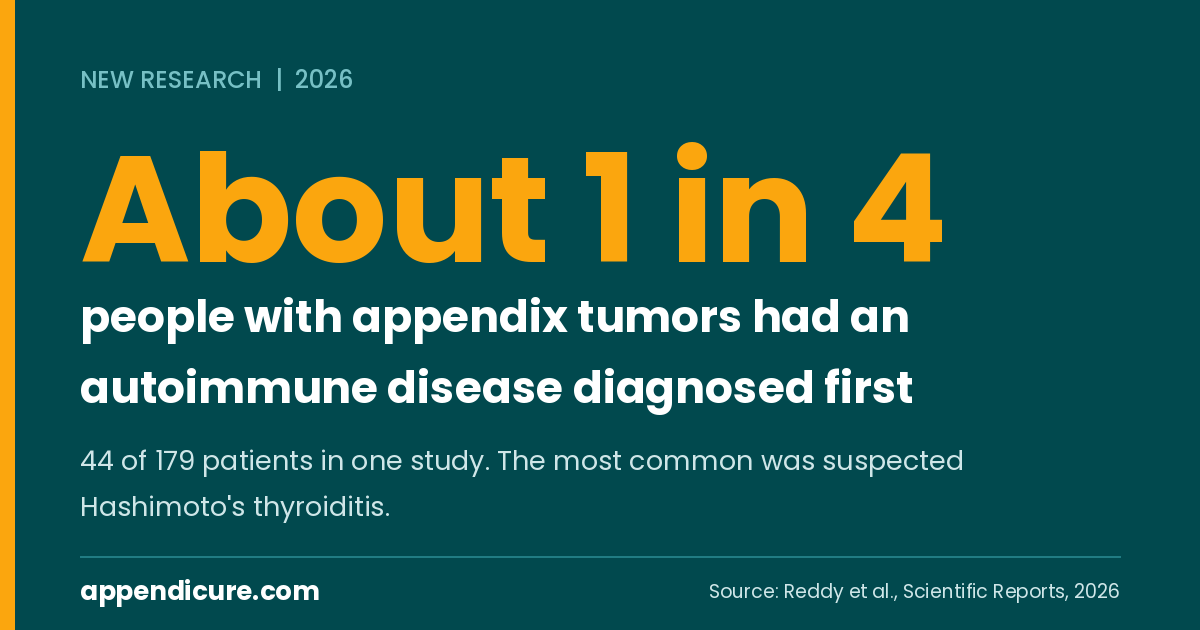

A study of 179 people with appendix tumors at the University of Chicago and Yale found that 44 of them, about 1 in 4, had an autoimmune disease diagnosed before their tumor. The most common was suspected Hashimoto's thyroiditis. The study had no comparison group of people without appendix cancer, so on its own it can't say whether autoimmune disease raises the risk of appendix cancer.
When this study came out, I shared it in the Appendicure Facebook group and asked one question. Had you ever been diagnosed with an autoimmune condition? It drew more replies than almost anything I've posted.
One disclosure first. Dr. Kiran Turaga at Yale, the study's senior author, is an Appendicure partner.
What the researchers studied
An autoimmune disease is one where the immune system attacks the body's own tissue. In Hashimoto's thyroiditis it attacks the thyroid. Rheumatoid arthritis, ulcerative colitis, and lupus are other examples.
Researchers went through the medical records of 179 people with appendix tumors who were seen by peritoneal surgery teams. 134 were treated at the University of Chicago between 2016 and 2021, and 45 at Yale between September 2022 and February 2024. The team recorded any autoimmune disease that was diagnosed before the appendix tumor.
The study grouped patients into four tumor types. There were 61 people with appendiceal mucinous neoplasms, which is the category LAMN and HAMN fall under, though the paper doesn't split them out. There were 49 with mucinous adenocarcinoma, 45 with goblet cell adenocarcinoma (GCA), and 24 with non-mucinous adenocarcinoma. Signet ring cases were counted inside the adenocarcinoma groups. The paper doesn't report pseudomyxoma peritonei (PMP) as its own group, and it didn't include appendiceal neuroendocrine tumors. Most patients, 108 of 179, had stage 4 disease. That fits a group seen by peritoneal surgery teams, but the results may not match people whose tumor was found early during an appendectomy.
Scientific Reports published the paper online on November 9, 2026, as an early "Article in Press" version that the journal will replace with a final edited version. The authors reported no outside funding and no competing interests. It's a look back at existing records from two centers, which makes it hypothesis-generating.
What the study found
Of the 179 patients, 44 had an autoimmune disease diagnosed before their appendix tumor. Thyroid disease was the most common. 25 people had suspected Hashimoto's thyroiditis and 5 had Graves' disease. Next came rheumatoid arthritis in 9 people and inflammatory bowel disease in 8 (4 with Crohn's disease and 4 with ulcerative colitis). Lupus showed up in 4, psoriasis in 3, Sjögren's syndrome in 2, and a handful of other conditions in one person each. Some people had more than one.
40 of the 44 people with an autoimmune disease were women. The share with autoimmune disease was about the same across all four tumor types. The researchers found no statistically significant differences in tumor grade or stage between people with and without autoimmune disease, and none in survival among the University of Chicago patients, the only group they had enough follow-up to compare.
The paper says "suspected" Hashimoto's for a reason. Hashimoto's is the most common cause of an underactive thyroid. Doctors find an underactive thyroid with routine thyroid blood tests, and an antibody test called anti-TPO can help show that Hashimoto's is the cause. Many patients in this study never had the antibody test, because it doesn't change how an underactive thyroid is treated. So the researchers counted someone as suspected Hashimoto's if their chart showed hypothyroidism with no other cause, such as thyroid surgery, radiation, iodine deficiency, or a medicine. The authors say this may have overcounted. Nearly everyone in that group was taking levothyroxine, the standard thyroid hormone pill, and the records didn't show whether they started it before or after their appendix tumor was found.
What this study can't tell you
The researchers didn't compare these patients to people without appendix cancer, and they say plainly that this study can't show autoimmune disease raises the risk of appendix cancer. One in four sounds high, but the paper has no matching group to measure it against.
An earlier study involving some of the same Yale researchers did make that comparison. It appeared as an abstract for the 2026 ASCO Annual Meeting, which means it's a short conference summary rather than a full research article. The team used All of Us, a National Institutes of Health research program that pools health records from volunteers across the country. They compared 203 people with appendiceal adenocarcinoma to 327,591 adults with no history of cancer. Autoimmune disease showed up in 18.7% of the appendix cancer group and 10.2% of the others. Thyroid conditions that weren't coded as autoimmune were more common too, 32.5% compared with 11.2%. Both differences held up after the researchers accounted for age and sex. Among the autoimmune conditions, inflammatory bowel disease had the strongest link.
That abstract has its own limits. It counted diagnoses from billing codes, and it doesn't say whether they came before or after the cancer. People being treated for cancer see doctors more often, which gives other conditions more chances to be found and recorded. It included only adenocarcinoma, so it may not apply to LAMN. And because Dr. Turaga led both studies, this is a separate dataset studied by an overlapping research team, not confirmation from an independent group. Even so, the abstract found an association, not a cause.
The authors of the new paper point to one more problem. Hashimoto's and many other autoimmune diseases are more common in middle-aged women, and appendix tumors are also common in middle-aged women. 115 of the 179 patients in this study were women, so that overlap could explain some of what they saw.
Neither study means an autoimmune disease caused anyone's cancer, and neither suggests new tests or treatment changes.
The blood test part of the study
The researchers also studied blood from 68 University of Chicago patients, 17 with autoimmune disease and 51 without. Small pieces of DNA float in the blood after cells release them. The team looked at a chemical tag on that DNA called 5hmC, which helps control which genes are switched on.
They found differences between the two groups in some immune pathways and some cancer-related pathways, and the authors are careful about what that means. Only one of the 58 DNA regions they flagged passed a stricter statistical check, and none of the 80 genes did. DNA in the blood comes from many kinds of cells, including immune cells, so the differences could come from the autoimmune disease itself rather than from the tumor. The authors call this part exploratory. It wasn't designed or validated as a diagnostic or predictive test.
What 45 Appendicure members told me
I asked the question in the Appendicure Facebook group on November 10, and 45 people answered. A few answered for a family member.
Sixteen people named an autoimmune condition. Five had thyroid disease, four with Hashimoto's and one with Graves' disease. Four had a form of inflammatory arthritis. Two have rheumatoid arthritis, and one of them also has Sjögren's syndrome. One has ankylosing spondylitis and one has psoriatic arthritis. Two had broader connective tissue diseases. One has mixed connective tissue disease, and one has lupus and Sjögren's along with polymyalgia rheumatica. The other five had ulcerative colitis, psoriasis, antiphospholipid syndrome, autoimmune hepatitis, and type 1 diabetes, one person each. Most of the sixteen didn't say when they were diagnosed. The ones who did gave dates from about a year to more than twenty years before their appendix cancer. One has taken medicine to calm her immune system for more than a decade, which is the kind of detail the study's records didn't capture.
One of the four members with Hashimoto's was treated at the University of Chicago in 2019. She said she gave blood samples for a study there and thinks it may have been this one. The blood test part of this study did use plasma banked from University of Chicago patients, so she may be right, though there's no way to confirm it from outside.
Seven more people, including one wife answering for her husband, had hypothyroidism but didn't say what caused it. Four of them had it for 20 years or more before their appendix cancer. One of the seven also has lichen sclerosus, a skin condition whose cause isn't settled, though the immune system may play a part. I didn't count it as autoimmune for that reason.
Three more people found out about a condition only after their appendix cancer. Two were diagnosed with hypothyroidism, and one of them said her thyroid had never been checked before. The third was diagnosed with morphea, a form of localized scleroderma that's generally considered autoimmune, about a year after her surgery. I listed these three separately because they specifically reported being diagnosed after cancer.
The rest of the answers fell outside the question. Two people said their husband has an autoimmune condition but didn't say whether he was the one with appendix cancer. One parent said her daughter, the patient, has Raynaud's, which on its own usually isn't autoimmune. Three people had conditions that aren't autoimmune, including fibromyalgia, a new allergy to medical adhesive, and severe allergies with eczema. Thirteen said no.
Thyroid problems came up more than anything else, which matches both the study and the ASCO abstract. The study would probably have counted some of the people with hypothyroidism and no stated cause as suspected Hashimoto's, after checking their charts for other causes. I can't do that from a comment.
I'm not turning these answers into a percentage. People with an autoimmune condition may have been more likely to reply than people without one. The diagnoses are self-reported, most people didn't mention their subtype, and some answers came from family members.
Members also raised things the study didn't measure. Several people mentioned allergies, including some who answered no. A few brought up family history on their own. And the member whose thyroid was never checked before her cancer made a point that applies to the study too. Records only show what someone was tested for, so some thyroid problems may never have been found.
Sorting it out by subtype
The study compared four broad tumor groups, but it couldn't separate every subtype. LAMN and HAMN weren't reported separately, and neither was PMP. Most members didn't mention their subtype either. The Appendicure registry collects pathology reports, subtype, and tumor mutation results. Those details can help researchers distinguish between tumor subtypes in future studies. The registry is IRB-reviewed.
Join the Patient-Led Global Appendix Cancer Registry. If you have appendix cancer, you can join here. Use the link for where you live.
Join the Registry: United StatesJoin the Registry: International
Already enrolled? Add new reports or correct your record
Frequently asked questions
Does autoimmune disease cause appendix cancer?
That hasn't been shown. The ASCO abstract found autoimmune disease was more common in people with appendix cancer than in people without cancer, but more common together doesn't mean one causes the other.
Which autoimmune disease was most common in the study?
Suspected Hashimoto's thyroiditis, in 25 of 179 patients. Rheumatoid arthritis and inflammatory bowel disease came next.
Which appendix tumors did the study include?
Appendiceal mucinous neoplasms, mucinous adenocarcinoma, goblet cell adenocarcinoma, and non-mucinous adenocarcinoma. It didn't include appendiceal neuroendocrine tumors, and it didn't report PMP or signet ring cases separately.
Should I get my thyroid tested because of this study?
The study doesn't recommend any new testing for appendix cancer patients. If you have questions about your thyroid, ask your own doctor.
One question for you
Were you diagnosed with an autoimmune condition before your appendix cancer? Answer yes or no in the comments, and add your subtype if you know it. If you know someone with appendix cancer and a thyroid condition, send them this post.
Read More
Appendicure is a 501(c)(3) nonprofit. If you'd like to support this work, you can donate here.
Amanda
This post is for education and isn't medical advice. Talk with your own care team about your health and treatment.
Sources
- Reddy B, Malina Y, Bregio C, et al., Turaga KK. Prevalence of autoimmune disease and associated 5-hydroxymethylcytosine cell-free DNA patterns in appendiceal neoplasms. Scientific Reports, Article in Press, 2026. https://doi.org/10.1038/s41598-026-78101-4 (free to read)
- Ofori KA, Bader J, Reddy B, et al., Turaga K. Associations of autoimmune diseases with appendiceal cancer in a population-based study. Journal of Clinical Oncology 44, no. 16_suppl (2026 ASCO Annual Meeting, publication-only abstract e16495). https://ascopubs.org/doi/10.1200/JCO.2026.44.16_suppl.e16495


Leave a Reply