
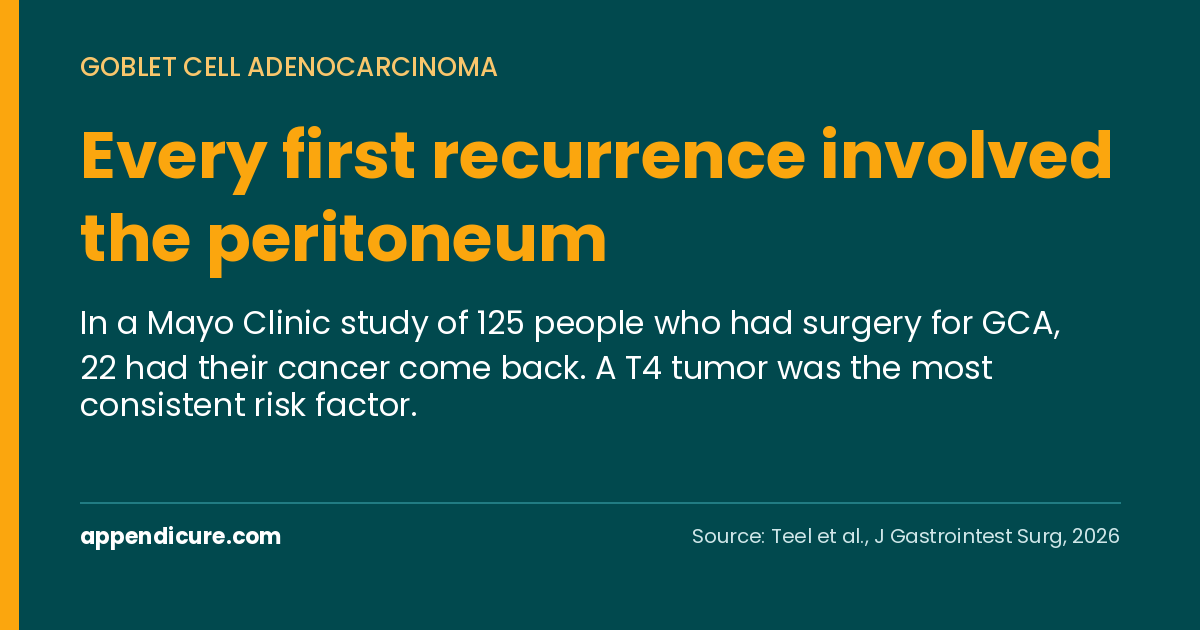

A 2026 Mayo Clinic study followed 125 people who had surgery for goblet cell adenocarcinoma (GCA) of the appendix without distant metastases. During follow-up, 18% had their cancer come back, and every first recurrence involved the peritoneum, the thin lining of the abdomen. A T4 tumor was the most consistent risk factor, but recurrences also happened in people with lower T stages, so the authors recommend follow-up after surgery for everyone with GCA.
GCA has a reputation for spreading to the lining of the abdomen. Less has been known about what happens after surgery meant to remove all of the cancer, including how often it comes back, where it shows up, and how long to keep watching. My husband David has GCA, and so does Dr. Steve Himmelstein, who sits on the Appendicure board, so these questions are personal for me.
What the Mayo Clinic study looked at
The study was published in the Journal of Gastrointestinal Surgery in November 2026 by Austin Teel, Dr. Travis Grotz and colleagues. They reviewed the records of 125 patients treated at Mayo Clinic's sites in Minnesota, Arizona and Florida between 1990 and 2024. Everyone had GCA without distant metastases, meaning there were no separate peritoneal metastases or metastases to distant organs when they had surgery. The abstract doesn't say how many had cancer in nearby lymph nodes.
GCA used to be called goblet cell carcinoid, and older pathology reports didn't always label it consistently. So the team had pathologists look at every case again using the current World Health Organization definitions.
Most patients, 83%, had a right hemicolectomy, which removes the right side of the colon along with the appendix. Another 12% had only their appendix removed, and 5% had an ileocecectomy, a smaller operation that removes the end of the small intestine and the start of the colon. About a third, 31%, also got chemotherapy after surgery.
Goblet cell adenocarcinoma recurrence: what the study found
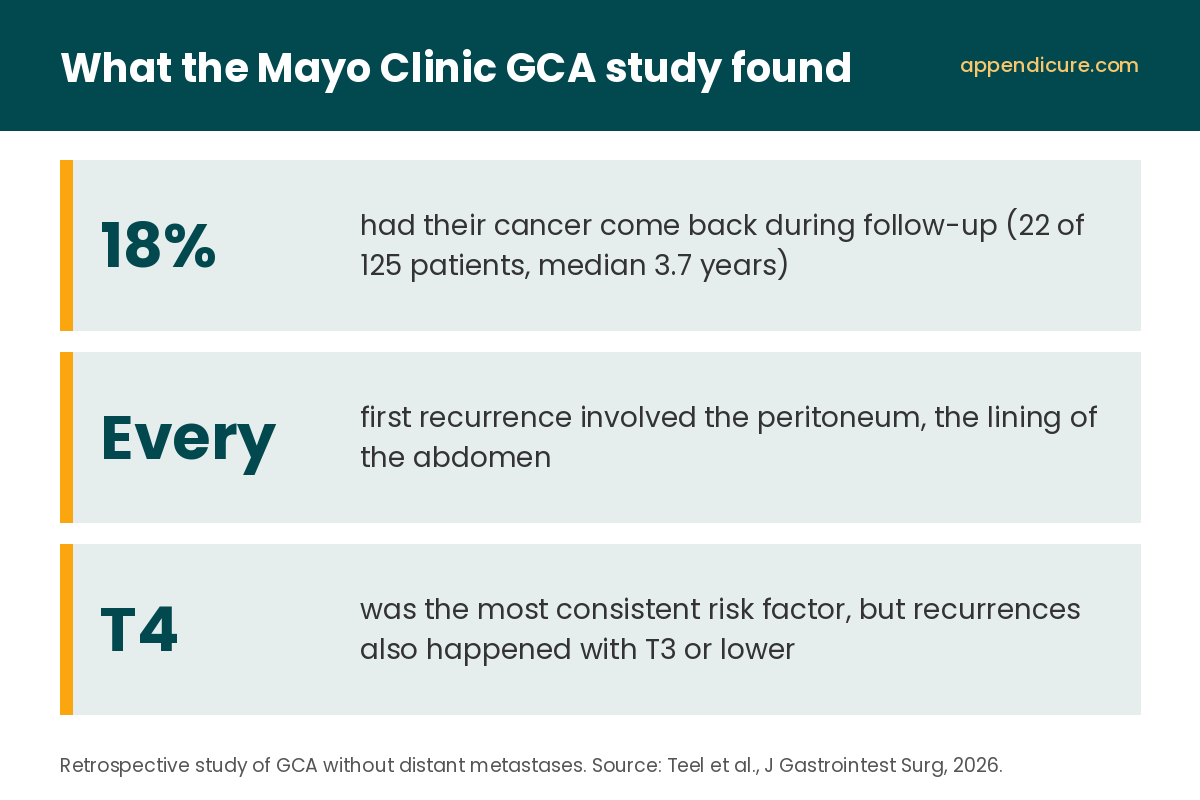
Patients were followed for a median of about 3.7 years. During that time, 22 of the 125 patients, or 18%, had their cancer come back. That 18% is what the researchers saw during follow-up. It isn't a lifetime recurrence risk.
Every one of those first recurrences involved the peritoneum. Five people also had cancer return near where the tumor had been removed, and one person had it return somewhere farther away in the body.
The study looked at recurrences within 10 years of surgery. Among people whose cancer came back in that window, the median time to recurrence was about 3.5 years, and some recurrences came several years after surgery.
Which patients had the highest risk
The researchers checked which features of the tumor were linked to recurrence. Two stood out.
The first was a T4 tumor. The T stage on a pathology report describes how far the tumor grew. T4 means the tumor involved the appendix's outer peritoneal surface or directly invaded an adjacent organ or structure. Patients with T4 tumors had a roughly fivefold higher hazard of recurrence during follow-up than patients without T4 tumors. T4 remained associated with recurrence in an additional statistical analysis, which made it the most consistent finding in the study.
The second was a positive margin, meaning cancer cells were found at the cut edge of the tissue the surgeon removed. Positive margins were also linked to a roughly fivefold higher hazard of recurrence than negative margins. But this estimate was imprecise, and it was less certain in the additional analysis. The authors describe it as adding prognostic information, not as a settled finding.
A lower T stage did not mean zero risk. Recurrences also happened in patients whose tumors were T3 or lower.
David and Steve
My husband David was diagnosed with GCA in January 2024, after a colonoscopy biopsy found it. His pathology report lists his tumor as grade 3, poorly differentiated, and T4a, meaning it had grown through the outer surface of the appendix. Cancer was found in 1 of the 21 lymph nodes removed, and all of his margins were clear. His stage is 3B. He had no separate peritoneal metastases or metastases to distant organs, so he fits the group of patients the Mayo study followed, and his T4a tumor is a feature the study associated with increased recurrence risk. His only treatment was a right hemicolectomy. On his oncologist's advice, he didn't have chemotherapy. He has had no evidence of disease since February 2024, and he gets a Signatera blood test every three months. Every result so far has been negative.
Steve is a retired physician. His pathology report lists his GCA as high grade, with signet ring cells making up about a fifth of the tumor. It was T4b, meaning it had grown into a nearby organ, in his case the small intestine. Cancer was found in 2 of 25 lymph nodes, and it had already spread to the lining of his abdomen, so his cancer was stage 4 and he isn't the kind of patient the Mayo study included. In 2022 he had cytoreductive surgery with HIPEC, and his margins were clear. This summer, his Signatera result came back slightly elevated. Signatera is a blood test built from a person's own tumor that looks for that tumor's DNA in the blood. About two months later, a CT scan showed two spots on his bowel. He is on chemotherapy now, and in December he is scheduled for laparoscopic surgery with Dr. Patrick Wagner at Allegheny Health Network in Pittsburgh. Dr. Wagner is an Appendicure research partner. Steve is fine with me sharing his story.
Blood tests like Signatera haven't been studied much in GCA, and they don't replace scans. For Steve, the blood test was the first warning, and a scan is what showed where the cancer was. A negative result does not rule out cancer or recurrence. In a 2024 study of 94 appendix cancer patients at two centers, Signatera didn't find tumor DNA in some patients whose cancer was known to be there, and it found it less often in people who had recently had chemotherapy. That study mixed appendix cancers of different grades, and its abstract doesn't report GCA separately. Two of its authors, Dr. JP Shen of MD Anderson and Dr. Kiran Turaga of Yale, work with Appendicure.
What people with GCA describe
Questions about recurrence also come up in the support groups I follow. In a recent thread in another appendix cancer support group, a member with stage 4 GCA asked whether anyone had gone a few years with no evidence of disease and then had the cancer come back. Several people with GCA answered.
One woman wrote that her mother was first diagnosed with stage 3 GCA, had no evidence of disease for about two years, and then had a confirmed spot appear. Other spots her doctors had watched for a long time, and thought were scar tissue, are now believed to be cancer spread through her abdomen.
Others wrote about living with surveillance. One member with GCA, two and a half years out with no evidence of disease, said she'd had scans and bloodwork every three months, had recently moved to every four, and couldn't imagine ever stopping.
These individual accounts cannot tell us how often recurrence happens, and some of the people in that thread had stage 4 disease, which the Mayo study didn't include.
What the authors recommend
The authors conclude that everyone who has surgery for GCA should have follow-up afterward, with how closely they're watched based on their own risk factors. They also call for studies that follow patients forward in time to test ways of finding peritoneal spread earlier or preventing it.
The abstract doesn't specify a surveillance schedule or establish whether chemotherapy or HIPEC reduces recurrence.
Study limitations
This was a look back at records from one health system, not a trial. It shows which features went along with recurrence. It can't prove that any of them caused it.
Only 22 people had a recurrence, which is a small number for sorting out risk factors. That's why the margin finding is uncertain. Treatment and imaging also changed a lot between 1990 and 2024.
The study covers only GCA without distant metastases at the time of surgery. It doesn't apply to people who already had peritoneal metastases, and it doesn't cover other appendiceal cancers, including LAMN, HAMN, mucinous adenocarcinoma, signet ring cell carcinoma or appendiceal neuroendocrine tumors.
I read the published abstract. The full paper is behind a paywall, so details such as how tumor grade or chemotherapy factored into the results aren't covered here.
Questions to bring to your next appointment
- What T stage is listed on my pathology report?
- Were my margins clear?
- What is my surveillance plan, and how many years will it last?
- Which scans or blood tests will you use to watch for peritoneal spread?
- If something looks unclear on a scan, who reviews it, and do they see a lot of appendix cancer?
Join the Patient-Led Global Appendix Cancer Registry. The registry collects pathology and molecular report data from people with any type of appendix cancer, in any country. Your pathology report includes the details this study used, like T stage and margin status, and the registry collects that report when you enroll. Use the link for where you live.
Join the Registry: United StatesJoin the Registry: International
Already enrolled? Add new reports or correct your record
Frequently asked questions
Where does goblet cell adenocarcinoma come back after surgery?
In this study, every first recurrence involved the peritoneum.
Can GCA come back years after surgery?
Yes. Some recurrences in this study happened several years after surgery.
Does a lower T stage mean no follow-up is needed?
No. Recurrences also happened in patients with T3 or lower tumors, which is why the authors recommend follow-up for everyone.
One question for you
If you have GCA, does your pathology report list your tumor as T4? Yes, no, or not sure. Tell me in the comments. If you know someone with GCA, send them this post.
Read More
Appendicure is a 501(c)(3) nonprofit. If you'd like to support this work, you can donate here.
Amanda
This post is for education and isn't medical advice. Talk with your own care team about your health and treatment.
Sources
- Teel A, Siegler EL, Miller R, et al. Peritoneal Recurrence After Resection of Appendiceal Goblet Cell Adenocarcinoma. Journal of Gastrointestinal Surgery, 2026. https://doi.org/10.1016/j.gassur.2026.102678
- PubMed abstract, PMID 43044810. https://pubmed.ncbi.nlm.nih.gov/43044810/
- Belmont E, Bansal VV, Yousef MMG, et al. Multi-Institutional Study Evaluating the Role of Circulating Tumor DNA in the Management of Appendiceal Cancers. JCO Precision Oncology, 2024. https://doi.org/10.1200/PO.23.00531
- T stage definitions for appendix cancer (NCI SEER). Link

Leave a Reply